Building Civilizational Immune Systems
Vyadhikshamatva and the Five Pillars of Civilizational Immunity
Civilizations that survive do not survive by accident. They build immune systems: distributed, self-repairing networks that detect threats, mobilize defenses, and regenerate after damage. This lesson introduces the Five Pillars of Civilizational Immunity through the Ayurvedic lens of Vyadhikshamatva, examines Israel's deliberate construction of a civilizational immune system, and shows how India's own distributed architecture, from Vijayanagara's rise to the Bhakti movement's grassroots revolution, has functioned as the world's most resilient immune response for millennia.
See It Today: How Israel Built a Civilizational Immune System from Scratch
In 1881, fewer than 25,000 Jews lived in Ottoman Palestine. Hebrew was a dead liturgical language, used only for prayer and religious study, not spoken in any home, marketplace, or school on earth. Jewish communities were scattered across dozens of countries, speaking Yiddish, Ladino, Arabic, and dozens of other languages. They had no shared state, no army, no unified educational system, and no territorial base. By every metric used in Lesson 01_03, this was a civilization that should have been permanently broken.
By 2024, Israel is a nation of 9.8 million people with one of the world's most advanced economies, a military capable of projecting power across the Middle East, and a cultural infrastructure that produces world-class universities, a thriving film industry, and a technology sector that rivals Silicon Valley. Hebrew, dead for nearly two millennia as a spoken language, is now the mother tongue of over 7 million people.
This did not happen organically. Every element was deliberately engineered.

Eliezer Ben-Yehuda arrived in Palestine in 1881 with a single obsession: revive Hebrew as a living spoken language. He raised his son, Ben-Zion, as the first native Hebrew speaker in modern history, refusing to let the child hear any other language. He compiled the first modern Hebrew dictionary, coined thousands of new words for modern concepts, and campaigned relentlessly until Hebrew became the language of instruction in Jewish schools across Palestine. By the time Israel was founded in 1948, an entire generation spoke Hebrew as their first language.
David Ben-Gurion, Israel's founding Prime Minister, understood that language alone was insufficient. He built a comprehensive civilizational immune system: universal military service that forged shared identity across immigrant communities from 70 countries, a national education curriculum that taught shared history and sacred geography, the kibbutz movement that created new institutional frameworks, and cultural institutions that connected modern Israel to ancient civilizational memory. Later programs like Birthright Israel, which has brought over 800,000 young diaspora Jews to Israel since 1999, extended this immune system globally.
Israel built all five pillars of civilizational immunity within a single century. The question for India is not whether such construction is possible. Israel proved it is. The question is whether India, which already possesses these pillars in weakened form, will strengthen them before they erode beyond recovery.
The Mechanism: The Five Pillars of Civilizational Immunity
Ayurveda classifies immunity into three types. Sahaja Bala is innate strength, the resilience you are born with. Kalaja Bala is time-adapted resilience, strength built through surviving challenges. Yuktikrita Bala is deliberately constructed immunity, defenses you consciously build. A civilization, like a body, needs all three. But unlike a body, a civilization can also lose its immunity through neglect, and must actively work to maintain it.
The concept underlying all three is Vyadhikshamatva: the capacity to resist disease. Applied to civilizations, it means the capacity to withstand faultline engineering, cultural erosion, epistemological attack, and institutional capture without fragmenting. The five pillars below are the components of civilizational Vyadhikshamatva.
Pillar 1: Epistemological Sovereignty (Sva-Jnana)
A civilization that does not control its own narrative is a civilization waiting to be rewritten by others. Epistemological sovereignty means owning your own history, philosophy, and knowledge frameworks. It means your scholars study your civilization through your categories, not borrowed ones. It means your children learn their civilizational story from their own intellectual traditions, not from external interpreters.
Israel achieved this by making Hebrew the language of scholarship, ensuring that Israeli universities study Jewish history and philosophy through Jewish intellectual frameworks. India's challenge is that much of the global narrative about Indian civilization is still produced by Western academia, filtered through postcolonial, Marxist, or evangelical lenses. Reclaiming Sva-Jnana does not mean rejecting outside perspectives. It means ensuring that the primary voice in your civilizational story is your own.
Pillar 2: Institutional Redundancy (Bahuvyavastha)
Lesson 01_03 showed that centralized civilizations shatter when the center falls. Institutional redundancy means distributing civilizational functions across multiple independent institutions so that no single point of failure can collapse the whole system. When one university burns, another continues. When one dynasty falls, another rises. When one temple is destroyed, the tradition survives in a hundred others.
This is India's greatest inherited strength. Shankaracharya's four mathas, the guru-shishya parampara, the decentralized temple network, the regional language literary traditions: these are all expressions of Bahuvyavastha. Israel built institutional redundancy deliberately through its kibbutz network, multiple universities, and distributed military infrastructure. India inherited it organically but must now consciously maintain it.
Pillar 3: Cultural Transmission (Sanskriti-Vahana)
A civilization is only as alive as its last generation of practitioners. Cultural transmission means the active, living transfer of civilizational knowledge, practices, and identity from one generation to the next. Not museum preservation. Not academic study. Living practice: festivals celebrated with understanding, languages spoken with fluency, arts performed with devotion, philosophical traditions debated with rigor.
Israel's Hebrew revival is the most dramatic modern example. A dead language became a living mother tongue within three generations because Ben-Yehuda and his successors insisted on transmission, not preservation. India's challenge is that many of its transmission systems are weakening. Sanskrit is studied as a relic rather than practiced as a living intellectual language. Classical arts survive in performance halls but struggle to find the next generation of practitioners. Festival celebrations continue, but the philosophical understanding behind them fades.
Pillar 4: Identity Coherence (Ekatma-Bodha)
A civilization survives when its members feel a shared identity deeper than any sub-group affiliation. Identity coherence does not mean uniformity. It means that a Tamil Shaivite, a Bengali Vaishnava, a Marathi from the Warkari tradition, and a Kashmiri Shaivite all recognize themselves as expressions of a shared civilizational story. Their differences are real and valuable. But their shared identity is deeper.
Israel forged this through universal military service, shared language, and a national narrative connecting modern Israelis to ancient history. India's Ekatma-Bodha has historically been maintained through shared epics (the Ramayana retold in every region), shared pilgrimage networks (Char Dham connecting the four corners), and shared philosophical frameworks (dharma as the organizing principle). When these weaken, sub-identities become primary, and the civilization becomes vulnerable to Bheda.
Pillar 5: Strategic Awareness (Satarka-Buddhi)
The final pillar is the immune system's detection capability. A civilization must be able to identify threats before they mature, track the actors engineering its faultlines, and respond with coordinated counter-measures. This is the Arthashastra's Gudhapurusha (intelligence) function applied at civilizational scale.
Israel's Mossad, Shin Bet, and military intelligence are the most visible expressions of this pillar, but strategic awareness extends beyond intelligence agencies. It includes media literacy among citizens, academic institutions that study adversary strategies, legal frameworks that regulate foreign interference, and a cultural disposition toward vigilance. Satarka-Buddhi, in Ayurvedic terms, corresponds to Sattvavajaya: psychological immunity, the capacity to resist narrative manipulation and maintain clarity of perception even under information warfare.
The Pattern: India's Distributed Immune Response
The five broken civilizations examined in Lesson 01_03 each lacked at least three of the five pillars. Yugoslavia lacked institutional redundancy, identity coherence, and cultural transmission. The Ottoman Empire lost epistemological sovereignty, cultural transmission, and identity coherence when Ataturk severed it from its past. Native American civilizations had all five pillars systematically destroyed simultaneously.
India's civilizational history tells a different story. Not because India was never attacked. India endured invasions, occupations, and colonial exploitation that would have permanently destroyed most civilizations. It survived because its immune system activated repeatedly, in different forms, across different centuries.
The Vijayanagara Immune Response
When the Delhi Sultanate devastated northern India's civilizational infrastructure, destroying Nalanda, Vikramashila, and thousands of temples between the 12th and 14th centuries, the civilizational network did not collapse. It regenerated from a different node.
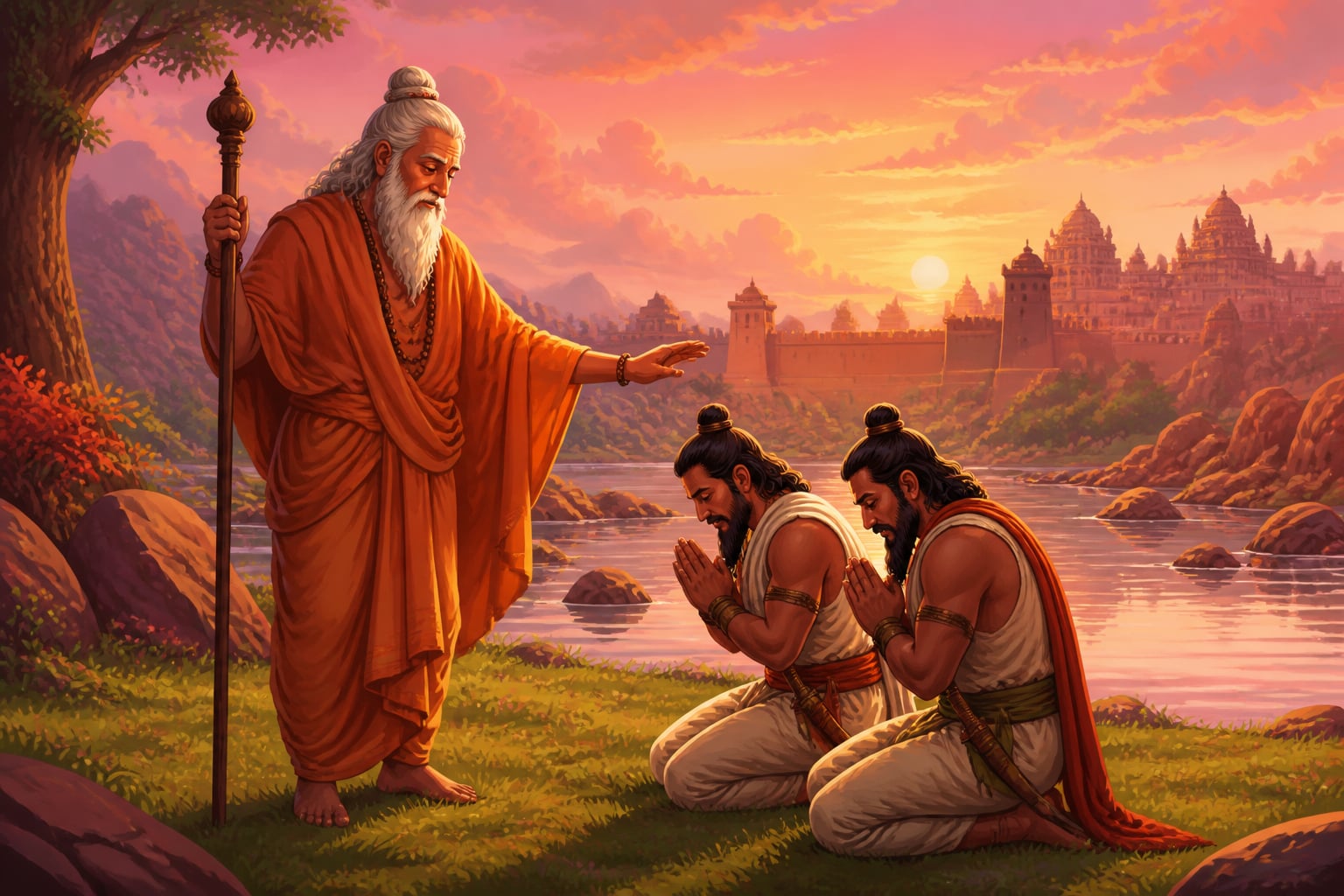
The Vijayanagara Empire, founded in 1336 by Harihara and Bukka under the guidance of Vidyaranya (the head of Sringeri Matha, itself part of Shankaracharya's distributed immune network), rose as a deliberate civilizational immune response. Krishnadevaraya, its greatest ruler (r. 1509-1529), did not merely build a kingdom. He rebuilt civilizational infrastructure: massive temple complexes, patronage of Sanskrit and Telugu scholarship, revival of classical arts, restoration of pilgrimage networks, and economic systems that made Vijayanagara one of the wealthiest cities on earth.
Even when Vijayanagara itself fell at the Battle of Talikota in 1565, the civilizational functions it had revived did not die. They dispersed into the Nayaka kingdoms of Madurai, Thanjavur, and Ikkeri, which continued the same civilizational work for another two centuries. The node was destroyed. The network persisted. This is Bahuvyavastha in action.
The Bhakti Immune Response
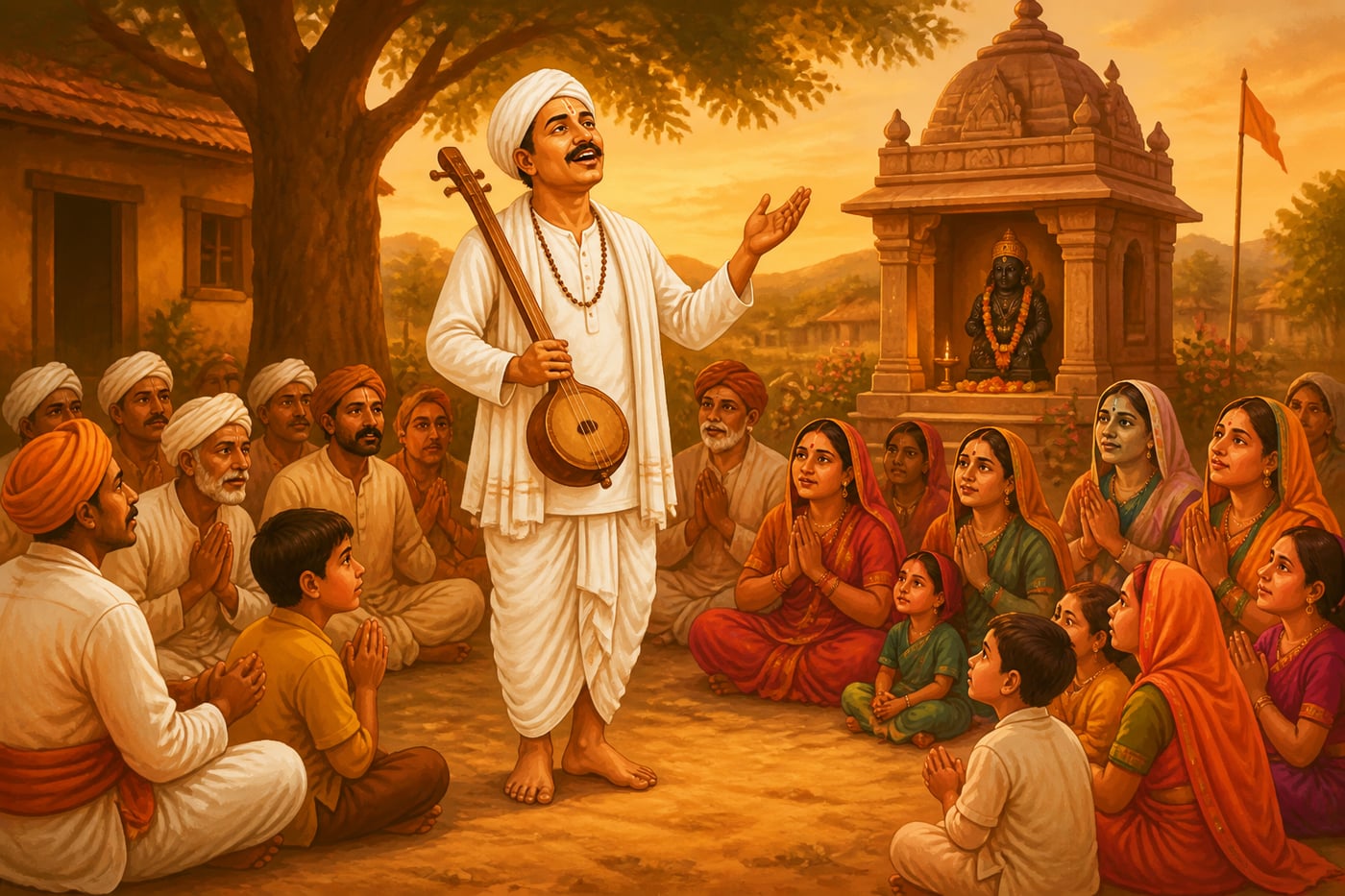
While Vijayanagara represented the political and institutional immune response, the Bhakti movement represented something equally powerful: a grassroots civilizational immune response that bypassed every destroyed institution.
When temples were demolished, universities burned, and priestly institutions disrupted, the Bhakti saints took dharma directly to the people. They composed in vernacular languages, not Sanskrit. They sang in streets and fields, not temples. They dissolved barriers of social hierarchy that had calcified over centuries. Kabir in the north, Tukaram in Maharashtra, Basaveshwara in Karnataka, Andal and the Alvars in Tamil Nadu, Chaitanya in Bengal: each was a civilizational immune cell activating independently, without central coordination, in response to the same threat.
The Bhakti movement demonstrated Sanskriti-Vahana at its most powerful. When formal transmission systems were destroyed, informal ones arose. When institutional gatekeepers were removed, direct transmission flourished. The civilization's cultural memory was not stored in any single institution. It was distributed across millions of practitioners, and no invader could destroy them all.
Together, Vijayanagara and the Bhakti movement illustrate why India survived when Yugoslavia, the Ottoman Empire, and the Soviet Union did not. India's immune system was not centralized. It was distributed, redundant, and self-activating. When one node fell, another rose. When formal systems broke, informal systems took over. This is Vyadhikshamatva at civilizational scale.
Dharmic Wisdom: Vyadhikshamatva and the Body Politic
Ayurveda does not merely treat disease. It builds the body's capacity to resist disease before it strikes. Charaka Samhita, the foundational Ayurvedic text, describes three types of Bala (strength): Sahaja (innate), Kalaja (time-developed), and Yuktikrita (deliberately built). The healthiest body possesses all three. The same principle applies to civilizations.
India's Sahaja Bala is its civilizational architecture: the distributed network of dharma, sacred geography, knowledge systems, temple institutions, festivals, and philosophical pluralism described in this course. This is the innate immune system, inherited over millennia.
India's Kalaja Bala is the resilience built through surviving repeated civilizational assaults: invasions, colonial occupation, partition. Each crisis that did not destroy the civilization strengthened it, like a body developing antibodies through exposure. The Vijayanagara response, the Bhakti movement, the freedom struggle: each was a Kalaja Bala response.
But both Sahaja and Kalaja Bala can weaken through neglect. Charaka warns that even innate strength deteriorates without proper maintenance (ahara, vihara, achara: diet, lifestyle, conduct). A civilization that inherits a powerful immune system but fails to maintain it will find itself vulnerable despite its heritage.
This is where Yuktikrita Bala becomes essential: the deliberately constructed immunity that Israel exemplifies. India cannot rely solely on inherited strength or crisis-forged resilience. It must consciously build and maintain its five pillars, just as a person must consciously maintain their health through proper diet, exercise, and lifestyle.
The Arthashastra reinforces this through the concept of Yogakshema: the dual duty of the state to both acquire new prosperity (Yoga) and protect what already exists (Kshema). Kautilya insists that Kshema, the protection and maintenance of existing civilizational assets, is as important as Yoga, the pursuit of new achievements. A civilization that pursues economic growth while neglecting its knowledge systems, sacred geography, and cultural transmission is like a person who builds muscle while ignoring their immune system. They may look strong. But the first serious infection will reveal the truth.
The Defense: Activating India's Immune System Today
The five pillars are not abstract theory. Each corresponds to specific actions that individuals, communities, and institutions can take today.
Epistemological Sovereignty: Support and build Indian-led scholarship on Indian civilization. This means funding Indian universities to establish world-class Indology departments, supporting scholars who study dharmic traditions through dharmic categories, and creating accessible popular content that tells India's civilizational story through Indian lenses. Every time you share a well-researched Indian perspective on Indian history instead of defaulting to a Western interpretation, you strengthen this pillar.
Institutional Redundancy: Strengthen distributed civilizational institutions. Patron a local temple, gurukulam, or classical arts school. Support multiple independent institutions rather than concentrating resources in a single organization. The lesson of Vijayanagara is clear: when one node falls, others must be strong enough to carry the load. Build many nodes.
Cultural Transmission: Become a link in the chain. Learn a classical art, study a philosophical text, teach your children the meaning behind festivals, not just the rituals. The Bhakti saints showed that transmission does not require grand institutions. It requires individuals who care enough to keep the flame alive and pass it on.
Identity Coherence: Actively cultivate civilizational identity alongside regional pride. Travel to pilgrimage sites outside your region. Read epics from traditions beyond your own. Engage with the philosophical diversity within dharmic civilization. The more deeply you experience the breadth of Bharatiya civilization, the more naturally Ekatma-Bodha arises.
Strategic Awareness: Develop media literacy and institutional awareness. Learn to trace narratives to their sources. Follow funding flows behind organizations that claim to speak for Indian communities. Support legal frameworks that address foreign interference in domestic civilizational matters. Viveka, the discernment introduced in Lesson 01_01, is the individual expression of this pillar.
The civilizations that broke in Lesson 01_03 did not lack the raw materials for survival. They lacked the awareness to see their vulnerabilities and the discipline to address them. India possesses the most resilient civilizational architecture in human history. The question is not whether the immune system exists. It does. The question is whether this generation will maintain it, strengthen it, and pass it on stronger than they received it. That is the work of Vyadhikshamatva. That is the work of this course.
Case studies
Israel's Deliberate Construction of Civilizational Immunity
After nearly two millennia of diaspora, the Zionist movement faced a civilizational challenge without parallel in modern history: rebuilding a nation whose language had not been spoken as a mother tongue for centuries, whose people were scattered across dozens of countries, and whose cultural continuity had been maintained only through religious practice. Ben-Gurion and his contemporaries understood that political statehood alone would not be sufficient. They needed to reconstruct the immune system of a civilization from near zero. The project was deliberate, systematic, and operated simultaneously across language, education, land, military, and culture.
The Arthashastra recognizes that a rashtra (nation) is not merely territory or population but a living organism sustained by shared memory, language, and purpose. Kautilya's concept of vijigishu, the king who seeks to expand and defend the realm, applies here not to military conquest but to the conquest of cultural amnesia. Israel's founders acted as civilizational physicians, diagnosing the vulnerabilities of a dispersed people and prescribing structured remedies for each one.
Hebrew was revived from a liturgical language into a living mother tongue spoken by millions, an achievement linguists considered nearly impossible. The Birthright Israel program, launched in 1999, has since brought over 800,000 young diaspora Jews to Israel to strengthen civilizational connection across generations. Military service, collective memory institutions like Yad Vashem, and a national curriculum centered on civilizational continuity created overlapping layers of immune response.
Civilizational immunity does not arise spontaneously. It must be engineered deliberately across language, education, memory institutions, and rites of passage, especially when the organism has been weakened.
India has ancient civilizational assets that were never fully destroyed, yet the institutional transmission of those assets has weakened across generations. The Israeli model raises a direct question: which Indian institutions today are deliberately designed to transmit civilizational memory rather than merely administer services?
Hebrew went from zero native speakers in the 1880s to over 9 million speakers today, the only successful large-scale language revival in recorded history.
Vijayanagara: India's Political Immune Response
By the early 14th century, the Delhi Sultanate had devastated the political and temple infrastructure of southern India. The destruction of Halebidu, Somnath, and dozens of major temple complexes represented not merely military conquest but the deliberate targeting of civilizational nodes: places where knowledge, resources, ritual, and community converged. In 1336, two brothers, Harihara and Bukka Raya, founded the Vijayanagara Empire under the guidance of the philosopher-statesman Vidyaranya. The founding was explicitly framed as a dharmic restoration project, not merely a political rebellion.
Vidyaranya embodied the ancient Indian understanding that civilizational recovery requires both rajya (political power) and jnana (knowledge leadership). The Arthashastra describes the ideal state as one where the king and the learned are in active partnership. Vijayanagara institutionalized this partnership: Vidyaranya provided the philosophical legitimacy and civilizational vision while Harihara and Bukka built the military and administrative structure to protect and fund it.
Vijayanagara became the largest empire in India for over two centuries and served as the primary patron of Sanskrit scholarship, Carnatic music, temple architecture, and Telugu and Kannada literature. Krishnadevaraya, who ruled from 1509 to 1529, personally composed the Telugu classic Amuktamalyada and hosted the Ashtadiggajas, eight great poets at his court. Even after the catastrophic defeat at Talikota in 1565, the civilizational seed survived: Vijayanagara's vassal Nayaka kingdoms in Thanjavur, Madurai, and Ikkeri continued the cultural and temple-building tradition for another century.
A civilization can absorb enormous political defeats if it has successfully distributed its cultural memory across multiple nodes. The goal of a civilizational immune response is not to prevent all damage but to ensure the information survives.
India's post-independence cultural institutions have often been administered rather than animated by civilizational purpose. Vijayanagara's example asks whether India today has equivalents: institutions explicitly designed to transmit, protect, and extend the civilizational inheritance even under adverse conditions.
Krishnadevaraya's reign saw the construction or renovation of over 50 major temple complexes across south India, each functioning as a center of education, economics, and cultural transmission simultaneously.
The Bhakti Movement: India's Grassroots Immune Response
Between the 7th and 17th centuries, as temple institutions were destroyed, Sanskrit learning networks were disrupted, and political patronage collapsed across large parts of India, something unexpected happened. Dharmic transmission moved out of formal institutions and into the streets, fields, and marketplaces. Bhakti saints across every region began composing devotional poetry in the vernacular languages of ordinary people. Andal sang in Tamil, Kabir in Bhojpuri and Braj Bhasha, Tukaram in Marathi, Basaveshwara in Kannada, Chaitanya in Bengali. The medium changed but the message, the reality of the divine, the path of devotion, the equality of all seekers, remained continuous with the Upanishadic tradition.
The Bhagavata Purana describes bhakti as a path that requires no institutional intermediary, accessible to any person regardless of caste, gender, or learning. The Bhakti movement operationalized this teaching as a civilizational survival strategy. When the formal transmission channels were compromised, the tradition fell back to its most resilient layer: direct personal devotion expressed in language everyone could understand and remember. This mirrors the ecological concept of redundancy in immune systems, where multiple pathways can carry the same essential signal.
The Bhakti movement produced over 10,000 documented compositions across at least 12 Indian languages, creating a vast distributed archive of dharmic teaching embedded in living oral and musical traditions that state power could not easily locate or destroy. Saints like Tukaram continued composing abhangas even as formal Maratha political structures were under siege. The tradition also actively challenged the internal weakening of caste exclusivity, strengthening the social immune response alongside the cultural one. Chaitanya's movement in Bengal created a revival strong enough to produce the Gaudiya Vaishnava tradition that persists globally today.
When central nodes fail, a healthy civilization routes around the damage by distributing transmission to the grassroots level. The Bhakti saints demonstrated that dharma does not require elaborate institutions to survive, only committed carriers willing to speak in the language of the people.
In an era when digital platforms allow anyone to publish in their native language, India has the technological infrastructure for a new Bhakti-style distributed civilizational transmission. The question is whether the content being transmitted carries genuine civilizational depth or merely cultural aesthetics.
The Alvars, the Tamil Vaishnava poet-saints, composed the Nalayira Divya Prabandham, a collection of 4,000 verses compiled between the 6th and 9th centuries that continues to be recited daily in Vaishnava temples across south India more than 1,200 years after composition.
Reflection
- Of the five pillars of civilizational immunity (Epistemological Sovereignty, Institutional Redundancy, Cultural Transmission, Identity Coherence, Strategic Awareness), which one do you actively practice in your daily life, and which one feels most absent or neglected in your personal sphere of influence?
- India's civilizational immune response has historically been Sahaja, arising organically through saints, poets, and warrior kings rather than through state design. Given what you have seen in modern India, is that inherited immune system still firing reliably, or does the civilization now require Yuktikrita, a deliberately constructed immune architecture like Israel built after 1948?
- Every civilization that has deliberately built an immune system has also risked building walls. Israel's Birthright program and Hebrew revival are extraordinary achievements, but they are inseparable from a strong in-group logic. Is it possible to construct civilizational immunity, the kind that remembers, transmits, and defends, without generating an exclusionary 'us versus them' identity? Or is some degree of boundary-drawing philosophically unavoidable?