Lessons from Broken Civilizations
What Broke, What Survived, and Why
Civilizations do not break randomly. From Yugoslavia to the Ottoman Empire to Native America, the same patterns repeat: the strongman trap, civilizational amnesia, systematic erasure, externally imposed fragmentation, and identity replacement. This lesson examines five broken civilizations to extract the warnings India must heed.
See It Today: Yugoslavia's Thirty-Year Wound
On September 24, 2023, a group of heavily armed Serbian paramilitaries ambushed a Kosovo police patrol near the village of Banjska in northern Kosovo. One police officer was killed. The attackers retreated into a Serbian Orthodox monastery where investigators later discovered a stockpile of weapons, armored vehicles, and military equipment. NATO deployed additional peacekeeping forces. The EU-brokered dialogue between Serbia and Kosovo, already stalled for months, collapsed entirely.
This was not a relic from the 1990s wars. This happened thirty-two years after Yugoslavia began its disintegration, and twenty-four years after the Kosovo War ended.
Yugoslavia was once a multiethnic federation of 23 million people. Serbs, Croats, Bosniaks, Slovenians, Macedonians, Montenegrins, and Albanians shared workplaces, neighborhoods, and marriages. Between 1991 and 2001, a series of wars killed over 140,000 people, displaced four million, and produced the worst atrocities on European soil since World War II, including the Srebrenica massacre of over 8,000 Bosniak men and boys.
The Banjska attack proves something crucial: civilizational wounds do not heal on their own. Three decades, EU integration efforts, NATO peacekeeping, billions in reconstruction aid, and the fractures remain active. Yugoslavia is not ancient history. It is a living laboratory of civilizational collapse.
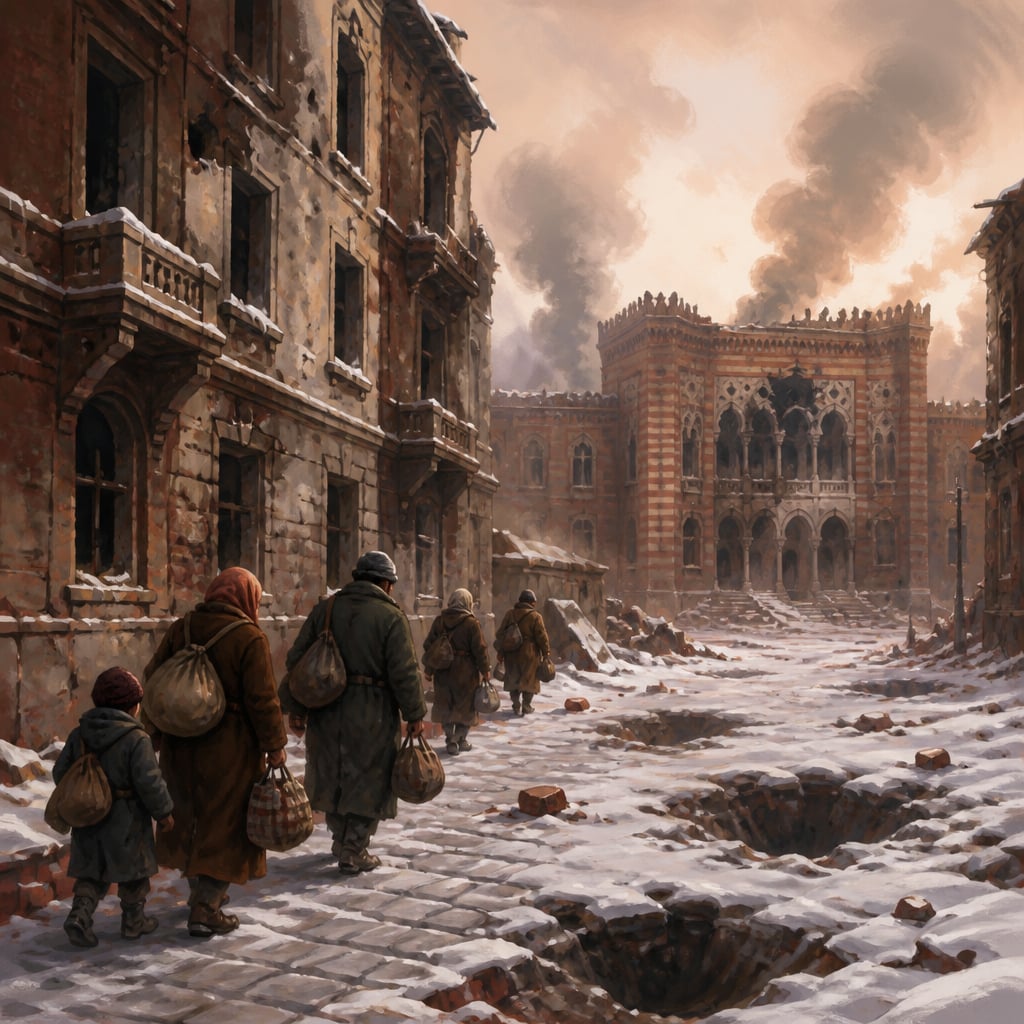
This lesson examines five broken civilizations, not as distant tragedies, but as diagnostic case studies. What broke? What survived? And what patterns must India recognize before they repeat?
The Mechanism: Five Patterns of Civilizational Collapse
Across Yugoslavia, the Soviet Union, the Ottoman Empire, Native America, and post-colonial Africa, five recurring patterns emerge. No civilization broke from a single cause. But every broken civilization exhibits at least three of these five patterns.
Pattern 1: The Strongman Trap
Josip Broz Tito held Yugoslavia together for 35 years through personal authority, a carefully balanced federal structure, and the suppression of ethnic nationalism. When he died in 1980, no institution could replace him. The federal system he built depended on his personal mediation between republics. Without him, Serbian, Croatian, and Slovenian nationalisms, suppressed but never resolved, erupted within a decade.
The Soviet Union fell into the same trap at civilizational scale. The Communist Party's centralized authority replaced organic cultural, religious, and ethnic identities with "Soviet Man." When the ideology lost credibility in the 1980s, there was nothing underneath. Fifteen republics suddenly needed to construct national identities from scratch, and several descended into ethnic conflict within months.
The lesson is precise: centralized authority that suppresses diversity without building shared organic identity creates a time bomb. The strongman holds the pieces together. When he goes, the pieces fly apart with accumulated force.
Pattern 2: Civilizational Amnesia

In 1928, Mustafa Kemal Ataturk changed Turkey's script from Arabic to Latin. Within a single generation, Turks could not read their own grandparents' letters, legal documents, or literary heritage. He abolished the caliphate, banned traditional dress, replaced Islamic law with the Swiss civil code, and closed religious schools.
Ataturk was not a foreign conqueror. He was a Turkish nationalist who genuinely believed that modernization required civilizational erasure. The Ottoman Empire did not fall solely to external forces. Its civilizational identity was deliberately dismantled from within by reformers who equated westernization with progress.
The result was a civilization severed from its own past. Modern Turkey spent decades in an identity crisis, torn between a European future it was never fully admitted to and an Ottoman-Islamic past it had been taught to reject. The recent resurgence of Ottoman nostalgia under Erdogan reveals how deep the wound of civilizational amnesia runs: people reach for a past they were forced to forget.
The lesson: modernization that requires civilizational amnesia is not modernization. It is self-inflicted civilizational destruction.
Pattern 3: Systematic Erasure
The destruction of Native American civilizations represents the most complete civilizational breaking in modern history. European colonizers did not merely conquer territory. They systematically targeted every civilizational system simultaneously.
Languages were destroyed. Of more than 300 indigenous languages spoken before European contact, fewer than 175 survive today, and most are critically endangered. Sacred geography was seized and desecrated. Knowledge systems transmitted through oral traditions were severed when elders were killed or displaced. Children were forcibly taken to boarding schools designed, in the words of Captain Richard Henry Pratt, to "kill the Indian, save the man." Spiritual practices were legally banned in the United States until the American Indian Religious Freedom Act of 1978.
When all six civilizational systems are destroyed simultaneously, survival becomes nearly impossible. The Native American experience shows what total civilizational erasure looks like: not merely military defeat, but the deliberate destruction of language, sacred geography, knowledge systems, institutional structures, cultural practices, and philosophical traditions all at once.
Pattern 4: Externally Imposed Fragmentation
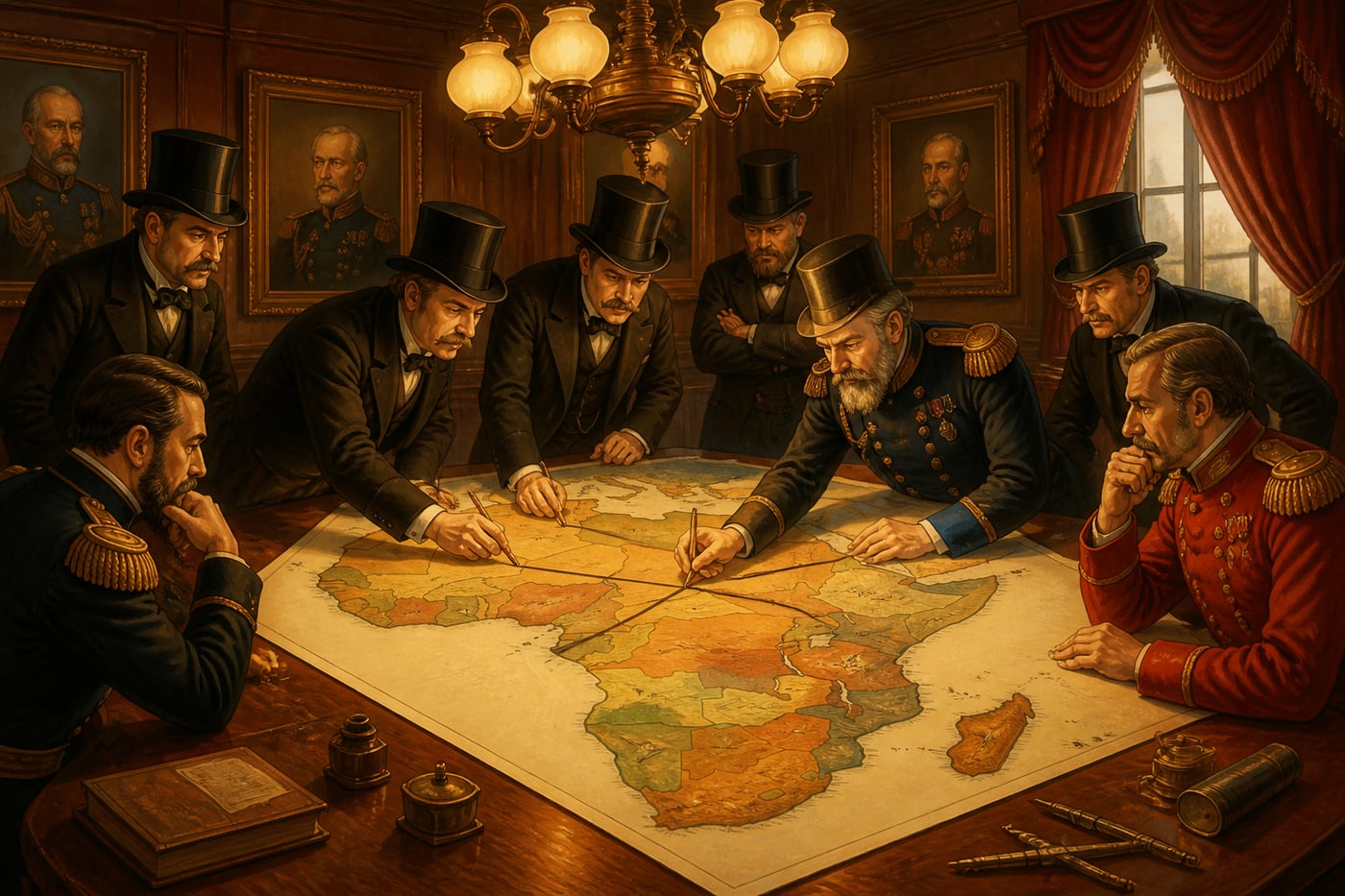
At the Berlin Conference of 1884-85, European powers carved Africa into colonial territories with borders that deliberately split ethnic groups across multiple colonies and forced rival groups into single administrative units. The Bakongo people were divided among French Congo, Belgian Congo, and Portuguese Angola. The Somali people were split among British, Italian, and French territories.
Post-independence, these artificial boundaries became nations. But nations require internal coherence, and colonial borders were designed for extraction, not cohesion. The result has been decades of civil wars, coups, and ethnic violence across the continent. The Rwanda genocide examined in Lesson 01_01 was one expression of this pattern, but the pattern extends from Sudan to Nigeria to the Democratic Republic of Congo.
The lesson: when external powers define a civilization's internal categories and boundaries, those definitions outlast the external power and become self-perpetuating sources of conflict.
Pattern 5: Identity Replacement
The Soviet experiment attempted something unprecedented: replacing all organic identities with an ideological identity. Russian, Ukrainian, Georgian, Uzbek, Armenian identities were subordinated to "Soviet" identity. Local languages were marginalized in favor of Russian. Religious traditions were suppressed. Historical narratives were rewritten to fit Marxist frameworks.
When the Soviet Union collapsed in 1991, people reached for the organic identities that had been suppressed for seven decades. But those identities had been distorted by decades of suppression and manipulation. The result was not a clean revival but a series of identity conflicts: Nagorno-Karabakh between Armenia and Azerbaijan, wars in Chechnya, frozen conflicts in Transnistria and Abkhazia. Artificial identity imposed over organic identity does not eliminate the organic. It distorts and weaponizes it.
The Pattern: What Survived and What Didn't
Across these five cases, a clear hierarchy of civilizational resilience emerges.
Civilizations organized as centralized states broke when the center collapsed. Yugoslavia fractured when Tito's personal authority ended. The Ottoman civilizational identity shattered when Ataturk abolished its central institutions. The Soviet Union dissolved when its central ideology lost credibility. In each case, the civilization had concentrated its cohesion in a single point of failure: a leader, an institution, or an ideology.
Civilizations attacked through systematic erasure suffered the worst. Native American civilizations, targeted simultaneously across all six systems (language, sacred geography, knowledge, institutions, culture, philosophy), experienced near-total civilizational death. When nothing survives, there is nothing to rebuild from.
Civilizations subjected to external fragmentation survived in fragments. Post-colonial Africa retained cultural identities, languages, and traditions within communities, but lost civilizational-scale coherence. The pieces survived. The mosaic was shattered.
The pattern reveals a crucial variable: distributed civilizations survive what centralized civilizations cannot. A civilization organized as a network, with redundant systems and multiple centers of authority, can lose nodes without losing the whole. A civilization organized around a single center collapses when that center falls.
This is exactly the insight that distinguishes India from every civilization examined in this lesson. India was never organized as a centralized state or a single-ideology system. It survived as a distributed network: when Nalanda burned, Vikramashila continued. When Delhi fell, Vijayanagara rose. When temples were destroyed, festivals continued in homes. When political power was lost, philosophical traditions persisted through guru-shishya parampara.
But this distributed architecture is not automatic immunity. It is a feature that must be actively maintained. When the network's nodes weaken, when civilizational memory fades, when shared practices lose meaning, the distributed advantage erodes. Every broken civilization in this lesson believed it was too old, too large, or too complex to break. Every one was wrong.
Dharmic Wisdom: Sanghata and Sabhyata Kshaya
The Mahabharata's Shanti Parva contains Bhishma's teachings on statecraft delivered from his deathbed. Among the most urgent warnings is his description of how kingdoms fall. Not through external conquest alone, but through the loss of internal cohesion.
Bhishma describes the progression of decline: first, dharma weakens among the ruling class. Then, the institutions that maintain social harmony lose their integrity. Then, the people lose faith in shared frameworks. Finally, external enemies exploit the resulting fractures.
This is Sabhyata Kshaya: civilizational decline. It is not a single event but a process. The Kala Chakra, the wheel of time, turns for all civilizations. But the Mahabharata insists this is not fatalism. The wheel turns, but human action determines the speed and direction.
The antidote is Sanghata: cohesion. Not uniformity, not centralized control, but the organic binding force that holds diverse elements together. The Arthashastra defines a kingdom's true strength not as its armies or treasury, but as the contentment and cohesion of its people. Prakriti, the natural constituent elements of the state, must be in harmony.
The deepest lesson from the broken civilizations is Atma-Vismriti: self-forgetting. The Ottomans forgot who they were when Ataturk severed them from their past. The Soviets replaced organic memory with ideological memory and lost both. Native Americans had their memory forcibly erased. In each case, when a civilization forgets who it is, it loses the will to defend what it was.
Viveka, the discernment taught in Lesson 01_01, tells you when you are being attacked. Sanghata gives you the strength to resist. But neither matters if Atma-Vismriti has already taken hold. A civilization that has forgotten itself will not recognize the attack, and would not care even if it did.
The Defense: Five Warnings for India
Each broken civilization offers India a specific warning.
Warning 1, from Yugoslavia: Do not build on strongmen. Tito's Yugoslavia collapsed because its cohesion was personal, not institutional. India's civilizational strength must be embedded in institutions, traditions, and shared practices, not dependent on any individual leader, party, or government. Leaders come and go. Institutions endure.
Warning 2, from the Ottoman Empire: Do not confuse modernization with civilizational erasure. Ataturk's mistake was believing that progress required severing all connection to the past. India can modernize its technology, economy, and governance without abandoning Sanskrit, without forgetting its philosophical traditions, without treating its civilizational heritage as an obstacle to development. The goal is not preservation in amber but living continuity.
Warning 3, from Native America: Protect all six civilizational systems simultaneously. The Native American tragedy shows what happens when every system is destroyed at once. India must recognize that language revival alone is insufficient if sacred geography is neglected. Temple restoration means nothing if knowledge systems are not transmitted. Festival celebration is empty if philosophical understanding is lost. The six systems are interdependent. Strengthening one while ignoring others creates the illusion of civilizational health.
Warning 4, from Africa: Resist externally imposed identity categories. The colonial categories that fragmented Africa continue to define its conflicts. India must be vigilant about external frameworks imposed on its internal diversity, whether "caste-as-race" framing at the United Nations, "Dravidian vs. Aryan" theories that serve separatist agendas, or "minority vs. majority" binaries that obscure civilizational unity. Internal reform is essential. External classification is a weapon.
Warning 5, from the Soviet Union: Ideological unity without civilizational roots is fragile. The Soviet experiment proves that imposed ideology cannot replace organic identity. India's unity must grow from civilizational roots, shared stories, shared philosophies, shared sacred geography, not from ideology alone. Political nationalism without civilizational depth is the Soviet model. It breaks.
The civilizations examined in this lesson did not lack intelligence, resources, or courage. They lacked the awareness to see their own vulnerabilities before it was too late. India's advantage is not that it is immune to these patterns. It is that it can study them, recognize them, and build defenses before the wheel turns.
Case studies
Yugoslavia: The Strongman Trap and Engineered Fragmentation
Josip Broz Tito held Yugoslavia's six republics together from 1945 to 1980 through personal authority, a carefully balanced federal structure, and the suppression of ethnic nationalism. After his death, the federal presidency rotated annually among republic representatives, but no individual or institution could replicate his mediating authority. Slobodan Milosevic exploited the vacuum. His 1989 speech at Kosovo Polje, delivered at the 600th anniversary of the Battle of Kosovo, transformed historical grievance into political mobilization, reviving Serbian nationalism and triggering a chain reaction across all republics. Between 1991 and 2001, a series of wars killed over 140,000 people, displaced four million, and produced the Srebrenica massacre of over 8,000 Bosniak men and boys. Seven successor states emerged, none fully at peace.
Kautilya's Arthashastra warns that Prakriti-kopa (discontent among the constituent elements of a state) is the gravest of all threats. Tito managed Yugoslavia's Prakriti through personal mediation, not through organic Sanghata (cohesion). The six republics were held together by authority, not by shared civilizational bonds. The Mahabharata's Shanti Parva teaches that a kingdom's strength lies in the contentment of its people, not in the power of its ruler. When the ruler departs and the people have no shared identity deeper than political structure, the state does not decline. It detonates.
Yugoslavia produced seven successor states (Slovenia, Croatia, Bosnia, Serbia, Montenegro, North Macedonia, Kosovo), multiple wars, ethnic cleansing, and Europe's worst atrocities since World War II. As of 2023, Kosovo remains contested, Bosnia's ethnic power-sharing government barely functions, and Serbia refuses to recognize Kosovo's independence. The Banjska attack of September 2023 proved that the faultlines remain active three decades after the initial breakup.
Centralized authority that suppresses diversity without building shared organic identity is a time bomb, not a solution. The strongman holds the pieces together. When he goes, the pieces fly apart with accumulated force. Civilizational cohesion must be institutional and cultural, not personal.
Any nation that relies on a single leader, party, or ideology for unity rather than on shared civilizational bonds is repeating the Yugoslav pattern. India's strength lies in its distributed civilizational architecture. The moment that architecture is replaced by dependence on any single political authority, the Yugoslav trajectory becomes possible.
Sarajevo hosted the 1984 Winter Olympics as a symbol of Yugoslavia's multiethnic harmony. Eight years later, the same city was besieged for 1,425 days (1992-1996), the longest siege in modern warfare. The Olympic bobsled track became a military position.
Native America: The Most Complete Civilizational Breaking
European colonization of North America did not merely conquer territory. It systematically targeted every civilizational system simultaneously. Over 300 indigenous languages were reduced to fewer than 175, most critically endangered. Sacred geography was seized through treaties, broken treaties, and forced relocations like the Trail of Tears (1830s). Knowledge systems transmitted through oral traditions were severed when elders were killed or communities dispersed. The Indian boarding school system, launched under Captain Richard Henry Pratt's motto 'Kill the Indian, save the man,' forcibly removed children from families to erase language, dress, and spiritual practice. Native spiritual traditions were legally criminalized until the American Indian Religious Freedom Act of 1978. Tecumseh's attempt to build a pan-tribal confederacy (1808-1813) represented the closest Native Americans came to civilizational-scale unity, but his defeat at Tippecanoe and death at the Battle of the Thames ended the last viable resistance.
The Mahabharata warns of samula vinasha: destruction 'root and all.' Native American civilizations experienced exactly this. Using the six-system framework from this course (dharma/ethical framework, sacred geography, knowledge systems, institutional structures, cultural practices, philosophical traditions), every system was attacked simultaneously. No single system survived intact enough to regenerate the others. Tecumseh's failed confederacy illustrates the Arthashastra's teaching that distributed power without institutional coordination (Sanghata) falls piece by piece. Each tribe negotiated or fought alone, and each fell alone.
The Native American population collapsed from an estimated 5-15 million before European contact to 237,000 by the 1900 US Census. Today, cultural revival movements exist across many tribes, including language reclamation programs and the protection of sacred sites. But full civilizational recovery faces near-impossible odds because the oral transmission chains that carried knowledge systems were broken. What was not written down and not transmitted to the next generation is gone permanently.
When all six civilizational systems are destroyed simultaneously, recovery becomes nearly impossible. Distributed civilizations without pan-civilizational institutions fall piece by piece. The lesson for India is precise: protect all six systems simultaneously, because the loss of any one weakens all the others.
India's six civilizational systems are under pressure but none has been fully destroyed. Sanskrit is weakened but alive. Sacred geography is contested but not erased. Temple institutions are restricted but functioning. The Native American case shows what total loss looks like. India still has what Native Americans lost. The question is whether India will recognize the value of what it still holds before it is too late.
The United States did not legally permit Native Americans to practice their own spiritual traditions until the American Indian Religious Freedom Act of 1978. For nearly two centuries, an entire civilization's spiritual practice was criminalized by the government that occupied its land.
The Ottoman Empire: Self-Inflicted Civilizational Amnesia
Between 1923 and 1938, Mustafa Kemal Ataturk implemented a series of reforms that deliberately dismantled Ottoman civilizational identity. The caliphate was abolished in 1924, removing the symbolic center of Sunni Islamic authority. In 1928, the script was changed from Arabic to Latin, instantly making the entire Ottoman literary, legal, and philosophical heritage unreadable to the next generation. Traditional dress including the fez was banned. Islamic law was replaced wholesale with the Swiss civil code, Italian penal code, and German commercial code. Religious schools (medreses) were closed. The 'Sun Language Theory' attempted to prove that Turkish was the origin of all languages, severing it from its Arabic and Persian cultural roots. Ataturk was not a foreign conqueror. He was a Turkish nationalist who genuinely believed that modernization required civilizational erasure.
Chanakya Niti teaches that a mirror is useless to one who has no eyes. Ataturk's reforms destroyed the civilization's eyes, its ability to see and read its own heritage, while offering a Western mirror as replacement. This is Atma-Vismriti (self-forgetting) as deliberate state policy. The Arthashastra warns that a kingdom's strength rests on its Prakriti (constituent elements) being in harmony. Ataturk's reforms did not harmonize Turkey's Prakriti. They amputated it. He treated the civilization's heritage as a diseased limb to be removed rather than a living system to be strengthened.
Modern Turkey spent decades in an identity crisis, rejected by Europe (EU accession stalled since 1987) yet severed from its Ottoman-Islamic heritage. Under Erdogan, neo-Ottoman nostalgia surged, revealing that civilizational memory, once suppressed, does not disappear cleanly. It festers and returns distorted. The 2020 reconversion of Hagia Sophia from museum to mosque was a symbolic attempt to recover what Ataturk erased. Most Turks today cannot read Ottoman-era documents, court records, literature, or their own family letters from before 1928.
Modernization that requires civilizational amnesia is not modernization. It is self-inflicted civilizational destruction. A civilization can adopt new technology, new governance structures, and new economic models without severing its connection to its own philosophical, literary, and spiritual heritage. The Ottoman case is the permanent warning.
India faces persistent pressure to treat Sanskrit as dead, temple traditions as superstition, dharmic philosophy as obstacle to progress, and its civilizational heritage as incompatible with modernity. This is exactly the logic Ataturk followed. The Ottoman case shows the endpoint: a civilization that cannot read its own past, reaching for fragments of identity it was taught to despise.
After the 1928 script change, Turkey's functional literacy rate dropped to approximately 10% because the population that could read Ottoman script could not read the new Latin alphabet. The government deliberately sacrificed an entire generation's literacy to sever civilizational continuity.
Reflection
- Of the six civilizational systems (dharma/ethical framework, sacred geography, knowledge systems, institutional structures, cultural practices, philosophical traditions), which ones are you personally connected to? Which ones have you lost connection with? If a future generation depended on you alone to transmit Indian civilization, what would survive and what would be lost?
- The Ottoman Empire broke itself from within. Ataturk genuinely believed he was saving Turkey by severing it from its past. Can well-intentioned modernizers be the greatest threat to a civilization? How do you distinguish between necessary reform and civilizational suicide, especially when the reformer sincerely believes they are acting for the good?
- This lesson argues that distributed civilizations survive what centralized civilizations cannot. But distribution also means slower decision-making, less coordinated response, and vulnerability to piece-by-piece erosion. Is India's distributed architecture a strength or a vulnerability in the modern world of rapid information warfare, centralized tech platforms, and coordinated institutional pressure? Does the network need a center, and if so, what should that center be?