Partition's Legacy & Proxy War Infrastructure
Two-Nation Theory, ISI Operations, and Border Instability
The Islamist faultline in India did not emerge spontaneously. It was constructed through a century-long pipeline: Syed Ahmad Khan's Aligarh Movement (1875) planted the seed of Muslim separatism, Muhammad Iqbal gave it philosophical architecture (1930), and Muhammad Ali Jinnah built the political machine that converted theory into Partition (1947). Direct Action Day in Calcutta proved that the Two-Nation Theory could be enforced through organized violence. The resulting state of Pakistan, structurally dependent on anti-India identity, built the ISI into one of the world's most sophisticated proxy war machines. From the 1989-90 ethnic cleansing of Kashmiri Pandits to the 26/11 Mumbai attacks, the infrastructure operates through recruitment, training, infiltration, financing, and denial. Understanding this machine is the prerequisite for dismantling it.
The Aligarh Seed
Every civilizational faultline begins with an idea. The Islamist faultline in India began with one man's response to the 1857 uprising.
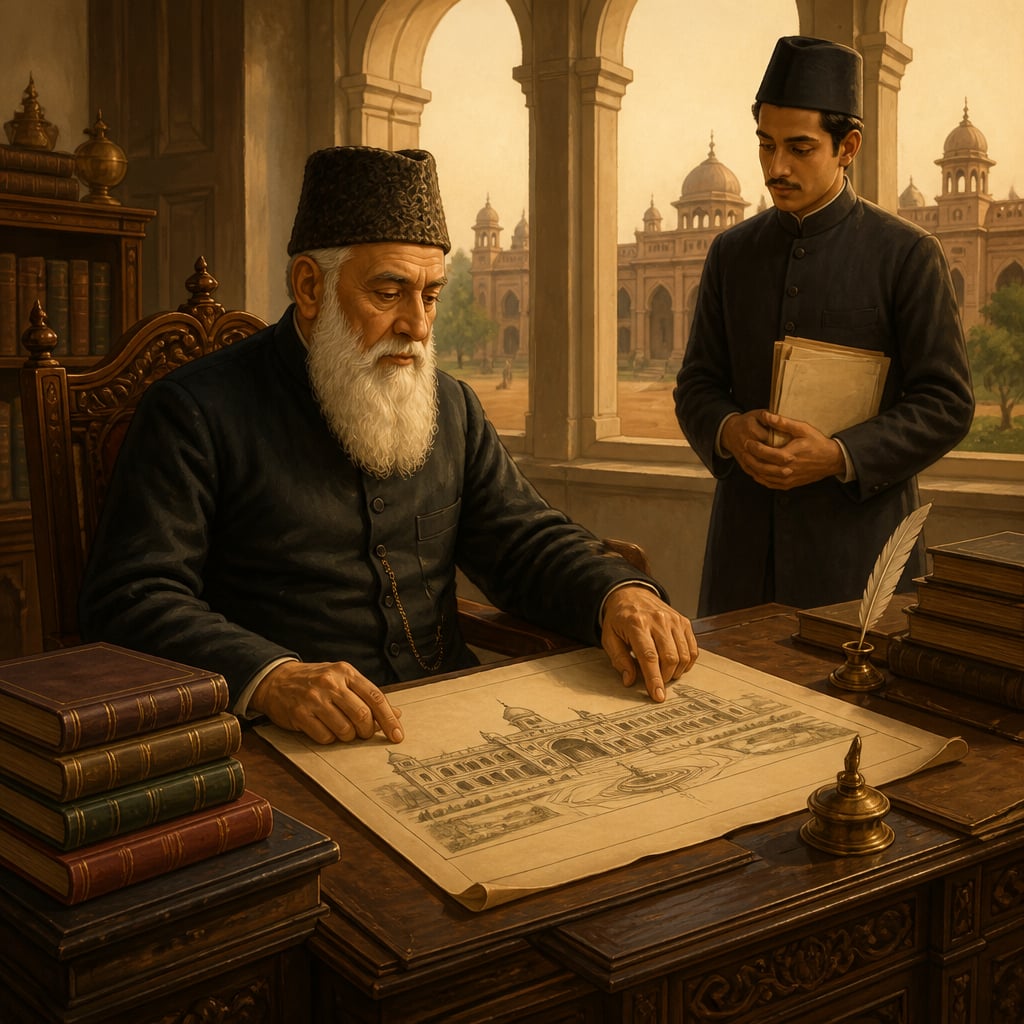
Sir Syed Ahmad Khan, a Mughal-era nobleman and British loyalist, watched the failed revolt of 1857 devastate the Muslim aristocracy. The British had crushed the rebellion and dismantled what remained of Mughal power. Khan's diagnosis: Muslims had fallen behind because they had resisted Western education and British partnership. His prescription: modernize Muslim education along British lines, keep Muslims loyal to the Crown, and argue that Muslims were a distinct political community whose interests diverged from the Hindu majority.
In 1875, Khan founded the Muhammadan Anglo-Oriental College at Aligarh (later Aligarh Muslim University). The institution became far more than a school. It became the intellectual incubator for Muslim separatism in India. Aligarh produced generation after generation of leaders who absorbed Khan's central thesis: that Hindu and Muslim interests were fundamentally incompatible, and that Muslims needed separate political representation to protect themselves.
Khan opposed the Indian National Congress from its founding in 1885, arguing that democratic politics in a Hindu-majority country would marginalize Muslims. He advocated separate electorates: the idea that Muslims should vote only for Muslim candidates in reserved constituencies. The British, who understood the tactical value of communal division, enthusiastically implemented this through the Morley-Minto Reforms of 1909.
The Aligarh Movement did not create the Two-Nation Theory from nothing. But it created the institutional infrastructure, the intellectual habit, and the political vocabulary that made the Two-Nation Theory thinkable.
The Intellectual Architecture: Iqbal's Vision
Ideas need poets. The Two-Nation Theory found one in Muhammad Iqbal.
Iqbal was a philosopher, poet, and political thinker of genuine brilliance. His Urdu and Persian poetry ranks among the finest in the language. His philosophical engagement with Nietzsche, Bergson, and Rumi produced original work on selfhood and civilizational revival. He was not a hack. He was a first-rate mind who arrived at a conclusion with civilizational consequences.
In his 1930 presidential address to the All-India Muslim League at Allahabad, Iqbal articulated what would become the intellectual blueprint for Pakistan. He called for 'the amalgamation of North-West Indian Muslim states into a single state' as the 'final destiny' of Muslims in that region. His argument was not merely political. It was civilizational: Islam and Hinduism were not just different religions but different social orders, producing different types of human beings with different conceptions of community, law, and purpose.
Iqbal died in 1938, nine years before Pakistan's creation. But his Allahabad Address became the foundational document. Choudhary Rahmat Ali, a Cambridge student, coined the name 'Pakistan' (Land of the Pure) in 1933, drawing on the initial letters of Punjab, Afghania, Kashmir, Sindh, and Balochistan. An idea born in Aligarh, given philosophical form by Iqbal, and named by Rahmat Ali, now needed a political operator.
Jinnah's Machine: From Demand to Partition
Muhammad Ali Jinnah was that operator. A London-trained barrister who had once been called the 'ambassador of Hindu-Muslim unity' for his role in the 1916 Lucknow Pact, Jinnah underwent a political transformation in the 1930s. By 1940, he had become the singular voice demanding a separate Muslim state.
The Lahore Resolution of March 1940 formalized the demand. Jinnah's political genius lay in understanding that the Two-Nation Theory needed not just intellectual arguments but electoral proof. He set out to demonstrate that Indian Muslims were a monolithic political community that followed the Muslim League.
The 1937 provincial elections had been a disaster for the League. It won only 109 of 482 Muslim seats across British India. The Congress won outright majorities in six provinces. The League could not credibly claim to speak for all Muslims when most Muslims did not vote for it.
By 1946, Jinnah had rebuilt the machine. In the 1945-46 elections, the Muslim League won 446 of 495 Muslim seats in the provincial legislatures. It swept the Central Assembly's Muslim seats entirely. This electoral transformation, achieved through a combination of religious mobilization, fear of Hindu domination, and organizational discipline, gave Jinnah the mandate he needed. He could now claim that the Muslim vote had spoken: it wanted Pakistan.
But electoral mandates are one thing. Forcing the issue is another.
Direct Action Day: Theory Meets Violence
On August 16, 1946, the Muslim League launched 'Direct Action Day' to press for Pakistan. Jinnah declared: 'We have forged a pistol and are in a position to use it.' In Calcutta, under the Muslim League government of Huseyn Shaheed Suhrawardy, the call to action became a call to violence.
What followed was the Great Calcutta Killings. For 72 hours, organized mobs rampaged through the city. Between 4,000 and 10,000 people were killed. Over 100,000 were left homeless. The violence was not spontaneous. Suhrawardy's government had declared a public holiday to ensure maximum participation in the League's rally. Police were instructed to stand down. Weapons were pre-positioned.
The Calcutta violence triggered a chain reaction: Noakhali (October 1946), Bihar (November 1946), and Punjab (March 1947). Each round of killing reinforced the League's argument that Hindus and Muslims could not live together. The Two-Nation Theory was being proved not by logic but by blood. Violence was the argument.

By the time Lord Mountbatten announced the Partition plan on June 3, 1947, the ground had been so thoroughly soaked that separation seemed like the only way to stop the killing. The theory had manufactured the evidence for its own necessity.
Pakistan: The Permanent Faultline State
Partition created Pakistan. But Pakistan, as constituted, was not merely a new country. It was a state whose foundational identity required permanent antagonism toward India.
This is a structural observation, not a cultural one. The Two-Nation Theory asserted that Hindus and Muslims were two separate nations that could not coexist. Pakistan's legitimacy as a state rests on this assertion. If Hindus and Muslims can coexist peacefully within India (which India's 200+ million Muslims demonstrate daily), then Pakistan's foundational ideology is falsified. A stable, pluralistic India is an existential threat to Pakistan's self-narrative.
This explains why Pakistan's security establishment has consistently invested in destabilizing India, even when such destabilization harmed Pakistan's own development. It is not irrational behavior. It is structurally rational for a state whose identity depends on the failure of the Indian project.
The instrument of this destabilization is the Inter-Services Intelligence, the ISI.
ISI: The Proxy War Machine
Pakistan's ISI, established in 1948, evolved from an intelligence-gathering agency into one of the most sophisticated proxy war machines in modern geopolitics. Its transformation accelerated during the 1979-89 Soviet-Afghan War, when the CIA funneled billions of dollars through the ISI to arm Afghan mujahideen. The ISI learned to manage, train, and deploy non-state armed groups at scale. When the Soviets withdrew, the ISI redirected this infrastructure toward India.
The playbook, refined over decades, operates through five layers.
Recruitment. Identify and radicalize young men through madrasas and militant organizations. Lashkar-e-Taiba, Jaish-e-Mohammed, and Hizbul Mujahideen serve as the operational arms. Each has distinct specializations. LeT focuses on fedayeen-style attacks in India's heartland. JeM targets military and security installations. Hizbul Mujahideen operates within Kashmir using local recruits.
Training. Camps in Pakistan-occupied Kashmir and Pakistan's tribal areas provide weapons training, tactical planning, and ideological indoctrination. The ISI maintains plausible deniability through organizational layering: the military trains the ISI, the ISI trains the militant group, the militant group deploys the operative.
Infiltration. Armed groups cross the Line of Control through established corridors, supported by cover fire from the Pakistani military. The ceasefire violations along the LoC that India endured for decades were not random. They provided covering action for infiltration.
Financing. A network of charities, hawala channels, and Gulf-funded organizations provides financial support. Pakistan's FATF greylisting from 2018 to 2022 documented these financing networks in detail.
Denial. After every attack, Pakistan's official position follows a script: deny involvement, demand evidence, then ignore the evidence when provided.
Kashmir: The Open Wound
Kashmir is where the proxy war infrastructure meets a genuine political dispute, and the combination has been devastating.
The conflict's roots predate the ISI's involvement. In 1931, communal agitation in Srinagar, partly instigated by figures from British India, began the process of communalizing what had been a syncretic Kashmiri identity. The Dogra monarchy's policies had created genuine grievances among Kashmiri Muslims. Sheikh Abdullah's National Conference channeled these grievances into a political movement.
But the transformation of Kashmir from a political dispute into an armed insurgency was engineered. In 1987, allegations of rigged state elections provided the spark. The ISI, flush with resources and expertise from the Afghan war, provided the accelerant. Young Kashmiris who had gone to Afghanistan for jihad returned as trained fighters. The ISI's Director General, Hamid Gul, who had overseen the Afghan mujahideen program, now directed the same infrastructure at Kashmir.
What followed was systematic. Between 1989 and 1990, an organized campaign of targeted killings, threats, and intimidation drove approximately 350,000 Kashmiri Pandits from the Valley. On the night of January 19, 1990, mosques across the Valley broadcast messages through loudspeakers: 'Raliv, Galiv ya Chaliv' (Convert, die, or leave). Hit lists of prominent Pandits were published in local newspapers. Community leaders were assassinated. The message was unmistakable: Kashmir was for Muslims only.
This was not spontaneous communal violence. It was an organized ethnic cleansing, enabled by ISI-backed militant groups, executed by radicalized local networks, and ignored by a paralyzed Indian state apparatus that failed to protect its own citizens. Over three decades later, the vast majority of Kashmiri Pandits remain in exile.
The Terror Financing Pipeline
Proxy wars require money. Pakistan's terror financing infrastructure operates through multiple channels.
State budget. Pakistan's military consumes a disproportionate share of national resources. Significant portions of the ISI's budget are unauditable, directed toward operations that officially do not exist.
Gulf funding. Saudi Arabia, the UAE, and other Gulf states have historically funded Wahhabist institutions in Pakistan that serve as radicalization pipelines. Madrasas funded by Gulf charities have taught curricula that glorify jihad and dehumanize non-Muslims.
Charity fronts. Organizations like Jamaat-ud-Dawa (the political front of Lashkar-e-Taiba) operated openly in Pakistan, collecting donations, running hospitals and schools, and recruiting operatives. Despite being designated as terrorist organizations by the UN, they functioned freely for years.
Hawala networks. Informal money transfer systems move funds across borders without paper trails. The 26/11 Mumbai attacks were partially financed through hawala channels traced back to Pakistan.
Drug trade. The Afghan opium trade, which flows through Pakistan, provides revenue streams that overlap with terror financing networks. The ISI's involvement in narcotics trafficking has been documented by multiple international agencies.
The Defense
Understanding the proxy war infrastructure is not an invitation to hatred. It is a prerequisite for effective defense.
Distinguish the state from its people. Pakistan's security establishment, not the Pakistani people, drives the proxy war machine. Millions of Pakistanis suffer under the same military-jihadi complex that targets India. The Two-Nation Theory has failed Pakistan's own citizens, producing a country where the military consumes the nation.
Strengthen border infrastructure. India's investment in border fencing, surveillance technology, and the LoC anti-infiltration grid has dramatically reduced cross-border infiltration since the early 2000s. The ceasefire agreement of 2021 reflects a new equilibrium.
Target the financing. India's push for FATF accountability against Pakistan, combined with domestic reforms in financial monitoring, attacks the proxy war at its most vulnerable point: the money.
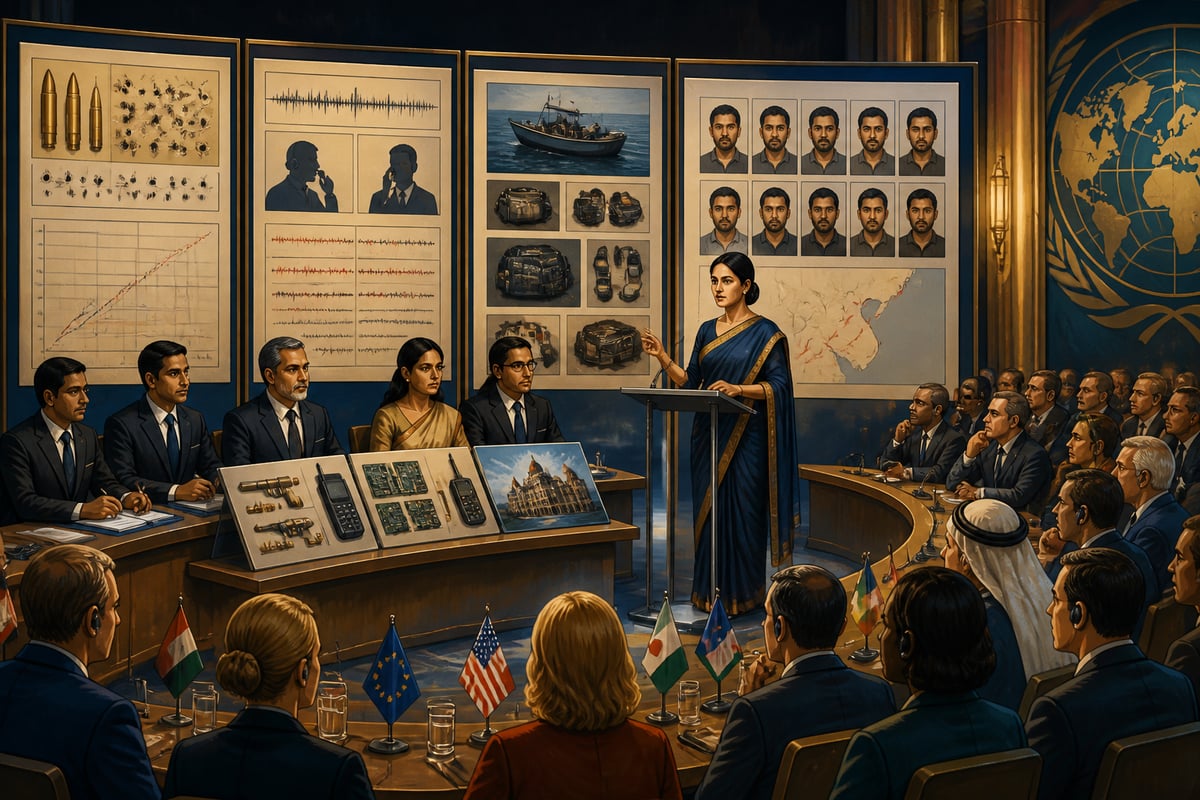
Document and internationalize. India's approach after 26/11, providing evidence to international courts, pursuing Interpol red notices, and building diplomatic coalitions, converts proxy war attacks into diplomatic and legal pressure on Pakistan.
Address genuine grievances. The most effective counter to proxy war exploitation is to address the legitimate grievances that proxy warriors exploit. In Kashmir, this means governance reform, economic development, and political integration alongside security measures.
The Islamist faultline is not about Islam. It is about a state infrastructure built on the Two-Nation Theory, funded by Gulf petrodollars, operationalized through the ISI, and directed at India's territorial integrity and civilizational cohesion. Understanding the machine is the first step toward dismantling it.
Case studies
Direct Action Day: The Great Calcutta Killings (1946)
On August 16, 1946, the Muslim League called for 'Direct Action' to press the demand for Pakistan. Bengal's Chief Minister Huseyn Shaheed Suhrawardy declared a public holiday, ensuring government offices and factories closed while maximum numbers could attend the League's rally. Police were given stand-down orders in key areas. Pre-positioned weapons and organized cadres turned a political demonstration into 72 hours of orchestrated carnage. Between 4,000 and 10,000 people were killed in Calcutta. Over 100,000 were rendered homeless. The violence spread outward in a chain reaction to Noakhali, Bihar, and Punjab over the following months. Each massacre reinforced the argument that Hindus and Muslims could not coexist, manufacturing the evidence for Partition through the very violence Partition was supposed to prevent.
Kautilya's Arthashastra identifies kutayuddha (covert warfare) as a strategic option where the true aggressor conceals their role behind layers of deniability. Direct Action Day was kutayuddha in domestic politics. The Muslim League's formal position was merely a 'day of action.' The actual operation, organized cadres, pre-positioned weapons, police stand-down, was designed to produce maximum violence while maintaining the fiction of spontaneous communal conflict. The Arthashastra also warns about the danger of leaders who use religious sentiment (dharma-lobha) as a tool for political mobilization. Jinnah's explicit threat about having 'forged a pistol' made the strategic intent unmistakable.
The Calcutta killings proved that the Two-Nation Theory could be enforced through violence. The chain reaction of retaliatory massacres across India created conditions so horrific that Partition appeared to be the only way to stop the bloodshed. Lord Mountbatten accelerated the independence timeline, and India was divided on August 15, 1947. Over one million people died in the Partition violence.
Political theories that require violence to 'prove' themselves reveal their own illegitimacy. The Two-Nation Theory could not succeed through democratic debate, so it succeeded through blood.
The Direct Action Day playbook, state complicity in organized violence disguised as spontaneous communal conflict, remains a template studied by intelligence agencies worldwide. Understanding how political movements manufacture crises to create 'inevitable' outcomes is essential for recognizing similar patterns in the present.
The Muslim League's electoral trajectory tells the story in numbers: from 109 of 482 Muslim seats in 1937 (22.6%) to 446 of 495 in 1946 (90.1%), a transformation achieved in just nine years through religious mobilization and manufactured fear.
The Kashmiri Pandit Exodus: Ethnic Cleansing in the Valley (1989-90)
Between 1989 and 1990, approximately 350,000 Kashmiri Pandits, the indigenous Hindu population of the Kashmir Valley, were driven from their homes through a systematic campaign of targeted assassinations, threats, and intimidation. On the night of January 19, 1990, mosques across the Valley broadcast messages through loudspeakers: 'Raliv, Galiv ya Chaliv' (convert, die, or leave). Hit lists of prominent Pandits, including judges, lawyers, teachers, and government officials, were published in local newspapers. Community leaders like Justice Neelkanth Ganjoo (who had sentenced JKLF founder Maqbool Bhat) were assassinated in broad daylight. The campaign was orchestrated by ISI-backed militant groups including JKLF and Hizbul Mujahideen, working through radicalized local networks. The Indian state apparatus, despite having intelligence and military capabilities, failed to intervene effectively.
The Shanti Parva's teaching on rajadharma is unequivocal: the protection of subjects is the king's primary and non-negotiable duty. Bhishma declares that a ruler who fails to protect his people forfeits the moral basis of his authority. The Indian state's failure during the Pandit exodus was not a failure of capability but of will. The government possessed the constitutional authority, the intelligence apparatus, and the military force to protect its citizens. It chose not to deploy them. In dharmic political philosophy, this represents the most fundamental violation of the ruler-subject compact. The rajadharma failure of 1990 haunts Indian governance to this day.
Over 350,000 Kashmiri Pandits, representing virtually the entire Hindu population of the Valley, were displaced. Most settled in refugee camps in Jammu and across North India. Over three decades later, despite government rehabilitation promises, the vast majority remain in exile. The Valley's syncretic culture, where Hindus and Muslims had coexisted for centuries, was destroyed in a matter of months.
A state that fails to protect its most vulnerable citizens from organized ethnic cleansing cannot claim to have fulfilled its most basic obligation. Security is not optional. It is the precondition for every other function of governance.
The abrogation of Article 370 in August 2019 and the subsequent reorganization of Jammu and Kashmir into Union Territories was partly a response to the institutional failure that enabled the 1990 exodus. The rehabilitation of Kashmiri Pandits remains an ongoing challenge, with government housing projects and employment quotas still far from restoring what was lost.
Before 1990, an estimated 400,000-600,000 Kashmiri Pandits lived in the Valley. By 1991, fewer than 3,000 Pandit families remained. This represents a demographic elimination rate exceeding 95% in under two years.
26/11 Mumbai Attacks: The Proxy War Machine Exposed (2008)
On November 26, 2008, ten operatives of Lashkar-e-Taiba, trained by Pakistan's ISI, launched coordinated attacks across Mumbai. They targeted the Taj Mahal Palace Hotel, the Oberoi Trident Hotel, Chhatrapati Shivaji Terminus railway station, the Leopold Cafe, and the Chabad House at Nariman House. Over four days, they killed 166 people (including 28 foreign nationals from 10 countries) and wounded over 300. The lone surviving attacker, Ajmal Kasab, was captured alive and confessed to ISI involvement. David Coleman Headley, an American double agent of Pakistani origin, later testified in US federal court that the ISI had directed the attack planning, provided funding, and coordinated with LeT leadership. His testimony documented the full proxy war pipeline: state sponsor to militant organization to field operative.
The Arthashastra classifies hostile states into categories based on their structural relationship to one's own state. The 'durjana' (wicked neighbor) is one who combines permanent hostility with deceptive peace gestures. Kautilya's prescribed response to a durjana is not war but systematic weakening through diplomatic isolation, economic pressure, and intelligence operations. India's post-26/11 strategy followed this framework precisely. Rather than launching a military strike (which would have given Pakistan the conventional war it could better absorb), India pursued evidence-based international pressure, building the case through Kasab's testimony, Headley's US court evidence, and UNSC designations of LeT and JeM leadership.
The attacks killed 166 people and exposed the full ISI proxy war infrastructure to international scrutiny. India chose a strategic response over an emotional one: pursuing legal evidence, international designations, and diplomatic pressure. Kasab was tried and executed. Headley's testimony in US courts established ISI involvement as legal fact. The attacks contributed to Pakistan's eventual FATF greylisting and the international isolation of groups like Jamaat-ud-Dawa.
Strategic patience and evidence-based response can be more devastating to a proxy war machine than a military strike. India's post-26/11 approach converted an act of terror into a long-term diplomatic weapon against the state that sponsored it.
The 26/11 attacks transformed India's counterterrorism architecture. The National Investigation Agency (NIA) was created in 2009. The National Security Guard's deployment protocols were overhauled. Coastal security received massive investment. The attacks also established a template that India used again after Pulwama (2019), where the Balakot airstrike demonstrated that India had moved from purely diplomatic response to active deterrence.
David Headley conducted five surveillance trips to Mumbai between 2006 and 2008, photographing targets and reporting directly to ISI handler 'Major Iqbal.' His US court testimony runs to over 1,000 pages, making 26/11 the most thoroughly documented state-sponsored terror attack in modern history.
Reflection
- When you encounter news about India-Pakistan relations, do you find yourself reacting emotionally (anger, fear, frustration) or analytically (asking who benefits, what the structural incentives are, what evidence exists)? How might shifting from emotional reaction to structural analysis change your understanding of the conflict?
- The Two-Nation Theory claimed that shared religion alone could form the basis of nationhood. East Pakistan's separation into Bangladesh in 1971 disproved this. Yet Pakistan continues to invest in the theory's logic through proxy war. What does it take for a state to abandon a foundational ideology even after it has been empirically falsified?
- The lesson argues that understanding a hostile state's proxy war machine is a prerequisite for effective defense, not an invitation to hatred. Where is the line between strategic awareness and communal prejudice? Can a civilization maintain vigilance against a specific state-sponsored threat without allowing that vigilance to harden into suspicion of an entire religious community?