Indian Muslims as Partners, Not Opponents
Dara Shikoh, Rahim, Kalam, and Bharatiyata Beyond Religion
Indian Islam contains a powerful tradition of civilizational partnership, from Dara Shikoh's Vedanta-Sufi synthesis to APJ Abdul Kalam's lived Bharatiyata. This lesson examines the evidence for this partnership, the Wahhabist forces displacing it, and why the demographic competition frame serves India's adversaries rather than its citizens.
See It Today: The Missile Man Who Read the Gita
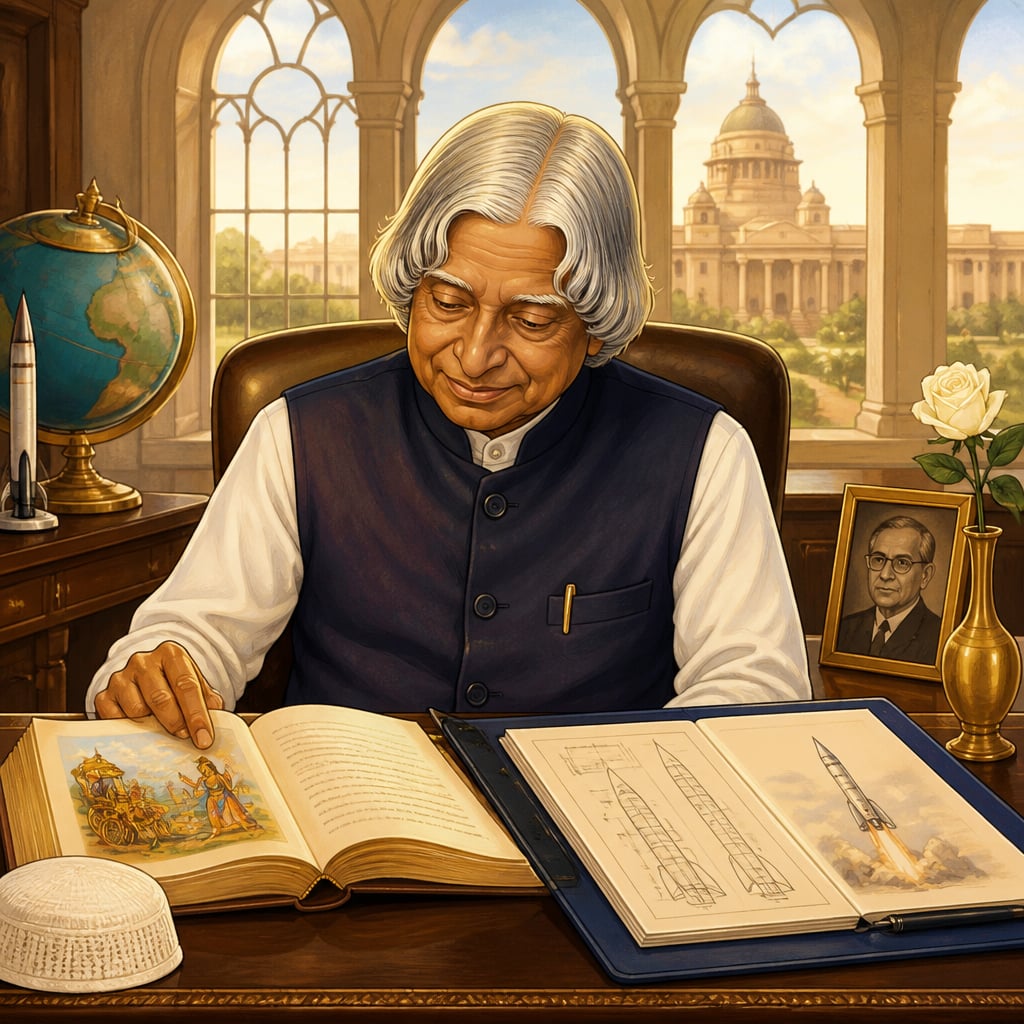
In 2002, Avul Pakir Jainulabdeen Abdul Kalam was sworn in as India's 11th President. Born in Rameswaram, a Hindu pilgrimage town in Tamil Nadu, to a boat-owning Muslim family, Kalam grew up beside the Ramanathaswamy Temple. His closest childhood friend was Aravindan, the son of the temple's head priest. Kalam played the veena daily. He was a lifelong vegetarian. He quoted the Bhagavad Gita, the Quran, and the Tamil classic Thirukkural with equal reverence and fluency.
None of this created any contradiction in Kalam's mind. When asked about his identity, he called himself an Indian first, always. His book Wings of Fire (1999) sold over a million copies and became a touchstone for Indian aspiration across every religious and caste line. In opinion polls conducted during and after his presidency, Kalam consistently ranked as India's most trusted public figure.
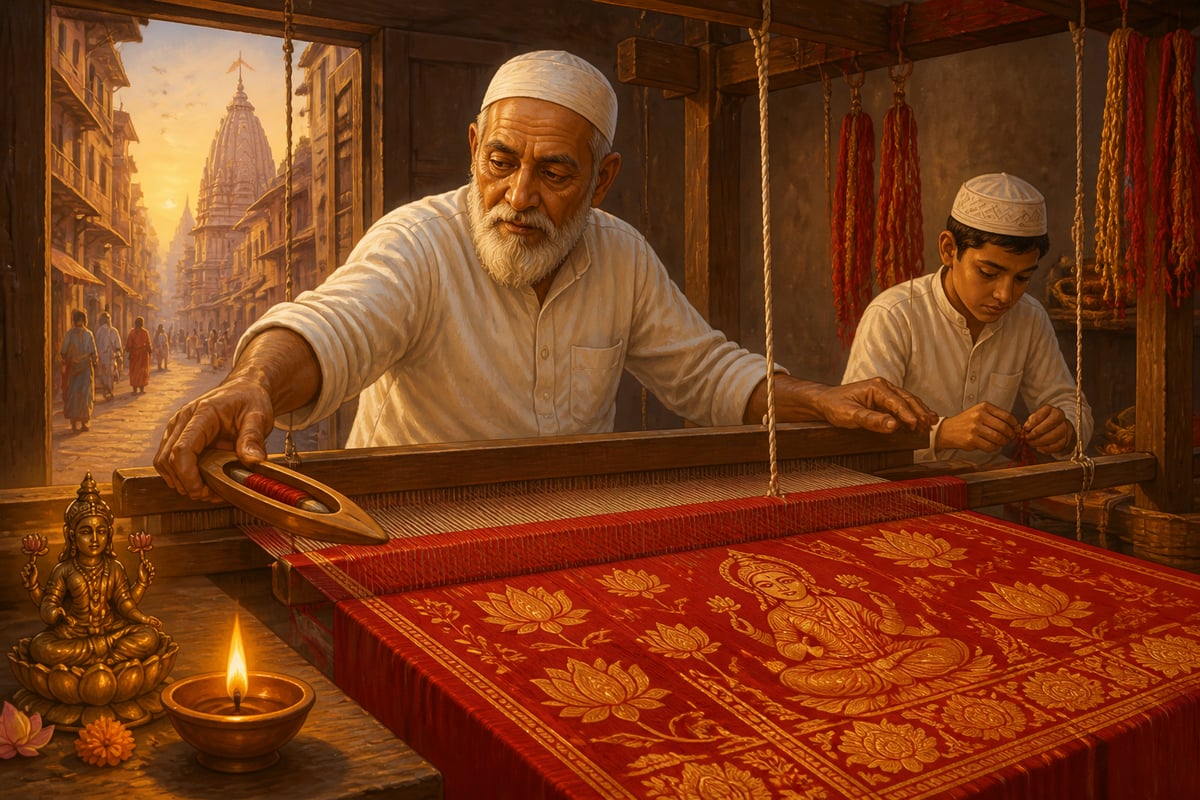
Kalam was not performing syncretism for cameras. He was expressing something that millions of Indian Muslims live quietly every day: a Bharatiyata (Indian civilizational identity) that is deeper and older than any single religious framework. The Kalam phenomenon was not an anomaly. It was the visible peak of a mountain whose base includes the Muslim weavers of Varanasi creating saris for Hindu deities, the Muslim craftsmen of Puri helping build Lord Jagannath's chariot, and the millions of Indian Muslims who visit Sufi Dargahs and participate in syncretic festivals that Wahhabist puritanism has declared heretical.
The question is not whether Indian Muslims can be civilizational partners. Centuries of evidence say they already are. The question is whether this partnership tradition will survive the ideological assault being waged against it.
The Mechanism: Two Islams in India
Indian Islam is not monolithic. Understanding the partnership reality requires recognizing that at least two distinct Islamic traditions coexist in India, and they are in direct conflict with each other.
The Native Tradition: Sufi, Syncretic, Bharatiya
The Chishti Sufi order, established in India by Moinuddin Chishti in the 12th century, made a deliberate choice: it adopted local languages, incorporated Indian musical traditions, and emphasized experiential devotion over doctrinal rigidity. Nizamuddin Auliya, the most influential Chishti saint of medieval Delhi, reportedly observed Ekadashi fasts. His disciple Amir Khusrau created Qawwali by fusing Persian ghazal with Indian raga. The Chishti order produced saints who were indistinguishable from Bhakti movement figures in their devotional intensity and their accessibility to common people.
This organic synthesis crystallized into the Barelvi tradition, formalized by Ahmad Raza Khan of Bareilly (1856-1921). The Barelvi school, representing an estimated 200 million Muslims in South Asia (the largest single denomination), explicitly defends practices that connect Indian Muslims to the subcontinent's civilizational fabric: visiting Dargahs and seeking intercession through saints, celebrating Urs (death anniversaries of Sufi saints) with music and community feasting, observing Milad-un-Nabi (the Prophet's birthday) with festivity, and incorporating local cultural practices into religious life. Ahmad Raza Khan wrote over 1,000 scholarly works defending these practices as theologically legitimate.
The data on shared cultural practices is striking. A 2019 CSDS survey found that over 60% of Indian Muslims reported visiting Dargahs at least once a year. Hindu attendance at major Dargahs remains significant: the Ajmer Sharif Dargah receives an estimated 150,000 daily visitors during the annual Urs, with Hindus constituting roughly 20-30% of attendees. The Nizamuddin Dargah in Delhi, the Haji Ali Dargah in Mumbai, and hundreds of smaller Sufi shrines function as shared civilizational spaces where religious boundaries dissolve.
The Imported Tradition: Wahhabist Puritanism
Against this native tradition stands an imported one. Wahhabism, originating in 18th-century Arabia through Muhammad ibn Abd al-Wahhab's alliance with the Saud family, defines itself by rejection of precisely those practices that make Indian Islam civilizationally connected: saint veneration (condemned as shirk/polytheism), Dargah visits, Sufi music, syncretic festivals, and any accommodation with local cultural practices.
The mechanism of displacement is well-documented. Saudi Arabia's global religious spending between 1975 and 2005 is estimated at $75-100 billion. This funding built mosques, madrasas, and cultural centers worldwide, with explicit conditions that they teach Wahhabist curriculum and reject local Islamic traditions. In India, this has manifested as:
Madrasa curriculum shifts: Traditional madrasas teaching Barelvi/Sufi-influenced Islam face competition from Gulf-funded institutions teaching puritan theology that explicitly condemns syncretic practices.
Ideological pressure on Dargah culture: Wahhabist organizations in India regularly issue statements condemning Dargah visits, Urs celebrations, and Sufi music as un-Islamic innovations (bid'ah). Young Indian Muslims educated in Wahhabist institutions increasingly view their parents' and grandparents' syncretic practices as theologically wrong.
Displacement of local leadership: Traditional community leaders (pirs, sajjada-nashins) whose authority rests on spiritual lineage and community service are being displaced by ideologues whose authority derives from Gulf-funded institutional networks.
The result is a generational war within Indian Islam. The grandmother who visits Ajmer Sharif and the grandson who considers it shirk represent two fundamentally different relationships with Indian civilization.
The False Frame: Demographic Competition
The "demographic threat" narrative, which frames Indian Muslims as a monolithic bloc in competition with Hindus, is not just factually misleading. It actively serves the Wahhabist project.
When Hindu groups treat all Indian Muslims as a single threatening category, they push Indian Muslims toward exactly the monolithic identity that Wahhabist organizations promote. The Muslim weaver in Varanasi who creates saris for Hindu temples, the Barelvi who visits Dargahs, the Sufi musician who sings at both Hindu and Muslim gatherings: when these individuals are treated as part of a "demographic threat," they have fewer reasons to maintain their civilizational partnerships and more reasons to retreat into the religious-identity-only framework that Wahhabism offers.
The demographic competition frame is a strategic gift to India's actual adversaries. It erases the distinction between Bharatiya Muslims and Islamist ideologues, treating both as the same problem. This is precisely what both Wahhabist organizations and Pakistan's ISI want: an India where Muslim identity and Indian civilizational identity are seen as incompatible.
The Pattern: The Prince Who Saw Two Oceans Meet
The idea that Islam and Bharatiya civilization are fundamentally compatible is not modern wishful thinking. It has a documented intellectual history spanning centuries.
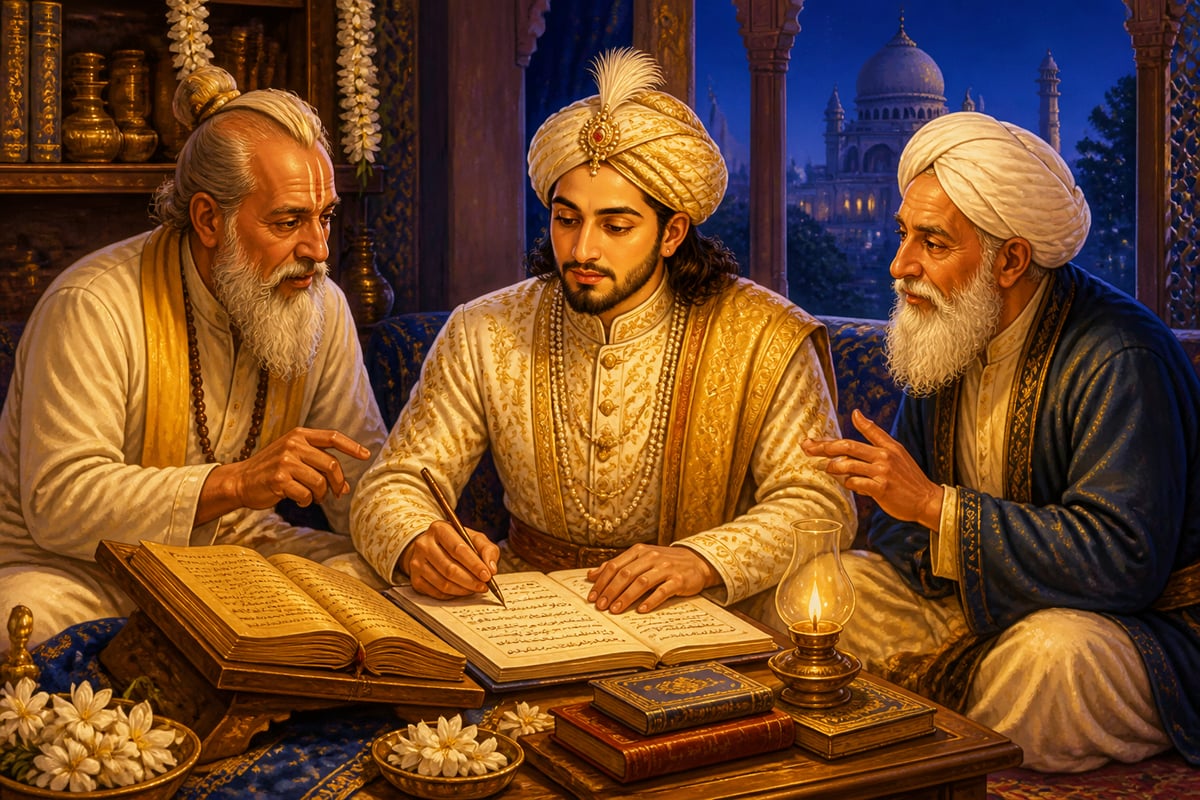
In 1655, Prince Dara Shikoh, eldest son of Mughal Emperor Shah Jahan and heir apparent to the throne, completed Majma-ul-Bahrain (The Meeting of Two Oceans). This was not a diplomatic gesture of "tolerance." It was a rigorous philosophical argument that Sufi concepts and Vedantic concepts describe the same metaphysical reality. Dara Shikoh studied Sanskrit with Banaras pandits, engaged Sufi scholars in comparative theological discussions, and produced a systematic mapping of Sufi and Vedantic terminology.
Two years later, in 1657, he completed his masterwork: Sirr-i-Akbar (The Greatest Secret), a Persian translation of 50 Upanishads. In his introduction, he wrote: "After having access to this great treasure, I found it the Truth of Truths... without doubt or suspicion." He argued that the Quran's reference to a "hidden book" (Kitab al-Maknun) pointed to the Upanishads themselves.
Dara Shikoh was not alone. Abdul Rahim Khan-i-Khana (1556-1627), a Mughal military commander and one of Akbar's Navaratnas, wrote dohas in Hindi that are among the most celebrated devotional poetry in the language. His verses invoke Ram, Krishna, and the moral frameworks of Dharmic tradition. Today, Rahim's dohas are taught in Hindi classrooms across India. Most students do not know their author was a Muslim nobleman who commanded armies.
Raskhan (Sayyid Ibrahim, 16th-17th century), a Muslim of noble Pathan lineage, was so devoted to Lord Krishna that he wrote: "If I am to be born again, let me be born among the cowherds of Gokul." His Braj Bhasha poetry is considered among the finest ever written about Krishna's leelas, alongside Surdas.
The civilizational fork came in 1659, when Aurangzeb executed Dara Shikoh on charges of apostasy and seized the throne. This was not just a succession war. It was a civilizational choice between two models of Indian Islam: one that saw Indian civilization as a partner, and one that saw it as an enemy. Aurangzeb's victory strengthened the puritanical tradition. But it did not destroy the syncretic one. That tradition survived through Sufi orders, devotional poetry, shared festivals, and the lived practices of ordinary Indian Muslims who continued to participate in India's civilizational fabric.
Dharmic Wisdom: The Civilization That Absorbs
The Rig Veda declares "Ekam Sat Viprah Bahudha Vadanti" (Truth is one; the wise call it by many names). This is not a platitude. It is a civilizational operating system. Unlike exclusivist theological frameworks that operate on a single-path truth claim, Dharmic civilization operates on the principle that multiple paths can lead to the same truth.
This is why Indian civilization could integrate with Islam in a way that no other non-Islamic civilization managed. China suppressed Islam. Europe expelled it. India synthesized with it. The Sufi-Bhakti convergence, the architectural synthesis of Indo-Islamic art, the linguistic fusion that created Urdu and Hindustani, the culinary and musical traditions that blend both heritages: these are not accidents of proximity. They are products of a civilizational framework architecturally designed for synthesis.
The Arthashastra offers a practical complement to this philosophical principle. Kautilya's statecraft does not organize society by religious belief. It organizes by function, loyalty, and contribution. A citizen who contributes to the Rashtra's security, prosperity, and cultural life is a partner regardless of personal theology. The Arthashastra's test is not "what do you believe?" but "do you serve the civilizational project?"
By this standard, Kalam building India's missiles, Rahim enriching India's literature, the Varanasi weaver creating temple saris, and the Sufi musician singing at a shared festival are all performing Rashtra-seva (service to the nation-civilization). Their religious identity is their personal matter. Their civilizational contribution is the public measure.
The Defense: Protecting the Partnership Model
The Bharatiya Muslim partnership model is under attack from two directions simultaneously, and defending it requires action on both fronts.
Counter the Wahhabist Displacement
The most urgent threat to Indian Muslim civilizational partnership is not Hindu hostility. It is the systematic Wahhabist displacement of native Indian Islamic traditions. This requires:
Support Sufi and Barelvi institutions: India's Dargahs, Sufi music traditions, and syncretic festivals are civilizational assets, not just Muslim religious sites. Their preservation serves India's civilizational interest. Policy should actively support the Waqf boards that maintain Dargahs, fund the preservation of Sufi musical traditions (Qawwali, Kafi, Manqabat), and protect syncretic festivals from both Wahhabist condemnation and sectarian suspicion.
Track and counter Gulf ideological funding: India's FCRA (Foreign Contribution Regulation Act) framework should specifically monitor ideological imports that seek to replace native Indian Islamic traditions with imported puritan theology. The distinction is precise: foreign funding for education, healthcare, and community development is welcome. Foreign funding designed to make Indian Muslims reject their civilizational heritage is a national security concern.
Amplify Indian Muslim intellectual voices: Scholars, writers, and public intellectuals who articulate a Bharatiya Muslim identity deserve institutional platforms. The Dara Shikoh tradition did not die. It continues in scholars who argue that Indian Islam's syncretic character is not weakness but theological strength. These voices are often drowned out by both Wahhabist funding and simplistic anti-Muslim narratives.
Reject the Demographic Competition Frame
Organizations and media that frame all Indian Muslims as a demographic threat are doing the Wahhabist project's work for them. Every time a Bharatiya Muslim is treated as a threat rather than a partner, it strengthens the argument that Indian civilization and Islam are incompatible.
Distinguish between Bharatiya Muslims and Islamist ideologues: The Varanasi weaver and the radical preacher are not the same person, the same community, or the same threat level. Treating them identically is strategic blindness. India's security apparatus should target radicalization networks with precision while its cultural and political institutions embrace civilizational partners.
Celebrate shared cultural spaces: Dargahs, syncretic festivals, shared musical traditions, and the living tradition of civilizational partnership are strategic assets. They prove daily that the two-nation theory was wrong. Invest in them. Participate in them. Protect them from puritans on both sides who want them to disappear.
Learn the tradition: Read Dara Shikoh. Read Rahim's dohas. Listen to Qawwali. Visit Ajmer Sharif. Understand that Indian Islam produced a civilizational synthesis unmatched anywhere else in the world. This knowledge is the foundation of genuine partnership: not patronizing tolerance, but earned respect for a shared civilizational achievement.
The partnership between Indian Muslims and Bharatiya civilization is not aspirational. It is historical fact, living practice, and strategic necessity. The question is whether India will protect it from those, on both sides, who profit from its destruction.
Case studies
APJ Abdul Kalam: Bharatiyata at the Highest Office
In 2002, APJ Abdul Kalam, a devout Muslim born in the Hindu pilgrimage town of Rameswaram, was sworn in as India's 11th President with near-unanimous parliamentary support. Kalam had led India's missile program (Agni, Prithvi) and was the principal scientific advisor behind the 1998 Pokhran-II nuclear tests. He played the veena daily, was a lifelong vegetarian, quoted the Bhagavad Gita and Thirukkural alongside the Quran, and his closest childhood friend was the son of the Ramanathaswamy Temple's head priest. His book 'Wings of Fire' (1999) sold over a million copies across every demographic. In polls during and after his presidency, Kalam ranked as India's most trusted public figure, transcending every religious and caste boundary.
Kalam embodied the Arthashastra's functional citizenship model: Kautilya measures a citizen's value by their contribution to the Rashtra's security, prosperity, and cultural life, not by their personal theology. Kalam built India's missile deterrent (Danda), inspired millions of young Indians (Yogakshema), and represented civilizational unity at the highest office. The Gita's sama-darshana (equal vision) was not an abstract concept for him but a lived daily practice. He demonstrated that Bharatiyata is not about which scripture you read but whether you serve the civilizational project.
Kalam's presidency (2002-2007) proved that Indian Muslim identity and deep civilizational belonging are naturally compatible when not distorted by either Wahhabist puritan ideology or anti-Muslim hostility. His 'Vision 2020' for India inspired a generation. After his death in 2015 while delivering a lecture to students, he received a state funeral attended by leaders across the political and religious spectrum. His legacy remains the most powerful modern evidence against the claim that Muslim and Bharatiya identities are inherently in tension.
Bharatiyata is not about religious conversion or cultural erasure. It is about civilizational participation. Kalam lost nothing of his Muslim identity by playing the veena, reading the Gita, or building missiles for India. He gained a civilizational wholeness that neither Wahhabist puritanism nor demographic competition narratives can explain or accommodate.
Kalam's example directly refutes both the Wahhabist claim that Indian Muslims must reject non-Islamic cultural practices and the demographic competition claim that Indian Muslims are civilizational outsiders. His life is evidence that the partnership model is not aspirational theory but demonstrated reality at the highest level of national life.
Kalam won the 2002 presidential election with 922,884 votes out of a total 1,107,851 electoral college votes cast, roughly 89% support across party lines. He remains the only scientist and the only unmarried person to have served as India's President.
Dara Shikoh: The Civilizational Road Not Taken
In 1655, Prince Dara Shikoh, eldest son of Mughal Emperor Shah Jahan and heir apparent to the world's richest throne, completed 'Majma-ul-Bahrain' (The Meeting of Two Oceans), a systematic philosophical argument that Sufi and Vedantic metaphysics describe the same ultimate reality. He had studied Sanskrit with Banaras pandits, engaged Sufi masters in comparative theological analysis, and mapped Sufi terminology onto Vedantic concepts with scholarly precision. Two years later, he completed 'Sirr-i-Akbar' (The Greatest Secret), translating 50 Upanishads into Persian, writing in his introduction: 'After having access to this great treasure, I found it the Truth of Truths... without doubt or suspicion.' In 1659, his younger brother Aurangzeb defeated Dara Shikoh in battle, put him on trial for apostasy, and had him executed. Aurangzeb then reversed the syncretic Mughal policies, imposing jizya tax on non-Muslims and ordering destruction of Hindu temples.
Dara Shikoh's intellectual project was a direct application of the Rig Vedic principle 'Ekam Sat Viprah Bahudha Vadanti' (Truth is one; the wise call it by many names). His Majma-ul-Bahrain was not interfaith diplomacy. It was rigorous Vedantic analysis applied across traditions, demonstrating that Sufi wahdat al-wujud (unity of existence) and Vedantic Advaita (non-duality) point to identical metaphysical truths. His execution represents what happens when civilizational synthesis loses to exclusivist puritan ideology. Kautilya would recognize Aurangzeb's choice as strategic folly: dividing the Rashtra's subjects against each other to impose theological uniformity.
Aurangzeb's 49-year reign (1658-1707) exhausted the Mughal treasury through constant wars, alienated Hindu subjects, and directly precipitated the Mughal decline. Dara Shikoh's Sirr-i-Akbar survived. It reached Europe through Anquetil-Duperron's Latin translation (1801-1802), introducing the Upanishads to Western philosophy. Schopenhauer called it 'the consolation of my life.' The syncretic tradition Aurangzeb tried to destroy persisted through Sufi orders and shared cultural practices. The puritanical tradition he championed became the foundation for later separatist ideologies, culminating in the two-nation theory and Partition.
Civilizational synthesis requires intellectual courage and institutional support. Dara Shikoh had the scholarship but lost the succession war. His vision survived because it was embedded in lived cultural practices that no emperor could fully destroy. Pursue synthesis intellectually, but anchor it in institutions and practices that survive political reversals.
The Dara Shikoh vs. Aurangzeb fork is not historical trivia. It is the same choice India faces today: between a civilizational model that includes Indian Muslims as partners in a shared philosophical heritage, and an exclusivist model that demands Muslims choose between faith and civilizational belonging. Every effort to support syncretic Indian Islam is a vote for Dara Shikoh's road.
Dara Shikoh's Sirr-i-Akbar translated 50 Upanishads into Persian, making it the most comprehensive pre-modern cross-civilizational philosophical translation project in recorded history. It remained the primary channel through which Upanishadic thought reached European philosophy for nearly a century.
The Sacred Weavers: Muslim Artisans in Hindu Devotional Traditions
In the narrow lanes of Varanasi's Madanpura and Jaitpura neighborhoods, Muslim weaver families have created Banarasi silk saris for Hindu brides and temple deities for over 500 years. An estimated 80% of Varanasi's traditional handloom weavers are Muslim. These families weave images of Hindu deities, sacred symbols, and temple motifs into fabric destined for Hindu wedding ceremonies and temple sanctums. In Puri, Muslim carpenter families have historically contributed to building Lord Jagannath's Ratha Yatra chariots. In Tirupati, Muslim zari (gold thread) workers create the ornate garments used to adorn the Venkateswara deity. In Lucknow, Muslim artisans produce Chikankari embroidery worn at Hindu festivals across North India. These are not recent accommodations. They are multi-generational traditions where Muslim craftsmen consider their work for Hindu devotional purposes a matter of professional pride and cultural inheritance.
The Arthashastra organizes the Rashtra by function and contribution, not by religious identity. These artisans embody Kautilya's model: their value to the civilizational fabric is measured by what they create, not what they believe. The concept of samarasya (harmonious co-mingling) is visible at the loom itself: Muslim hands weaving Hindu sacred imagery is civilizational integration at its most intimate and organic level. No politician organized this. No policy mandated it. It grew from centuries of shared civilizational life where religious identity did not prevent professional devotion to another tradition's sacred needs.
This tradition faces a dual threat. Wahhabist ideology pressures young Muslims to reject work involving Hindu religious imagery as un-Islamic. Simultaneously, industrial mass production and power looms undercut the economic viability of traditional handloom work. The combination threatens to destroy in one generation a civilizational partnership that survived five centuries. Several weaver families in Varanasi have reported younger members questioning whether creating Hindu religious imagery is permissible, reflecting the penetration of Wahhabist thinking into communities where it was previously unknown.
Civilizational partnership is not built in parliaments or debating halls. It is built at the loom, at the workshop, at the shared festival. The Muslim artisan tradition proves that Bharatiyata lives in daily practice and professional devotion. Protecting these traditions from both ideological purism and economic displacement is a civilizational priority.
The artisan tradition is the most powerful grassroots evidence against the demographic competition narrative. A Muslim weaver creating a sari for a Hindu temple deity is performing civilizational partnership at a level more real and more durable than any political speech. If India loses this tradition to Wahhabist ideology or economic disruption, it loses irreplaceable evidence that the two-nation theory was wrong.
An estimated 80% of Varanasi's traditional Banarasi silk weavers are Muslim, producing saris essential to Hindu wedding rituals and temple worship across India. The Banarasi silk industry employs approximately 100,000 weavers, making it one of the largest examples of inter-faith economic collaboration in the world.
Reflection
- Think about the Indian Muslims in your own life, neighborhood, or professional world. What civilizational partnerships (shared festivals, professional collaborations, cultural practices) do you participate in or witness? Have you ever consciously invested in strengthening these partnerships, or do you take them for granted?
- Dara Shikoh and Aurangzeb were brothers raised in the same palace with the same father. One saw Indian civilization as a partner to Islam; the other saw it as an enemy. What determines whether a person embraces civilizational synthesis or retreats into exclusivism, even when their circumstances are identical?
- The Rig Veda declares 'Ekam Sat Viprah Bahudha Vadanti' (Truth is one; the wise call it by many names). Is this principle a strength that enables civilizational absorption, or a vulnerability that prevents robust self-defense? Can a civilization built on radical pluralism defend itself against traditions built on exclusivist truth claims without abandoning its own foundational principle?