Gulf Funding and Radicalization
Wahhabism Replacing Sufi Traditions and Madrasa Networks
Gulf funding has systematically displaced India's indigenous Muslim traditions through a consistent mechanism. This lesson traces the theological roots from al-Ghazali's 11th-century closing of ijtihad through the 1744 Wahhabi-Saudi pact to modern petrodollar-funded da'wah networks. It examines how Wahhabism replaces Sufi-Barelvi traditions, how madrasa networks and returning Gulf migrants serve as transmission channels, and how displacement follows a four-phase pattern from economic entry to political mobilization. Case studies from the Wahhabi-Saudi pact, ISIS recruitment in India, and Chechnya's transformation from secular nationalism to jihadism illustrate the pattern across contexts.
See It Today: The PFI Files
In September 2022, the National Investigation Agency executed India's largest coordinated law enforcement operation. Teams simultaneously raided Popular Front of India (PFI) offices and residences across 15 states, arresting over 150 people in a single morning. Days later, the Union Home Ministry declared PFI and its affiliates unlawful associations under UAPA.
The NIA chargesheets that followed exposed something far beyond a single organization. They revealed a multi-layered radicalization infrastructure: "Tarbiyat" (training) modules combining physical fitness camps with ideological indoctrination, a network of "service organizations" providing humanitarian cover, and financial arteries connecting ground-level cadres to Gulf-based donors through hawala networks and shell companies. Recruits were systematically taught that Indian democracy was fundamentally incompatible with Islamic governance.
The PFI was not an aberration. It was the visible tip of a radicalization infrastructure whose roots stretch back decades, whose funding originates thousands of miles away, and whose theological foundations were laid centuries ago. Understanding how Gulf money transforms theological movements into political networks, and how Wahhabi ideology displaces syncretic Indian Muslim traditions, is the subject of this lesson.
The Mechanism: Theological Architecture and the Funding Pipeline
The Gates of Ijtihad: Al-Ghazali's Turning Point
To understand why Gulf funding produces radicalization rather than mere religiosity, you must understand the theological architecture it promotes.
In early Islamic intellectual history, two competing traditions shaped how believers interpreted their faith. The Mu'tazila school championed Ijtihad: independent rational inquiry, the right of scholars to reason from first principles about theology, law, and governance. The Ashari school, championed by the 11th-century theologian Abu Hamid al-Ghazali, argued for Taqlid: faithful adherence to established legal opinions, with the "gates of ijtihad" effectively closed.
Al-Ghazali's "Tahafut al-Falasifa" (The Incoherence of the Philosophers) was a devastating blow against rationalist Islamic philosophy. He argued that human reason was inherently limited, that philosophical inquiry into divine matters was dangerous, and that faithfulness to revealed scripture and prophetic traditions was the only reliable path. His victory was institutional, not just philosophical. Within a century, the Mu'tazila tradition was marginalized across the Sunni world.
Sanjay Dixit identifies this as the foundational theological shift. When ijtihad closed, Islamic jurisprudence ossified. Legal opinions from the 8th-10th centuries became permanent, unchangeable precedent. The capacity for internal theological reform was structurally foreclosed. The system that Gulf funding exports is built on taqlid, not ijtihad. It does not invite questioning. It demands compliance.
The Wahhabi-Saudi Nexus: 1744 to the Present
In 1744, Muhammad ibn Abd al-Wahhab, a theologian from the Najd region of central Arabia, struck an alliance with Muhammad ibn Saud, a local tribal chief. The deal was straightforward: ibn Abd al-Wahhab would provide theological legitimacy; ibn Saud would enforce Wahhabi doctrine. This created a theological-political nexus where religious authority and state power were structurally fused.

When the Saudi dynasty conquered the Arabian Peninsula and established the Kingdom of Saudi Arabia in 1932, the Wahhabi establishment controlled the religious infrastructure of the state housing Islam's two holiest cities. The 1973 OPEC oil embargo then transformed this regional arrangement into a global one. Oil prices quadrupled, giving Saudi Arabia unprecedented wealth. Between 1975 and 2005, Saudi Arabia spent an estimated $75-100 billion on global da'wah (Islamic proselytization): funding over 1,500 mosques, 210 Islamic centers, 202 colleges, and nearly 2,000 schools worldwide.
The theology this money exports is specifically Wahhabi: iconoclastic, puritanical, hostile to Sufi traditions, and insistent on literalist interpretation of Islamic law. It is not "Islam" in some generic sense. It is a specific 18th-century Arabian theological movement being imposed on Muslim communities whose indigenous traditions look nothing like it.
Sufism: Complicating the "Moderate" Narrative
A common assumption holds that Sufism represents "peaceful Islam" and that promoting Sufi traditions counters Wahhabi radicalism. Sanjay Dixit devotes substantial analysis to challenging this narrative.
While individual Sufi mystics produced genuine poetry of spiritual transcendence, Sufi orders as institutional structures often facilitated political Islam rather than opposing it. Several major Sufi orders in India played direct roles in military campaigns, political mobilization, and the expansion of Islamic political authority. The shrine networks that Sufism built were simultaneously spiritual institutions and political infrastructure.
This does not mean Sufism and Wahhabism are identical. Barelvi tradition, rooted in South Asian Sufi practice, differs from Deobandi tradition in its veneration of saints, shrine worship, and devotional practices. But Dixit argues the difference is primarily one of method, not ultimate theological goal. Both traditions affirm the supremacy of Islamic revelation. Both resist theological pluralism at the doctrinal level. The Barelvi approach is culturally softer and more accommodating of local traditions, which is precisely why Wahhabism specifically targets it for replacement. The popular framing of "good Sufism vs. bad Wahhabism" oversimplifies a complex theological landscape.
The Funding Pipeline into India
Gulf theology reaches Indian communities through three primary channels.
First, direct madrasa funding. Saudi Arabia, Qatar, Kuwait, and the UAE fund Islamic educational institutions across India: construction costs, teacher salaries, curricula. These madrasas teach a standardized curriculum prioritizing Arabic language, Quranic memorization, and theological training in Wahhabi or Deobandi frameworks. What they displace are indigenous educational traditions: local language, local history, and syncretic cultural practices.
Second, returning migrants. India's Gulf diaspora (over 8 million workers) undergoes cultural transformation during years abroad. Workers who left practicing Barelvi traditions return after prolonged exposure to Wahhabi norms in Gulf states. The transformation is visible: changed dress, changed practices, changed attitudes toward local customs. This is cultural osmosis through economic migration, not formal conversion.
Third, digital infrastructure. Gulf-funded satellite channels, social media platforms, and online preachers broadcast Wahhabi theology directly into Indian homes. The framing consistently positions Indian governance as anti-Muslim, serving as a radicalization accelerant even when it does not directly promote violence.
The Pattern: Displacement, Not Conversion
The pattern across India is not dramatic mass conversion but gradual cultural displacement. The process follows a consistent sequence.
Phase 1: Economic Entry. Gulf money enters a community through legitimate channels: mosque construction, madrasa funding, charitable work, employment opportunities. The funding addresses real needs. Communities with poor schools accept madrasa funding. Communities without proper mosques welcome construction grants.
Phase 2: Theological Standardization. Funded institutions begin teaching a standardized Wahhabi or Deobandi curriculum. Local traditions, festivals, shrine visits, devotional music, and syncretic practices shared with Hindu neighbors are gradually labeled "bid'ah" (unacceptable innovation) or "shirk" (polytheism). Young people educated in these institutions begin viewing their grandparents' practices as theologically impure.
Phase 3: Cultural Rupture. A generational divide opens. Elders who grew up visiting dargahs, celebrating Muharram with Hindu neighbors, and practicing local festival traditions find their grandchildren rejecting these practices as un-Islamic. The shared cultural space between Hindu and Muslim communities erodes. Not because relationships soured, but because the theological framework allowing syncretism has been replaced by one forbidding it.
Phase 4: Political Mobilization. Once a community's theological framework shifts from syncretic to puritanical, political mobilization becomes possible. Grievances previously addressed through democratic channels are reframed as evidence of fundamental civilizational incompatibility. Organizations like PFI emerge from this theological soil, not from a vacuum.
This pattern is not unique to India. It has replayed across Indonesia, Bosnia, Chechnya, Central Asia, and sub-Saharan Africa. Wherever Gulf money enters, indigenous Muslim traditions face displacement by Wahhabi standardization. The specific Indian dimension is that this displacement also severs the cultural threads connecting Muslim and Hindu communities. Threads built over centuries of shared festivals, shared music, and shared sacred geography.
Dharmic Wisdom: Kutayuddha and Paravritti
The Arthashastra describes Kutayuddha: covert or indirect warfare. Within this framework, the use of wealth to reshape an adversary's internal social structure is a recognized strategic tool. What Gulf funding accomplishes in Indian Muslim communities is precisely Kutayuddha: external wealth reshaping internal theological and cultural structures in ways that serve the donor's geopolitical interests.
The dharmic concept of Paravritti (turning, transformation) captures what happens when a community's spiritual orientation is rotated from its indigenous axis. The Barelvi traditions of Indian Muslims were not "pure" or "impure" Islam in some abstract sense. They were the natural turning of a universal faith toward local cultural soil. When Wahhabism displaces Barelvi tradition, it uproots a tree that had grown deep into Indian soil and replants a desert shrub transplanted from Arabia.
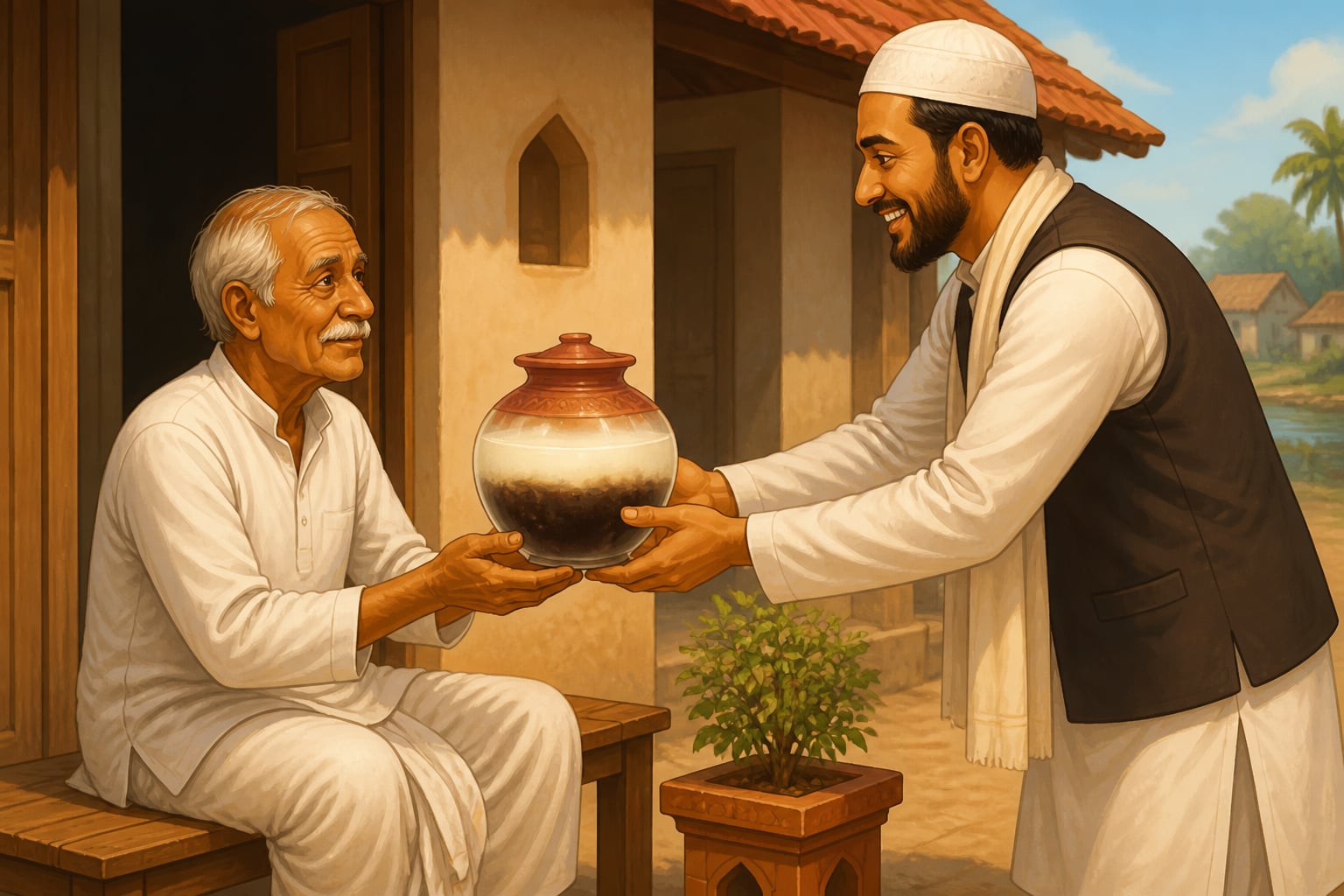
Chanakya warns of the "vishakumbha": the poison-pot friend who speaks sweetly to your face while destroying your purpose from behind. Gulf-funded charitable work operates in exactly this pattern. The surface is humanitarian. The mechanism underneath is theological displacement. Recognizing this dual nature requires Viveka, the capacity to see strategic architecture beneath the charitable facade.
The defense begins with Svadhyaya: self-study, self-understanding. For Indian Muslim communities, this means reclaiming the theological independence that ijtihad represents. For Indian civilization as a whole, it means understanding that the displacement of syncretic Indian Muslim traditions is not merely a "Muslim problem" but a civilizational loss. When Urs celebrations stop, when qawwali traditions fade, when dargah visits become theologically forbidden, the shared civilizational fabric loses threads that took centuries to weave.
The Defense: Eyes Open, Hands Extended
Defending against Gulf-funded radicalization requires action on multiple levels.
Follow the money. India's Foreign Contribution Regulation Act (FCRA) is the primary legal tool for monitoring foreign funding of religious institutions. Strengthening FCRA enforcement, increasing transparency requirements for institutions receiving foreign funds, and building intelligence capacity to track hawala networks are essential regulatory steps. The NIA's PFI investigation demonstrated this capacity exists. The question is consistent application.
Support indigenous Muslim traditions. The most effective counter to Wahhabi standardization is the survival of India's own Muslim traditions: Barelvi devotional practices, Sufi musical traditions, syncretic festivals, local language religious scholarship. These represent Indian Muslim civilization's own heritage. Their survival depends not just on Muslim communities preserving them but on Indian society valuing the shared heritage they represent.
Rebuild the shared civilizational space. The ultimate defense is the shared civilizational identity that Wahhabism targets. Festivals celebrated together, sacred sites honored across traditions, musical and literary traditions that transcend religious boundaries. When a Hindu family attends an Urs and a Muslim family celebrates Diwali, that is not "tolerance." That is civilizational Sanghata: the organic binding force holding diverse communities together.
Secure information sovereignty. Gulf-funded media platforms shape how Indian Muslims understand their own situation. Building Indian media infrastructure that provides honest, evidence-based coverage, rather than the polarized narratives offered by either extreme, is a civilizational necessity.
The Arthashastra teaches that the wise ruler addresses threats at their source, not merely at their symptoms. Banning organizations treats symptoms. Tracking funding addresses the pipeline. But the true source is the theological and cultural displacement that Gulf funding enables. Supporting the indigenous traditions that Wahhabism seeks to replace is the civilizational defense.
Case studies
The Wahhabi-Saudi Pact of 1744: Theology Meets Power
In 1744, Muhammad ibn Abd al-Wahhab, a Najdi theologian expelled from multiple towns for his extreme iconoclasm, found refuge with Muhammad ibn Saud, chieftain of Diriyah, a small oasis settlement in central Arabia. The two men struck a pact: ibn Abd al-Wahhab would provide religious legitimacy and theological justification for ibn Saud's political ambitions. In return, ibn Saud would enforce Wahhabi religious doctrine, including the destruction of shrines, tombs, and practices deemed polytheistic, across his expanding domains. Within decades, Wahhabi-Saudi forces conquered much of the Arabian Peninsula, destroying Sufi shrines, Shia holy sites, and centuries-old sacred architecture. The first Saudi state was defeated by Ottoman-Egyptian forces in 1818, but the theology-power fusion survived through two subsequent Saudi states, culminating in the Kingdom of Saudi Arabia established in 1932. The discovery of oil in 1938 gave this theological-political nexus the wealth to project power globally.
Kautilya's Arthashastra describes alliances where a weak party seeks a powerful partner. The Wahhabi-Saudi pact represents something the Arthashastra would classify as particularly dangerous: the fusion of purohita (priestly authority) with rajya (political power) in a structure where neither can function without the other. Chanakya warns that when priest and king become structurally inseparable, the state becomes brittle and must perpetually expand to justify its own existence. The Saudi-Wahhabi fusion made the theology inseparable from state survival, which means the state must perpetually export the theology to maintain its own legitimacy.
The Kingdom of Saudi Arabia became custodian of Islam's two holiest cities (Mecca and Medina) and used this position plus oil wealth to fund global Wahhabi expansion. Between 1975 and 2005, an estimated $75-100 billion flowed into mosques, madrasas, Islamic centers, and da'wah infrastructure across the world. The theology of a single 18th-century Arabian preacher became the default 'orthodox' Islam taught from Nigeria to Indonesia to India, displacing centuries of diverse local traditions.
When theological authority fuses with political power and unlimited wealth, the resulting system does not merely spread a religious interpretation. It actively destroys alternatives. The Wahhabi-Saudi pact is not ancient history. It is the operating system that still drives Gulf-funded radicalization worldwide.
Every Gulf-funded madrasa, mosque, and Islamic center in India carries the DNA of this 1744 pact. The theology being taught is not a neutral interpretation of Islam but a specific political-theological project designed to standardize Muslim practice under Wahhabi norms. Understanding the pact explains why the funding exists: it is not charity. It is theological imperialism funded by oil wealth.
In 1802, Wahhabi-Saudi forces sacked the Shia holy city of Karbala in modern Iraq, killing an estimated 2,000-5,000 people and looting the Shrine of Imam Husayn. By 1925, the Saudi conquest of Hejaz led to the demolition of Jannat al-Baqi cemetery in Medina, destroying tombs venerated by Muslims worldwide for over a thousand years. The pattern of sacred geography destruction that began in Arabia now operates through theological displacement rather than physical demolition.
ISIS Recruitment from India: The Pipeline's Sharpest End
Between 2014 and 2022, Indian intelligence agencies documented over 100 cases of Indians attempting to join or successfully joining the Islamic State. The NIA's investigations revealed a consistent pattern. Recruitment concentrated in two demographic clusters: young educated professionals from Kerala with Gulf connections, and students from Telangana and Karnataka exposed to online radicalization. The Kerala cluster was particularly significant. Of the documented cases, over 40% originated from Kerala, the state with India's highest Gulf migration rate. The recruits were not economically desperate. Many held engineering degrees, IT jobs, or medical qualifications. The radicalization pathway typically began with online content from Gulf-based preachers on YouTube and Telegram, progressed through small study circles (halaqas) that reframed Indian Muslim identity as incompatible with Indian democracy, and culminated in attempts to travel to Syria, Iraq, or Afghanistan. In 2016, a group of 21 Keralites including women and children traveled to Afghanistan to join ISIS, representing one of the largest single-group defections from India to a terrorist organization.
Kautilya describes how enemy kingdoms deploy agents (gudhapurusha) within rival states to create disaffection. The ISIS recruitment pipeline represents a modern version: digital gudhapurushas operating from Gulf states and conflict zones, targeting specific demographics within India. The Arthashastra would classify this as 'mantra-yuddha' (psychological warfare) combined with 'kutayuddha' (covert operations). The most alarming aspect, from a Kautilyan perspective, is that targets were not marginalized individuals with genuine grievances but educated professionals with economic opportunities. This suggests radicalization operated at the level of identity, not economics, making it far harder to counter with development programs alone.
NIA and state police arrested over 130 individuals across multiple cases. Several received lengthy prison sentences. The 21 Keralites who traveled to Afghanistan were killed in drone strikes or captured by Afghan forces; their children were eventually repatriated. Investigations exposed a broader infrastructure: WhatsApp groups, Telegram channels, YouTube preachers, and physical study circles forming a radicalization conveyor belt. Post-crackdown, authorities identified and disrupted dozens of similar cells across south and west India.
The ISIS recruitment pipeline demonstrates that Gulf-influenced radicalization has progressed beyond cultural displacement to active terrorist recruitment within India. The pathway from Gulf-funded theological education to online radicalization to terrorist recruitment is documented, prosecuted, and ongoing.
While ISIS as a territorial entity collapsed by 2019, the digital radicalization infrastructure remains active. NIA continues to arrest individuals connected to ISIS-inspired cells. The theological ecosystem that produced these recruits (Gulf-influenced online preachers, anti-democracy narratives, civilizational incompatibility framing) operates unchanged. The organization was dismantled. The ideology was not.
Of 100+ Indians documented as ISIS recruits or attempted recruits, over 40% were from Kerala, a state with India's highest Human Development Index and literacy rate. This shatters the assumption that radicalization is driven by poverty or illiteracy. Kerala's Gulf migration rate (the highest in India) is the stronger correlating variable, suggesting cultural exposure to Wahhabi norms through economic migration is a more powerful radicalization vector than material deprivation.
Chechnya: From Secular Nationalism to Gulf-Funded Jihadism
When Chechnya declared independence from Russia in 1991, its leader Dzhokhar Dudayev was a secular Soviet Air Force general who framed the struggle as national liberation, not religious war. The first Chechen war (1994-1996) was fought primarily on nationalist grounds, and Chechnya won de facto independence through the Khasavyurt Accord of 1996. Between the two wars (1996-1999), a transformation occurred. Arab fighters, most prominently Ibn al-Khattab (a Saudi national), arrived with Gulf funding and Wahhabi ideology. They established training camps, funded fighters, and systematically promoted Wahhabism as a replacement for Chechnya's indigenous Sufi Islam, primarily the Qadiriyya and Naqshbandiyya orders. The inter-war period saw targeted assassinations of moderate leaders, imposition of Sharia courts, and marginalization of Sufi elders. By the time the second Chechen war began in 1999, the movement had been captured. Shamil Basayev, originally a secular nationalist fighter, had transformed into a self-declared jihadist who orchestrated the Beslan school massacre (2004, 334 dead including 186 children) and the Moscow theater hostage crisis (2002, 170 dead).
The Arthashastra describes how an enemy exploits a kingdom's internal crisis (vyasana) to insert its own influence. Chechnya's legitimate grievance against Russian domination was the vyasana. Gulf funding and Wahhabi ideology were the external influence inserted into that crisis. Kautilya would identify this as a textbook case of 'para-mantra' (enemy counsel): the adversary does not create the conflict but captures and redirects it. The Chechen people's genuine desire for self-determination was hijacked by a theological movement that transformed national liberation into global jihad, serving interests in Riyadh rather than Grozny.
The second Chechen war (1999-2009) was far more devastating than the first. Russia installed Ramzan Kadyrov, who brutally suppressed the jihadist movement while establishing authoritarian rule. Chechnya's indigenous Sufi traditions, which Wahhabists had tried to destroy, were cynically revived by Kadyrov as a tool of political control. The original goal of Chechen national self-determination was lost entirely, crushed between Russian military force and Gulf-funded jihadist capture.
Gulf funding does not create grievances. It captures and redirects legitimate grievances toward theological extremism. The Chechen case shows the full trajectory: a legitimate national movement, captured by external theological-financial influence, transformed into jihadism, and ultimately destroyed. The people who suffered most were ordinary Chechens who wanted freedom but received jihad instead.
The same pattern is visible in Kashmir, where legitimate political aspirations were captured by jihadist theology funded through Pakistani and Gulf channels. In both cases, the people with genuine grievances lost everything because external theological-financial forces redirected their struggle toward unwinnable religious war. The lesson for India: legitimate Muslim grievances must be addressed through democratic channels before they can be captured by external theological movements.
Between the first and second Chechen wars (1996-1999), an estimated $25-30 million in Gulf funding flowed into Chechnya through Islamic charitable organizations. Ibn al-Khattab alone is believed to have channeled millions from Saudi donors. Within three years, this relatively modest investment transformed a secular nationalist movement into a jihadist one, demonstrating that theological capture does not require massive funding. It requires strategic placement during moments of vulnerability.
Reflection
- Have you witnessed the displacement of syncretic practices in Muslim communities you know? Think about specific changes: dress, festival participation, attitudes toward music and shrine visits, relationships with Hindu neighbors. If you are Muslim, have your own family's practices changed across generations? If you are non-Muslim, have you noticed changes in how Muslim neighbors engage with shared cultural traditions? What specifically changed, and when?
- This lesson argues that Gulf funding displaces indigenous Muslim traditions. But is there a counter-argument? Could standardization bring theological clarity, reduce superstition, and strengthen Muslim identity? When does 'displacement of tradition' become 'reform and purification'? How do you distinguish between external theological imperialism and genuine internal religious reform?
- The lesson describes a four-phase displacement cycle: economic entry, theological standardization, cultural rupture, and political mobilization. Is this unique to Gulf-funded Islamist movements, or does this pattern appear in other forms of ideological colonization? Consider: Western liberal universalism entering Indian academia through funding, or corporate culture displacing regional traditions. If the pattern is universal, what does that reveal about the relationship between wealth, ideology, and cultural sovereignty?