The Colonization of the Mind
Cultural Inferiority, Elite Deracination, and Civilizational Shame
Psychological colonization is not a metaphor. It is a three-layered system that destroys indigenous knowledge, creates a culturally alienated elite, and trains the colonized mind to police itself. From Macaulay's 1835 Minute to today's English-medium premium, the mechanism is the same: make a civilization ashamed of itself.
See It Today: The English-Medium Premium
Every year, millions of Indian families make a calculation that reveals more about civilizational psychology than any academic paper could. They spend anywhere from five to ten times the cost of a vernacular school to place their child in an English-medium institution. In some cases, this means skipping meals, taking on debt, or pulling resources from other children. The decision is rarely questioned. It is considered obvious, rational, even loving.

India has over 400,000 English-medium schools, and the number grows every year. The market signals are clear: vernacular-medium graduates face systemic disadvantage in corporate hiring, social credibility, and professional advancement. A Hindi-medium engineer from a top college will still be judged differently in a Bangalore boardroom than an English-medium peer with identical technical skills. Speaking in one's mother tongue in elite professional or social spaces carries a quiet stigma, a marker of being "not quite there yet."
None of this is accidental. No parent making this tradeoff is irrational. They are responding accurately to an incentive structure that treats fluency in a foreign language as the primary signal of intelligence, competence, and social worth. The question worth asking is not why parents make this choice. The question is: how did a civilization of 1.4 billion people arrive at a point where mastery of a foreign tongue became the defining threshold of respectability? And who designed that threshold?
The Mechanism: The Three Layers of Psychological Colonization
Psychological colonization is not a metaphor. It is a system, and like any well-designed system, it has components that reinforce each other. Understanding the mechanism requires seeing all three layers operating simultaneously.
Layer 1: Destroy Indigenous Knowledge Infrastructure
The first move is structural. Replace the education system entirely. When you control what people learn, you control how they think, what they consider valid knowledge, and what they dismiss as superstition.
The colonial curriculum did not merely add European knowledge to an existing Indian foundation. It replaced the foundation. European civilization was presented as the universal standard of human progress: Greek philosophy as the origin of rational thought, Roman law as the origin of governance, the Scientific Revolution as the origin of empirical inquiry. Indian contributions were either erased or reframed as primitive precursors that required European refinement.
What was erased matters as much as what was taught. Indian mathematics (the decimal system, zero, trigonometric functions, infinite series predating Newton and Leibniz by centuries), Indian astronomy (heliocentric models in the Aryabhatiya, accurate planetary calculations), Indian metallurgy (the rust-resistant Delhi Iron Pillar, wootz steel exported across the ancient world), Indian medicine (Sushruta's surgical techniques, including rhinoplasty, documented over two millennia ago), Indian philosophy (epistemological frameworks in Nyaya that rival anything in Western analytic philosophy). None of this entered the colonial classroom. A student educated under the colonial system could graduate with honors and know nothing about the intellectual achievements of their own civilization.
Layer 2: Create a Culturally Alienated Elite
The structural destruction of indigenous knowledge creates a vacuum. Layer 2 fills that vacuum with a specific kind of person. Thomas Babington Macaulay stated the goal with remarkable clarity in his 1835 Minute on Education: the creation of "a class of persons Indian in blood and colour, but English in tastes, opinions, morals and intellect."
This was not a side effect. It was the stated objective of colonial education policy. And it succeeded beyond what Macaulay could have imagined, because this class became self-perpetuating. After the British left, the culturally alienated elite did not disappear. They inherited the institutions: universities, media houses, corporate structures, bureaucracies. They set the standards for social aspiration. They defined what counted as "educated," "modern," and "progressive."
This is visible everywhere once you learn to see it. Bollywood, India's most powerful cultural engine, operates within a colonial gaze so normalized it is invisible to most viewers. Fair skin remains the dominant casting preference. Western lifestyle markers (apartments in Manhattan, degrees from Oxford, parties with cocktails) signal sophistication. English-speaking characters are complex and aspirational; Hindi-speaking, rural, or traditional characters are comic relief or obstacles to be overcome. Fair & Lovely (now Glow & Lovely, rebranded but structurally unchanged) is psychological colonization turned into a consumer product, generating hundreds of crores annually by monetizing the internalized belief that darker Indian skin is a problem to be solved.
The elite class does not need the British to maintain colonial hierarchies. They maintain them voluntarily, because the hierarchies place them at the top.
Layer 3: The Colonized Mind Polices Itself
The deepest victory of psychological colonization is when external enforcement becomes unnecessary. The colonized mind does the colonizer's work for free.
Consider festival shame. Every Diwali, a predictable cycle plays out among India's English-educated urban class. Diwali is criticized for air pollution. Holi is wasteful of water. Karva Chauth is patriarchal. Jallikattu is animal cruelty. The criticisms are not offered in a spirit of reform from within the tradition. They carry a specific tone: embarrassment, the desire to signal distance from one's own culture. The same individuals celebrate Halloween, Valentine's Day, and Christmas without subjecting those festivals to equivalent scrutiny. No discourse on the environmental cost of millions of plastic Halloween costumes in landfills. No feminist critique of Valentine's Day's commercial reduction of love to purchased goods. The scrutiny is selectively applied, and the selection reveals the hierarchy: Western cultural practices are default-acceptable, Indian practices must justify their existence.
Or consider the IIT-to-Silicon-Valley pipeline. India operates some of the world's most competitive engineering institutions. The public subsidizes this education heavily. The aspiration hierarchy then dictates that "making it" means leaving. The brightest products of Indian education measure success by whether they can secure a position at Google, Meta, or a Bay Area startup. This is brain drain as a psychological phenomenon, not merely an economic one. Compare this with China, which has engineered a significant reverse brain drain over the past two decades through a combination of institutional prestige, competitive salaries, and a cultural narrative that frames returning home as ambition rather than failure.
The most revealing feature of the colonized mind is not its submission. It is its aggression toward those who refuse to submit. Anyone who expresses pride in Indian knowledge systems, speaks an Indian language in an elite professional space, or questions the universality of Western frameworks is immediately labeled "regressive," "bhakt," "sanghi," or "anti-modern." The colonized mind does not merely accept its own inferiority. It actively enforces inferiority on others. The person who quotes the Arthashastra in a policy discussion is "saffronizing." The person who quotes Machiavelli is "well-read."
The Pattern: From Macaulay to Fanon
The Indian experience is not unique. Recognizing the global pattern strips away the illusion that this is about Indian culture being genuinely inferior and reveals it as a repeatable colonial technology.
Macaulay's Minute of 1835 is the origin document. His contempt for Indian learning was not subtle: "a single shelf of a good European library was worth the whole native literature of India and Arabia." On this basis, he recommended that all government education funding be redirected from indigenous institutions to English-language education. The policy was adopted. Within decades, the indigenous education infrastructure that had functioned for centuries was defunded, delegitimized, and largely destroyed.
Dharampal's research, published as "The Beautiful Tree" (1983), documented what was destroyed. Drawing on British survey records from the early 19th century, Dharampal showed that India had a widespread, functional indigenous education system before colonial intervention. Literacy rates in many regions of pre-British India were comparable to, and in some cases exceeded, those of contemporary England. Schools operated in every village, supported by community funding, teaching a curriculum that included mathematics, grammar, ethics, and practical skills. The British did not fill an educational vacuum. They dismantled a functioning system and replaced it with one explicitly designed to produce clerks and administrators loyal to colonial interests.

Frantz Fanon, writing about French colonialism in Africa and the Caribbean, described the identical psychological mechanism from the inside. In "Black Skin, White Masks" (1952), Fanon analyzed how the colonized person learns to see themselves through the colonizer's eyes. They develop what Fanon called "lactification": the drive to be accepted by the colonizer's culture through abandoning their own. The colonized intellectual speaks the colonizer's language with pride, adopts the colonizer's cultural references as markers of sophistication, and feels genuine shame about indigenous cultural practices. Fanon was describing the same phenomenon Macaulay engineered, observed from the other end.
The India-Africa parallel is precise. Both colonialisms produced a class of elites who, after political independence, continued enforcing colonial cultural hierarchies from within. Nehru's Cambridge-educated worldview and Leopold Senghor's Paris-educated aesthetics were products of the same machine. Both men were brilliant. Both were also, in specific and measurable ways, agents of cultural continuity for the systems that had colonized their nations.
Ngugi wa Thiong'o, the Kenyan novelist, drew the sharpest conclusion. In "Decolonising the Mind" (1986), he argued that language carries culture, and writing in the colonizer's language perpetuates mental colonization regardless of the content. He made the radical decision to stop writing in English entirely and compose only in his native Gikuyu. His reasoning was direct: you cannot decolonize the mind while thinking in the colonizer's categories. Whether or not one agrees with his absolute position, the diagnosis is precise. Language is not a neutral tool. It carries embedded hierarchies, and choosing which language you think in is a political act.
Dharmic Wisdom: Sva-Dharma Against Civilizational Shame
The Bhagavad Gita (3.35) offers a framework that cuts to the core of psychological colonization: "Shreyan sva-dharmo vigunah para-dharmat sv-anushthitat." Better is one's own dharma, though imperfectly performed, than the dharma of another, well performed.
Sva-Dharma (one's own path, nature, duty) versus Para-Dharma (another's path, an alien framework) maps precisely onto the psychology of colonization. The colonial project, at its deepest level, is a Para-Dharma project. It says: your way of knowing is inferior. Your language is inadequate. Your traditions are superstition. Adopt our way. The colonized mind accepts this proposition and then performs Para-Dharma with great dedication, mastering English, adopting Western cultural markers, internalizing Western aesthetic standards, while abandoning the Sva-Dharma that is the source of authentic civilizational strength.
This is Atma-Vanchana: self-deception. The colonized mind genuinely believes its adoption of foreign cultural standards is "progress" and "modernity." It mistakes submission for sophistication. It confuses the ability to perform well within someone else's framework with genuine intellectual development.
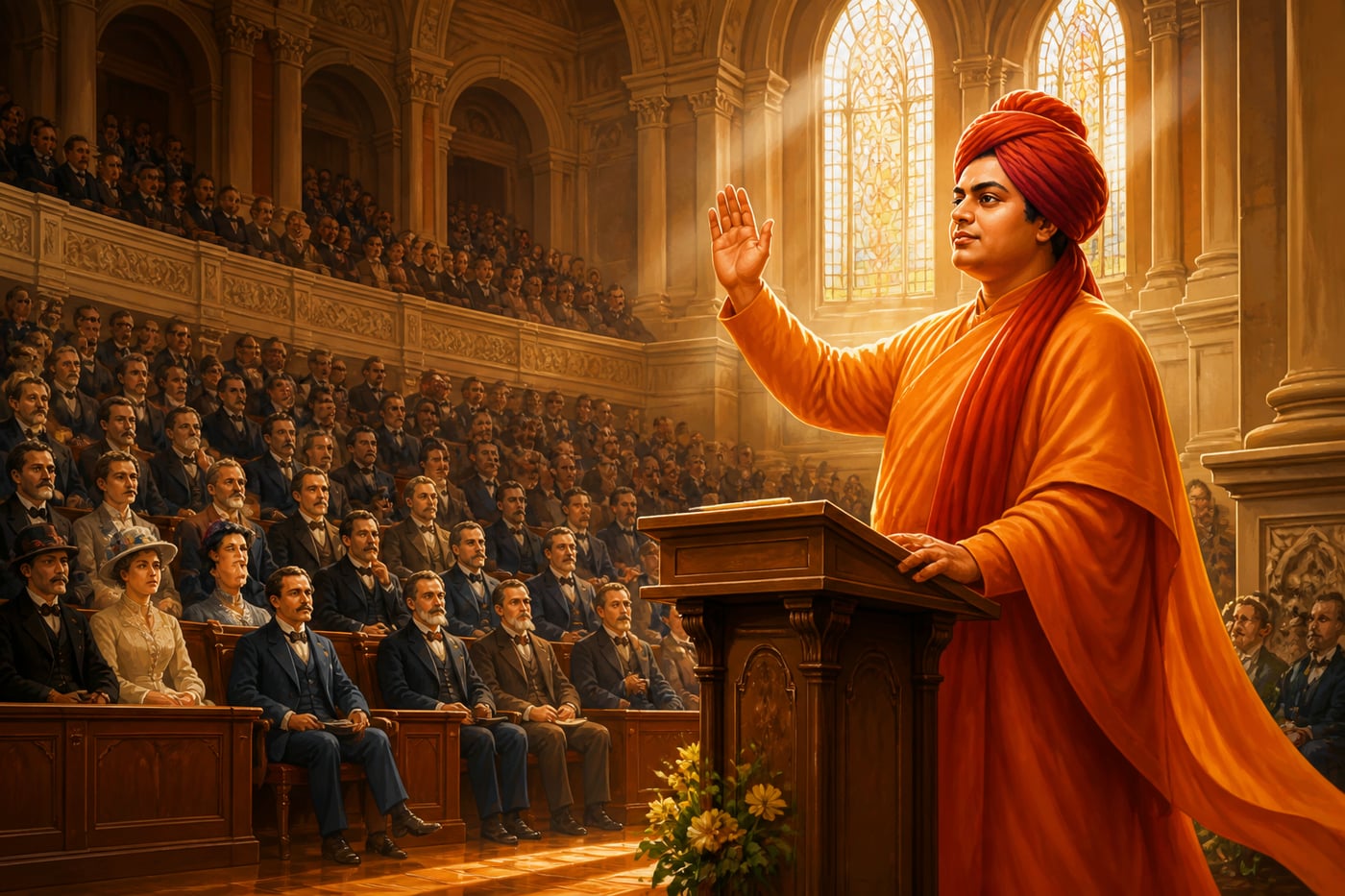
Swami Vivekananda demonstrated the alternative at the 1893 Parliament of Religions in Chicago. He did not arrive seeking Western validation by mimicking Western categories. He spoke from within the Indian tradition with complete civilizational confidence. "The present convention is in itself a vindication of the wonderful doctrine preached in the Gita," he declared. The result was not rejection but respect. The audience recognized authentic authority. Civilizational confidence commands respect; imitation does not.
The critical distinction: Sva-Dharma does not mean rejecting all external knowledge. India has always been a civilization that absorbs, adapts, and integrates. Greek astronomy, Persian administrative techniques, Chinese silk-making. The capacity to learn from others without losing yourself is itself an Indian civilizational strength. The difference is between learning from the world with confidence and hating yourself for not being Western. The first is intellectual openness. The second is colonization.
The Defense: Reclaiming the Civilizational Mind
Decolonizing the mind requires intervention at three levels, because colonization operates at three levels.
Individual: Start with language. Speak your mother tongue without apology in every space, including professional ones. Read one text from your own intellectual tradition for every Western text you consume. Develop the habit of noticing colonial gaze when it operates in you: the reflexive cringe at a "heavy accent," the assumption that a Western source is more credible than an Indian one, the embarrassment at traditional practices. Recognition is the first step. You cannot fight what you cannot see.
Community: Build social prestige around Indian knowledge. Support vernacular-medium education financially and socially. Celebrate scholars, writers, and thinkers who work in Indian languages with the same enthusiasm reserved for those who publish in English. Create communities, online and offline, where civilizational literacy in Indian traditions is valued as a form of sophistication, not dismissed as parochialism.
Institutional: Decolonize the curriculum. This does not mean removing Western knowledge. It means teaching Indian mathematics alongside European mathematics, Indian political philosophy alongside Locke and Hobbes, Indian epistemology alongside Descartes. Fund serious academic research in Indian languages. Create career pathways in law, medicine, engineering, and business that do not penalize vernacular-medium education. The institutional incentive structure must change, or individual and community efforts will always swim against the current.
The colonization of the mind is the deepest wound because the patient does not know they are injured. They mistake their symptoms for sophistication and their disease for progress. The next lesson examines what genuine decolonization looks like: not just political independence, but the liberation of mind, institution, and soul.
Case studies
Macaulay's Minute of 1835: The Blueprint for Psychological Colonization
In February 1835, Thomas Babington Macaulay submitted his Minute on Education to the Governor-General of India. The document declared that 'a single shelf of a good European library was worth the whole native literature of India and Arabia.' Macaulay recommended redirecting all government education funding from indigenous institutions (Sanskrit pathshalas, Arabic madrasas, vernacular schools) to English-language education. The explicit goal: to create 'a class of persons Indian in blood and colour, but English in tastes, opinions, morals and intellect' who would serve as intermediaries between the British rulers and the Indian masses.
The Gita's warning about Para-Dharma maps precisely onto Macaulay's design. He did not merely add English to Indian education. He created a system where performing Para-Dharma (adopting Western cultural frameworks) became the only path to social advancement, employment, and respectability. The Arthashastra would recognize this as Bheda at the deepest level: not dividing communities from each other, but dividing a civilization from itself.
The policy succeeded beyond Macaulay's projections. Within two generations, India's indigenous education infrastructure was largely destroyed. The English-educated class became self-perpetuating, inheriting colonial institutions after 1947 and maintaining the same cultural hierarchies without British enforcement. India achieved political independence but not psychological sovereignty.
Psychological colonization is more durable than military occupation. You can remove an army. Removing a worldview that the colonized have internalized as their own requires recognizing the engineering behind it.
Macaulay's 1835 design is still operational. The English-medium premium, the prestige hierarchy in Indian academia that privileges Western-published scholarship, and the cultural cringe of India's urban elite are direct products of a policy implemented nearly two centuries ago.
Dharampal's research using British survey records showed that the Madras Presidency alone had over 12,000 indigenous schools in the 1820s, with literacy rates in some districts exceeding those of contemporary England. This entire system was defunded and replaced within decades of Macaulay's Minute.
Frantz Fanon and Africa's Mirror: The Global Pattern of Colonized Minds
In 1952, Frantz Fanon, a Black psychiatrist from Martinique trained in France, published 'Black Skin, White Masks.' Drawing on clinical experience treating colonized patients, Fanon described how colonialism produces a specific psychological condition: the colonized person internalizes the colonizer's gaze and begins to see themselves as inferior. He called this 'lactification,' the drive to whiten oneself culturally by adopting the colonizer's language, manners, tastes, and values. Three decades later, Kenyan novelist Ngugi wa Thiong'o extended Fanon's analysis in 'Decolonising the Mind' (1986), arguing that writing in the colonizer's language perpetuates mental colonization regardless of content. He stopped writing in English and composed exclusively in Gikuyu.
Fanon's 'lactification' is a clinical description of Atma-Vanchana (self-deception) as described in dharmic thought. The colonized intellectual genuinely believes their cultural submission is personal growth. The Gita's framework is diagnostic: they have abandoned Sva-Dharma for Para-Dharma and mistaken the resulting alienation for sophistication. Ngugi's response, returning to his mother tongue, is an act of Sva-Dharma reclamation.
Both Fanon and Ngugi demonstrated that psychological colonization is not unique to India but a repeatable colonial technology applied across Africa, the Caribbean, and Asia. Post-independence African nations experienced the same pattern: politically free but culturally governed by colonial hierarchies, with Paris-educated and London-educated elites maintaining European cultural standards from within.
Recognizing that psychological colonization is a global pattern, not an Indian peculiarity, is itself an act of decolonization. It shifts the explanation from 'Indian culture is genuinely inferior' to 'this is a known technology of domination applied to multiple civilizations.'
Fanon's analysis remains clinically relevant. The 'lactification' he described in 1952 Martinique is visible in 2026 India every time an educated Indian feels embarrassment at their own cultural practices while treating Western cultural norms as default sophistication.
When Ngugi wa Thiong'o announced in 1986 that he would write only in Gikuyu, his publisher initially refused to print the work. Today, his Gikuyu novels are translated into dozens of languages, and he is perennially nominated for the Nobel Prize in Literature, proving that civilizational authenticity, not cultural imitation, earns global recognition.
India's English-Medium Premium: Macaulay's Design, Still Running
In 2026, India's private English-medium education sector is one of the largest in the world, with over 400,000 schools charging fees that range from five to ten times those of equivalent vernacular-medium institutions. Parents across economic classes make extraordinary financial sacrifices to place children in English-medium schools, correctly perceiving that vernacular-medium graduates face systemic disadvantage in corporate hiring, social credibility, and professional advancement. A 2019 study by Azim Premji University found that English-speaking Indians earn 34% more than equally qualified Hindi speakers. The premium is not about the language itself but about the social hierarchy it signals.
The English-medium premium is Macaulay's 1835 design functioning exactly as intended, nearly two centuries later. The system does not need British administrators to maintain itself. It is self-perpetuating through market incentives: employers prefer English speakers, so parents invest in English education, which reinforces the prestige hierarchy, which signals to the next generation that vernacular education is inferior. This is Para-Dharma enforced not by colonial decree but by economic incentive, the most durable form of psychological colonization.
India has produced a linguistic hierarchy that correlates strongly with economic class. English fluency functions as a class marker more than a communication tool. Millions of capable Indians are filtered out of professional opportunities not for lack of competence but for lack of fluency in a language foreign to their upbringing. The civilization subsidizes the very hierarchy that diminishes the majority of its people.
The most effective colonial systems are those that no longer need the colonizer to operate. When the colonized population voluntarily maintains the hierarchy through market behavior, the colonization is complete. Reversing it requires changing institutional incentives, not just individual attitudes.
This is not a historical case study. It is the daily reality of hundreds of millions of Indian families making educational decisions shaped by a 190-year-old colonial policy. Every parent choosing English-medium education is rational. The system that makes their choice necessary is not.
A 2019 Azim Premji University study found that English-speaking Indians earn 34% more than equally qualified Hindi speakers in comparable roles. The wage premium for English in India is among the highest language premiums documented anywhere in the world.
Reflection
- Think about your own cultural consumption over the past month: books, films, podcasts, social media. How much of it was rooted in Indian intellectual traditions versus Western ones? When you encounter Indian philosophy or history, do you instinctively evaluate it against Western standards, or do you engage with it on its own terms?
- Does thinking in English change how you relate to Indian concepts? When you encounter a term like Dharma, Rta, or Atman, do you instinctively reach for an English translation, and does something get lost in that translation? Can a person be genuinely multilingual without any language becoming the 'real' one?
- If your critical thinking tools were themselves shaped by colonial education, how do you think your way out of colonization? Is analyzing psychological colonization in English, using Western analytical frameworks like Fanon's, itself an example of the problem it describes?
- Japan's Meiji Restoration (1868) involved rapid Western modernization while retaining Japanese language, Shinto traditions, and cultural pride. India's post-independence elite adopted Western cultural frameworks wholesale. Both nations faced the same Western pressure. Why did Japan's leadership choose selective adoption while India's chose cultural surrender? What structural or psychological factors explain the difference?