Decolonizing Mind, Institution, and Soul
Sva-Rajya Beyond Political Independence
Political independence was only the first layer of decolonization. Through Singapore's strategic decolonization under Lee Kuan Yew, ISRO's proof of institutional sovereignty, and the persistent colonial DNA in India's media, academia, and intellectual frameworks, this lesson maps the three domains of Sva-Rajya: political (achieved), institutional (partial), and epistemological (barely begun). It concludes by revealing how the colonial wound created the fracture lines that new actors now exploit, bridging to the five faultline chapters of Act II.
See It Today: How Singapore Decolonized the Operating System
In August 1965, Singapore was expelled from Malaysia. Lee Kuan Yew wept on national television. The island had no natural resources, no hinterland, no military, and a population divided among Chinese, Malay, Indian, and Eurasian communities shaped by decades of British colonial administration. Every institution on the island ran on British colonial software. By any conventional analysis, this was a city-state destined for dependency or collapse.
By 2024, Singapore has the third-highest GDP per capita in the world, a military that punches far above its weight, and an education system consistently ranked among the top three globally. It achieved this not by rejecting modernity, and not by copying the West wholesale, but through something far more sophisticated: selective adoption without civilizational surrender.

Lee Kuan Yew understood a distinction that most post-colonial leaders missed. There is a difference between a civilization's tools and its operating system. Western science, technology, and economic methods are tools. They can be adopted by any civilization without losing identity. But Western liberalism, Western individualism, and Western definitions of rights, progress, and governance are an operating system. Adopting them means running your civilization on someone else's code.
Singapore adopted the tools ruthlessly. English became the language of business and administration, not because it was culturally superior, but because it was economically necessary and ethnically neutral in a multi-racial society. Western corporate law, financial regulation, and scientific education were imported wholesale. But the operating system remained distinctly non-Western.
Lee rejected Western-style adversarial democracy in favor of communitarian governance, meritocratic hierarchy, family as the foundational social unit, and the state's active role in engineering social outcomes. Singapore's Housing Development Board policy forced ethnic integration in every housing block, rejecting both colonial racial segregation and Western liberal individual choice. The government maintained Confucian ethics education alongside English-medium instruction. Mandatory National Service built shared identity across ethnic lines.
The result was a society that speaks English but thinks Asian. A state that uses Western financial instruments but governs through Confucian-Asian principles. A nation that sends its students to MIT and Oxford but brings them home to serve a civilizational vision that is distinctly Singaporean.
India took the opposite path. India kept the colonial operating system and changed the flag on the desktop. The civil service, the legal codes, the education system, the media ecosystem, and the intellectual frameworks all remained colonial in their deep architecture. Lesson 03_04 diagnosed how this happened: the three layers of psychological colonization that created a self-perpetuating system requiring no British presence to maintain itself. This lesson asks the strategic question: what must India do now?
The Mechanism: The Three Domains of Sva-Rajya
The Sanskrit concept of Sva-Rajya means "self-rule," but its meaning extends far beyond political governance. Sva means "one's own," and Rajya means "kingdom, domain, sovereignty." True Sva-Rajya operates across three domains, each progressively deeper and harder to achieve.
Domain 1: Political Sva-Rajya (Sovereignty over Governance)
This is the most visible layer: democratic self-governance, territorial sovereignty, military independence, diplomatic autonomy. India achieved Political Sva-Rajya on August 15, 1947. The British left. Indians governed Indians. Elections were held. A constitution was written.
Political Sva-Rajya is necessary but wildly insufficient. A nation can govern itself while still thinking in borrowed categories, running borrowed institutions, and measuring itself by borrowed standards. Political independence without institutional and epistemological independence is like owning a house but letting someone else decide the furniture, the rules, and the language spoken inside it.
Domain 2: Institutional Sva-Rajya (Sovereignty over Systems)
This is the structural layer: the design of education systems, legal frameworks, economic models, administrative machinery, and cultural institutions. Institutional Sva-Rajya means that a civilization's systems are designed to serve its own values and civilizational vision, not inherited from a colonial power and left unreformed.
India's record here is mixed. In some domains, institutional decolonization has been remarkably successful. ISRO built a world-class space program from scratch after being denied cryogenic engine technology, proving that India can create sovereign institutions when it commits to doing so. The UPI digital payments system leapfrogged Western financial infrastructure. India's pharmaceutical industry became the "pharmacy of the world" through indigenous capability building.
But in other domains, colonial institutional DNA persists almost untouched. The Indian Administrative Service still mirrors the structure and culture of the colonial Indian Civil Service, designed to administer subjects rather than serve citizens. Until 2023, India's criminal law operated on codes written by the British in the 1860s. The Hindu Religious and Charitable Endowments Acts, originally colonial instruments for controlling temple wealth, remain in force, giving state governments authority over Hindu religious institutions while other religious institutions operate autonomously.
Domain 3: Epistemological Sva-Rajya (Sovereignty over Mind and Narrative)
This is the deepest layer, and the least decolonized. Epistemological Sva-Rajya means that a civilization understands itself through its own categories, tells its own story through its own frameworks, and evaluates its own worth by its own standards.
India's epistemological colonization runs deep. Indian history is still widely periodized as "Hindu Period, Muslim Period, British Period," a framework that reduces civilizational continuity to a sequence of rulers defined by religion. Indian social reality is analyzed through Western social science categories: "caste" (a Portuguese word) replaces the far more complex indigenous categories of jati and varna. "Religion" (a category rooted in Abrahamic monotheism) is applied to dharmic traditions that do not fit it. "Secularism" (a concept born from European church-state conflicts) is treated as the only legitimate framework for managing India's spiritual diversity.
The deepest wound is this: many educated Indians have internalized these external categories so completely that they no longer recognize them as imports. The colonial framework has become invisible precisely because it has become the default lens. This is what Para-Tantra looks like at civilizational scale: a civilization running on another civilization's intellectual software without realizing it.
The Pattern: India's Decolonization Audit
Seventy-nine years after political independence, India's decolonization can be mapped across three categories: what has been decolonized, what remains colonized, and what is being re-colonized by new actors through modern mechanisms.
What Has Been Decolonized
Political sovereignty is secure. India governs itself through democratic institutions, maintains an independent foreign policy, and commands one of the world's largest militaries.
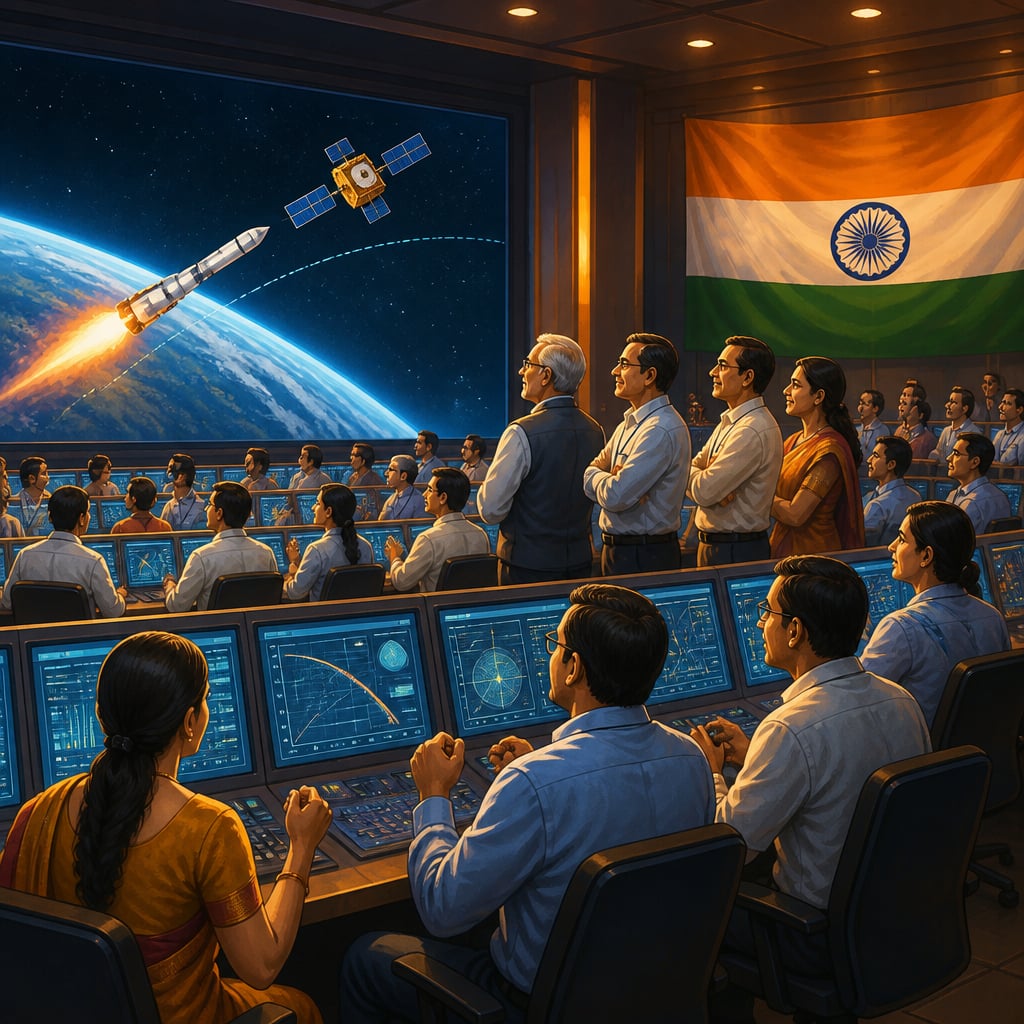
Selective institutional sovereignty has been achieved where India committed to indigenous capability building. ISRO's Chandrayaan-3 successfully landed on the Moon's south pole in 2023. India's UPI processes over 12 billion transactions monthly. The indigenous Tejas fighter aircraft and INS Vikrant aircraft carrier demonstrate growing defense self-reliance. The 2023 replacement of colonial-era IPC, CrPC, and Evidence Act with the Bharatiya Nyaya Sanhita, Bharatiya Nagarik Suraksha Sanhita, and Bharatiya Sakshya Adhiniyam marks the first comprehensive overhaul of India's criminal justice framework since 1860.
The pattern is clear. Where India chose Sva-Tantra, it succeeded spectacularly. Where it defaulted to Para-Tantra, colonial structures persisted.
What Remains Colonized
India's English-language media and intellectual class operates as a Para-Tantra ecosystem with remarkable structural completeness. The most influential policy debates, the most prestigious academic appointments, and the highest-profile cultural commentary all occur in English, within Western analytical frameworks, for an audience that measures Indian reality against Western benchmarks. Vernacular media reaches vastly larger audiences. Hindi news alone reaches roughly ten times the audience of English news. But English-language media carries disproportionate institutional prestige and policy influence.
This is not a complaint about a language. English is a tool, and India has every reason to use it strategically, as Singapore does. The issue is the total ecosystem: when the language of elite discourse also carries the categories, assumptions, and evaluative frameworks of a foreign civilization, and when this combination is treated as the only legitimate form of intellectual expression, the result is a permanent epistemological dependency. Indian concepts are routinely filtered through Western categories before they are taken seriously. Dharma becomes "religion." Jati becomes "caste." Artha becomes "economics." Each translation flattens a nuanced indigenous concept into a Western category that distorts it.
What Is Being Re-Colonized
The most alarming category is re-colonization: domains where new actors extend colonial-era frameworks through modern mechanisms.
Western universities and their global networks continue to define how Indian civilization is understood worldwide. "South Asian Studies" departments frame India primarily through categories of caste oppression, religious communalism, and democratic backsliding. Scholars who approach Indian civilization through dharmic intellectual frameworks are routinely dismissed as "biased," while scholars who use Western theoretical lenses are treated as "objective" and "academic." This is not a conspiracy. It is a structural asymmetry built into the global knowledge production system, and it directly continues the colonial project of defining India from the outside.
This academic apparatus will be examined in full detail in Chapter 4, which traces how Western Indology became a civilizational weapon. But the key insight for this lesson is that re-colonization does not require armies, trade companies, or political control. It requires only control over the categories through which a civilization understands itself.
Dharmic Wisdom: Sva-Tantra and the Architecture of True Freedom
The Arthashastra makes a critical distinction between two types of states: Sva-Tantra (self-governing, operating on its own system) and Para-Tantra (other-governed, operating within another's system). Kautilya treats Para-Tantra as a condition to be escaped at all costs, because a state that operates within another's framework serves another's purposes even when it believes it is serving its own.
Applied to India's post-colonial condition, the Para-Tantra diagnosis is precise. India is politically Sva-Tantra but epistemologically Para-Tantra. It governs itself but understands itself through borrowed categories. It elects its own leaders but educates its children through a borrowed intellectual framework. It defends its borders but leaves its civilizational narrative in the hands of external interpreters.
The Ishavasya Upanishad opens with a teaching that illuminates the path between two dangers. "Ishavasyam idam sarvam" declares that all reality is pervaded by the sacred. No civilization has a monopoly on truth. Then comes the injunction: "tena tyaktena bhunjithah, ma gridhah kasya svid dhanam." Enjoy the world through the spirit of detachment. Do not covet the wealth of another.
This is not isolationism. It is the philosophical foundation of Singapore's approach. Use the tools of the world. Adopt what is genuinely useful: English, Western technology, modern financial instruments. But do not covet another civilization's intellectual operating system, thinking it superior to your own. "Ma gridhah" is a warning against the civilizational covetousness that makes a nation abandon its own intellectual traditions because another's appear more prestigious. A civilization that covets Western epistemological categories while neglecting its own Pramana-shastra, its own Nyaya logic, its own Arthashastra governance, is in a state of gridhah: covetous clinging to what belongs to another while what it already possesses atrophies from neglect.
The Mundaka Upanishad deepens this further with its distinction between Apara Vidya (lower knowledge, instrumental and technical) and Para Vidya (higher knowledge, liberating and transformative). Replacing Western textbooks with Indian textbooks is Apara-level reform. Building Indian institutions that generate original knowledge from within Indian epistemological frameworks is Para-level decolonization. ISRO achieved this in engineering: it did not copy Western rocket designs with Indian labels. It solved Indian problems through Indian engineering culture, producing original solutions that outperformed Western equivalents at a fraction of the cost. The challenge is to achieve the same Para Vidya transformation in the humanities, social sciences, and public discourse.
The Defense: Completing the Decolonization
Lesson 03_04 identified the wound. This lesson maps the roadmap. Completing India's decolonization requires the ISRO model applied across all three domains.
The ISRO Principle: Sovereignty Through Capability

ISRO's success was not an accident. It followed a precise pattern that can be replicated. First, acknowledge the dependency: India was dependent on foreign technology for space launch capabilities. Second, commit to building indigenous capability rather than negotiating for imported solutions. Third, invest the decades of sustained effort required to build world-class indigenous institutions. Fourth, demonstrate results that prove indigenous capability can match or exceed imported alternatives. Mangalyaan reached Mars for $74 million. NASA's comparable MAVEN mission cost $671 million. The argument for Sva-Tantra was won not by rhetoric but by results.
This principle must now be applied to the domains where India remains Para-Tantra. Education needs its own ISRO moment: not incremental reform of the colonial curriculum, but a ground-up reimagining of what Indian education looks like when designed from Indian civilizational principles. The humanities and social sciences need their own Mangalyaan: institutions that study Indian civilization through Indian frameworks and produce scholarship so rigorous that the world takes notice.
Institutional Decolonization: Redesign, Don't Just Rename
India's 2023 criminal law reform (BNS, BNSS, BSA replacing IPC, CrPC, Evidence Act) offers a template. After 163 years, India did not simply amend colonial codes. It replaced them with new codes conceived in Indian terminology and adapted to Indian realities. This model, replace rather than patch, must extend to education policy, administrative structures, and knowledge institutions.
The critical error to avoid is cosmetic decolonization: changing names without changing operating logic. Renaming a colonial institution does not decolonize it if the institutional culture, decision-making frameworks, and evaluation metrics remain colonial. Singapore's success came precisely because Lee Kuan Yew redesigned institutional logic, not just institutional labels.
Epistemological Decolonization: Build, Don't Just Critique
The greatest risk in decolonization discourse is getting trapped in permanent critique without building alternatives. Identifying colonial frameworks is necessary but insufficient. India must build world-class institutions for studying Indian civilization through Indian intellectual frameworks. This means Indology departments at Indian universities that rival anything at Oxford or Chicago, staffed by scholars as fluent in Paninian grammar as they are in Western linguistics, as conversant with Nyaya logic as with analytic philosophy. The goal is not to reject Western scholarship but to ensure that the primary voice in India's civilizational conversation is Indian.
Personal Decolonization: Pratyabhijna
Decolonization at the individual level is an act of Pratyabhijna: self-recognition. It is not about acquiring new knowledge. It is about re-recognizing the civilizational depth that was always present but was obscured by colonial education. When Dharampal's research revealed that pre-colonial India had sophisticated education networks, advanced metallurgy, and agricultural systems that outperformed European contemporaries, he did not create new information. He recovered what colonial narratives had buried. Every individual's decolonization follows the same pattern: not learning to be Indian, but remembering.
Bridge to Act II: The Wound That Will Not Close
Chapter 3 has traced the colonial wound from its first incisions through the rewriting of history, the seeding of divisions, the colonization of the Indian mind, and now the unfinished work of decolonization.
But this is not merely a historical autopsy. The colonial wound matters today because it created the fracture lines that external actors continue to exploit. The British may have left India in 1947. But the fractures they created, and in some cases deliberately engineered, remain open. New actors are working to keep them open, to widen them, and to use them as instruments of civilizational fragmentation.
Who are these actors? What tools do they use? How do they transform colonial-era fractures into modern weapons?
That is the story of the next five chapters.
Chapter 4 examines how Western Indology became a civilizational weapon, how academic institutions construct narratives that undermine Indian civilizational confidence, and how the epistemological colonization described in this lesson is being actively maintained through institutional power.
Chapter 5 traces how racial and ethnic faultlines, many of them colonial constructions, are being exploited to fragment Indian identity from the outside.
Chapter 6 investigates the machinery of religious conversion and how it targets vulnerable communities along the very fracture lines that colonialism created.
Chapter 7 dissects the engineering of the caste faultline: how an indigenous system of social organization was rigidified by colonial census, weaponized by colonial politics, and is now being internationalized as a tool of civilizational pressure.
Chapter 8 examines regional separatism and sub-national identity movements, the ultimate expression of civilizational fragmentation.
The colonial wound created the fracture lines. Now we examine who is keeping them open, and how.
Case studies
ISRO: India's Space Program as Institutional Sva-Tantra
In 1963, Vikram Sarabhai founded the Indian Space Research Organisation with a vision: India must develop its own space capabilities rather than remain a permanent consumer of Western technology. The early years were defined by extreme frugality and improvisation. Rocket components were transported on bicycles and assembled in a church in Thumba, Kerala. The real test came in 1993, when the United States pressured Russia to cancel a deal to transfer cryogenic engine technology to India. Rather than seeking alternative foreign suppliers, ISRO committed to building its own cryogenic engines from first principles. The project took nearly two decades. By 2014, ISRO placed the Mars Orbiter Mission (Mangalyaan) into Martian orbit on its first attempt, at a cost of $74 million. NASA's comparable MAVEN mission, launched the same year, cost $671 million.
ISRO exemplifies Sva-Tantra in its deepest sense: building your own system from your own foundations. When denied access to foreign technology, ISRO did not accept permanent dependency. It chose the harder path of indigenous capability building. The Arthashastra would recognize this as the correct response to a Para-Tantra condition: rather than negotiating better terms of dependency, build the capacity to be self-governing. The frugality was not a limitation but a feature. ISRO's engineering culture, shaped by Indian constraints, produced solutions that outperformed wealthier alternatives.
ISRO became one of the world's leading space agencies, successfully landing Chandrayaan-3 on the Moon's south pole in 2023, building a commercial launch business, and developing indigenous satellite navigation (NavIC). India went from a technology-denied nation to a technology-exporting one in the space domain.
Institutional decolonization succeeds when a nation commits to building indigenous capability rather than negotiating for imported solutions. The key is the decision point: when faced with external denial or dependency, do you seek a different external source, or do you build your own? ISRO chose to build. That choice, repeated across other domains, is the ISRO Principle.
ISRO's model is the template for decolonizing every domain where India remains Para-Tantra. Education, social sciences, humanities, media, and governance can all follow the same pattern: acknowledge the dependency, commit to indigenous capability, invest sustained effort, and demonstrate results that silence skeptics.
ISRO's Mangalyaan cost $74 million, less than the $100 million production budget of the Hollywood film 'Gravity.' India reached Mars for less than the cost of a movie about space, on its first attempt, a feat neither NASA nor the Soviet program achieved with their inaugural Mars missions.
India's English-Language Intelligentsia: The Para-Tantra Ecosystem
India's English-language media ecosystem, comprising newspapers, news channels, magazines, and digital platforms, reaches a relatively small fraction of India's population compared to vernacular media. Hindi news alone reaches roughly ten times the audience of English news. Yet English-language media carries disproportionate influence over policy debates, international perception, corporate decision-making, and the self-image of India's urban professional class. This ecosystem operates within Western analytical categories with remarkable consistency. Indian social phenomena are analyzed through frameworks developed in Western academia. Success is measured against Western benchmarks. India's civilizational categories are either absent from elite discourse or present only as translated approximations that flatten their meaning.
This is Para-Tantra at the level of civilizational narrative. The issue is not the English language itself, which India has every reason to use as a strategic tool. The issue is that the language carries an entire epistemological framework: categories of analysis, standards of evaluation, and assumptions about what constitutes 'progress' and 'modernity.' When this framework becomes the only legitimate mode of intellectual expression, the civilization loses the ability to think about itself in its own terms. Singapore uses English without epistemological surrender because it consciously maintains Asian philosophical frameworks alongside English-medium instruction. India's English-language ecosystem has no equivalent counterweight.
The result is a two-tier intellectual culture. India's English-language elite produces sophisticated analysis of Indian reality using borrowed categories. India's vernacular intellectual traditions carry indigenous categories but lack institutional prestige. Scholars, journalists, and commentators who operate from Dharmic frameworks are categorized as 'biased' or 'communal,' while those who operate from Western frameworks are treated as 'objective' and 'professional.'
Using a foreign language is not colonization. Using a foreign language as the exclusive carrier of a foreign epistemological framework, while marginalizing indigenous frameworks, is. The distinction between Singapore's model (strategic bilingualism with civilizational sovereignty) and India's model (English-medium epistemological dependency) is the difference between Sva-Tantra and Para-Tantra.
Every time an Indian intellectual uses the word 'caste' instead of distinguishing between Varna and Jati, the word 'religion' instead of 'Dharma,' or the word 'myth' instead of 'Itihasa,' the colonial translation framework is reinforced. These are not neutral word choices. Each substitution imports a Western category that distorts the Indian concept it replaces.
India has 22 officially scheduled languages, each carrying intellectual traditions spanning centuries or millennia. Yet over 90% of Indian academic research is published in English, and the most influential policy think tanks, media outlets, and universities operate primarily in English within Western analytical frameworks.
Academic Neo-Colonization: The Re-Colonized Narrative
The most prestigious global interpretations of Indian civilization are produced not in India but in Western universities. 'South Asian Studies' departments at major American and European universities employ scholars trained primarily in Western theoretical traditions (postcolonial theory, subaltern studies, Marxist analysis, critical theory) to produce authoritative interpretations of Indian history, society, religion, and politics. These interpretations frame India primarily through categories of caste oppression, religious communalism, gender inequality, and democratic fragility. Scholars who approach Indian civilization through indigenous intellectual frameworks (Nyaya epistemology, Mimamsa hermeneutics, Arthashastra political theory) are routinely marginalized as 'ideological' or 'Hindu nationalist,' while scholars using Western theoretical frameworks are treated as maintaining 'academic objectivity.'
This is epistemic colonization maintained through institutional power rather than political power. The colonial project did not merely conquer Indian territory. It conquered the right to define what India means, how Indian civilization should be understood, and which frameworks are legitimate for studying it. That right was exercised from London and Oxford during colonial rule. Today it is exercised from Chicago, Harvard, and Columbia. The institutional location changed. The structural relationship, external authority defining internal reality, did not.
The global narrative about India is shaped by scholars whose intellectual formation occurred within Western theoretical traditions. This narrative feeds back into Indian media, policy debates, and educational curricula through international partnerships, foreign-funded research, and the prestige hierarchy that privileges Western-published scholarship. Indian scholars who wish to gain global recognition must publish in Western journals, use Western theoretical frameworks, and submit to Western peer review standards. The result is a knowledge production system that structurally disadvantages indigenous Indian perspectives on Indian civilization.
Epistemological colonization does not require political control. It requires only institutional control over the categories through which a civilization understands itself. When the most authoritative interpretations of your civilization are produced outside it, by scholars trained in non-indigenous frameworks, and when these interpretations shape your own educational and media systems, the colonial circuit is complete regardless of political independence.
This machinery is examined in comprehensive detail in Chapter 4, which traces how Western Indology became a civilizational weapon. The bridge from this lesson to the next chapter is direct: the colonial wound described in Chapter 3 created the fracture lines, and the academic apparatus described here is one of the primary mechanisms keeping those fracture lines open and widening them.
A survey of South Asian Studies departments at top US universities reveals that the vast majority of faculty received their doctoral training within Western theoretical traditions. The number of tenured faculty at these institutions who are trained in classical Indian intellectual traditions (Sanskrit, Nyaya, Mimamsa, Arthashastra) and use them as primary analytical frameworks is vanishingly small by comparison.
Reflection
- Consider the three domains of decolonization from this lesson: political, institutional, and epistemological. In your own life, which domain remains most colonized? Look at the language you think in, the metrics you use to judge success, the experts you instinctively trust, and the knowledge systems you turn to in a crisis. Where does your deepest Para-Tantra actually live?
- ISRO represents successful institutional decolonization, while much of Indian academia remains epistemologically colonized. What makes the difference? Is it simply political will, or is there something about scientific institutions that makes them easier to decolonize than humanities and social sciences? If so, what does that tell us about where the colonial wound cuts deepest?
- This lesson argues that political independence without epistemological sovereignty is incomplete. But the reverse question is equally important: is it possible to achieve genuine epistemological sovereignty while participating in a global knowledge economy built on Western institutional structures, peer review systems, university models, and publication norms? Or does true Sva-Tantra require building entirely parallel knowledge institutions from scratch?