Seeds of Division & Institutional Deformation
Census Rigidification, Separate Electorates, and Colonial Institutional DNA
The British did not merely rule India. They rebuilt it from the inside out. The census froze fluid jati into rigid racial caste. Separate electorates made unity structurally impossible. The Criminal Tribes Act branded 13 million people criminal by birth. Colonial law, bureaucracy, and education were designed for control, not service. Temples were seized, villages stripped of self-governance, and artisan economies destroyed. This lesson traces how these seeds of division were planted and why many of them are still growing.
The Counting Machine: Census and the Rigidification of Caste
Before the British arrived, Indian society organized itself through jati: thousands of local, occupational, and kinship-based communities that varied enormously by region. A weaver's jati in Bengal operated differently from a weaver's jati in Gujarat. Boundaries were porous. A family could shift occupations over generations. Individuals of extraordinary ability could transcend their birth circumstances entirely. Valmiki, the author of the Ramayana, was born into a hunter community. Chandragupta Maurya rose from obscurity to build an empire. Shivaji Maharaj's Bhonsle clan defied every rigid classification.
The British needed something simpler. An empire cannot administer complexity. It needs categories.
Starting with the first systematic census in 1871, colonial administrators began the project of classifying India's population into fixed, hierarchical groups. The census did not merely record social reality. It created a new one. Census commissioners demanded that every Indian fit into a clearly defined "caste" with a fixed rank. Communities that had never thought of themselves in relation to a hierarchy spanning all of India were suddenly forced to compete for position in a colonial ranking system.
The architect of this transformation was Herbert Hope Risley, Census Commissioner for the 1901 census. Risley was a devoted follower of European racial science. He believed that Indian social groups were fundamentally racial categories, and he set out to prove it. His method was anthropometry: measuring skulls, recording nasal indices (the ratio of nose width to nose length), and classifying communities along a racial spectrum from "Aryan" to "Dravidian."
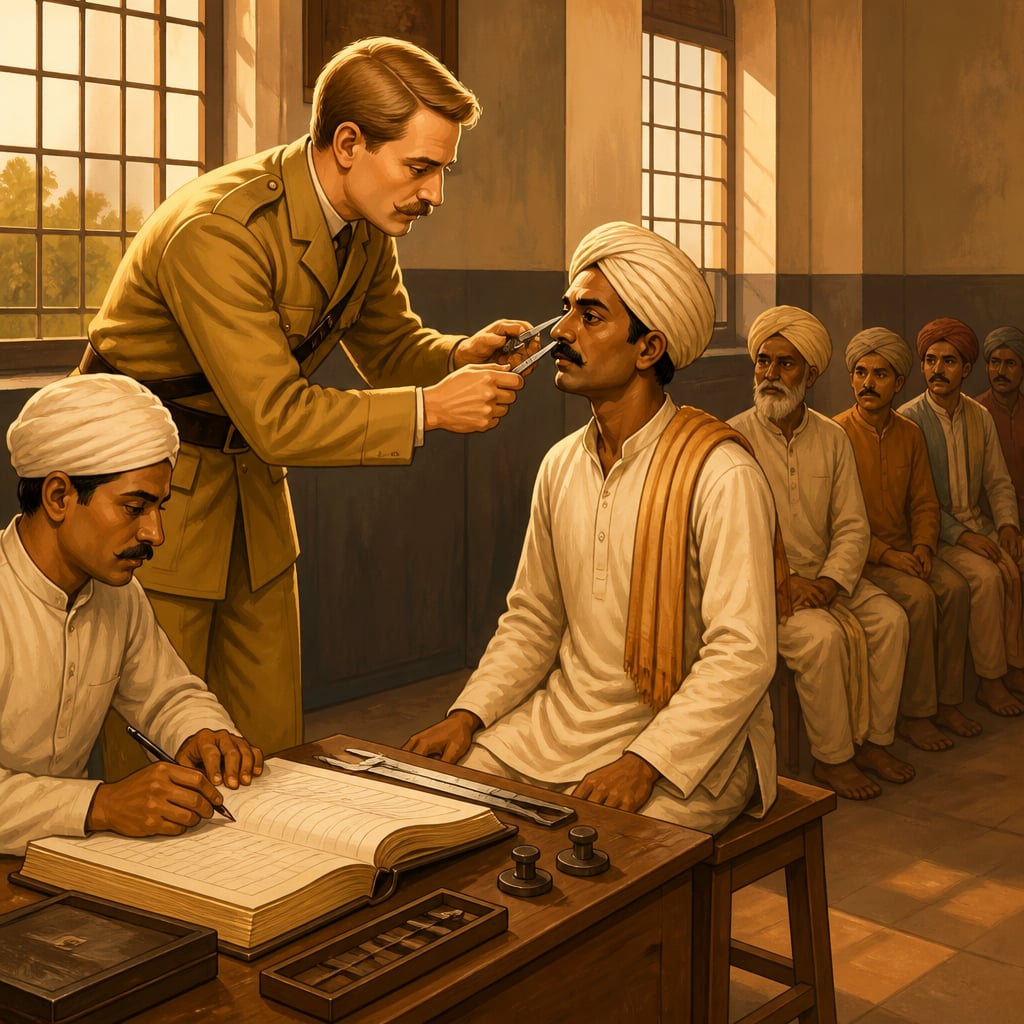
Risley's 1901 census classified 2,378 castes and tribes into a rigid hierarchy based on these measurements. Communities that had coexisted for centuries were now ranked against each other by a colonial bureaucrat wielding a pair of calipers and discredited racial theory. The nasal index has no scientific validity whatsoever. But it had administrative power. Once embedded in census records, legal documents, and government policy, these classifications became social facts.
The census triggered exactly what it claimed to merely observe. Communities that had never organized politically around caste identity began doing so, because the census made caste the primary currency of colonial administration. If your community was classified higher, you got better access to education, government positions, and legal protections. Petitions flooded census offices from communities demanding reclassification upward. Caste associations formed for the first time, not to preserve tradition, but to lobby for better census positioning.
The British did not invent jati. But they performed a lethal transformation: they took a fluid, local, context-dependent social system and froze it into a rigid, pan-Indian, racial hierarchy. The living organism became a fossil. And the fossil became a weapon.
The Bengal Laboratory: Partition as a Template for Communal Mobilization
Before the British institutionalized communal division in law, they tested it through administration. The laboratory was Bengal, and the experiment was Partition.
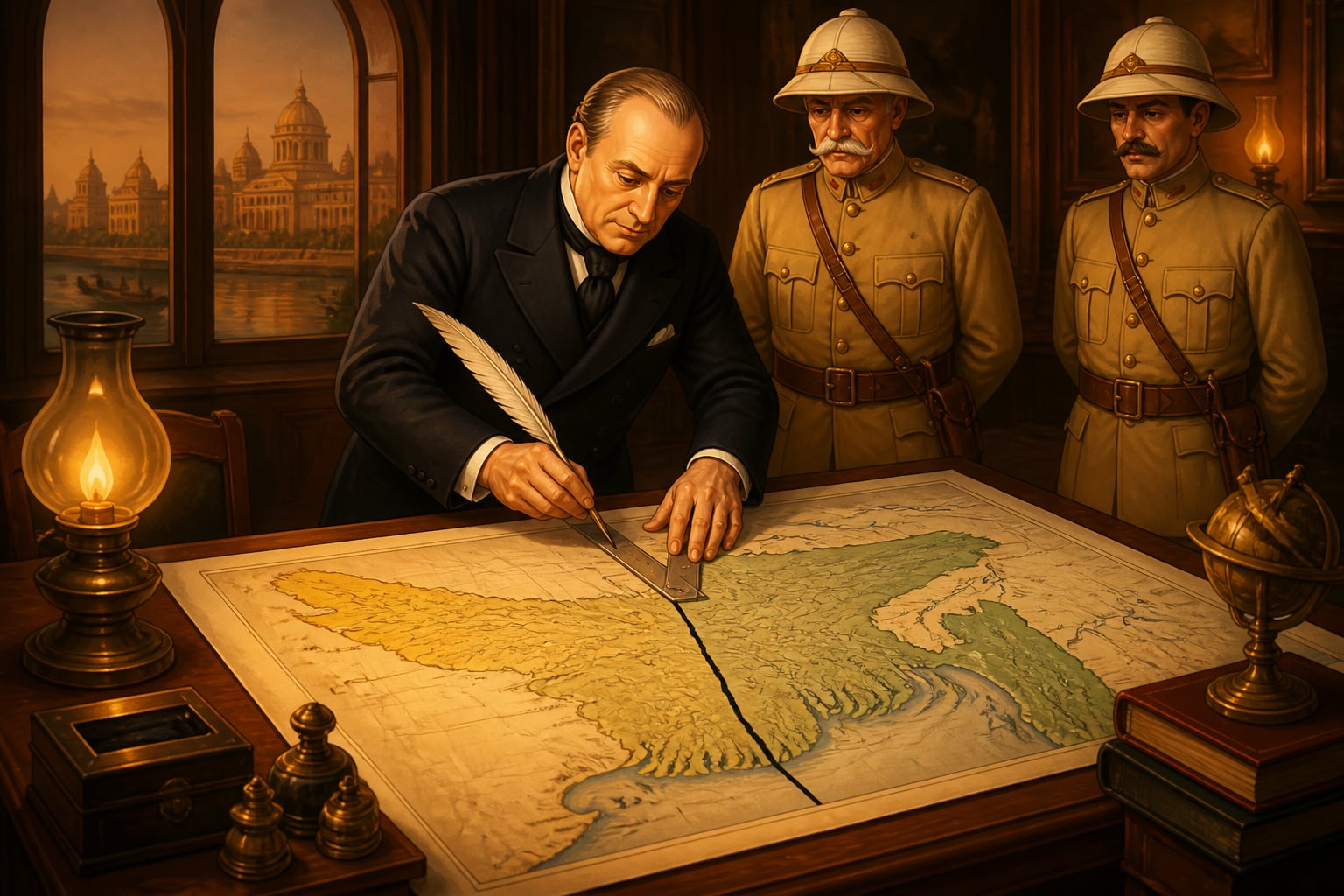
In 1905, Viceroy Lord Curzon announced the partition of Bengal, then the largest and most politically active province in British India. The stated justification was administrative efficiency: Bengal was too large to govern as a single unit. The actual logic was surgical. The new province of Eastern Bengal and Assam was carved out with a Muslim majority. Western Bengal, Bihar, and Orissa retained a Hindu majority. A province where Hindu and Muslim Bengalis had built shared literary, commercial, and political traditions was split along religious lines by administrative fiat.
Curzon was explicit in private correspondence about his intentions. He described the Bengali intelligentsia as a 'nest of vipers' whose political agitation threatened British control. Partition would divide the educated Hindu elite of Calcutta from the Muslim peasantry of eastern Bengal, preventing them from ever forming a unified political bloc. The administrative boundary would become a communal boundary, and the communal boundary would become a political reality.
The experiment worked exactly as designed. The Swadeshi movement that erupted in response to Partition initially united Hindus and Muslims in shared outrage. But the British quickly moved to exploit the new fault line. Colonial officials encouraged the formation of the Muslim League in 1906, providing a communal political vehicle that had not existed before Partition created the conditions for it. The Nawab of Dhaka, Khwaja Salimullah, whose estates depended on British goodwill, became its first president. Within months, the cross-community solidarity of Swadeshi began fracturing along the very lines Curzon had drawn.
The Bengal Partition was reversed in 1911. But the reversal taught the British something more valuable than the Partition itself: administrative division was temporary and reversible. What they needed was structural division, embedded in constitutional law, that no future agitation could undo. The answer came four years after Partition, in 1909.
The Architecture of Division: Separate Electorates and Martial Race Theory
Census classification and the Bengal experiment were preliminary steps. The British then embedded communal identity into constitutional structures designed to make unity permanently impossible.
The bridge between Bengal 1905 and the Morley-Minto reforms of 1909 was the Simla Deputation of 1906. A delegation of 35 Muslim leaders, led by the Aga Khan, traveled to Simla to petition Viceroy Minto for separate electorates. The petition was presented as a spontaneous expression of Muslim political aspiration. The reality was more choreographed. W.A.J. Archbold, Minto's own principal of the Anglo-Oriental College at Aligarh, had helped draft the memorandum. The British were authoring the demand and then graciously agreeing to it. Lady Minto recorded in her diary that the deputation was 'a work of statesmanship that will affect India and Indian history for many a long year.' She was right, though not in the way she intended.
The Morley-Minto reforms (Indian Councils Act of 1909) introduced separate electorates for Muslims. Under this system, Muslim voters could only vote for Muslim candidates, and Hindu voters could only vote for Hindu candidates. The political logic was devastating: no politician ever needed to build cross-community coalitions. Electoral success came from mobilizing your own community, which meant emphasizing difference, grievance, and threat from the other side. Every election became, in effect, a religious census.
As Sanjay Dixit has analyzed, separate electorates did not reflect pre-existing political division. They manufactured it. Before 1909, Indian political movements like the early Congress had Hindu and Muslim leaders working together. Separate electorates made such cooperation structurally unnecessary and politically disadvantageous. Why appeal to voters across religious lines when your electorate is guaranteed to be only your own community? The structural incentive was to out-communalize your rivals within your own community, not to build bridges across communities.
The architecture built itself outward from 1909 with mechanical inevitability. The Lucknow Pact of 1916, intended as Hindu-Muslim cooperation, actually conceded the principle of separate electorates and gave Muslims weightage beyond their population share. The principle, once conceded, could only expand. The Government of India Act 1919 extended separate electorates further. The Simon Commission (1928) and the Round Table Conferences (1930-32) debated how much communal representation to entrench, never whether to dismantle it.
The system expanded. The Communal Award of 1932 proposed extending separate electorates to Depressed Classes (what the British classified as "untouchables"). Gandhi recognized this for what it was: the further fragmentation of Hindu society into permanently separate political blocs. He undertook a fast unto death against it, leading to the Poona Pact, a compromise that preserved joint electorates with reserved seats instead.
Alongside political division, the British engineered military division through the Martial Race Theory. After the 1857 uprising shocked the colonial administration, they needed to ensure that Indian soldiers could never unite against British rule again. The solution was classification. Certain communities (Sikhs, Gurkhas, Pathans, Rajputs, Dogras) were labeled "martial races," inherently suited for military service. Others were labeled "non-martial," unfit for soldiering.
The theory had no scientific basis. Communities that had fought ferociously against the British in 1857, like the Awadhi sepoys, were conveniently reclassified as "non-martial." Communities from regions where the British faced less resistance were classified as "martial." The real criterion was loyalty to the Empire, repackaged as racial biology.
The result was a military deliberately constructed to prevent pan-Indian solidarity. Regiments were organized by community, stationed far from home, and trained to see other Indian communities as fundamentally different. The British Indian Army that fought in two World Wars was an extraordinary fighting force. It was also an extraordinary machine of internal division.
Criminal by Birth: The Criminal Tribes Act
In 1871, the British colonial government passed the Criminal Tribes Act, one of the most extraordinary pieces of legislation in modern history. It designated entire communities as "born criminals." Not individuals who had committed crimes. Entire jatis, classified as genetically predisposed to criminal behavior.
The intellectual framework came from Europe. Victorian criminologists like Cesare Lombroso had theorized that criminality was hereditary, identifiable through physical characteristics. The British applied this pseudo-science to India with particular enthusiasm. Nomadic communities, forest-dwelling groups, and itinerant traders were primary targets. The Pardhis, Sansis, Banjaras, Kanjars, and over 120 other communities were registered under the Act.
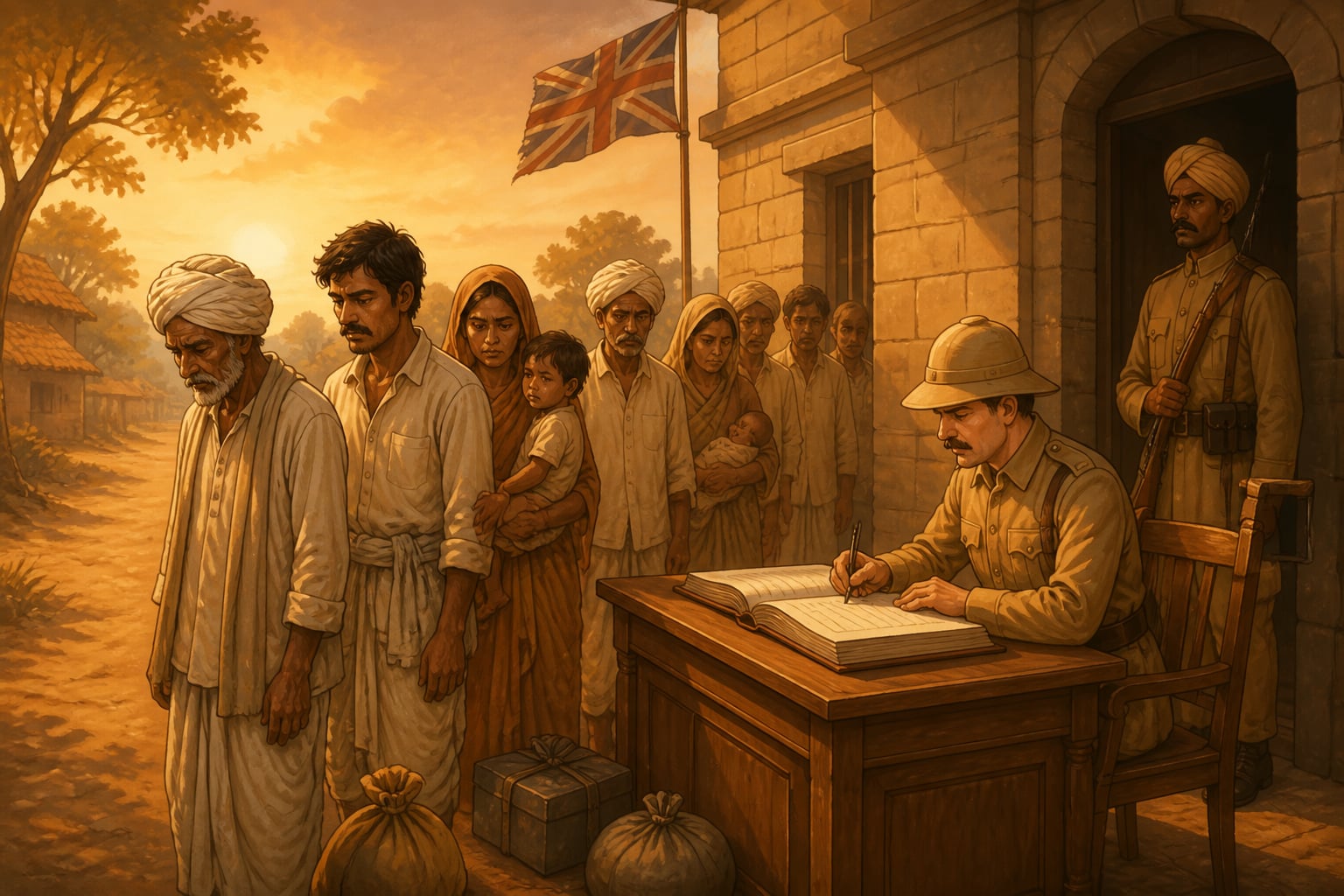
Registration meant surveillance, restricted movement, mandatory reporting to the police, and forced settlement in designated areas. Registered community members, including children, were fingerprinted and required to report their whereabouts at regular intervals. Failure to comply meant imprisonment. An entire population was placed under a system closer to supervised detention than civil governance.
The scale was staggering. By the time of independence, over 13 million Indians across 127 communities were classified as Criminal Tribes. Thirteen million people branded criminal not for anything they did, but for who they were born as.
The Criminal Tribes Act was repealed in 1952, and the designated communities were "denotified." But the stigma did not evaporate with the legislation. Many states replaced the Criminal Tribes Act with Habitual Offenders Acts that continued to target the same communities under different legal language. Police profiling of Denotified Tribes (DNT) communities continues to this day. The colonial label created a social reality that has outlived both the colonizer and the law.
Institutional Deformation: Colonial DNA in Indian Systems
The census, separate electorates, martial race theory, and Criminal Tribes Act were tools of social engineering. But the British also rebuilt India's institutional architecture from the ground up, replacing indigenous systems with colonial ones designed for extraction and control.
The Legal System. In 1860, Thomas Babington Macaulay drafted the Indian Penal Code (IPC), which became the foundation of Indian criminal law. The IPC was not designed for justice. It was designed for control. Section 124A (sedition) was written specifically to criminalize Indian resistance to British rule. Bal Gangadhar Tilak was prosecuted under it for his writings. The IPC remained India's criminal law framework for 163 years after it was drafted and 76 years after independence. It was only replaced by the Bharatiya Nyaya Sanhita (BNS) in 2023. Britain itself had long since reformed many of the laws it imposed on India.
The Bureaucratic System. The Indian Civil Service (ICS), predecessor of today's IAS, was designed as a mechanism for colonial governance, not public service. Its fundamental orientation was top-down control: extracting revenue, maintaining order, and implementing policy dictated from London. The steel frame of the British Raj became the steel frame of independent India, with its structural DNA largely intact. The relationship between bureaucrat and citizen still carries echoes of the relationship between colonial administrator and subject.
The Education System. Macaulay's 1835 Minute on Education explicitly aimed to create "a class of persons Indian in blood and colour, but English in tastes, in opinions, in morals and in intellect." The traditional education system, which Dharampal's research showed was remarkably widespread and effective, was systematically dismantled. In its place came an English-medium system designed to produce clerks for colonial administration, not thinkers for civilizational renewal.
The Temple Seizure: Controlling the Civilizational Heartbeat
Of all colonial institutional interventions, the seizure of Hindu temples may have had the deepest civilizational impact.
Hindu temples were never merely places of worship. They were the institutional heart of Indian civilization. A major temple was simultaneously a spiritual center, an educational institution (running schools and supporting scholars), an economic engine (managing lands, employing thousands, funding public welfare), a cultural hub (patronizing music, dance, sculpture, and literature), and a community gathering point. To control the temple was to control the community's spiritual, economic, educational, and cultural life in a single stroke.
The British recognized this. The Madras Hindu Religious and Charitable Endowments Act (1925-27) gave the colonial government direct administrative control over Hindu temples, their lands, and their revenues. The stated justification was preventing "mismanagement." The actual effect was severing Hindu communities from the institutional infrastructure that had sustained civilizational life for centuries.
The most remarkable aspect of this story is what happened after independence. The colonial temple control framework was not dismantled. It was expanded. State governments across India retained and strengthened control over Hindu temples through HR&CE (Hindu Religious and Charitable Endowments) departments. In Tamil Nadu alone, the HR&CE controls approximately 44,000 temples. Temple revenues are diverted to state treasuries. Ancient temple lands are encroached upon or sold. Centuries-old idols go missing. Temple infrastructure crumbles under bureaucratic neglect.
Meanwhile, churches and mosques in India remain entirely self-governed. No government department manages their finances, appoints their administrators, or diverts their revenues. This asymmetry is not a conscious policy decision debated and chosen by independent India. It is a colonial inheritance so deeply embedded that most Indians do not even know it exists.
The Great De-industrialization: Artisan Collapse and Village Destruction
In 1750, India produced approximately 25% of the world's manufactured goods. Indian textiles, particularly Dhaka muslin and Surat cotton, were luxury products sought across the globe. Indian steel (Wootz) was the raw material for Damascus swords. Indian shipbuilders constructed vessels that rivaled anything in European fleets. An intricate network of guilds, artisan families, and trading communities sustained this production.
By 1900, India's share of world manufacturing had collapsed to approximately 2%. This was not natural economic evolution. It was engineered de-industrialization.
The mechanism was tariff warfare, not military conquest. British industrial policy imposed heavy duties on Indian manufactured goods entering Britain while allowing British manufactured goods to flood India duty-free. Indian raw materials (cotton, indigo, jute) were extracted at low prices and shipped to British factories, then returned as finished goods that undercut Indian artisans. The railways, celebrated as a colonial gift, were designed primarily for extraction: moving raw materials from the interior to ports, not connecting Indian markets to each other.
The human cost was catastrophic. Millions of skilled artisans, weavers, metalworkers, and craftspeople were reduced to agricultural labor. Entire towns that had thrived on manufacturing became impoverished villages. The sophisticated guild systems that had transmitted technical knowledge across generations collapsed. Skills developed over centuries were lost within a single generation.
Alongside artisan destruction, the British systematically dismantled village self-governance. India's villages had operated with remarkable autonomy for centuries, managing their own disputes, maintaining their own infrastructure, and organizing their own economic life through panchayat systems. The colonial revenue administration replaced this with centralized control. Village commons were converted to state property. Local dispute resolution was replaced by colonial courts. The village, once a self-governing unit, became merely an administrative subdivision for revenue extraction.
The Defense: Recognizing Colonial Continuity
The most dangerous colonial wounds are not the ones that still bleed. They are the ones that have scarred over so completely that we mistake them for natural features of our society.
When we accept that temples should be controlled by government departments while churches and mosques govern themselves, we have internalized a colonial arrangement without questioning it. When we treat census-era caste categories as ancient and immutable, we have accepted a colonial classification as civilizational truth. When we operate under legal frameworks designed to control colonial subjects rather than serve free citizens, we are living inside colonial architecture.
The first act of civilizational defense is recognition. Three principles apply.
Distinguish between pre-colonial and colonial. Not everything old is indigenous. Many of the structures we inherit from "tradition" were actually manufactured during colonialism. The rigid caste hierarchy, the bureaucratic state, the controlled temple, the de-industrialized village. These are colonial products, not civilizational constants.
Trace institutional DNA. For any institution that shapes your life, ask: When was this designed? By whom? For what purpose? If the answer is "by colonial administrators, for colonial control," the next question is obvious: Why are we still using it?
Demand institutional decolonization. Political independence was achieved in 1947. Institutional independence remains incomplete. The IPC lasted until 2023. Temple control persists. Census categories endure. Bureaucratic structures remain. True Sva-Rajya (self-governance) requires rebuilding institutions to serve civilizational purposes rather than colonial ones.
The colonial wound examined in this lesson did not heal with independence. It was institutionalized. The seeds of division planted by census, separate electorates, and criminal classification continue to bear fruit. The institutional deformation of temples, courts, schools, and villages continues to shape daily life. Recognizing this is not dwelling in the past. It is diagnosing the present so that the future can be different.
Case studies
Criminal by Birth: The Criminal Tribes Act and 13 Million Lives
In 1871, the British colonial government passed the Criminal Tribes Act, designating over 127 communities as 'born criminals.' The legislation drew on Victorian criminology, which theorized that criminal behavior was hereditary and could be identified through physical characteristics. Nomadic communities, forest-dwelling groups, and itinerant traders were primary targets. The Pardhis, Sansis, Banjaras, Kanjars, and dozens of other communities were subjected to mandatory registration, restricted movement, forced settlement in designated camps, and compulsory fingerprinting of all members including children. By 1947, over 13 million Indians across these communities were living under a system closer to supervised detention than civil governance. They were not accused of any specific crime. Their crime was being born into a particular jati.
The Criminal Tribes Act represents a direct inversion of dharmic principles. In the Bhagavad Gita (4.13), Krishna explains that varna is determined by guna (qualities) and karma (actions), not by janma (birth) alone. The colonial act encoded the exact opposite: identity and moral character were fixed at birth, permanently, for entire communities. The Mahabharata repeatedly demonstrates that birth does not determine worth. Vidura, born of a servant, is the wisest counselor. Karna, raised by a charioteer, is among the greatest warriors. Dharmic thought insists on the primacy of individual action over birth-determined destiny. The Criminal Tribes Act replaced this with European racial determinism.
The Act was repealed in 1952, and the communities were officially 'denotified.' But the social damage proved far more durable than the legislation. Several states replaced the Criminal Tribes Act with Habitual Offenders Acts that continued to target the same communities under different legal language. Denotified Tribes (DNT) communities today remain among the most marginalized groups in India, frequently subjected to police profiling, social exclusion, and denial of basic services. A 2008 National Commission report found that DNT communities had lower literacy, higher poverty, and less access to government services than Scheduled Castes and Scheduled Tribes.
Classification creates reality. The British did not discover that these communities were criminal. They created that reality through institutional classification. Once a label is embedded in legal, administrative, and social structures, it becomes self-fulfilling. The stigma of the Criminal Tribes Act demonstrates that colonial social engineering can outlive both the colonizer and the law itself.
Denotified tribes in India still face police profiling and social stigma in 2026. The Criminal Tribes Act's legacy demonstrates how colonial-era classifications embed themselves in institutional practice long after the originating legislation is repealed, a pattern visible in racial profiling debates worldwide.
Over 13 million Indians across 127+ communities were classified as 'born criminals' under the Criminal Tribes Act. The Renke Commission (2008) found that even 56 years after denotification, these communities had a literacy rate of just 5.63%, far below the national average, with many still lacking basic identity documents needed to access government services.
Temple Control: A Colonial Seizure That Independent India Never Reversed
In 1925-27, the British colonial government passed the Madras Hindu Religious and Charitable Endowments Act, placing Hindu temples under direct state administrative control. The stated justification was preventing mismanagement of temple funds. The actual effect was giving the colonial state control over the wealth, land, and community infrastructure of Hindu temples. After independence, this colonial framework was not only retained but expanded. State governments across India created HR&CE (Hindu Religious and Charitable Endowments) departments to manage Hindu temples. In Tamil Nadu alone, the HR&CE controls approximately 44,000 temples, managing their finances, appointing administrators, and overseeing their operations. Temple revenues, once used to fund education, healthcare, cultural patronage, and community welfare, are now diverted to state treasuries. Meanwhile, churches and mosques in India operate with complete autonomy, managing their own finances, appointing their own leaders, and directing their own resources without any government oversight.
Hindu temples were never merely places of worship. The Agama Shastras describe the temple as a complete civilizational institution: a center for spiritual practice, education, arts, community gathering, and economic redistribution. The great temples of South India ran schools, maintained hospitals, funded irrigation works, and supported thousands of artisans, musicians, and scholars. Kautilya's Arthashastra treats temples as essential public institutions whose maintenance is a governance priority. Seizing control of temples is equivalent to seizing control of the civilization's institutional nervous system. The British understood this. What is harder to explain is why independent India continued the seizure.
Today, many government-controlled temples suffer from administrative neglect, financial mismanagement, and physical deterioration. Ancient idols have been stolen from temples under HR&CE control. Temple lands valued at thousands of crores have been encroached upon or sold. Legal challenges to temple control have progressed slowly, though public awareness of the issue has grown significantly in recent years, with several court petitions and legislative proposals seeking to return temple governance to Hindu communities.
The most dangerous colonial legacies are the ones so deeply embedded that we mistake them for normal. When a colonial-era mechanism for controlling Hindu communities continues to operate under an independent government, and most citizens do not even know it exists, the colonial project has achieved something more durable than political control. It has achieved cognitive colonization.
The selective government control of Hindu temples, while churches and mosques operate independently, remains one of India's most asymmetric institutional arrangements. The growing 'Free Hindu Temples' movement draws directly on this colonial history to argue for equal treatment across religions.
The HR&CE department in Tamil Nadu alone controls approximately 44,000 temples, managing an estimated annual revenue of over 2,500 crore rupees and overseeing temple lands worth tens of thousands of crores. Meanwhile, zero churches and zero mosques in India are under equivalent government administrative control.
From Bengal 1905 to Partition 1947: The 42-Year Arc of Manufactured Division
In 1905, Lord Curzon partitioned Bengal along religious lines, creating a Muslim-majority eastern province and a Hindu-majority western province. The move was presented as administrative rationalization. In private, Curzon described the Bengali intelligentsia as a 'nest of vipers' and saw partition as a way to break their political power. The Swadeshi movement that erupted in response initially united Hindus and Muslims in shared outrage. But the British moved quickly to exploit the new fault line. In 1906, a delegation of 35 Muslim leaders, coached by Viceroy Minto's own officials, petitioned for separate electorates. The Morley-Minto reforms of 1909 granted them. From that point, every election in India became a religious census. The Lucknow Pact (1916) conceded the principle of communal weightage. The Government of India Act (1919) extended it. The Communal Award (1932) deepened it. The Lahore Resolution (1940) demanded a separate Muslim state. On August 16, 1946, the Muslim League called Direct Action Day in Calcutta, triggering communal violence that killed an estimated 4,000 people in 72 hours. Within a year, India was partitioned. Over 14 million people were displaced. Between 200,000 and 2 million were killed in communal violence. A civilizational catastrophe that began as an administrative boundary drawn by one Viceroy in 1905.
The Arthashastra identifies bheda (creating dissension) as one of the four upayas (strategic methods) for weakening an adversary. Kautilya warns that bheda is most effective when the target does not recognize it is being applied. The 42-year arc from Bengal Partition to India's Partition is a textbook case of bheda deployed at civilizational scale. Each step appeared to address a legitimate grievance or administrative need. Separate electorates were framed as protecting minority rights. Communal weightage was presented as fairness. The demand for Pakistan was articulated in the language of self-determination. At no point did the structural architecture of division announce itself as divide-and-rule. That is precisely what made it effective. Kautilya would have recognized the pattern immediately: the adversary who divides your people while claiming to protect them is more dangerous than the one who attacks openly.
The Partition of 1947 created two nations, displaced over 14 million people, and generated communal violence on a scale unprecedented in the subcontinent's history. But the deeper outcome was structural. The template of communal mobilization perfected between 1905 and 1947 did not disappear with Partition. Identity-based electorates, communal vote banks, and the political incentive to mobilize along religious lines rather than civic interests remain features of Indian politics. The colonial architecture was dismantled in law (joint electorates were restored) but its behavioral logic persists. Politicians still win elections by consolidating community identity rather than building cross-community coalitions.
Structural incentives shape political behavior more powerfully than goodwill or ideology. Once separate electorates made communal mobilization the rational path to power, even well-intentioned leaders found themselves operating within a communal logic. The lesson is not that Indians were naturally divided. It is that any people, anywhere, will divide along whatever lines their political structures incentivize. Change the structure, and you change the behavior.
The 42-year arc from Bengal's partition to India's partition demonstrates that structural incentives, once embedded in electoral systems, generate their own momentum regardless of individual intentions. This pattern is visible today wherever electoral systems incentivize communal mobilization over cross-community coalition building.
The Partition of 1947 displaced over 14 million people in the largest mass migration in recorded history. An estimated 200,000 to 2 million people died in the accompanying communal violence. The 42-year arc from Bengal's administrative partition (1905) to India's political partition (1947) passed through exactly six structural milestones: Simla Deputation (1906), Morley-Minto reforms (1909), Lucknow Pact (1916), Communal Award (1932), Lahore Resolution (1940), and Direct Action Day (1946). Each step built on the previous one. None was reversible once taken.
Reflection
- Think about the last time you visited a government office, court, or dealt with land records. How many of those systems were designed during colonial rule, for colonial purposes? What would a system designed to serve Indian citizens, rather than control colonial subjects, look like?
- The British census forced people to pick a single fixed identity from a ranked hierarchy. How do you define yourself? Do you think of your jati, region, language, religion, or civilizational identity first? Which of these feels most natural, and which was shaped by institutional categories you inherited without choosing?
- The British created separate electorates so communities would never need to build coalitions across religious lines. Every election became a religious census. Where do you see identity-based political mobilization today? Is it the natural expression of community interest, or the continuation of a colonial structural logic that rewards division over unity?
- Hindu temples remain under government control while churches and mosques are self-governed. Is this a legitimate constitutional arrangement, a colonial inheritance that no one questions, or something else entirely? What would genuinely dharmic governance of sacred spaces look like?