Destruction of Education and Knowledge
Macaulay's Minute, Gurukul Destruction, and the Severance of Dharma from Education
India possessed one of the world's most sophisticated decentralized education systems before colonialism. This lesson traces the deliberate three-phase destruction of that system through delegitimization, defunding, and replacement, and reveals why severing Dharma from education was the deepest wound of all.
See It Today: The Invisible Amputation
An engineering student at IIT Bombay can derive Fourier transforms but has never heard of Madhava of Sangamagrama, the 14th-century Kerala mathematician who discovered infinite series for trigonometric functions 300 years before Newton and Leibniz. A medical student at AIIMS can name every bone in the body in Latin but cannot name the eight branches of Ayurveda codified by Charaka two millennia ago. A literature student at Delhi University can analyze Shakespeare's sonnets in exquisite detail but has never read a single verse of Kalidasa in the original Sanskrit.
This is not accidental ignorance. It is the product of a 190-year-old engineering project.
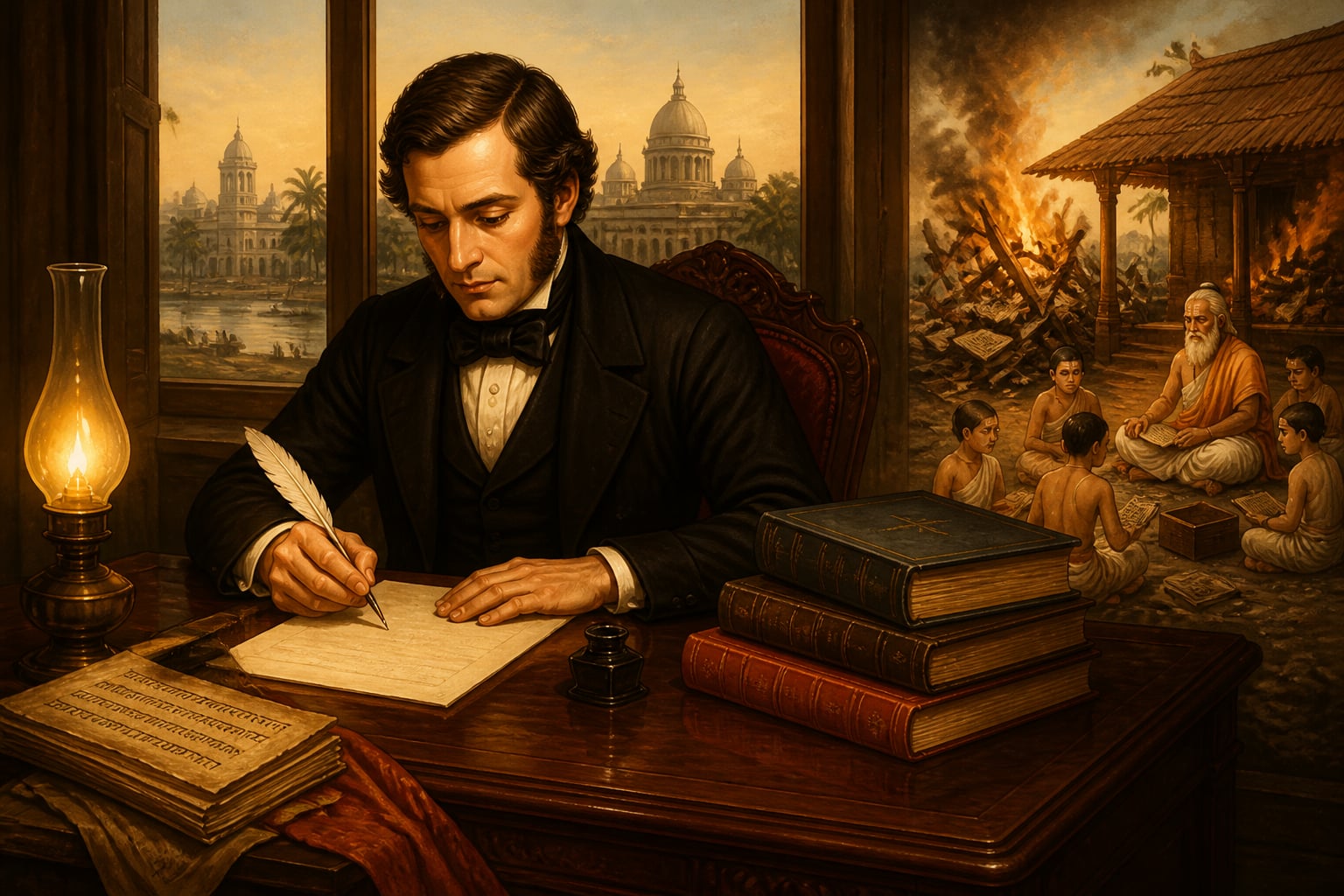
In 1835, a 34-year-old British politician named Thomas Babington Macaulay sat in Calcutta and drafted a document that would sever an entire civilization from its knowledge systems. His Minute on Education did not merely change which language Indian students would study in. It redefined what counted as knowledge, who qualified as educated, and what an entire civilization was permitted to remember about itself.
The destruction of Indian education is not a historical footnote. It is the foundational wound of the colonial project. Every other faultline examined in this course, caste rigidification, historical distortion, institutional capture, psychological colonization, was made possible because the knowledge system that could have resisted them was dismantled first.
You cannot defend what you do not remember. And the first thing colonialism attacked was memory itself.
The Mechanism: Three Phases of Educational Destruction
The destruction of India's education system did not happen in a single dramatic event. It unfolded over decades through a precise three-phase strategy: delegitimize, defund, replace. Understanding this mechanism is essential because it is the template that has been applied to knowledge systems across the colonized world.
Phase One: Delegitimize (1780s-1835)
Before you can destroy an education system, you must first convince people it has no value. The British accomplished this through a sustained intellectual campaign that reframed millennia of Indian scholarship as superstition, mythology, and backwardness.
The early British Orientalists like William Jones and Henry Thomas Colebrooke had genuine, if patronizing, respect for Sanskrit learning. Jones famously noted the structural similarities between Sanskrit, Greek, and Latin. But by the 1820s, a new faction had gained influence: the Anglicists, led by figures like Charles Grant and James Mill.
James Mill's "History of British India" (1817) was particularly devastating. Mill, who never visited India and knew no Indian language, wrote a comprehensive history that classified Indian civilization as "rude" and "backward." His work became the standard textbook at Haileybury College, where East India Company officers were trained. Every British administrator who arrived in India from the 1820s onward had been taught that Indian knowledge systems were worthless.
Macaulay's Minute of 1835 was the culmination of this delegitimization. His words are worth reading precisely because they reveal the strategy: "I have no knowledge of either Sanscrit or Arabic. But I have done what I could to form a correct estimate of their value... I have never found one among them who could deny that a single shelf of a good European library was worth the whole native literature of India and Arabia."
Notice the technique. A man who admits he cannot read the literature he is evaluating declares it worthless based on the opinions of unnamed informants. This is not scholarship. It is epistemic warfare. And it worked because it came with the authority of the colonial state behind it.
Macaulay was explicit about his goal: "We must at present do our best to form a class who may be interpreters between us and the millions whom we govern; a class of persons, Indian in blood and colour, but English in taste, in opinions, in morals, and in intellect." The objective was not education. It was the creation of a collaborator class that would administer India on Britain's behalf while being culturally alienated from its own civilization.
Phase Two: Defund (1835-1854)
Delegitimization alone could not kill a system that had survived for millennia on decentralized community patronage. The second phase was economic strangulation.
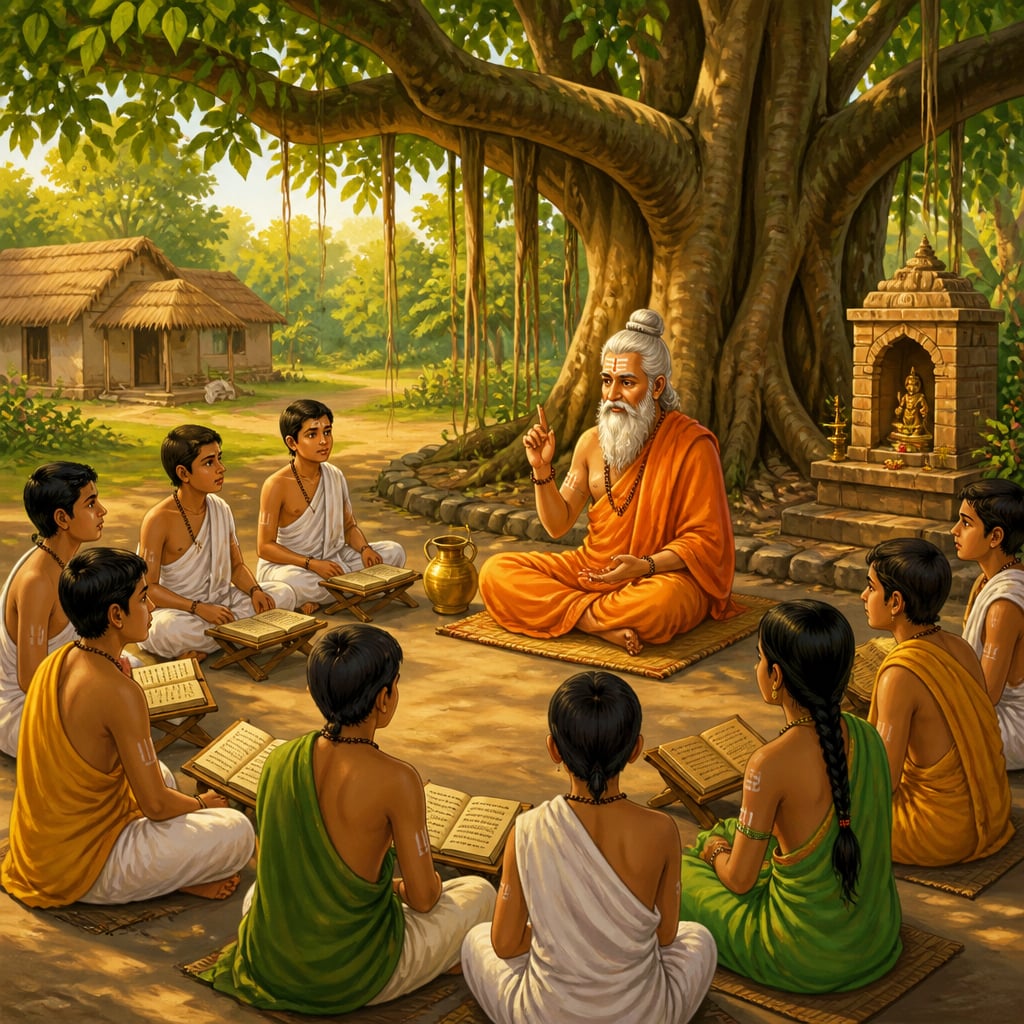
Lord William Bentinck's English Education Act of 1835, passed on the strength of Macaulay's Minute, redirected government education funds exclusively to English-medium instruction. Overnight, the state withdrew patronage from Sanskrit pathshalas, Persian madrasas, and indigenous schools that had operated across the subcontinent.
But indigenous schools did not depend primarily on state funding. They ran on community patronage: land grants, local donations, and the social contract between villages and their teachers. The colonial administration attacked this too. Revenue settlements like the Permanent Settlement in Bengal and the Ryotwari system in Madras disrupted the traditional land-grant structures that sustained educational institutions. When village revenue systems were reorganized for maximum extraction to the colonial treasury, the surplus that had funded local schools evaporated.
The effect was slow but devastating. A pathshala that had operated for generations on a small land grant found its grant "resumed" (confiscated) by the new revenue system. A gurukul that depended on the prosperity of its surrounding village found the village impoverished by new tax demands. The schools were not closed by decree. They were starved of the economic ecosystem that had sustained them.
Phase Three: Replace (1854 onwards)
The final phase was the construction of a replacement system designed to produce colonial administrators, not educated human beings.
Sir Charles Wood's Education Despatch of 1854, known as the "Magna Carta of Indian Education," established the framework that would govern Indian education for the next century. It created a grant-in-aid system where government funding was available to any school, but only if it adopted the prescribed English-medium curriculum, employed approved teachers, and submitted to government inspection.
This was the bureaucratic kill mechanism. Indigenous schools that had survived delegitimization and defunding now faced a choice: adopt the colonial curriculum and receive funding, or maintain traditional knowledge and die of financial starvation. Most could not survive without grants. Those that adopted the new system ceased to be indigenous schools in anything but location.
Wood's Despatch also established universities at Calcutta, Bombay, and Madras (1857) modeled on the University of London. These were not centers of research or original thought. They were examination bodies that certified graduates in British curricula. The message was clear: legitimate knowledge flows from London. Anything that did not fit the London model was not knowledge at all.
The Pattern: What Was Actually Destroyed
The standard colonial narrative presents pre-British India as educationally backward, with knowledge confined to Brahmin elites and the masses wallowing in ignorance. This narrative was essential to justify the replacement system. It was also a lie.
In 1983, Gandhian historian Dharampal published "The Beautiful Tree," a landmark work that recovered suppressed British survey data about India's pre-colonial education system. The title comes from Mahatma Gandhi's description of the indigenous education system as "a beautiful tree" that was destroyed by the British.
Dharampal's most explosive findings came from William Adam's three reports (1835, 1836, 1838) on indigenous education in Bengal and Bihar. Adam, a Scottish missionary, was commissioned by the colonial government to survey existing schools. His findings were so inconvenient that they were suppressed for over a century.
Adam found approximately 100,000 indigenous schools in Bengal and Bihar alone. Extrapolating to all of India, Dharampal estimated that there were between 700,000 and 1,000,000 schools across the subcontinent. In the Madras Presidency, Thomas Munro's survey (1822-1826) found that every village of any size had at least one school, and many had several.
The student composition was particularly significant. Adam's data showed that so-called "lower caste" students comprised a substantial portion of the student body, ranging from one-third to over one-half in various districts. The colonial myth of Brahmin educational monopoly was contradicted by the colonizers' own data.
These were not primitive institutions. The indigenous schools taught a structured curriculum that included reading, writing, arithmetic, accounting, and depending on the institution, grammar (Vyakarana), logic (Nyaya), astronomy (Jyotisha), mathematics (Ganita), medicine (Ayurveda), metallurgy (Dhatuvada), architecture (Vastu Shastra), and dozens of other specialized disciplines. Higher learning institutions like the tols of Bengal and the pathshalas of Banaras maintained rigorous multi-year curricula comparable in depth to European universities.
But the most significant feature of Indian education was not its breadth of subjects. It was its integration of knowledge with Dharma. Education was not merely the transmission of information. It was the formation of character. The guru-shishya relationship was not a commercial transaction between teacher and consumer. It was a sacred bond in which the guru accepted responsibility for the student's complete development: intellectual, moral, and spiritual.
This is what Macaulay's system destroyed most thoroughly. The replacement system separated knowledge from wisdom, information from character, and education from Dharma. A student could now accumulate facts without developing discernment. Could earn credentials without cultivating virtue. Could master techniques without understanding their purpose.
The separation of Dharma from education was not a byproduct of modernization. It was a deliberate strategy. An education system rooted in Dharmic principles produces individuals who think independently, question authority based on first principles, and maintain civilizational loyalty. A colonial education system needs compliant administrators who accept the legitimacy of colonial rule. Dharma in education was an obstacle to colonial control, so it was removed.
Dharmic Wisdom: Sa Vidya Ya Vimuktaye
The Vishnu Purana contains a definition of education that reveals exactly what was lost: "Sa Vidya Ya Vimuktaye" - that is knowledge which liberates.
In the Dharmic framework, Vidya (knowledge) is not the accumulation of information. It is the progressive removal of ignorance that binds the human being to limited identity and suffering. Education is not a commercial product that increases earning capacity. It is the fundamental process by which a human being realizes their full potential.
The Taittiriya Upanishad prescribes the final instruction a guru gives to a graduating student: "Satyam vada. Dharmam chara." Speak truth. Walk in Dharma. The convocation address is not about career prospects. It is about how to live.
This stands in total contrast to Macaulay's stated purpose: creating a class "Indian in blood and colour, but English in taste, in opinions, in morals, and in intellect." The Dharmic system aimed to make the student more fully themselves. The colonial system aimed to make the student into someone else entirely.
The Arthashastra, characteristically practical, links education directly to civilizational survival. Kautilya insists that the king's primary duty (Raksha) includes protecting knowledge systems, because a civilization that loses its Vidya Parampara (knowledge traditions) loses the ability to reproduce its own culture. Within one generation of educational disruption, the civilizational immune system begins to fail.
This is precisely what happened. Within two generations of Macaulay's system, the Indian elite had internalized the colonial framework. They saw their own civilization through colonial eyes. They evaluated their own traditions using colonial criteria. They became, as Macaulay intended, Indians who thought like Englishmen. Not because they were stupid, but because the education system that would have given them a different framework had been destroyed.
The Counter-Example: Japan's Meiji Restoration
The standard colonial apology claims that the destruction of Indian education was a necessary cost of modernization. To acquire Western science, technology, and industrial methods, traditional systems had to be replaced. This argument collapses when you examine Japan.
In 1868, Japan was a feudal society that had been deliberately isolated from the world for over two centuries under the Tokugawa shogunate. When the Meiji Restoration opened Japan to modernization, the country faced the same challenge India did: how to acquire Western knowledge without losing civilizational identity.
Japan's answer was the opposite of the colonial model. The Meiji government aggressively imported Western science, technology, and industrial methods. They sent students to study in Europe and America. They hired foreign experts ("oyatoi gaikokujin") to teach Western techniques. They translated thousands of Western technical works into Japanese.
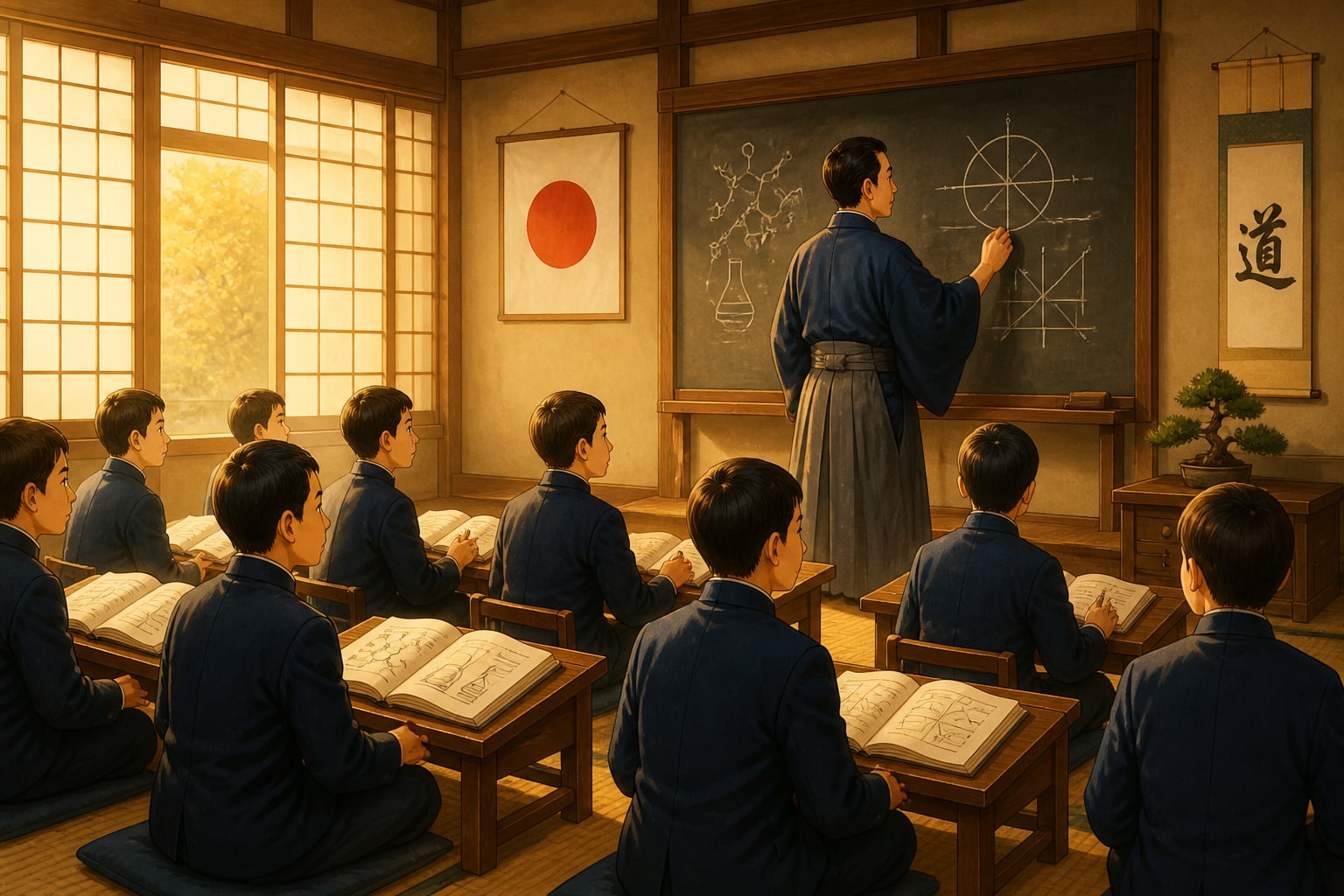
But they did all this while keeping the medium of instruction in Japanese. They maintained traditional ethics education (shushin) as a core component of the curriculum. They preserved the study of classical Japanese and Chinese texts. They ensured that modernization strengthened rather than replaced civilizational identity.
The Imperial Rescript on Education (1890) made this explicit: modern education would be built on the foundation of traditional Japanese values, loyalty, filial piety, public spirit, and the pursuit of learning. Western knowledge was a tool to be mastered, not an identity to be adopted.
The result was dramatic. Within 40 years, Japan transformed from a feudal society into a modern industrial power that defeated a European empire (Russia, 1905). It achieved this without creating a deracinated elite that despised its own civilization. Japanese scientists, engineers, and administrators were thoroughly modern in their technical capabilities and thoroughly Japanese in their civilizational identity.
This proves that the destruction of Indian education was not a requirement of modernization. It was a requirement of colonization. India did not need to lose its knowledge systems to gain new ones. Japan proved that a civilization can modernize without committing epistemic suicide.
The difference was sovereignty. Japan modernized on its own terms because it was never fully colonized. India was modernized on British terms because it was.
The Defense: Rebuilding the Knowledge Civilization
The colonial wound to India's education system is not merely historical. It is ongoing. The structures Macaulay and Wood created have been modified but never fundamentally replaced. The medium may have shifted, but the separation of Dharma from education, the privileging of Western frameworks as the default "universal" standard, and the systematic devaluation of indigenous knowledge systems persist in Indian education today.
Rebuilding requires action at three levels.
Recovery: The first step is recovering what was suppressed. Dharampal's work is a model. The data about India's pre-colonial education system exists in colonial archives, in suppressed survey reports, in revenue records that document land grants to educational institutions. This data must be systematically recovered, digitized, and made accessible. You cannot rebuild what you do not remember.
Reintegration: The second step is reintegrating Indian knowledge systems into contemporary education. This does not mean replacing physics with astrology. It means teaching Madhava alongside Newton, Charaka alongside Hippocrates, Panini alongside Chomsky, and the Arthashastra alongside Machiavelli. Indian contributions to mathematics, linguistics, medicine, metallurgy, and governance are not antiquarian curiosities. They are intellectual achievements that deserve their place in any genuinely universal curriculum.
Reconnection: The deepest step is reconnecting education with Dharma. Not in the narrow sense of religious instruction, but in the foundational sense: education as character formation, as the cultivation of Viveka (discernment), as the process by which a human being becomes capable of contributing to civilizational flourishing. The guru-shishya relationship, the integration of knowledge with ethics, the understanding that Vidya is for Vimukti (liberation, not just livelihood): these are not relics. They are the missing foundations without which education becomes mere credentialism.
The lesson from Japan is that modernization and civilizational identity are not opposites. The lesson from India's colonial experience is that when they are treated as opposites, the civilization pays for generations. The wound Macaulay inflicted in 1835 has not healed because the system he designed is still, in its essential architecture, the one India uses today.
Healing begins with seeing the wound clearly. That is the purpose of this lesson.
Case studies
Dharampal's Beautiful Tree: Recovering India's Suppressed Educational History
In the 1960s and 70s, Gandhian historian Dharampal spent years in British archives, systematically excavating colonial survey data that had been buried for over a century. His most significant discovery was William Adam's three reports (1835, 1836, 1838), commissioned by the Bengal government to survey indigenous education. Adam found approximately 100,000 schools in Bengal and Bihar alone, teaching reading, writing, arithmetic, and specialized subjects. Thomas Munro's earlier survey of the Madras Presidency (1822-26) had found similar density: every village of any size had at least one school. Crucially, Adam's data showed that students from so-called 'lower castes' comprised between one-third and one-half of the student body in various districts, directly contradicting the colonial narrative of Brahmin educational monopoly. These findings were so damaging to the justification for colonial education policy that they were suppressed and forgotten until Dharampal recovered them.
The Arthashastra emphasizes that a ruler's first duty is Raksha (protection), which includes protecting knowledge systems. The British violated this at the most fundamental level: they surveyed India's education system, documented its sophistication, and then suppressed that documentation to justify destroying the very system they had just proven worked. This is epistemic warfare in its purest form. The Taittiriya Upanishad's warning, 'prajatantum ma vyavacchetsih' (do not cut the thread of tradition), describes exactly what was severed. The thread was not broken by ignorance. It was cut deliberately by an administration that knew what it was destroying.
Dharampal published 'The Beautiful Tree' in 1983. The title comes from Gandhi's description of India's indigenous education as 'a beautiful tree' that was destroyed by the British. The book recovered data showing India had between 700,000 and 1,000,000 schools before colonial intervention, with a decentralized, community-funded system that had survived invasions, famines, and political upheaval for centuries. This system was dismantled not because it failed, but because its success was inconvenient to the colonial project.
The most devastating weapon in civilizational warfare is not destruction but erasure. The British did not merely destroy India's education system. They erased the evidence that it had ever existed, so that generations of Indians would believe they had been rescued from ignorance rather than robbed of knowledge.
Dharampal's method of recovering suppressed colonial data is a model for civilizational reclamation. Similar buried data exists in British archives about Indian metallurgy, agriculture, hydraulic engineering, and textile technology. The recovery project has barely begun.
Adam's surveys found approximately 100,000 indigenous schools in Bengal and Bihar alone. Extrapolated to all of India, Dharampal estimated 700,000 to 1,000,000 schools. By contrast, when the British began building their replacement system, the entire colonial education apparatus served a tiny fraction of this number.
Wood's Despatch of 1854: The Bureaucratic Kill Mechanism
In 1854, Sir Charles Wood, President of the Board of Control for India, issued an education despatch that became known as the 'Magna Carta of Indian Education.' The despatch established a grant-in-aid system under which government funding was available to any school, but only if it adopted the prescribed English-medium curriculum, employed government-approved teachers, and submitted to official inspection. It also created universities at Calcutta, Bombay, and Madras (1857) modeled on the University of London, functioning as examination bodies that certified graduates in British curricula. The despatch did not explicitly ban indigenous schools. It did something more effective: it created a two-tier system where government-recognized schools received funding, legitimacy, and their graduates received employment in the colonial administration, while indigenous schools received nothing and their graduates were shut out of all official positions.
Kautilya describes Kutayuddha (covert warfare) as achieving strategic objectives without open confrontation. Wood's Despatch is a masterclass in institutional Kutayuddha. No law prohibited gurukuls or pathshalas. No soldiers destroyed them. Instead, the colonial state created an economic ecosystem in which indigenous schools could not survive. This mirrors the Arthashastra's principle that controlling Kosha (treasury) and Arthakriya (economic activity) is more effective than Danda (force). You need not destroy an institution when you can simply make its survival economically impossible.
Within decades, thousands of indigenous schools closed as communities redirected resources toward the grant-aided system that offered economic returns. The pathshala teacher who had been a respected community figure became an irrelevant anachronism. By 1900, the replacement was near-total in urban areas. The colonial curriculum, focused on producing clerks and administrators rather than thinkers and leaders, became the default model of Indian education, a framework that persists in modified form to this day.
Bureaucratic warfare is the most durable form of civilizational destruction. Unlike military conquest, which provokes resistance, bureaucratic systems are adopted voluntarily by those they are designed to subjugate. The communities that abandoned their indigenous schools for grant-aided English schools were making rational economic choices within a system engineered to make those choices inevitable.
The grant-in-aid framework of 1854 established the template for India's modern education regulatory system: centralized curriculum control, government inspection, and economic incentives that reward conformity to prescribed frameworks. Understanding this origin helps explain why Indian education reform faces such deep structural resistance.
The three universities established by Wood's Despatch (Calcutta, Bombay, Madras in 1857) were not research institutions but examination bodies. They modeled the University of London's external examination system, certifying students in British curricula without any mandate for original research or indigenous knowledge creation.
Japan's Meiji Restoration: Modernization Without Civilizational Suicide
In 1868, Japan was a feudal society that had been deliberately isolated from the world for over 250 years under the Tokugawa shogunate. When the Meiji Restoration opened Japan to modernization, the government faced the same challenge colonial India did: how to acquire Western science, technology, and industrial methods. Japan's response was the opposite of the Macaulay model. The Meiji government aggressively imported Western expertise, sending students abroad and hiring foreign specialists (oyatoi gaikokujin). They translated thousands of Western technical works into Japanese. But they kept the medium of instruction in Japanese. They maintained traditional ethics education (shushin) as a core curriculum component. The Imperial Rescript on Education (1890) explicitly grounded modern education in Japanese civilizational values: loyalty, filial piety, public spirit, and the pursuit of learning.
The Arthashastra teaches that a wise ruler acquires the enemy's useful methods without adopting the enemy's identity. Kautilya's concept of Paragraha (taking from others) is specifically about strategic acquisition: learning from rivals while maintaining Svadharma (one's own civilizational path). Japan practiced Paragraha at national scale. They took Western science as a tool to be mastered, not as an identity to be adopted. India, under colonial rule, had no such choice. Macaulay's system was not Paragraha but Paravashatva (subjugation), forcing civilizational conversion as the price of access to modern knowledge.
Within 40 years, Japan transformed from a feudal society into a modern industrial power that defeated Russia in 1905, the first Asian nation to defeat a European empire in modern warfare. It achieved this without creating a deracinated elite alienated from its own civilization. Japanese scientists, engineers, and administrators were thoroughly modern in technical capability and thoroughly Japanese in civilizational identity. Japan proved that modernization does not require civilizational amnesia.
The destruction of India's education system was not a necessary cost of modernization. It was a deliberate strategy of colonization. Japan demonstrates that a civilization can acquire any knowledge system without abandoning its own. The difference was sovereignty. Japan modernized on its own terms because it chose to. India was modernized on British terms because it was forced to.
South Korea, China, and Israel have all followed variations of the Meiji model: aggressive acquisition of global knowledge while maintaining civilizational education. India's NEP 2020, with its emphasis on Indian knowledge systems and multilingual education, represents the first major policy attempt to shift from the Macaulay model toward something closer to the Meiji approach, nearly 190 years later.
Japan's literacy rate was already estimated at 40-50% before the Meiji Restoration, thanks to the terakoya (temple school) system that served commoners. Rather than destroying this existing infrastructure, the Meiji government built upon it, converting terakoya into modern elementary schools while preserving their community roots.
Reflection
- Think about your own education. What do you know about the Western intellectual tradition (Newton, Shakespeare, Aristotle) versus the Indian intellectual tradition (Madhava, Kalidasa, Panini)? Where did this imbalance come from, and what would you need to do to correct it?
- Why did the British need to delegitimize Indian knowledge before they could replace it? Why couldn't they simply introduce English education alongside the existing system, as Japan did with Western education?
- The Vishnu Purana defines Vidya as 'that which liberates.' Macaulay defined education as that which produces useful administrators. Are these two definitions fundamentally irreconcilable, or is there a way to integrate liberation and utility in education?