Neelakantha: The Blue-Throated One

Shiva drinks the cosmic poison

The churning produces the deadly Halahala poison threatening all creation. Lord Shiva consumes it, held in his throat by Parvati, turning his throat blue (Neelakantha). Gradually emerge the wondrous treasures: Lakshmi, Kaustubha gem, Airavata, Uccaihshravas, and finally the nectar.

Terror from the Depths

The churning continued with renewed vigor. Gods and demons pulled the great serpent Vasuki back and forth while Kurma held firm beneath. Mount Mandara spun in the Ocean of Milk, and the cosmic waters began yielding their secrets.

But the first thing to emerge was not treasure.
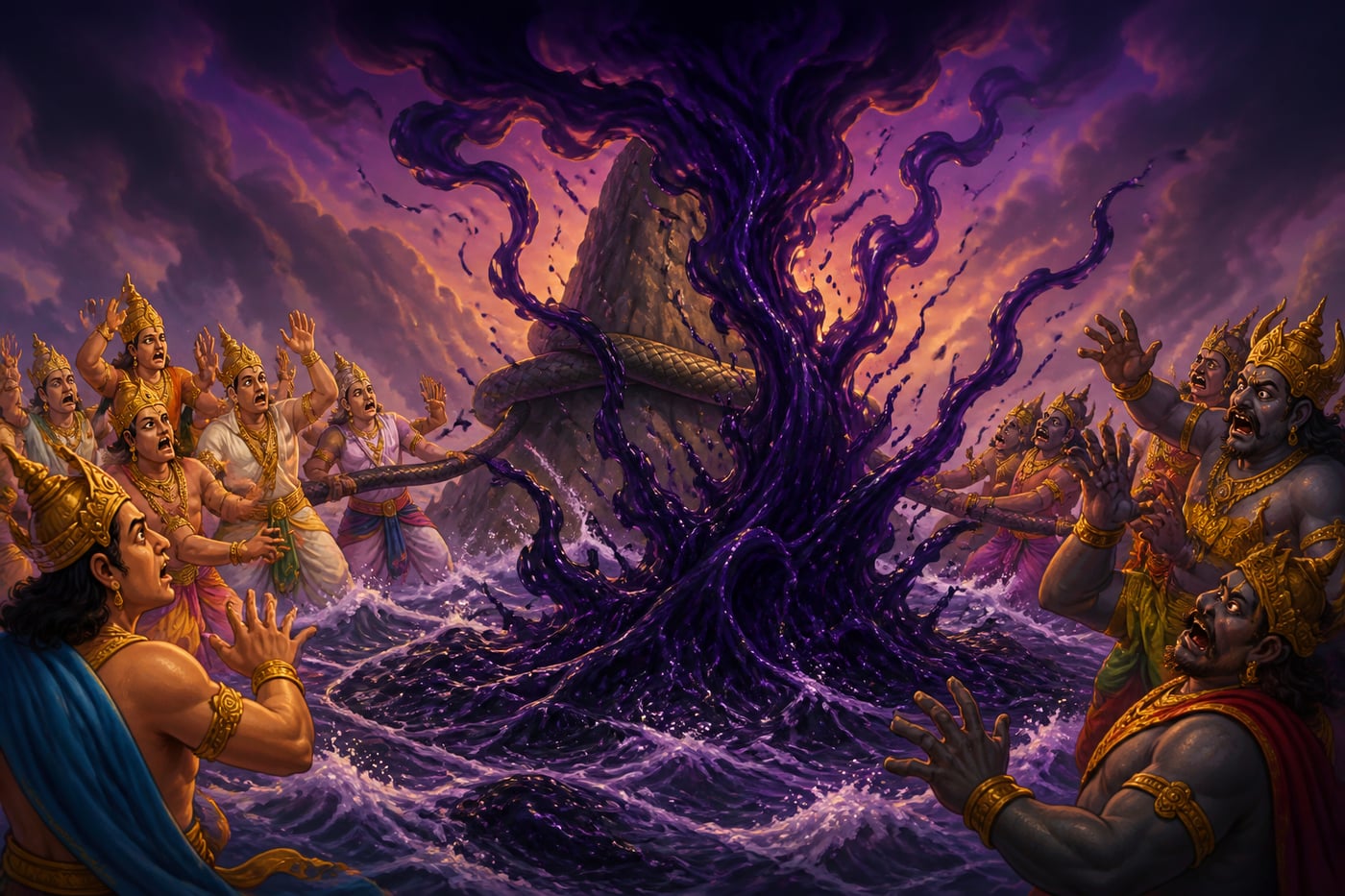
Halahala poison rising from the churning ocean as gods recoil

From the depths rose a terrible darkness - thick, viscous, spreading across the ocean's surface. A smell of death filled the air. This was Halahala, also called Kalakuta - the poison of time itself, concentrated venom capable of destroying all creation.

"The poison spread in all directions. It rose into the air, darkening the sun. It seeped into the waters, killing all it touched. It threatened to consume the three worlds in its terrible embrace."

Gods and demons alike recoiled in terror. Their great enterprise had produced not nectar but death. The very effort to gain immortality had unleashed mortality in its most concentrated form.

Property of Halahala Effect
Touch Instant death
Smell Paralysis and fear
Sight Blindness
Spread Uncontrollable

No One Would Save Them

The panicked gods approached Lord Vishnu. "Save us! The poison will destroy everything!"

But Vishnu shook His head. "This is not My role to play. There is only one being in all creation who can handle this poison - Lord Shiva."

The gods rushed to Mount Kailash, where Shiva dwelt in meditation with His consort Parvati. They found Him absorbed in cosmic contemplation, His third eye closed, His presence radiating infinite peace.

"O Mahadeva! Great Lord! The churning has produced a poison that threatens all existence. We know not what to do. Only You can save us!"

Shiva opened His eyes - those eyes that had witnessed the birth and death of countless universes. He saw the terror in the gods' faces. He sensed the poison spreading through creation. And He smiled.

"The welfare of the worlds is indeed the responsibility of the enlightened," He said, rising from His seat.

The Great Sacrifice

What happened next would define Shiva's nature for all time. Without hesitation, without seeking reward, without even pausing to consider the danger, the Lord of Destruction went to save creation.

At the shore of the milk ocean, the poison had formed a vast, roiling mass. Its fumes had already killed countless smaller beings. The gods maintained their distance, covering their faces, watching in helpless horror.

Shiva walked calmly to the poison. He cupped it in His hands - hands that had created and destroyed worlds. And He raised it to His lips.

"As easily as one might drink water, Lord Shiva took the Halahala poison into His mouth. He held it in His throat, neither swallowing nor spitting, containing within Himself the death of the universe."

Lord Shiva calmly drinks the Halahala poison as his throat turns deep blue.

But Parvati, who had followed Her husband, saw what was happening. The poison, even held in Shiva's throat, was too powerful to be safe. It began to burn, threatening to spread through His divine body.

In an act of intimate partnership, Parvati reached out and pressed Her hand against Shiva's throat. Her touch held the poison in place, preventing it from descending into His stomach or rising back into the world. There it would remain - forever.

Neelakantha: The Blue-Throated One

The poison, trapped in Shiva's throat, left its mark. His throat turned deep blue - the color of concentrated venom transformed by divine power. From this day, Shiva became known as Neelakantha, the "Blue-Throated One."

This blue throat would become one of Shiva's most distinctive features, depicted in countless sculptures and paintings. It tells the story of the god who:

The Bhagavatam notes that even Vishnu praised this act:

"This is the nature of the truly great - they accept difficulty to save others. What Shiva has done shows His supreme compassion. His blue throat will remind all generations of this selfless deed."

The Treasures Emerge

With the poison contained, the churning could continue. And now, at last, the ocean began yielding its wonders. One by one, extraordinary beings and objects emerged from the cosmic waters:

1. Surabhi (Kamadhenu) - The wish-fulfilling cow, capable of granting any desire. She was given to the sages for their sacrifices.

2. Varuni - The goddess of wine, accompanied by celestial intoxicants. The demons, attracted to pleasure, claimed her eagerly.

3. Parijata - The celestial wish-fulfilling tree, whose flowers never wilt and whose fragrance reaches all the heavens. It was planted in Indra's garden.

4. Apsaras - Celestial dancers of surpassing beauty, including Rambha, Urvashi, and Menaka. They would grace the courts of heaven.

5. Chandra - The Moon god emerged, radiant and cool. Shiva took him as an ornament for His hair, adding gentle light to the god who had just drunk cosmic darkness.

6. Uccaihshravas - The divine white horse with seven heads, king of horses. Bali Maharaja claimed him.

7. Airavata - The magnificent white elephant with four tusks, who would become Indra's mount.

8. Kaustubha - The most precious gem in existence, which adorns Vishnu's chest.

9. Shankha - The divine conch, which became Vishnu's Panchajanya, whose sound dispels evil.

Lakshmi rising from the ocean and choosing Vishnu as her consort

The Goddess Returns

Then came the moment the churning had truly been undertaken for. From the milky waters rose a lotus, and upon that lotus sat the most beautiful being in all creation - Lakshmi, the goddess of fortune.

"She was radiant like a thousand suns yet gentle as moonlight. Her beauty made all previous treasures seem dim. The universe held its breath as she emerged, for with her comes all prosperity, all success, all blessing."

Remember - this was the goddess whose departure had caused the gods' downfall. Indra's carelessness with Durvasa's garland had driven her away. Now she was returning, but to whom would she go?

The gods held their breath. The demons craned forward eagerly. Even Brahma and the sages watched with intense interest. Lakshmi surveyed all assembled - the powerful demons, the hopeful gods, the great sages, the cosmic beings.

She looked at the demons and turned away - they were too consumed by desire.

She looked at Brahma and the sages - but they had already renounced worldly fortune.

She looked at Indra - but remembered his carelessness.

Then her eyes found Vishnu - serene, complete, wanting nothing. She approached Him and placed a garland around His neck. She had chosen her eternal consort. Fortune belongs to the One who doesn't grasp for it.

The Bhagavatam explains her choice:

"Lakshmi saw in Vishnu one who was complete in Himself, attached to nothing, the shelter of all beings. She who is the bestower of fortune chose to eternally serve one who needed nothing from her. This is the mystery of divine love."

Dhanvantari and the Nectar

Finally, from the churning waters emerged Dhanvantari - the divine physician, father of Ayurveda. In his hands he carried what everyone had been waiting for: a golden pot containing Amrita, the nectar of immortality.

The moment was electric. Both gods and demons surged forward. Years of cooperative churning were instantly forgotten. Each side wanted the nectar for themselves.

The demons, being more aggressive, snatched the pot first. They ran, clutching immortality in their greedy hands. The gods gave chase, but the Asuras were stronger, faster, more desperate.

It seemed the entire purpose of the churning would be lost. The demons would drink the nectar, become immortal, and rule forever. All the gods' suffering would be for nothing.

But Lord Vishnu smiled. He had promised the gods that the nectar would reach only them. And He had a plan - one that would require Him to assume a most unexpected form.

The Cosmic Balance Sheet

As this phase of the churning ended, consider what had emerged:

Category Item Recipient
Danger Halahala poison Absorbed by Shiva
Animals Kamadhenu, Uccaihshravas, Airavata Various
Treasures Kaustubha, Parijata Vishnu, Indra
Beings Apsaras, Chandra, Lakshmi Heaven, Shiva, Vishnu
The Prize Amrita nectar Currently with demons

The ocean had yielded its treasures, including both poison and nectar, danger and blessing. This reflects a deeper truth: the depths of existence contain everything - good and evil, death and immortality. What matters is who receives what, and how they handle it.

Shiva received the poison and transformed it into an ornament of compassion. Vishnu received Lakshmi through non-attachment. The demons seized the nectar through aggression - but would they keep it?

The Teaching of the Poison

Before we follow the nectar to its resolution, consider what Shiva's act teaches:

The churning would soon conclude, but its lessons ripple through time. In our next lesson, we see how Vishnu reclaims the nectar through the most enchanting disguise ever assumed by the Divine.

Living traditions

The Samudra Manthan treasures have become part of everyday Indian vocabulary and commerce. 'Amrit' is a popular brand name for dairy products, medicines, and nutritional supplements. Lakshmi adorns currency notes and business establishments. Dhanvantari's image appears in ayurvedic clinics worldwide. The story has been adapted into countless films, television serials, and animated features. The ecological reading of the story - churning produces both poison and nectar, warning about disturbing natural systems - has found resonance in environmental discourse.

Reflection

More in Skanda 8: Withdrawal

All lessons in Skanda 8: Withdrawal ยท Srimad Bhagavatham course