Gajendra: The Elephant King's Crisis

Caught by a crocodile

Gajendra, king of elephants, enters a lake for sport. A mighty crocodile seizes his leg, and a thousand-year struggle ensues. When his strength fails and his herd abandons him, Gajendra remembers prayers from a previous birth and calls out to the Supreme Lord.

The Sacred Mountain

In the cosmic geography of the Bhagavatam, there exists a mountain called Trikuta - 'Three Peaks' - rising ten thousand yojanas into the sky. Its three summits, made of iron, silver, and gold, pierce the heavens while its roots reach deep into the ocean of milk. This celestial mountain, adorned with precious gems and waterfalls, was home to countless divine beings.

On Trikuta's slopes spread a magnificent garden called Ritumat, created by Varuna, lord of the waters. Here, every season bloomed simultaneously. Flowers that elsewhere blossomed only in spring existed alongside autumn's harvest and summer's abundance. The air carried the fragrance of a thousand blossoms while celestial birds filled the groves with melody.

In this paradise lived Gajendra, king of the elephants. He was no ordinary beast but the leader of a vast herd - mighty in body, noble in bearing, his tusks gleaming like mountain peaks at sunrise. When Gajendra moved through the forest, the earth trembled. When he trumpeted, the heavens listened.

The King at Play

One day, scorched by the summer heat, Gajendra led his herd toward a great lake nestled in Ritumat's heart. The Bhagavatam describes his approach:

"Surrounded by his she-elephants and young ones, intoxicated by his own strength and the fragrance of temporal juice flowing from his temples, Gajendra entered the lake."
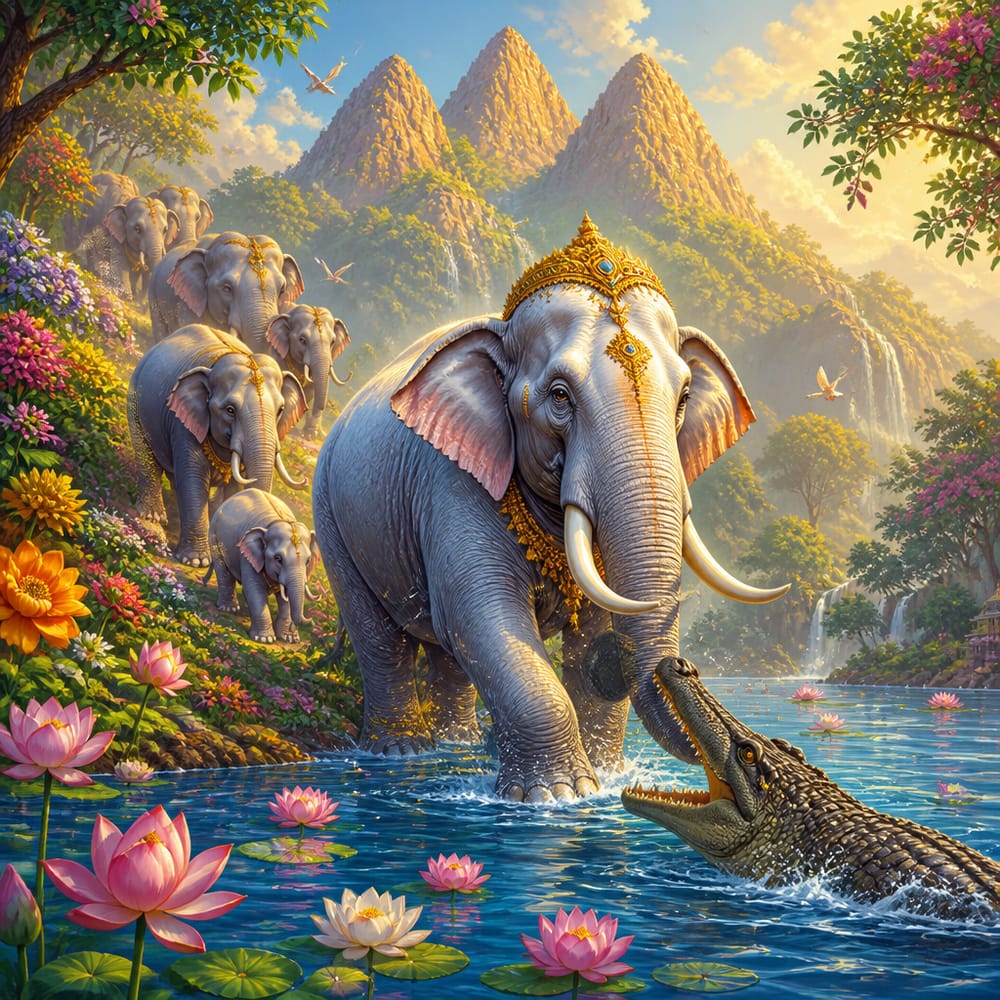
Gajendra leads his herd of elephants down Mount Trikuta to a lotus-filled lake.

The lake was no ordinary body of water. Its surface shimmered with golden lotuses. Its depths held cool, sweet waters perfumed by the pollen of celestial flowers. Gajendra plunged in joyfully, drinking deep, spraying water over his back, sporting with his family.

For a time, all was perfect. The king elephant reveled in his strength, his sovereignty, his pleasures. He had no thought of danger - why would he? He was mighty beyond measure, lord of his realm, surrounded by those who loved and depended on him.

This is how maya works. In our moments of greatest confidence, when we feel most secure in our power and possessions, we forget our vulnerability. We forget that we are not the controllers we imagine ourselves to be.

The Crocodile Strikes

From the depths of that beautiful lake, unseen, a mighty crocodile waited. The Bhagavatam calls him graha - one who seizes. As Gajendra sported in the shallows, the crocodile struck with terrible swiftness, clamping his massive jaws around the elephant's foot.

Gajendra's scream of shock echoed across the mountain. The she-elephants trumpeted in panic. The young ones scattered. The king who had walked invincible through the forest now found himself caught by an enemy he could not see, could not fight, could not understand.

Gajendra's Situation The Crocodile's Advantage
Mighty on land Weak in water
Surrounded by herd Fighting alone (they cannot help in water)
Used to victory Facing an enemy suited to this terrain
Attached to life The crocodile has no fear

The elephant pulled with all his enormous strength. The crocodile held firm. Gajendra dragged himself toward shore; the crocodile pulled him deeper. Hour after hour, day after day, the struggle continued.

A Thousand Years of Suffering

The Bhagavatam tells us this battle lasted a thousand years - a number that represents not merely duration but the complete exhaustion of worldly resources. For a thousand years, Gajendra fought with every weapon at his disposal:

But with each passing year, something changed. Gajendra grew weaker. The crocodile, in its element, maintained its grip. More terrifyingly, the she-elephants and young ones who had gathered at the shore began to drift away. They could not enter the water to help. They could not feed him. They could not do anything but watch.

Gajendra alone in the lake at twilight as his herd departs

"The other elephants, his friends and relatives, tried to help but could not. Eventually they returned to the forest, abandoning him to his fate."

This is perhaps the most painful moment in the story. When crisis comes, we discover that those we depended on have limits. Family, friends, wealth, status - all the resources we accumulated during prosperous times - prove insufficient against genuine existential threat.

The Moment of Awakening

As Gajendra's strength failed and his companions departed, something remarkable happened. In his desperation, memories arose from deep within - memories that were not from this life.

King Indradyumna in meditation, the previous birth of Gajendra

The Bhagavatam reveals that Gajendra had been a human king in his previous birth - Indradyumna, a great devotee of Vishnu. Due to a curse, he had taken birth as an elephant, forgetting his spiritual practices. But the impressions of his devotion (bhakti-samskara) remained dormant in his consciousness.

Now, in this moment of complete helplessness, those impressions awakened:

"The elephant king, having lost all hope of rescue by his own strength or by his companions, began to think deeply. He remembered prayers he had learned in a previous birth."

This is the crucial turning point. Until now, Gajendra had relied on:

All material resources were exhausted. Only now, at the absolute end of his own capacity, did he turn to the Divine.

The Nature of True Crisis

The Gajendra story illustrates a profound spiritual principle: genuine surrender often comes only when all other options have failed. As long as we believe we can solve our problems through our own efforts, we rarely turn wholeheartedly to God.

This doesn't mean we should be passive or abandon effort. But the story asks us to examine what we truly depend on:

Gajendra's situation stripped away everything except the fundamental question of existence: When all else fails, to whom - or what - do we turn?

The Prayer Begins to Form

In the closing moments of our lesson, Gajendra stands at the threshold. His body is exhausted. His herd has departed. The crocodile's grip has not loosened. Death seems certain.

But from the depths of his being, rising through layers of animal instinct and forgotten human memory, ancient prayers begin to surface. These are not rehearsed words or mechanical recitations. They are the cry of a soul that has finally understood its helplessness.

The Bhagavatam tells us:

"The elephant king, though an animal, possessed spiritual knowledge from his previous life. With single-pointed mind, he began to offer prayers to the Supreme Lord, whom he knew as the ultimate shelter."

Gajendra doesn't know which form of God to address. He doesn't know the proper mantras or rituals. He doesn't even know if he will be heard. But he knows one thing with absolute certainty: there is a Supreme Being, and only that Being can save him now.

This recognition - that there is something beyond ourselves, something transcendent, something worth calling to even in our darkest hour - is the beginning of true bhakti. Not philosophical understanding, not ritual performance, but the raw, desperate, utterly sincere cry of a soul that has nowhere else to turn.

As we leave Gajendra struggling in the lake, his trunk raised above the water, his voice crying out across the universe, we prepare for one of the Bhagavatam's most profound teachings: the famous Gajendra Stuti, the elephant's prayer of surrender that would shake the throne of heaven and bring the Lord Himself rushing to respond.

Living traditions

The Gajendra Moksha story has inspired countless artistic works, from classical Bharatanatyam dance dramas to contemporary films. The image of the elephant with raised trunk and lotus is one of the most recognizable symbols in Hindu iconography. The story is frequently taught to children as their first lesson in surrender to God. In 2018, a animated film 'Gajendra Moksha' brought the story to new audiences, and the scene appears in popular television serials depicting the Bhagavatam.

Reflection

More in Skanda 8: Withdrawal

All lessons in Skanda 8: Withdrawal ยท Srimad Bhagavatham course