Manthan: Churning the Milk Ocean

Devas and Asuras cooperate

The devas, weakened by Durvasa's curse, seek nectar of immortality from the Milk Ocean. Vishnu advises cooperation with the demons. Using Mount Mandara as the churning rod and Vasuki as the rope, they begin - but the mountain sinks until Kurma avatar supports it.

The Fall of the Gods

In the cosmic order, the Devas (gods) and Asuras (demons) exist in perpetual tension - light and darkness, order and chaos, competing for dominion over the three worlds. Usually, the gods held the upper hand. But a single moment of carelessness would change everything.
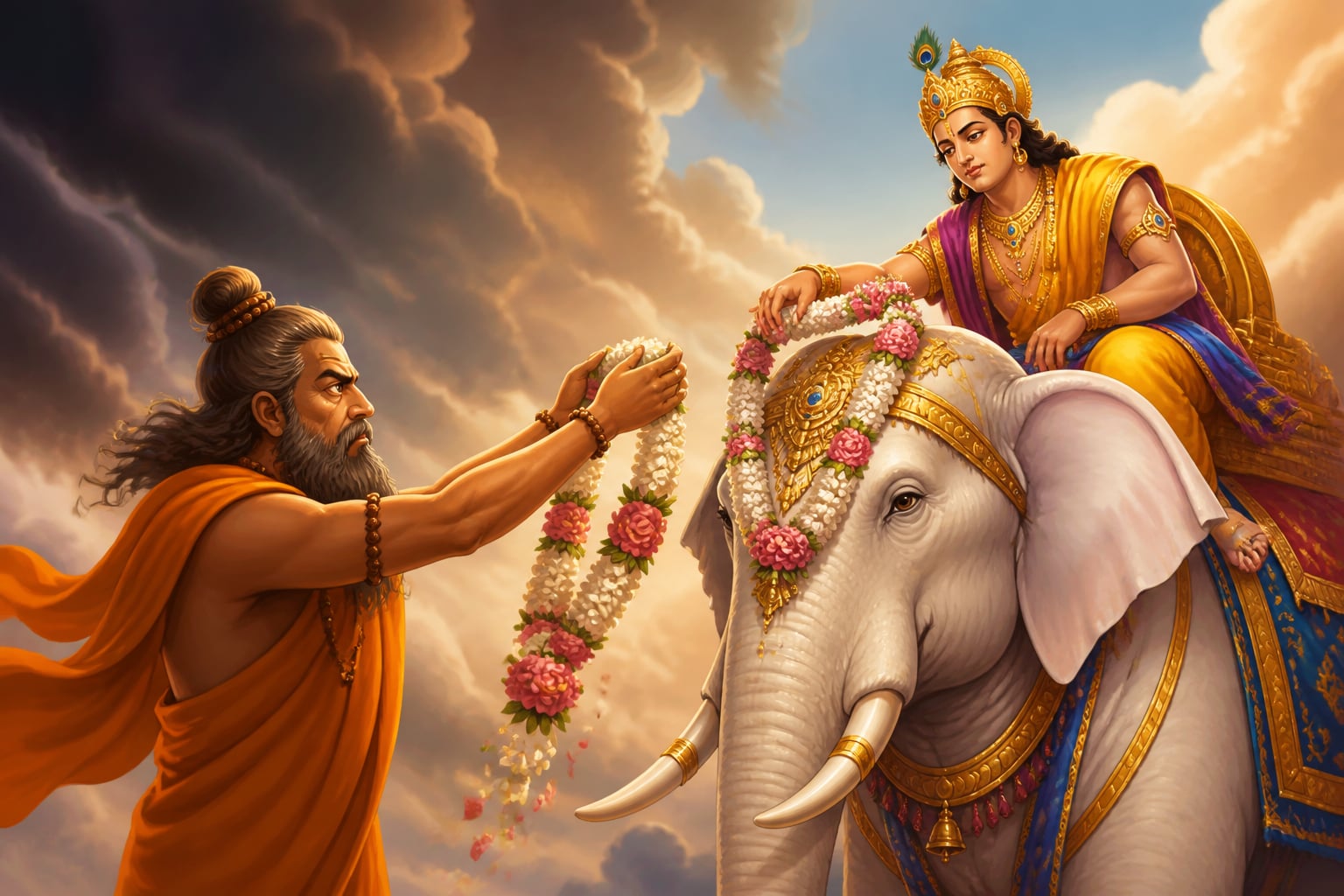
Indra carelessly handling Durvasa's garland atop Airavata

Indra, king of the gods, was riding his celestial elephant Airavata through the heavens when he encountered the sage Durvasa walking toward him. Durvasa, pleased from worship of the goddess, carried a divine garland blessed with sacred fragrance.

"Take this garland, O King of Gods," Durvasa offered. "It carries the presence of Lakshmi herself."

Indra, in a moment of thoughtless pride, took the garland and casually placed it on Airavata's head. The elephant, irritated by the fragrance, threw it to the ground and trampled it underfoot.

Durvasa's face darkened. The sage was famous for his fierce temper - his very name means 'difficult to dwell with.' What he gave was never merely a garland but a blessing, and Indra had shown contempt for it.

"You fool! Drunk on your power, you have insulted the goddess of fortune. May Lakshmi abandon you! May your strength fade, your glory diminish, and your kingdom crumble!"

The curse took immediate effect. Lakshmi withdrew from the three worlds. Without fortune's blessing:

Effect Consequence
Prosperity vanished Treasures faded, abundance ceased
Strength diminished The gods grew weak in battle
Courage failed Divine warriors lost their nerve
Sacrifices stopped Humans ceased their worship

Seeing the gods weakened, the Asuras launched a massive assault. Battle after battle, the demons won. The gods were driven from heaven, forced to hide, their kingdom falling to their ancient enemies.

Seeking Vishnu's Counsel

The defeated gods approached Lord Brahma, the creator, who took them to the Ocean of Milk (Kshirasagara) where Lord Vishnu reclines on the serpent Shesha. There, the gods poured out their suffering:

"O Lord, we have been cursed by Durvasa. Our strength is gone. The demons have conquered heaven. Without your intervention, we are lost."

Vishnu listened with compassion. His response, however, was unexpected:

"The nectar of immortality (amrita) lies hidden in the depths of this ocean. Churn it, and you will recover not only the nectar but all the treasures that have been lost, including Lakshmi herself. But you cannot do this alone. You must make peace with the Asuras and work together."

The gods were stunned. Cooperate with the demons? The very beings who had conquered their kingdom, killed their warriors, desecrated their shrines?

Vishnu explained further:

"Promise them a share of the nectar. Let them believe they will gain immortality. I will ensure the nectar reaches only you. But the churning requires their strength combined with yours."

This was divine strategy - using the demons' greed against them, channeling their power for a purpose they didn't fully understand.

The Cosmic Alliance

The gods approached Bali Maharaja, king of the Asuras, with their proposal. Bali was wise enough to be suspicious - why would the gods share anything with their enemies? But the promise of immortality was too enticing to refuse.

"Very well," Bali agreed. "We will churn together. But if there is any trickery..."

The unlikely alliance was formed. Gods and demons, enemies since the beginning of time, would work side by side for a common goal. This required:

1. A Churning Rod: Mount Mandara, one of the cosmic mountains, was chosen. Rising through all three worlds, it possessed the mass needed for this impossible task.

2. A Churning Rope: Vasuki, the great serpent king who serves as ornament on Lord Shiva's neck, agreed to serve as the rope. He would wrap around the mountain while gods and demons pulled his body back and forth.

3. A Base: The Ocean of Milk itself would be churned, but Mandara would need a foundation to rest upon - a problem that would soon prove critical.

The Great Churning Begins

The preparations were extraordinary. The gods and demons uprooted Mount Mandara from its cosmic foundation. Carrying it toward the Ocean of Milk, they struggled under its weight - even their combined divine strength barely sufficient.

Vasuki, the serpent king, coiled himself around the mountain. His thousand hoods spread like a canopy; his body stretched to impossible lengths. The Asuras, proud and aggressive, grabbed his head. The Devas took his tail.

And they began to churn.

Devas and asuras churn the Milk Ocean using Mount Mandara and the serpent Vasuki.

"Back and forth they pulled, the mountain spinning in the cosmic ocean. The waters churned and foamed. The sound of the manthan echoed through all the worlds."

But almost immediately, a disaster occurred. Mount Mandara, immensely heavy, began to sink into the ocean floor. No matter how vigorously they churned, the mountain descended deeper, threatening to vanish into the abyss. The great effort was failing.

Kurma the tortoise avatar supporting Mount Mandara from below

The Tortoise Divine

In this moment of crisis, Lord Vishnu intervened in a form no one expected. Descending into the ocean depths, He assumed the form of an enormous tortoise - Kurma Avatar - and placed His shell beneath Mount Mandara.

The Bhagavatam describes this avatar:

"The Lord, taking the form of a gigantic tortoise, dove into the ocean. His shell became the pivot upon which Mandara rested. Stretching for eight hundred thousand miles, Kurma appeared like another cosmic mountain beneath the first."

Aspect of Kurma Significance
Supporting from below The Divine sustains all effort from beneath, often unseen
Bearing the weight God carries the burden of both gods and demons
Enabling the work Without divine support, even cosmic endeavors fail
Present in depths The Lord works in the depths as well as the heights

With Kurma as the foundation, the churning could continue. But Vishnu's help didn't stop there. Seeing both gods and demons exhausted from their efforts, He infused them with fresh energy. He also entered the serpent Vasuki, helping him endure the pain of being pulled back and forth.

The Divine was present everywhere in this cosmic work - as the foundation below, as the energy within, as the orchestrator of the entire enterprise.

The Serpent's Suffering

While the churning continued, an unexpected consequence emerged. The Asuras, holding Vasuki's head, were exposed to the serpent's fiery breath. With each pull, Vasuki exhaled clouds of poisonous smoke and flames.

"The demon armies were scorched by Vasuki's breath. Their ornaments melted. Their bodies were burnt. Smoke rose from their ranks like clouds from a forest fire."

Meanwhile, the gods at the tail end were cooled by gentle breezes and sprinkled with nectar from the ocean spray. What seemed like a disadvantage - holding the 'lesser' tail end - proved to be blessing.

This detail carries a teaching: those who grasp for the prominent position, the 'head' of any enterprise, often find themselves burned. Those who accept the humble position, the servant's place, often receive unexpected grace.

The Ocean Transforms

As the churning intensified, the Ocean of Milk began to transform. The waters, agitated by Mount Mandara's rotation, began to yield their hidden contents. Cream rose to the surface, then separated into increasingly refined substances.

But not everything that emerged was beneficial. The ocean contained both nectar and poison, treasure and terror. What came first would test everyone's faith in the enterprise.

The stage was set for what would emerge: first the deadly Halahala poison that threatened all creation, then the treasures that would reshape the cosmos, and finally the nectar of immortality that everyone sought.

As gods and demons continued their rhythmic pulling, as Kurma held firm below and Vasuki endured above, the universe held its breath. Something was rising from the depths - something that would require Lord Shiva himself to address.

The Lesson of Cooperation

Before we move to what emerged, consider what the Samudra Manthan teaches about cooperation:

The churning of the ocean represents any great endeavor that requires cooperation among those who don't naturally agree. In families, organizations, nations - there are moments when former adversaries must work together. The Samudra Manthan shows both the possibility and the complexity of such alliances.

Vishnu's role throughout is instructive: He didn't churn the ocean Himself. He created conditions for others to do the work while providing the essential support without which their efforts would fail. This is often how the Divine operates - empowering our efforts rather than replacing them.

Living traditions

The Samudra Manthan remains one of the most recognized Hindu narratives globally. The churning scene decorates countless temples across South and Southeast Asia. The story is referenced in political discourse as a metaphor for cooperative effort despite differences. India's space agency ISRO named its lunar mission 'Chandrayaan' partly referencing the moon-god Chandra who emerged from the churning. The pharmaceutical company 'Amrit' takes its name from the nectar, as do numerous products. The 2013 Prayagraj Kumbh Mela drew an estimated 120 million visitors, making it the largest human gathering in history.

Reflection

More in Skanda 8: Withdrawal

All lessons in Skanda 8: Withdrawal ยท Srimad Bhagavatham course