Matsya: The Fish Incarnation

Saving the Vedas from deluge

At the end of a cosmic day, the demon Hayagriva steals the Vedas. Vishnu incarnates as Matsya, a fish that grows to enormous size. He guides King Satyavrata's boat through the deluge, tied to His horn, teaching him wisdom while protecting the Vedas and seeds of creation.

When the Universe Sleeps

At the end of each cosmic day (kalpa), something extraordinary happens. Brahma, the creator, grows tired. His eyelids become heavy, his attention wavers, and the universe itself begins to wind down. This is not like our daily sleep - it is a dissolution that lasts for a period equal to a thousand cosmic ages.

During this cosmic twilight, the physical universe is withdrawn. The worlds are dissolved into primordial waters. All beings enter a state of dormancy, their forms dissolved but their karmic seeds preserved, waiting for the next creation.

But in this particular twilight, something went wrong. A demon named Hayagriva - horse-headed, powerful, and cunning - saw an opportunity. As Brahma's consciousness dimmed, the Vedas - the eternal knowledge that flows from Brahma's mouth and serves as the blueprint for all creation - became vulnerable.

Hayagriva struck. In an instant, he stole the Vedas and disappeared into the primordial waters.

The Crisis of Lost Knowledge

Without the Vedas, the next creation would be impossible. The Vedas are not merely scriptures - they are the cosmic software, the divine code that programs reality itself. They contain the mantras that activate natural forces, the knowledge of how elements combine, the laws that govern stars and atoms alike.

If the Vedas remained lost, the universe would remain dissolved forever. The souls awaiting new bodies, the karma waiting to be resolved, the entire evolutionary journey of consciousness - all would be suspended indefinitely.

This was the threat that Matsya, the Fish Avatar, arose to counter.

A Tiny Fish Appears

In the kingdom of Dravida, on the banks of the Kritamala River, ruled a righteous king named Satyavrata. One morning, performing his daily rituals, he scooped water from the river in his cupped hands to offer to his ancestors.
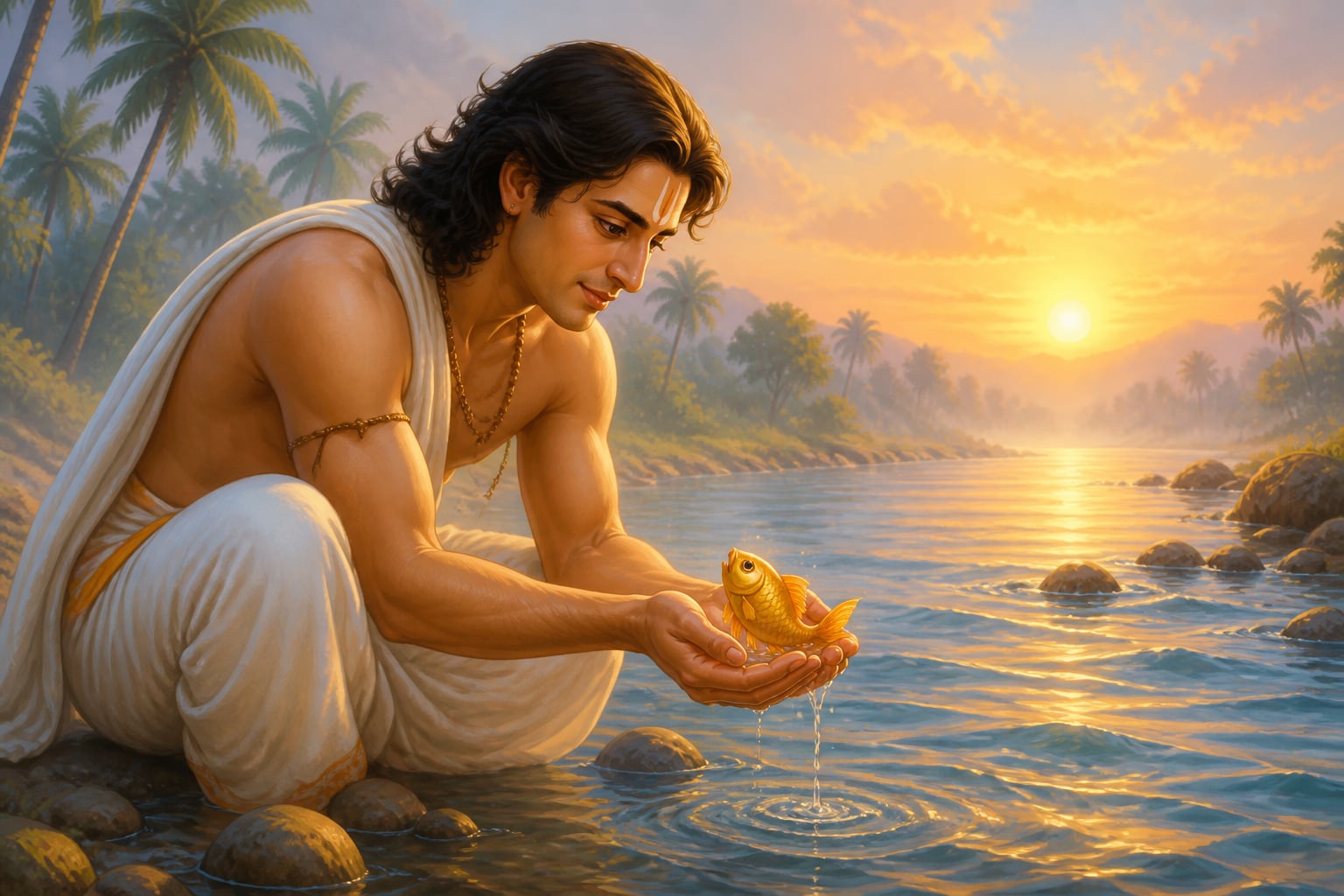
King Satyavrata holding a tiny fish in his cupped palms at sunrise

In the water was a tiny fish - so small it could fit in his palm.

'O King,' the fish spoke, 'please protect me. The larger fish in this river seek to eat me. Save my life, and I will be of great service to you.'

Satyavrata was startled - a talking fish! But his dharma was clear: a creature had sought his protection. He placed the fish in his water pot and took it home.

By morning, the fish had grown. It no longer fit in the pot.

'Please, O King, find me a larger home,' the fish requested.

Satyavrata transferred it to a large tank. By the next day, the fish had outgrown that too. He moved it to a well, then a pond, then a lake. Each container became too small within hours.

The Recognition

Finally, Satyavrata carried the now-enormous fish to the ocean. As he released it into the waves, he realized the truth.

'No ordinary creature grows like this,' Satyavrata said. 'You have repeatedly sought my protection, and I have repeatedly provided it. Now I understand - You are testing me, O Lord. Reveal Your true form!'

The fish smiled - if fish can smile. And then, in the waters of the ocean, its form expanded to cosmic proportions. A golden fish, miles in length, with a single horn rising from its head like a mountain peak. Its scales shimmered with the light of countless suns.

'Well recognized, O King,' Matsya spoke. 'You have passed the test of dharma. You protected the weak without questioning, without calculating benefit to yourself. For this, you shall be preserved when all else is destroyed.'

The Coming Deluge

Matsya then revealed the future:

'In seven days, the cosmic dissolution will begin. Rain will fall without ceasing. The oceans will rise beyond their boundaries. All land will be submerged. All creatures will perish. The universe will become a single, infinite ocean with no shore in any direction.'

Satyavrata listened with growing alarm. 'What can be done, O Lord?'

'Build a massive boat,' Matsya instructed. 'Gather in it the seeds of all plants, a pair of every species of animal, and the essence of all medicines. Invite the seven great sages (Saptarishis) to join you. When the waters rise, I will appear again. Tie your boat to my horn with the serpent Vasuki as your rope. I will guide you through the dissolution until the dawn of the new creation.'

The Building of the Ark

Satyavrata immediately began preparations. He had seven days - a cosmic blink, but in human time, enough to gather what was needed. His servants scoured the land for seeds, for eggs, for the essence of life in every form.

The seven sages - Bhrigu, Atri, Vasishtha, Vishwamitra, Gautama, Jamadagni, and Kashyapa - joined him. These were the mind-born sons of Brahma, the repositories of Vedic knowledge who had preserved wisdom across countless ages.

The boat was built, vast enough to hold the seeds of a world.

And then the rains began.

The Deluge

At first, it seemed like ordinary monsoon rain - heavy, relentless, but familiar. Then the rivers began to swell beyond any previous flood. Then the seas themselves began to rise, as if pulled by an invisible force.

Water poured from the sky and rose from the earth simultaneously. The boundaries between land and water, between river and sea, between atmosphere and ocean - all dissolved. The world became water.

Satyavrata and the sages boarded the boat as their kingdom disappeared beneath the waves. Cities vanished. Mountains became islands, then submerged entirely. Soon there was nothing visible in any direction but water - dark, churning, infinite.

And then, emerging from those primordial waters, came Matsya.

The fish was now truly cosmic in scale. Its body stretched to the horizons. Its golden scales illuminated the dark waters like a second sun. And its horn rose high above the waves, a mountain peak in an ocean world.

'Tie your boat to my horn,' Matsya commanded.

Vasuki, the great serpent, offered himself as the rope. His endless coils wrapped around the boat's prow and secured it to Matsya's horn. And then, the fish began to swim through the waters of dissolution.

The Matsya avatar pulls King Satyavrata's ark through the deluge waters with his horn.

The Teaching on the Waters

For an entire cosmic night, Matsya pulled the boat through the endless ocean. But this was not merely a journey of physical preservation. As they traveled, Matsya taught.

He explained the nature of the self (atman) and its relationship to the cosmos. He revealed the secrets of karma and rebirth. He described the evolution of consciousness through multiple lifetimes. He taught the paths of yoga, of devotion, of knowledge.

This teaching became the foundation of what would later be known as the Matsya Purana - the scripture of the Fish, containing wisdom imparted during the darkest hour of cosmic dissolution.

Satyavrata absorbed every word. The seven sages, though already wise beyond measure, found new depths of understanding. The seeds and creatures in the boat, though dormant, received the subtle vibration of this teaching, which would flower in the next creation.

Matsya battling Hayagriva to reclaim the stolen Vedas

The Battle with Hayagriva

But Matsya had another task. Somewhere in these infinite waters lurked Hayagriva, the demon who had stolen the Vedas.

Matsya's fish form was uniquely suited for this hunt. Moving through the waters with impossible speed, sensing vibrations that traveled through the cosmic ocean, Matsya tracked the demon to his hiding place.

The battle was fierce but brief. Hayagriva fought with demonic power, but against an avatar of Vishnu, there could be only one outcome. Matsya's horn became a weapon, piercing through Hayagriva's defenses. The demon fell, and from his grasp tumbled the Vedas - the stolen knowledge that would make the next creation possible.

Matsya retrieved the Vedas and held them safe until Brahma would awaken to receive them.

The New Dawn

Time moves differently during cosmic dissolution. What felt like an eternity to those in the boat was, in cosmic terms, a single night. And eventually, as all nights must, this night ended.

Brahma stirred from his sleep. With the Vedas restored to him, his creative power returned. The waters began to recede - not evaporating, but reconstituting themselves into the elements from which worlds are made.

Land appeared. Mountains rose. Rivers found their courses. The sun returned to its position in the sky.

And Satyavrata's boat came to rest on the peaks of the newly emerged Himalayas.

Matsya spoke one final time:

'O Satyavrata, you have preserved dharma through the dissolution. In the new age, you shall be known as Vaivasvata Manu - the progenitor of this humanity. From the seeds you have saved, life will spread across the earth. From the wisdom you have received, civilization will be established. You have been the instrument of continuation.'

With that, Matsya disappeared into the retreating waters. The Fish Avatar's mission was complete.

The Meaning of Matsya

Why did Vishnu choose to incarnate as a fish for this mission? The symbolism is profound:

Adaptation: Fish thrive where land creatures drown. When the world became water, only a water-being could navigate it. The Lord takes the form most suited to the task at hand.

Small beginnings: Matsya began as a tiny fish seeking protection. The greatest cosmic mission started with the smallest creature asking for help. Those who protect the weak may find themselves protecting the universe.

Growth through care: Each time Satyavrata provided a larger home for the fish, he was practicing dharma. That practice prepared him for the ultimate responsibility - preserving all life through the deluge.

The fish and the hook: In many traditions, the fish represents the soul and the ocean represents samsara (the cycle of rebirth). The divine fish moves freely through the waters of existence, guiding those who are lost.

Matsya is typically considered the first of the ten avatars (Dashavatara), appearing at the dawn of the cosmic cycle to ensure that knowledge and life continue from one creation to the next.

Living traditions

The Matsya story influences contemporary conservation ethics in India. The idea that protecting a small fish can have cosmic consequences encourages environmental protection. Many river cleanup initiatives invoke Matsya, arguing that protecting aquatic life is a dharmic duty. The story also appears in disaster preparedness literature - Matsya's warning and Satyavrata's preparation parallel modern emergency planning. The 'boat of seeds' concept has inspired seed banks and biodiversity preservation efforts.

Reflection

More in Skanda 8: Withdrawal

All lessons in Skanda 8: Withdrawal ยท Srimad Bhagavatham course