Tripura: Three Cities, Three Illusions

One arrow, three bodies undone

Three asura brothers receive three flying cities, one of gold, one of silver, one of iron, and a boon that makes them invincible as long as the three cities do not align. They become unconquerable for a thousand years. Shiva waits for one moment when the three align, draws a single arrow, and fires.

Three Brothers, Three Boons, Three Cities

Long after the great churning of the ocean, in a stretch of cosmic time when the asuras and devas were still arguing over who had the better claim to the universe, the demon Taraka had three sons. Tarakaksha, Vidyunmali, and Kamalaksha. They were brothers in the way only asura brothers can be in the Puranas, perfectly aligned, perfectly disciplined, and perfectly committed to a goal the gods would later regret allowing.

They went into deep tapas. Years passed. The mountains they sat on began to look slightly different from the weight of their stillness. Brahma, eventually, came to grant a boon.

The brothers had thought carefully. They knew the standard asura mistake. Asking for immortality outright was always refused. Asking for protection from a single named god could be circumvented. So they crafted their boon as a riddle.

"Build us three cities. One of gold, one of silver, one of iron. Place them in the sky, in the air between earth and sky, and on the earth. Let them move freely. Let them be invincible from every weapon, every god, every direction, except one. Let our death come only from a single arrow that strikes all three cities at the same instant, when they happen to align in a single line, and only that."

Brahma, who had to honour the discipline of their tapas, granted it. He warned them, gently, that the alignment of three flying cities into a single straight line was a thousand-year event. They would, by any practical measure, be immortal.

The brothers laughed.
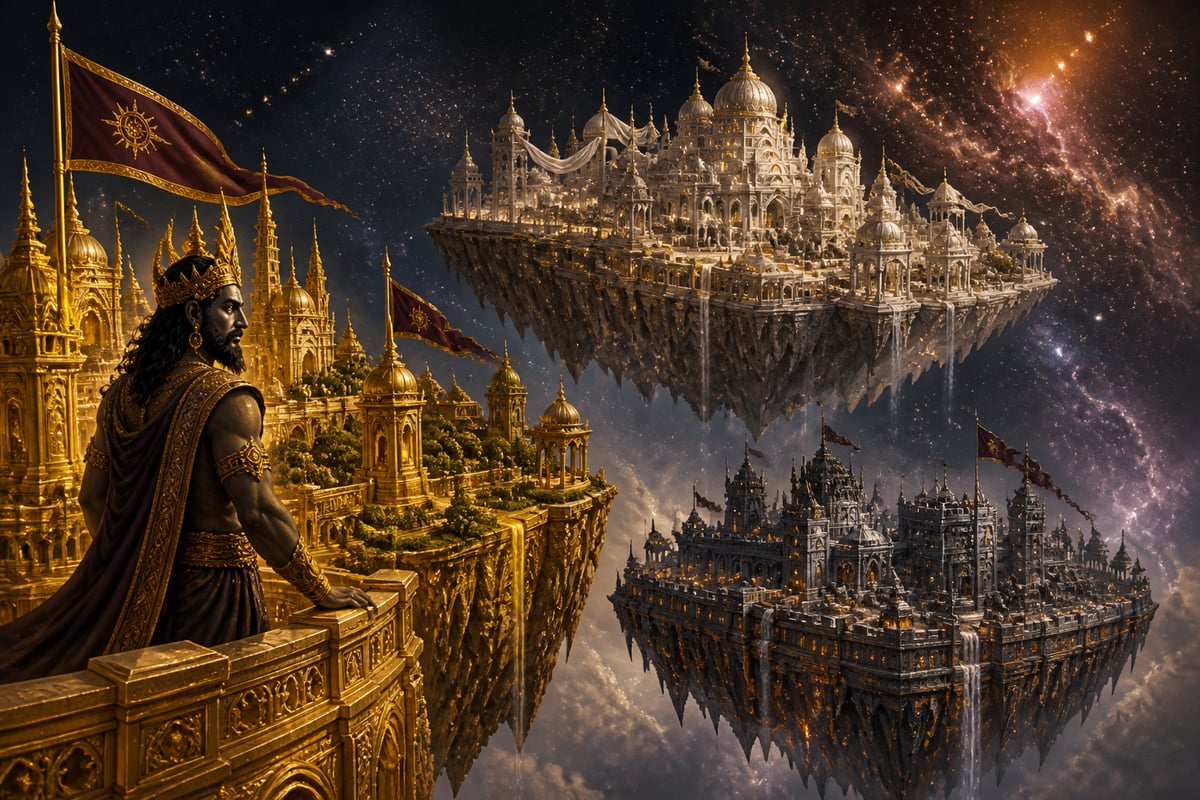
The three flying cities of gold, silver, and iron drifting in cosmic space

The great architect Maya, the asura craftsman, built the three cities. Saubha of gold rode high in the sky. Saubha of silver floated in the air. Saubha of iron rolled on the earth. The cities were each enormous, full of palaces, gardens, libraries, war-chambers. The brothers ruled them. From the protection of the three cities, they began, slowly, the work that all asuras eventually do. They troubled the gods. They troubled the rishis. They troubled the worlds.

The Gods Walk to Shiva

The gods fought back. Indra threw his vajra and it bounced off the city walls. Vishnu shot his Sudarshana chakra and it returned, baffled. Brahma could not revoke his own boon. The years grew long. Eventually, in the way the Puranas often resolve their hardest problems, the gods walked to Kailasa.

They told Shiva the story he already knew. They asked him to do what he does. He listened. He nodded.

Then, before he agreed to anything, he insisted on a strange thing. He told them they would have to build him a chariot worthy of the deed.

"This is not a chariot you can fetch from a shed. This is a chariot in which every part must be a god. Anything less will not hold the weapon I am about to make."

The gods, exhausted but obedient, set to work.

A Chariot Made of Gods

The Shiva Purana lingers on this image because it is, in the end, the picture the whole story is built around.

The chariot itself was the Earth, the living goddess Bhumi, becoming a vehicle. Her body, her mountains, her rivers, her seas, all of it. The two great wheels were the sun and the moon, turning in their tracks as the chariot moved. The four horses pulling it were the four Vedas, harnessed at last to a single arrow. The reins were the breaths. The driver was Brahma himself, holding the reins of the four Vedas with the calm of the creator who had set this entire problem in motion. The flagpole was Mount Mandara. The flag was the great snake Vasuki.

The bow was Mount Meru, the cosmic axis itself, bent to a curve. The bowstring was the serpent Anantaka, stretched taut. The arrow had as its shaft the eternal Vishnu. As its tip, the fire god Agni. As its feathered tail, the wind god Vayu. The whole arrow was the universe pointed at a single instant.

Shiva, smeared with ash, the third eye half open, mounted the chariot. He took the bow. He laid the Vishnu-Agni-Vayu arrow against the Anantaka string. He drew the bow halfway, and waited.

Shiva as Tripurantaka drawing the cosmic bow as the three cities align

This is the iconographic moment the tradition calls Tripurantaka, Shiva the ender of the three cities. It is one of the most depicted scenes in all of Shaiva sculpture. The Brihadeeswara temple in Thanjavur carries it on a wall panel ten feet across. The Pallava cave at Kailasanatha at Kanchipuram preserves it in stone from the eighth century. Every Tripurantaka image is the same instant, frozen: the bow drawn, the arrow ready, the universe waiting for the alignment.

The One Instant

For a long time the cities did not align. Days, months, years. The asura brothers grew complacent. The gods grew impatient. Shiva did not move. He held the bow. He breathed. The instant the universe gives, the universe gives once.

And then, in a single moment, the three cities crossed paths. Saubha of gold above Saubha of silver above Saubha of iron, all on a single vertical line for one heartbeat.

The arrow released.

The Shiva Purana describes the strike with restraint. The three cities did not explode. They burned. They burned because the arrow's tip was Agni, and because the cities themselves, beneath their architecture, were always going to burn. The brothers, the architect, the palaces, the gardens, all dissolved into a single fire that crossed all three altitudes at once. The fire faded. The sky was empty. The air was empty. The earth was empty.

It is said Shiva smiled, gently, and lowered the bow. He returned the chariot to the gods. He went back to his meditation. The gods went back to their work. The universe resumed.

The story is, on its surface, a great Puranic war story. But it is not, in the end, only a war story.

A meditator with the three bodies of gross, subtle, and causal slowly aligning

Adi Shankaracharya's Reading

In his commentary on the Tripura Tapini Upanishad, Adi Shankaracharya does something that has shaped how every serious Shaiva has read this story since. He says, plainly, that the three cities of Tripurasura are the three bodies of every human being.

The sthula sharira, the gross body, the iron city. Made of food, weight, mass. The body that walks and eats and tires. This is what most people think of when they hear the word body.

The sukshma sharira, the subtle body, the silver city. Made of breath, mind, emotion, memory. The body of dreams. The body that travels in sleep. The body in which most of your suffering and most of your inner life happens.

The karana sharira, the causal body, the gold city. Made of pure tendency, the deep root of who you are. The body of your samskaras, the seeds of your conditioning, the not-yet-acted future you carry. This is the body that survives across lifetimes, in the traditional reading. It is also the most invisible, the most difficult to find, and the most central.

Three bodies. Three cities. Each one moving in its own register. Each one, for most people, troubling the others most of the time.

The Tripurasura war is the story of how all three are ended at once.

What an Arrow Is

If the cities are the three bodies, the arrow is consciousness. Not consciousness as a vague abstraction. The specific, focused, undivided consciousness in which the three bodies are seen as bodies, recognised as appearances, and released into the formless that holds them.

This is why the chariot has to be made of gods. Ordinary attention cannot do this work. The fire that ends the three cities is not a fire generated by effort. It is the fire that is already burning at the heart of the cosmos, drawn into a single shaft by the will of the practitioner. The bow is the spine. The string is the breath. The arrow is the light of consciousness pointed inward.

The one instant in which all three cities align is the rare, precious moment in meditation when the gross body, the subtle body, and the causal body all become visible at once. Most practice is not yet at that depth. The cities are not aligned. They drift in their separate orbits. The arrow waits.

When the alignment comes, the practitioner does not have to act. The arrow releases itself. The three cities burn. What remains is the practitioner, no longer separated into three layers, recognised as the consciousness that was always holding all three.

This is the meaning the Shaiva tradition has carried for two thousand years inside the war story.

The 2026 Version

Most contemporary suffering is the felt confusion of the three bodies. The gross body is exhausted by work. The subtle body is full of unprocessed feeling. The causal body, full of old patterns and old fears, drives both without being seen. Most self-help addresses one of the three at a time. Diet for the gross body. Therapy for the subtle body. Coaching, sometimes, for the causal body.

The Tripurasura story is the tradition's claim that working on each body separately is endless. The three cities will keep drifting. The asura brothers will keep ruling. The work of a deeper kind of attention is to wait for the alignment and to let the single arrow do its work.

This is not magical thinking. The alignment happens, in small doses, in any honest practitioner's life. A single hour in deep meditation when the body, the breath, and the underlying pattern all become visible at once. A single conversation with a great teacher in which all three are seen and named. A single grief that strips you down enough that you cannot tell the body from the breath from the deep tendency. In those moments, the arrow is already drawn. What is asked of you is only to not flinch.

A Quiet Closing

The Shaiva tradition's most haunting images are often the most still. The Tripurantaka image is one of them. A god, smeared with ash, on a chariot made of the earth and the sun and the moon, holding a bow made of a mountain, waiting for three cities to align so that one arrow can end them.

It looks, at first, like a war scene.

It is, in the end, a meditation manual.

The three cities are inside you. The chariot is your own embodied life. The bow is your spine. The string is your breath. The arrow is your attention. And Shiva, in his ash and stillness, is the part of you that already knows how to hold the bow steady and wait for the instant the universe gives, and gives, and gives only when it is ready.

Living traditions

The Tripurasura story has had a quietly extraordinary modern afterlife. The three-bodies doctrine that Adi Shankaracharya extracted from it is now the standard psychological vocabulary of every classical Indian wellness school, including the major modern transmissions of yoga in the West through B.K.S. Iyengar, Pattabhi Jois, T.K.V. Desikachar, and Swami Sivananda's Divine Life Society. The Tripurantaka iconography appears on Indian postage stamps, on the cover of UNESCO publications about the Brihadeeswara temple, and in the logos of several Indian classical music and dance institutions, where the bow-drawn pose has become a metaphor for cultivated readiness. In contemporary cinema, S.S. Rajamouli's RRR and Baahubali drew on Tripurantaka iconography for several of their most striking action compositions, with the director acknowledging the Shaiva sources directly in interviews. The phrase ekena banena, with a single arrow, has become a Sanskrit shorthand quoted in management literature, leadership books, and even Indian Supreme Court judgements as a symbol of the principle that great works are completed in single decisive acts after long readiness. Across all of it, the lesson the Shiva Purana embedded in a war story remains intact, alive, and quietly working its way through the inner lives of practitioners who may never know exactly where they first met it.

Reflection

More in Demons and Transformations

All lessons in Demons and Transformations ยท Shiva Purana course