Samudra Manthana: The Great Churning

Poison and nectar from the same ocean

The gods and demons churn the ocean of milk together, not out of friendship but out of need. The first thing to emerge is not nectar but a poison that can end the world. The chapter on demons opens here, with a crisis no one planned for and a decision only one god can make.

Indra's Thousand Marks
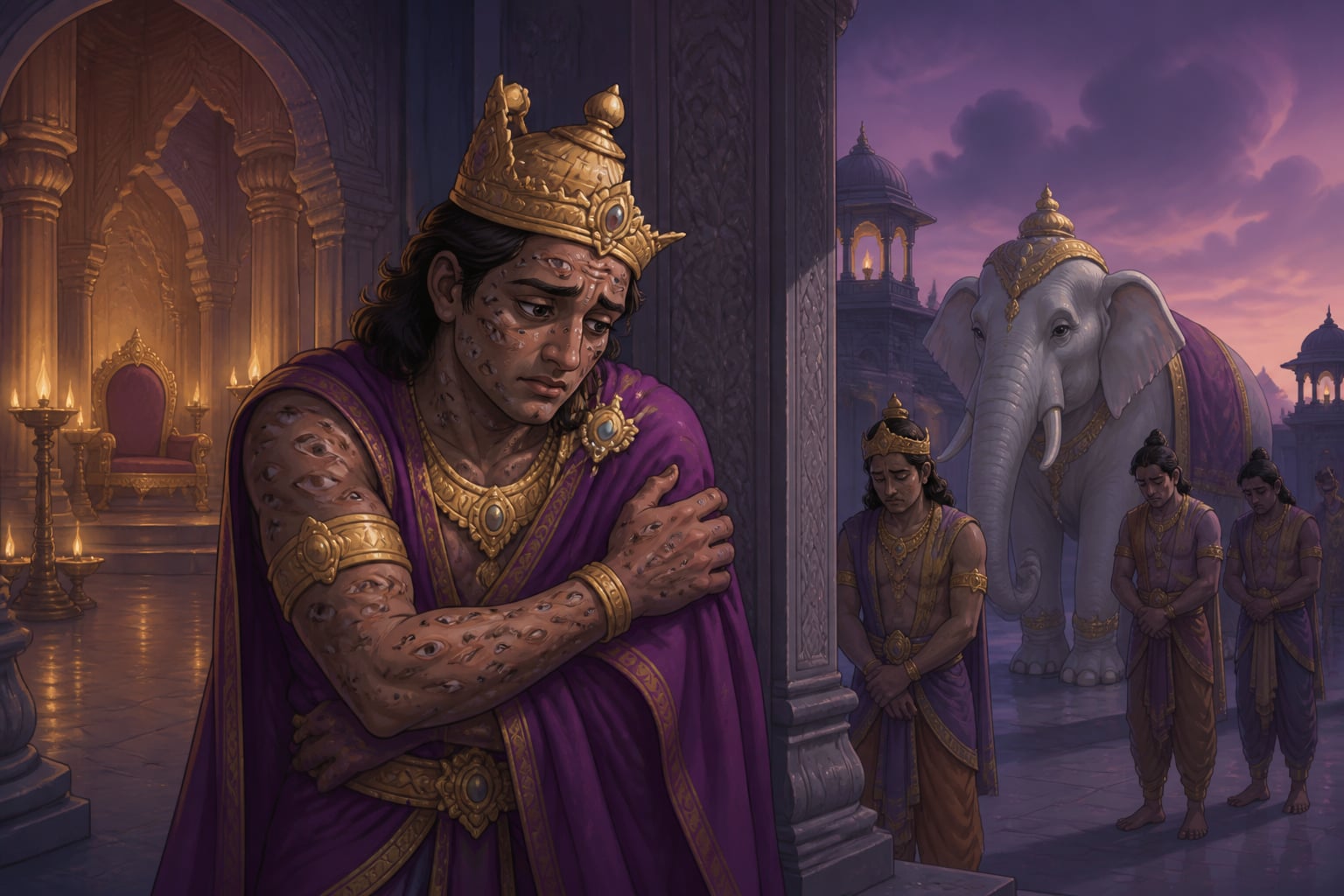
Indra hiding in shame, his body covered in the thousand marks of Gautama's curse

The Shiva Purana opens its chapter on demons with a story that has nothing to do, on the surface, with a demon. Indra, the king of the gods, has visited the ashram of the sage Gautama in disguise and slept with Gautama's wife, Ahalya, who is among the most beautiful women in the worlds and who, the Purana says with care, was deceived rather than complicit.

Gautama returns and sees what has happened. The Shiva Purana version of the curse is unusually precise. Gautama does not curse Indra to death. He curses Indra's body to be covered, immediately and visibly, in a thousand marks of yoni shape, the very symbol of what Indra had been chasing. The desire that had been hidden in his mind would now be written across his skin where every god could read it.

Indra, humiliated, hides for years. He cannot enter the assembly hall. He cannot lead his armies. The other gods do not jeer at him. They do not need to. The marks speak for themselves.

Eventually Indra goes to Shiva at Kailasa. He prostrates. He asks not for the marks to be removed but for them to be transformed into something that can be carried with dignity. Shiva, in the Purana's reading, performs an act that is the chapter's hidden key. He turns the thousand yoni-marks into a thousand eyes. Indra is now Sahasraksha, the thousand-eyed one. The shame becomes sight. The desire that had been blind becomes the capacity to see.

This is the frame the Purana places at the head of the entire chapter. Every demon in the chapters that follow is an inner pattern. The pattern, named honestly and offered to Shiva, becomes a faculty rather than a wound. The Manthana that follows in this lesson, the Halahala that follows in the next, the Tripura, the Andhaka, the Jalandhara, the Bhasmasura, the Gajasura, the Bhairava, are all read through this opening lens. The reader is being told, before the chapter begins, that what looks like a battle in each story is really a confession turned into a faculty.

The Churning Begins

With the Indra-Ahalya frame in place, the Purana turns to its first great demon-and-treasure story: the Samudra Manthana, the churning of the ocean of milk.

The gods, the devas, and the demons, the asuras, are not natural collaborators. The Vedic and Puranic literature shows them at war across the cosmic ages. But on this occasion, both sides have a problem. The devas have been weakened by a curse from the sage Durvasa and have lost their immortality. The asuras have not weakened, but they too have been told by Brahma that the cosmos is heading towards an imbalance neither side can fix alone.

Vishnu suggests the unthinkable. The two sides must collaborate, exactly once, to churn the Kshira Sagara, the ocean of milk. From the depths of that ocean, fourteen treasures will rise. The pot of amrita, the nectar of immortality, will be the last to emerge. If the work is done together, both sides will have access to it.

The asuras agree, with a private understanding that they will take the amrita for themselves at the end. The devas agree, with a private understanding of the same. Vishnu, who knows both private understandings, agrees with his own.

Mount Mandara and the Serpent Vasuki

The churning needs a rod and a rope. Mount Mandara, the central peak of the cosmic geography, is uprooted and placed in the ocean as the churning rod. Vasuki, the king of serpents, agrees, after some persuasion, to be wound around the mountain as the churning rope. The asuras take the head of the serpent. The devas take the tail. They begin to pull.

For a few moments the churning is steady. Then Mount Mandara, with no foundation in the ocean floor, begins to sink. The work threatens to end before it has begun.

Vishnu enters the water in the form of the giant tortoise, Kurma, and slides beneath the mountain. The mountain settles on the back of the tortoise. The churning resumes. The Purana lingers on this image because it carries one of the chapter's quieter teachings. Every great collaboration eventually finds itself sinking under its own weight. What keeps it going is something underneath, often unseen, that has agreed to bear the weight without being noticed.

Devas and asuras churn the ocean of milk with Mount Mandara and Vasuki

The Halahala

For a thousand years they pull. The ocean foams. The mountain spins.

The first thing to emerge from the ocean is not a treasure. It is the Halahala, sometimes called Kalakuta, the world-ending poison. The Purana describes it as a black smoke rising out of the water, so toxic that the leaves on the surrounding hills wither, the air becomes unbreathable, and the gods and demons alike begin to fall back from the work, choking.

This is the chapter's central teaching condensed into a single image. The poison comes first. Every long collaboration, every long work, every long marriage, every long enterprise, releases its poison before it releases its treasures. The collaborators almost always assume the poison is a sign that the work has gone wrong. The Shiva Purana corrects this assumption directly. The poison is not a sign that the work has gone wrong. The poison is what comes up first when anything is churned long enough to bring its real treasures to the surface.

The gods and demons turn to each other. Neither side can hold the Halahala. To inhale it is to die. To touch it is to die. To leave it on the surface is to lose the entire cosmos to its smoke.

They turn to Shiva.

Shiva at the Throat

Shiva is in meditation when the request reaches him. The Purana says he opens his eyes, takes one look at the situation, and walks down to the shore.

He does not ask the gods why they began a churning they could not finish. He does not ask the demons what they intended to do with the amrita. He does not ask why he was not consulted before the work began. The Purana lingers on this absence of reproach because the lesson is precise. When the poison is rising and the cosmos is at risk, the question of who is responsible is not the most useful question in the room.

Shiva cups his hands and gathers the Halahala. He raises it to his lips. Parvati, watching from beside him, does what only Parvati can do. She places her palm at his throat, between his lips and his stomach. The poison is held, by her grace, exactly at the throat. It cannot move further. It cannot kill the body that is offering to hold it.

Shiva swallows. The Halahala stops at his throat. His skin and his throat begin to turn blue. From this moment Shiva is Neelkantha, the blue-throated one. The next lesson takes up this name in detail. For now, the chapter has its image. The work continued. The cosmos was not lost. Someone agreed to hold what no one else could hold, and what was held did not destroy him because someone else agreed to hold him.

The fourteen treasures of the churning rising in luminous procession from the ocean

The Fourteen Treasures

With the Halahala held, the churning resumes. The Purana lists the treasures in their order of emergence. The list varies slightly across the texts. The Shiva Purana's list, with its fourteen items, is the canonical Shaiva enumeration.

Order Treasure Sanskrit Significance
1 The world-ending poison Halahala Held by Shiva
2 The wish-fulfilling cow Kamadhenu Source of every offering
3 The wish-fulfilling tree Kalpavriksha Source of every desire fulfilled
4 The seven-headed horse Uchhaishravas Speed and royalty
5 The four-tusked elephant Airavata Indra's mount
6 The Kaustubha jewel Kaustubha Worn by Vishnu on his chest
7 The celestial nymphs Apsaras Beauty and the arts
8 The goddess Lakshmi Sri Auspiciousness, prosperity, dharma
9 The intoxicating drink Varuni / Sura Pleasure that needs to be held carefully
10 The moon Chandra Worn by Shiva on his head
11 The Parijata tree Parijata The fragrant tree of Indra's garden
12 The conch Panchajanya Held by Vishnu
13 The bow Sharanga Held by Vishnu
14 The pot of nectar Amrita Held finally by Vishnu as Mohini

The lesson invites the reader to notice the sequence. The poison is first. The amrita is last. Between them, the treasures emerge in a careful pedagogical order. The cow before the tree. The horse before the elephant. The jewel before the nymphs. The intoxicating drink in the middle, as a reminder that not every treasure is unambiguous. Then the moon. Then the bow. Only at the very end, after thirteen prior emergences, the amrita itself.

The collaborators, the Purana says, had to do the work for a thousand years before the last pot rose. Most modern readers, encountering long-form collaborative work, want the amrita on day one. The Manthana is the dharmic correction.

What the Churning Teaches

The lesson reads three things directly out of the iconography.

First, the poison comes first. The collaborator who flees the work the moment the Halahala rises will never see the amrita. The Halahala is not a sign that the collaboration was wrong. It is the unavoidable first emergence of any deep churning.

Second, the work needs the bearer. Every long collaboration produces a moment when something has emerged that no one in the room can hold by their own resources. In that moment, the work either ends or it finds the figure willing to hold what no one else can hold. The figure may not be the founder. The figure may not be the most powerful. The figure is, simply, the one who steps forward when the smoke rises. The Shiva Purana names this figure as Shiva. Every real collaboration has its Shiva.

Third, the bearer needs to be held in turn. Even Shiva, holding the Halahala, would have died had Parvati not placed her palm at his throat. The bearer of the poison is not a hero standing alone. The bearer is supported by someone who knows precisely where to place the palm. Most modern leadership writing about resilience misses this entirely. The point is not to swallow the poison alone. The point is to be held, by someone, at the exact place where holding is needed.

The Modern Frame

The organisational theorist Ronald Heifetz at the Harvard Kennedy School, in his 1994 book Leadership Without Easy Answers and his 2002 book Leadership on the Line, named what he called adaptive work, the kind of long collaborative work that requires people to change their values, habits, and assumptions rather than simply apply known techniques to a known problem. Heifetz observed that adaptive work always produces a period of intense distress in the system, a period he called disequilibrium, before any real progress emerges. Most leadership in his data fled the disequilibrium and, as a result, never reached the work's actual treasures. Heifetz's central recommendation was that the leader's job in adaptive work is not to remove the disequilibrium but to regulate it, to hold it at a level the system can bear without collapsing.

The Shiva Purana, in its image of Shiva at the throat with Parvati's palm, gave this teaching iconographic form a thousand years earlier. Hold the disequilibrium. Do not let it kill the body. Do not let it dissipate. Hold it precisely at the throat, where it can be transformed without poisoning the work.

The rest of the chapter, lesson by lesson, will name seven further demons: the world-ending poison Halahala in lesson two, the three illusory cities of Tripurasura, the blind son Andhakasura, the two paired husbands Shankhachuda and Jalandhara, the fire-craving Bhasmasura, the elephant-skin demon Gajasura, and the terrifying Bhairava. Each demon is, in the chapter's framing, an inner pattern. Each pattern, like Indra's thousand marks at the start, has the potential to become a faculty if it is named honestly and held by what is willing to hold it. The Manthana is the door. The poison is the price of admission. The amrita is at the end. The dance continues, and the throat is willing.

Living traditions

The Samudra Manthana has had one of the longest geographic and intellectual reaches of any Hindu image. The twelfth-century Angkor Wat in Cambodia includes a 49-metre stone bas-relief of the churning along its eastern gallery, one of the finest narrative reliefs anywhere in the world. The Khmer Empire used the Manthana as the iconographic basis for its state. The image traveled across Southeast Asia with Hindu civilisation between the seventh and the fourteenth century CE and is preserved today at the entrances of Suvarnabhumi Airport in Bangkok and the Royal Palace in Phnom Penh. The Kumbh Mela, held every twelve years at the four sites where drops of amrita fell, is the world's largest religious gathering, with the 2025 Maha Kumbh at Prayagraj drawing over 660 million pilgrims. In contemporary thought, Ronald Heifetz's adaptive leadership framework at the Harvard Kennedy School translates the Halahala-holding act into modern organisational language as 'regulating the disequilibrium'. Bharat's central bank, the RBI, has used the Manthana as a metaphor for economic reform in multiple Governor's speeches across the 2010s. The image remains, a thousand years after its Puranic refinement, the dharmic tradition's most exported single statement about the nature of long collaborative work.

Reflection

More in Demons and Transformations

All lessons in Demons and Transformations ยท Shiva Purana course