Bhasmasura: The Boon That Consumes
Mohini's dance and why granting every wish is not kindness
An asura named Bhasmasura performed tapas and asked for one boon: whatever head he placed his palm on should turn to ash. Shiva granted it. Bhasmasura immediately raised his hand toward Shiva's own head. This lesson reads what happens next and what the Purana is saying about power given without wisdom.
A God Who Says Yes Too Easily
This chapter has been a procession of inner demons. Indra's desire as Ahalya's curse. The poison of the milk ocean as the daily burden. Tripura as the three illusions. Andhaka as desire gone blind. Shankhachuda and Jalandhara as the same pattern scaling across generations. Each demon, the chapter has been arguing, is a pattern in your own mind given a face.
This lesson introduces a different kind of demon. Bhasmasura is not the demon of an obvious sin. He is the demon of a wish granted.
His name, Bhasmasura, is built from two words. Bhasma means ash. Asura means a power of resistance. Bhasmasura, then, is the asura whose power is to make ash. He will become exactly his name, in exactly the way the name promised, and the cosmos will spend the rest of the story watching it happen.
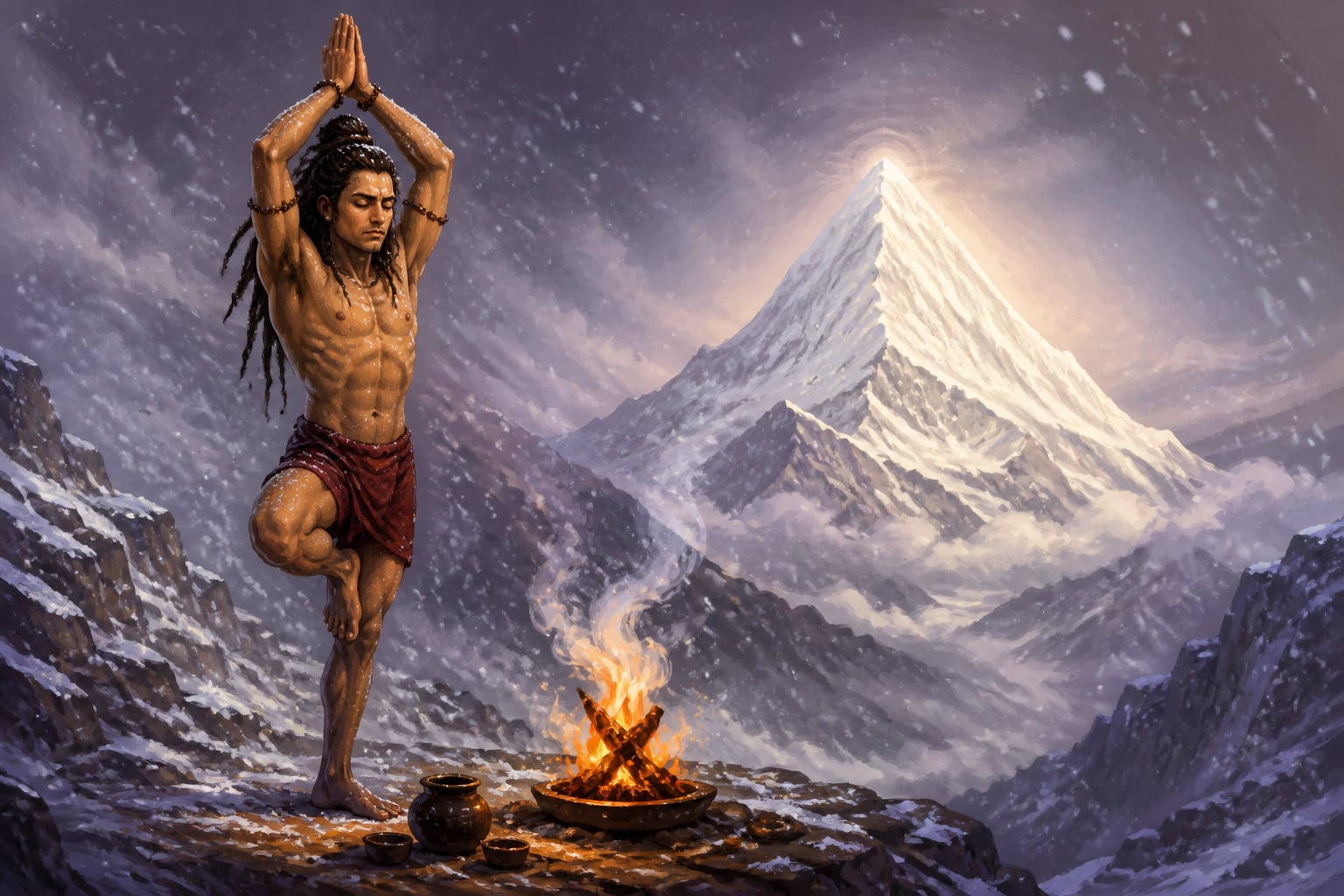
The story begins with a long tapas. An asura named Vrikasura, in some versions, sits in the forest and burns through years of meditation. He builds heat. He builds focus. He builds, eventually, enough force that Shiva must appear. Shiva, the god of the cremation ground, has a particular weakness: he cannot ignore a sincere tapas. When the heat is real, he comes. The Shiva Purana names this directly. Shiva is Ashutosha, easily pleased. He gives boons quickly. The very quality that makes him beloved is also the quality that, in this story, will create the disaster.
Vrikasura asks his boon. Whatever head I touch with my palm, let it instantly become ash.
Shiva pauses. The Shiva Purana says, plainly, that he saw the trouble coming. He could foresee what an unstable mind would do with such a power. But he had said yes already, in a sense, by appearing. And he believed, in the deeper Shaiva logic, that some lessons can only be taught by letting the boon play itself out. He granted it.
Bhasmasura, now in his new name, did exactly what an unstable mind does when given an instrument of immediate destruction. He looked around for the most impressive head to test it on. The most impressive head, in the cosmos, was Shiva's.
He turned and walked toward Shiva.

A God Who Runs
Shiva, the cremation-ground god, the destroyer of Kamadeva, the killer of Tripurasura with a single arrow, the one who drank the cosmic poison, ran.
This is one of the most striking moments in the Shiva Purana. The most powerful god in the iconography, who has not been afraid of any foe in any other story, picks up his trishula and his deer-skin and runs. He runs across the Himalayas. He runs across rivers. He runs across plains. Bhasmasura, palm raised, follows.
The Puranic narrators are not embarrassed by this scene. They want it to be embarrassing. The point is exact. Shiva, in this moment, is teaching something that he could not teach by dignified resistance. He is showing that even the most powerful god in the room is not immune to the consequences of his own carelessness. The boon was a real boon. Shiva had given it. Now Shiva had to live inside the world he had created.
This is the first half of the lesson. A power can be granted. Once granted, it cannot be wished away. The grantor is responsible for the world that the grant has now changed. Shiva, running across the Himalayas, is a god confronting his own decision. There is no shortcut.
Vishnu Watches
Vishnu, watching from Vaikuntha, understood. He also understood that the situation could not be solved from outside. Bhasmasura's boon required Bhasmasura's own choice to undo it. The only way out was a path that the asura would walk himself.
Vishnu took the form he had used during Samudra Manthana. He became Mohini, the most beautiful enchantress in the cosmos. The same form that had once distracted the asuras into giving up the amrita pot was now going to distract one specific asura into giving up his own life.
Mohini appeared on the path Bhasmasura was walking. The asura, mid-pursuit of Shiva, stopped. He had never seen anything more beautiful. He proposed marriage on the spot.
Mohini smiled. I will marry you. But only if you can dance as well as I do. I am, after all, a dancer first.
Bhasmasura, eager, agreed.
The Dance That Burns
Mohini began to dance. The dance was not a battle. It was not even an obvious trick. It was simply a sequence of postures, the kind a master dancer might teach a student. Bhasmasura, charmed, mirrored her. Hand here. Hand there. Foot here. Foot there.
The Shiva Purana lingers on this section. It is unusual in the Puranas for a dance to be the climax of a demon-killing. Mohini was patient. She showed each posture twice, three times. She let Bhasmasura settle into the rhythm. She gave him no reason to suspect.
Then, slowly, she lifted her right palm. She placed it on the crown of her own head. The gesture was natural. It was elegant. It belonged in the dance.
Bhasmasura, hypnotised by her, mirrored her perfectly.
He placed his right palm on the crown of his own head.

The boon worked exactly as Shiva had granted it. Whatever head his palm touched, that head turned instantly to ash. Bhasmasura's head, which his palm had touched, was the head that turned to ash. There was no announcement. There was no struggle. There was a small heap of ash on the ground, where there had been a demon a moment before.
Mohini stopped dancing. Vishnu walked back to Vaikuntha. Shiva, hidden behind a hill, watched the ash and let out the breath he had been holding for a long time.
The Lesson the Boon Was
The story is sometimes told as if Mohini was clever and Bhasmasura was stupid. The Shaiva tradition reads it differently. The trick worked because Bhasmasura had already trapped himself. The boon was not a separate thing from the dance. The boon and the dance were the same act, played out across two scenes. The first scene was the boon. The second scene was the boon claiming its own price.
This is what the chapter has been calling the asura pattern. Tarakasura's perfect boon called forth the very child who would kill him. Mahishi's perfect boon called forth the only being who could end her. Bhasmasura's perfect boon, here, called forth the one moment of distraction that would direct his palm to his own head.
The pattern is consistent enough across the Puranas that it has the force of a law. Every airtight defence builds, into itself, the door of its own undoing. The asura believes he is making himself invincible. The cosmos hears him saying out loud, with great precision, where his only weak point will be. Bhasmasura announced that the head his palm touched would burn. The cosmos quietly arranged for that head to be his own.
The deeper Shaiva point is that this is not the cosmos taking revenge. It is the cosmos returning the asura's words to him with full integrity. The asura asked. The cosmos delivered. The asura did not specify, in his asking, whose head his palm could touch. The cosmos held him to the literal terms of his own boon. He had the freedom, every moment, to put his palm somewhere else. He chose, in the dance, to put it where Mohini put hers. The choice was his.
Why Shiva Granted It
The most uncomfortable question in the story is the one the Shiva Purana refuses to dodge. Shiva saw it coming. Why did he say yes?
The tradition gives several answers, and they are worth holding together.
First, Shiva is Ashutosha, the easily pleased. The same quality that lets a sincere devotee approach him is the quality that, in extreme cases, gives a boon to someone whose intentions are not pure. The tradition does not ask Shiva to become harder to please, because if he did, the Markandeyas and the Kannappas of the world would never have reached him. The same door that lets the devotee in lets the asura in. The Shiva Purana is honest about this trade-off rather than apologetic.
Second, Shiva believed that the boon had to be given for the lesson to land. A theoretical warning would not have worked. Vrikasura, until that moment, was an asura who thought he was being clever. He needed to walk inside the consequence of his own cleverness, fully, before the cleverness could be undone. The boon was the curriculum. The dance was the final exam.
Third, the tradition does not pretend that Shiva is omniscient in the calculating sense. He is the cosmic force of dissolution and renewal, not a chess player who is always forecasting twenty moves ahead. He is generous, present, and easily moved. These are virtues. They occasionally cost something. The cost is held inside the larger generosity, not as evidence against it.
The Modern Asura
The lesson lands closer to modern life than most demon stories.
Most contemporary asuras are people who have been granted a power without the maturity to hold it. The young manager handed authority over a team without first being trained to handle it. The platform whose engineers built a feature whose social consequences they had not modelled. The investor whose capital scaled a behaviour that was charming at small scale and corrosive at large scale. The parent whose child was given access to every device, every show, every screen, in the name of love. In each case, a boon was granted by someone who could foresee the trouble but said yes anyway, often for reasons that felt like generosity in the moment.
The Bhasmasura lesson sits at two levels.
The first level is the asker. If you are being granted a power you do not yet know how to hold, the boon you have asked for may be the boon that consumes you. Power, in the Shaiva reading, is not a neutral substance. It has its own gravity. A position, a sum of money, a follower count, a credential, a free hand, all of these reshape the asker. Without the inner work to hold the new shape, the asker becomes the next demon to receive a Mohini visit. This is why the dharmic tradition is so careful about teacher-disciple relationships. The teacher is not, primarily, transmitting techniques. The teacher is gauging whether the student has the inner room for the next power before granting it.
The second level is the grantor. If you are in a position to grant power, money, access, or trust, the Shiva Purana asks you to take seriously the asymmetry of your saying yes. A yes from the powerful is not a small thing. It rearranges the world for the asker. Shiva, the most generous god in the cosmos, still had to run across the Himalayas because of one yes. The lesson for every parent, every investor, every senior leader, every regulator, every platform owner, is that generosity that is not paired with discernment is not, finally, generosity. It is the seed of the next ash heap.
The contemporary world is full of Bhasmasuras who are being told, by the structures around them, that anything they want is theirs. Many of these structures consider this freedom. The Shaiva tradition would, gently, call it the granting of the boon. The dance always comes later.
The Inner Anchor
This lesson, like every lesson in this chapter, lands on an inner-transformation anchor. The anchor here is discernment, which is the older sibling of the more famous Shaiva anchors of detachment and stillness.
Discernment, in this tradition, is not cleverness. It is not the ability to see a trick coming. It is the ability to hold one's own desires up to honest light before asking the universe for them. Bhasmasura did not lack intelligence. He lacked the willingness to ask, before formulating his boon, what kind of person he wanted to become. The boon was the externalisation of an unexamined wish. Once externalised, it had to play itself out.
The practice the Shaiva tradition prescribes for discernment is simpler than its outcome. Before asking for any new power, sit with the wish for a long enough time that the wish stops disguising itself. The wish will, at first, present itself in its most flattering form. I want this so I can help others. I want this for the right reasons. Sit longer. The wish will begin to show its second layer, the layer it does not show in public. I want this so I will not be afraid. I want this so I will not be ignored. I want this because someone who has it once humiliated me. This second layer is the layer that becomes the boon's price.
A practitioner who has done this work is, in the Shaiva sense, no longer an asura. He has not lost the wish. He has integrated it. The boon, when it comes, comes to a person with room enough inside to hold it. The dance, when it comes, finds a partner who knows where his own palm belongs.
Bhasmasura is every part of you that has asked for power without first asking what kind of palm you wanted to have.
Historical context
Puranic compilation period (c. 4th to 12th century CE), with the story preserved in both the Shiva Purana and the Bhagavata Purana and given regional theatrical forms from the 16th century CE onward.
The Bhasmasura story is one of the few Puranic narratives that appears in both Shaiva and Vaishnava canonical sources with the same essential plot. The Shiva Purana's Rudra Samhita (Yuddha Khanda) and the Bhagavata Purana's Skandha 8 give parallel accounts, and both traditions have read the story as a teaching on discernment without sectarian competition. The story's reach into regional theatrical forms is remarkable: it appears in Kathakali, Yakshagana, Kuchipudi, and Bharatanatyam repertoires, in Tamil Tevaram hymns of the Nayanmars, in Kannada Vachana literature of the Lingayats, and in Marathi Powada folk-ballads of Maharashtra. The cross-traditional preservation indicates that the underlying teaching, the boon that consumes its asker, addressed a question every Indian regional tradition felt the need to answer.
Living traditions
The Bhasmasura story has had unusual modern reach. Its cinematic adaptation in Kannada cinema, Bhasmasura Mohini (1968), became one of the most-watched mythological films of its era and was remade in Tamil and Telugu within five years. The story has been adapted for Indian children's television in Amar Chitra Katha format since 1972 and remains in continuous print. In modern Indian management literature, the Bhasmasura archetype is invoked frequently in discussions of regulatory capture, technology platforms, and unchecked institutional power. Most importantly, the story has saturated the everyday vocabulary of Indian languages so thoroughly that the phrase apne paer par kulhadi, the axe on one's own foot, no longer needs to name the demon to invoke him. The dharmic tradition's quiet teaching that an unexamined wish becomes its own punishment has become, in 2026, one of the most widely shared ethical commonplaces of Indian public life.
- Mohiniyattam Dance Tradition: The classical Indian dance form of Kerala, named directly after Mohini and rooted in the gestures of the Bhasmasura dance. Mohiniyattam is one of the eight classical Indian dance forms recognised by the Sangeet Natak Akademi. Its slow, sinuous movements (called the lasya register, in contrast to the fierce tandava register associated with Shiva) are a continuous lineage of the postures Mohini used. The tradition was nearly lost in the 19th century and was revived in the 1930s by Mahakavi Vallathol Narayana Menon at Kerala Kalamandalam, where it is now systematically taught and performed.
- Pradosham Boon Discernment Vrata: A traditional Shaiva practice observed on Pradosham, the thirteenth day of each lunar fortnight, especially in South Indian Saiva temples. Devotees sit in silence before the Shivalinga during the pradosha kala (roughly 4:30 PM to 6:00 PM) and offer, instead of a request, a discernment: what am I asking of the universe, and is the asker ready to receive what the request would bring? The vrata is older than the Bhasmasura story but has been re-anchored to it in Saiva Siddhanta theological commentaries from the 12th century onward, which name the practice as the householder's structural answer to Bhasmasura's failure of discernment.
- Kerala Kalamandalam: The deemed university for the performing arts of Kerala, founded in 1930 by the poet Mahakavi Vallathol Narayana Menon. The institution is the primary site for the formal teaching and performance of Mohiniyattam, Kathakali, Koodiyattam, and other classical Kerala arts. The campus, set on the banks of the Bharatapuzha river, includes a kalari (traditional training hall), open-air performance spaces, and an active community of artists. Visitors can attend morning practice sessions and evening performances. The Kalamandalam is a UNESCO-recognised institution and one of the most important sites in modern Indian classical-arts pedagogy.
- Bhasmagiri Hill, Indore: A hill near Indore in Madhya Pradesh, locally identified as the site where Bhasmasura turned to ash. The hill has a small Shiva temple near its base and a steep stairway leading to a viewpoint at the top. Local tradition holds that the soil of the hill itself, its grey-white colour, is the residue of Bhasmasura's burning. The site is modest by the standards of the major Jyotirlingas but is locally important and is included on the Indore-Ujjain pilgrimage route. It is also a popular trekking destination for the city.
Reflection
- Where in your life have you been asking the universe for a Bhasmasura-style boon, a power whose palm you have not yet examined?
- Why does the Shiva Purana keep Shiva's trait of Ashutosha, the easily pleased, even after the Bhasmasura story has shown its cost?
- If a perfect defence always writes the door of its own undoing, what does the dharmic tradition seem to be saying about the ethics of cleverness as a substitute for inner work?