Andhakasura: The Blind Demon Son
Desire without eyes, born of Shiva's own sweat
Andhakasura's name means the blind demon. He is born blind and the blindness is not physical. He is a son of Shiva who pursues Parvati without recognising her. The lesson names this pattern: desire that has lost its eyes, reaching for what is right in front of it without seeing whose face it actually wears.
The Inner Pattern
Before the story, the pattern. The Shiva Purana's chapter on the asuras has been read for centuries as a guidebook to the inner enemies that face every human being. Each demon is a habit of mind named with a face and given a battlefield so the reader can see what is happening inside themselves more clearly than they could without the story.
The pattern Andhakasura names is unusually specific. It is not desire as such. Hindu tradition does not pathologise desire. Kama is one of the four legitimate goals of human life. The pattern Andhakasura names is desire that has gone blind. Desire that no longer sees what or whom it is reaching for. Desire that has cut its eyes off because eyes get in the way of the grasp.
We have all met it. The man who pursues a woman because she is in front of him without noticing she is married, or his student, or his subordinate, or his daughter's friend. The career hunger that does not see whose career it is climbing on top of to ascend. The craving that walks through a temple and reaches for the offering without seeing the priest, the deity, or the difference between them. The lust that tries to seize the mother because the mother is convenient, and that does not notice she is the mother.
The Shiva Purana, with the directness the Puranas reserve for the most important lessons, gives this pattern an exact body, an exact origin story, and an exact death. Read carefully, the lesson is one of the most precise psychological teachings in any sacred literature.
The Drop Of Sweat
The origin story is the strangest in the chapter. The Shiva Purana's Rudra Samhita gives it slowly.
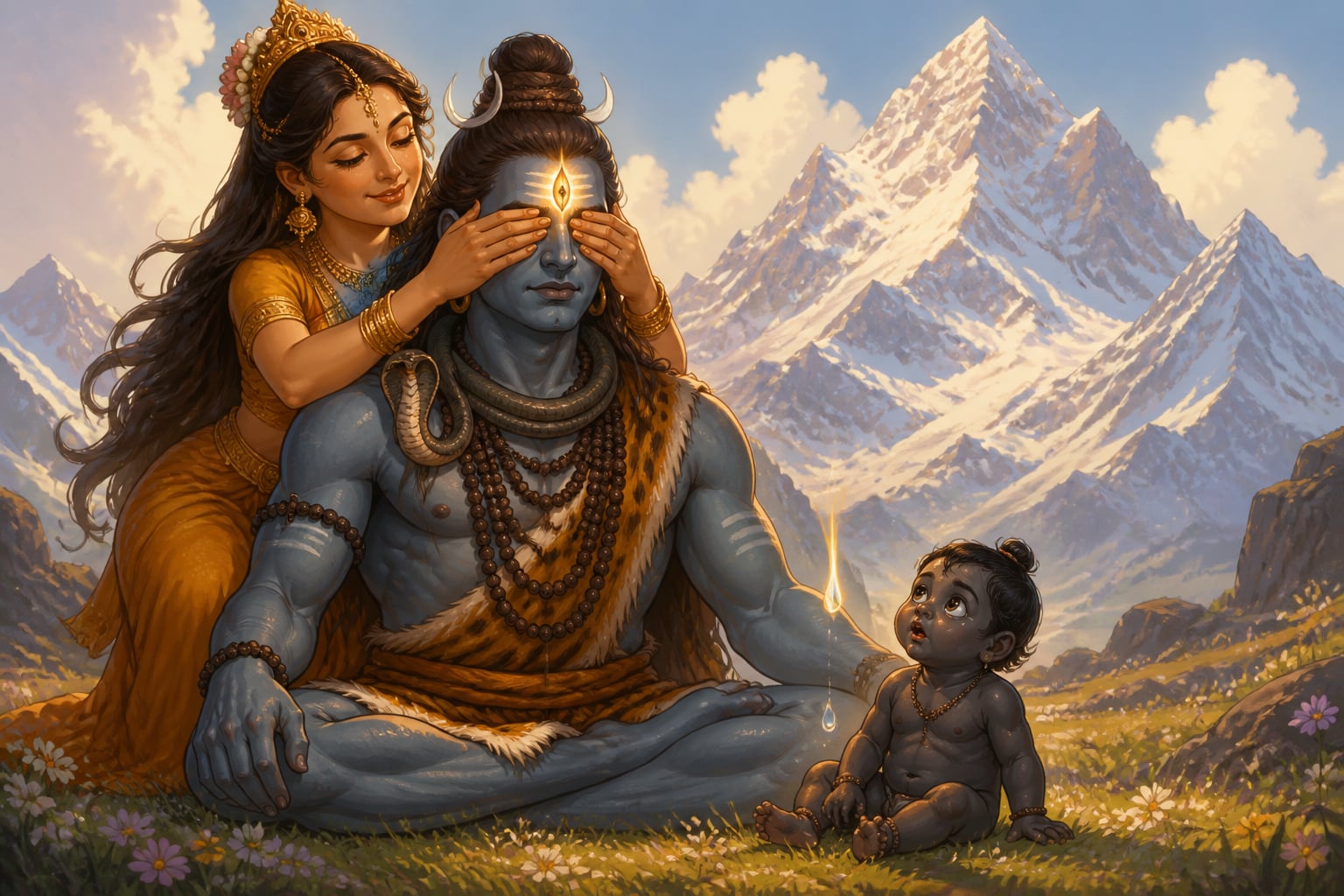
Long before Andhakasura comes near Parvati, before he grows up, before he is even born, there is a moment on Mount Kailasa. Shiva and Parvati are seated together. Parvati, in a moment of playfulness, walks up behind Shiva and covers his eyes with her two palms. The world goes dark. The lights of all the suns and moons and stars dim. The Shiva Purana says even Brahma and Vishnu felt the cold of that brief darkness in their distant heavens.
While her hands cover his eyes, Shiva's third eye, the one on his forehead, opens. Heat blazes from it. The whole cosmos almost catches fire. Shiva, holding the heat, sweats. A single drop of sweat runs down his forehead and falls to the ground.
From that drop, a boy rises. Dark-skinned. Strong-limbed. Eyes that do not see, because he was born in the moment when Shiva himself could not see. He has Shiva's strength but not Shiva's vision. He is the child of darkness, born from the fire that burned in darkness.
Parvati removes her hands. The cosmos is restored. The boy stands at their feet. The Shiva Purana is careful here. Shiva does not abandon the boy. Parvati does not deny him. They look at him together and accept him as their son. But neither of them can keep him on Kailasa. He is too dark, too unsteady, too clearly forged in a moment when the eyes were not open.
At that moment, an asura king named Hiranyaksha (the same who was killed by Vishnu's Varaha avatar in another cycle) is doing tapas in the forest below. He has no son. He prays for one. The Shiva Purana says Shiva and Parvati hear his prayer and send the boy down to him. Take him as your son. Raise him in your house.
Hiranyaksha is delighted. He takes the boy home. Names him Andhaka, the blind one, because the boy's eyes do not see. Raises him as the heir to the asura throne. The boy grows up calling Hiranyaksha his father, never told the truth of his birth. The drop of Shiva's sweat is now an asura prince.
The Boon
Andhaka grows. He is strong. He is restless. He resents his blindness. He wants to be more than his foster father. He goes into the forest and does tapas of his own, terrible tapas, the kind that bends Brahma's arm. Years pass. Brahma appears.
What do you want, Andhaka?
Andhaka asks for the cleverest boon his blind heart can imagine. Restore my sight. Make me unkillable except by one whom I myself recognise as my father.
Brahma considers. The boon has the structure of self-protection that asuras specialise in. Andhaka thinks no one but Hiranyaksha is his father, and Hiranyaksha is incapable of killing him. So the boon is, in his calculation, near-immortality.
Brahma grants it. Andhaka's eyes open. For the first time he can see. But because of how he was born, in the moment of darkness, his inner sight remains blind. He sees forms but not their meaning. He sees women but not which of them are sisters, mothers, daughters, wives. He sees the cosmos but cannot read it. The Shiva Purana is precise about this. The boon restored his outer eyes. The condition of his birth left his inner eyes shut.
The Climb
With the boon in hand, Andhaka begins his rise. He defeats kings. He conquers regions. He takes Hiranyaksha's throne after his foster father dies in another battle. He becomes the greatest asura emperor of his age. He surrounds himself with treasure. He surrounds himself with women, all taken by force. The kingdom shudders. The gods watch from above.
Then one day, his ministers, who have been searching the worlds for the most beautiful woman of the age, return with news.
There is a woman on Mount Kailasa, more beautiful than any in the three worlds. She is the wife of an ascetic. The ascetic is dark-bodied, ash-smeared, surrounded by ganas. The woman is golden, perfect, beyond description. Her name is Parvati.
Andhaka's blind heart leaps. He does not ask whose wife she is. He does not ask whose daughter she is. He does not ask, even when he should know, whose mother she is. He hears the description of the most beautiful woman in the three worlds and decides she will be his.
He assembles his army. He marches on Kailasa.
The Battle
Shiva sees the asura army approaching. He understands at once. The Shiva Purana's Rudra Samhita is restrained here. Shiva does not say that is my son. He says simply, the boy I let go has come to take what is not his.
The battle is enormous. The whole cosmos shakes. Andhaka has the strength of his asura body and the weapons of his asura kingdom. The ganas of Shiva fight with him for days. Vishnu joins. The Saptamatrikas, the seven mothers who emerged from the gods' own bodies for this battle, encircle the field. The fight goes on for what the Puranas describe as a full mahayuga of cosmic time.
At last Andhaka faces Shiva alone. He raises his weapon. He does not recognise the dark-bodied ascetic in front of him. He sees an enemy. He strikes.
Shiva, with a single thrust of his trishul, lifts Andhaka into the air. The trident pierces him through. Andhaka hangs in the sky, impaled, bleeding, suspended.

From each drop of his blood that falls to the ground, a new asura is born, fully grown, equally blind, equally violent. The earth is about to be flooded with replicas of him. The Saptamatrikas drink the falling blood before it touches the ground, the way Kali later drinks the blood of Raktabija. Even with that help, the situation is desperate.
Finally, Shiva does something the chapter has been building toward. He keeps Andhaka on the trident, suspended, dying slowly, but does not let him die. The Shiva Purana's verse for this moment reads:
शूले विद्धोऽन्धकः शम्भोः स्थितोऽनेकं समा शतम्। तप्तस्तेजोभिरीशस्य पापमस्य व्यशीर्यत॥
śūle viddho'ndhakaḥ śambhoḥ sthito'nekaṃ samā śatam | taptas-tejobhir-īśasya pāpam-asya vyaśīryata ||
Pierced on Shambhu's trident, Andhaka hung suspended for many hundreds of years. Burned by the brilliance of the Lord, his sin slowly fell away.
Shiva Purana, Rudra Samhita
For centuries, perhaps millennia of cosmic time, Andhaka hangs on the trident. The trident is over the cremation grounds where Shiva sits. The fire from Shiva's body burns the asura's flesh slowly away. The lust burns first. Then the pride. Then the rage. Then the blindness. Layer by layer, what made him an asura is consumed.

At last, when only the original drop of sweat is left, when the layers of accumulated demonness have all burned, Andhaka lifts what remains of his head and sees Shiva for the first time as Shiva. He sees the third eye that opened in the moment of darkness when he was born. He sees the form of the ascetic. He sees, in a flash of inner sight that no boon could give him, his own father.
He weeps. He apologises. He recites a hymn of praise that the Shiva Purana preserves at length, beginning with namo mahadevaya, namo namaste. The hymn names every aspect of Shiva. It is the apology of a son who has finally seen who he was attacking.
Shiva listens. Shiva forgives. Shiva lifts him down from the trident. The asura body has burned away. What remains is a quiet, sighted, devoted being. Shiva makes him a gana, a member of the inner court of Kailasa, and gives him the name Bhringi, the bee, because his devotion now hovers around Shiva the way a bee hovers around a flower. Bhringi is one of the famous attendants of Shiva in the iconography, often shown as an emaciated, three-legged ascetic dancing around the Linga.
The demon born from a drop of sweat ends as a devotee inside the same household.
What The Story Is Teaching
The lesson is layered. The Shiva Purana asks the reader to see at least four things at once.
One. The pattern of blind desire is not external. Andhaka is born from Shiva himself. The asuras in this chapter are not foreign invasions. They are projections of the divine itself, in moments when the divine looked away. The shadow your house casts is your own. The blind desire that rises in you was born in a moment when your own attention was elsewhere. The Shiva Purana refuses the easy reading that the demon is somebody else.
Two. Boons can restore outer sight without restoring inner sight. Andhaka's eyes were opened by Brahma's boon, but his inner blindness remained. Modern life is full of Andhakas who have studied at the best universities, who have the sharpest analytical eyes, and who still cannot see whose face they are reaching for. Education is not the same as inner sight. Brahma's boon is not the same as Shiva's recognition.
Three. Some sons can only be cured by being suspended. Shiva does not kill Andhaka. He also does not let him go. He pierces him on the trident and lets him hang there for centuries, slowly burning. The lesson is uncomfortable but precise. There are some patterns of blind desire that nothing short of long, patient, painful exposure to the brilliance of dharma will cure. The trident is not punishment. It is the cosmos's slow educational instrument. The sin falls away the way old paint flakes off a wall under steady sun.
Four. The end is recognition, not destruction. When Andhaka finally sees Shiva as his father, the demon is over. Not because he was killed but because he saw correctly. The Shiva Purana's deepest teaching about the inner enemies is that they are not defeated by being annihilated but by being seen for what they were. The boy on the trident sees the ascetic with the third eye and recognises him. In that recognition, the demonness ends.
Modern Echoes
The story has been read by modern Hindu psychologists as one of the clearest pre-Freudian accounts of what Western depth psychology calls the Oedipal pattern. The son, raised away from the father, returns as a young man and reaches for the mother without recognising the father he is challenging or the mother he is reaching for. Carl Jung, in his correspondence with the Indologist Heinrich Zimmer in the 1930s and 1940s, was particularly struck by the Andhaka story for exactly this reason. Jung noted that the Hindu version, unlike the Greek Oedipus, ends not with the son's tragic blinding but with the son's awakening to inner sight. The Greek myth ends in despair. The Hindu myth ends in recognition.
The contemporary therapist working with men struggling with blind appetite, whether sexual, financial, or vocational, has in the Andhaka story a more useful template than most. The demon is not external. It was born in your own moment of darkness. It can be recognised. It can be slowly burned away. The end is not your destruction but your homecoming as a different kind of being inside the same household.
In 2026, in any Indian household where a son has gone astray and a father is wondering whether to disown him, the question Shiva faced is the same. Do I cut him off, or do I keep him close enough that the brilliance of dharma can slowly burn away what made him this way? The Shiva Purana's answer is the trident. Hold him in the painful brilliance long enough. The recognition will come.
In the next lesson, the chapter turns to a different inner pattern. Shankhachuda and Jalandhara, the demons of the same desire scaled up across generations, where what one demon grasped at his daughter's wedding becomes what the next demon grasps at the cosmic woman herself. The drop of sweat that became Andhaka has its echoes in every chapter of the Shiva Purana that follows.
Key figures
Andhakasura
The blind demon son born from a drop of Shiva's sweat, raised by Hiranyaksha, slain in his demon form and reborn as Bhringi the devotee
Hiranyaksha
The asura king who adopted the boy from Shiva's sweat-drop and raised him as his son
Shiva
The biological father, the cosmic ascetic, the one who pierces Andhaka and then holds him on the trident long enough for the demonness to burn away
Parvati
The mother whose covering of Shiva's eyes was the moment of Andhaka's birth, and the woman the grown asura tried to seize without recognising
Historical context
The Andhakasura cycle has roots in the late Vedic and early Puranic periods (c. 500 BCE to 300 CE) and is consolidated in the Puranic age (c. 300-1400 CE) through the Shiva Purana, Linga Purana, Matsya Purana, and Vamana Purana, with major artistic flowering during the Vakataka, Western Chalukya, and Rashtrakuta dynasties (c. 500-1000 CE)
The Andhakasura story sits at the intersection of two major preoccupations of Hindu tradition. The first is the Puranic theology of the asuras, where every demon is treated as an inner pattern projected into a battlefield narrative. The second is the long Shaiva tradition of treating the inner work of the seeker as a long apprenticeship in recognising one's own dark drops. The story's geographic spread, from the western coast (Elephanta) through the Deccan (Ellora, Aihole) to South India (the Bhringi shrines of Karnataka and Tamil Nadu), shows how thoroughly the lesson was absorbed into the temple architecture and ritual life of the Shaiva subcontinent. Unlike some Puranic stories that remained confined to particular regions, the Andhaka cycle was transmitted everywhere a Shaiva sculptor could be commissioned to carve the Andhakasura Vadha panel.
Living traditions
The Andhakasura story has had an unusually rich modern afterlife. Heinrich Zimmer's 1946 Myths and Symbols in Indian Art and Civilisation brought the story to global academic attention. Carl Jung's correspondence with Zimmer in the 1930s and 1940s used the story as one of his anchoring examples for the depth-psychology reading of myth. Joseph Campbell, working with Zimmer's posthumous papers in the 1950s and 1960s, included the Andhaka cycle in his comparative mythology lectures at Sarah Lawrence College. In contemporary India, the story is increasingly used in dharmic counselling traditions and in some Hindu approaches to addiction recovery, where the Andhaka pattern (blind appetite born in a moment of inner darkness, treated through long exposure to dharmic brilliance rather than through repression or expulsion) maps onto the actual psychology of compulsive behaviours more accurately than many Western treatment frameworks. The trident-stance, neither cutting off nor giving in but holding the suffering one in clear truth long enough for transformation, has begun to circulate in Indian parenting and pastoral counselling literature as one of the most useful inheritances from the Shaiva Puranic tradition.
- Bhringi Worship Within Shiva Temples: Many traditional Shiva temples across Karnataka, Tamil Nadu, and Andhra Pradesh include a small subsidiary shrine to Bhringi, the transformed Andhakasura, often near the main sanctum or in the outer corridor. Devotees offer water and bilva leaves to Bhringi after offering to the main Linga. The custom preserves the lesson's central teaching: the asura who was held on the trident long enough became a devotee, and that devotee is still part of Shiva's household. Worshipping Bhringi is the worshipper's daily acknowledgement that their own inner Andhakas can become Bhringis if held long enough in the brilliance.
- Saptamatrika Puja At Andhakasura Vadha Sites: At several temples that carry prominent Andhakasura Vadha sculptures (notably the Elephanta caves and Ellora's cave 29), the Saptamatrika panel is worshipped on specific tithis through the year, particularly Ashtami of the bright fortnight in Ashvin and Chaitra months. The seven mothers who drank the demon's blood in the original story are honoured as the cosmic emergency response team that prevented the demon from multiplying. The puja often includes recitation of passages from the Shiva Purana's Yuddha Khanda and the Devi Mahatmya.
- Elephanta Caves: A UNESCO World Heritage site dating to the 6th century CE. The main cave contains the famous Trimurti (three-headed Shiva) panel, the Ardhanarishvara panel, the Kalyanasundara (Shiva-Parvati wedding) panel, the Gangadhara panel, the Nataraja panel, and the Andhakasura Vadha panel. The Andhakasura Vadha is among the most physically powerful sculptures in any Indian cave, with Shiva shown in towering motion holding the trident, the demon's body torn open, the cosmic battle frozen in stone. Standing in front of the panel by the slanting morning light, one feels the lesson in the body before reading it in the text.
- Ellora Caves, Cave 29 (Dhumar Lena): Ellora is a UNESCO World Heritage site with 34 caves carved over four centuries from c. 600 to 1000 CE. Cave 29, the Dhumar Lena, is one of the largest Shaiva caves and contains a magnificent Andhakasura Vadha panel along with the Lingodbhava, Kalyanasundara, and Ravananugraha panels. The cave is often quieter than the famous Kailasanatha (cave 16) and rewards a contemplative visit. The Andhakasura Vadha here, executed in the 7th century, is among the earliest large-scale treatments of the scene in Indian art.
- Bhringeshwara Temples Of Karnataka: Several Vijayanagara-era and earlier Shiva temples in Karnataka carry prominent Bhringi shrines and iconography. Bhringi is depicted as a three-legged emaciated ascetic dancing around the Linga, his form embodying the result of his transformation from Andhakasura. Visiting these temples and offering at the Bhringi shrine after the main Shiva worship is one of the few living devotional practices that directly continues the Andhaka story's resolution. Hampi's Virupaksha temple and several smaller Shaiva sites in the Hospet-Anegundi region include such shrines.
- Andhakasura Vadha Sculptural Panels: The Andhakasura Vadha is one of the most ambitious narrative panels in Indian temple art, requiring the sculptor to depict the towering Shiva, the suspended demon on the trident, the surrounding ganas, the seven mothers drinking blood, and often the smaller drops about to become new asuras. The compositional difficulty is high, and the surviving panels of the 6th to 9th centuries are among the masterpieces of Indian sculpture. Pilgrims who visit these sites are often guided by local priests who narrate the full story, making the panels into a kind of public dharma teaching.
Reflection
- What is one pattern of blind appetite in your own life that you have been treating as alien, and what would change if you accepted that it was born from a moment in your own house?
- Why does the Shiva Purana have Shiva keep Andhaka suspended on the trident for centuries rather than killing him quickly, and what does this say about how genuine inner change actually happens?
- If the inner enemies of any human being are projections of moments when their own attention failed, what does this say about the modern fixation on locating evil outside the self in foreign others?