Pralaya: The Necessary End
Four ways a universe ends
Most traditions celebrate beginnings. The Shiva Purana is equally serious about endings. It names four kinds of pralaya, four kinds of cosmic dissolution, from the daily sleep of creatures to the final absorption of the cosmos back into Shiva. Endings in this tradition are not failure. They are the other half of creation.
A Husband on a Verandah
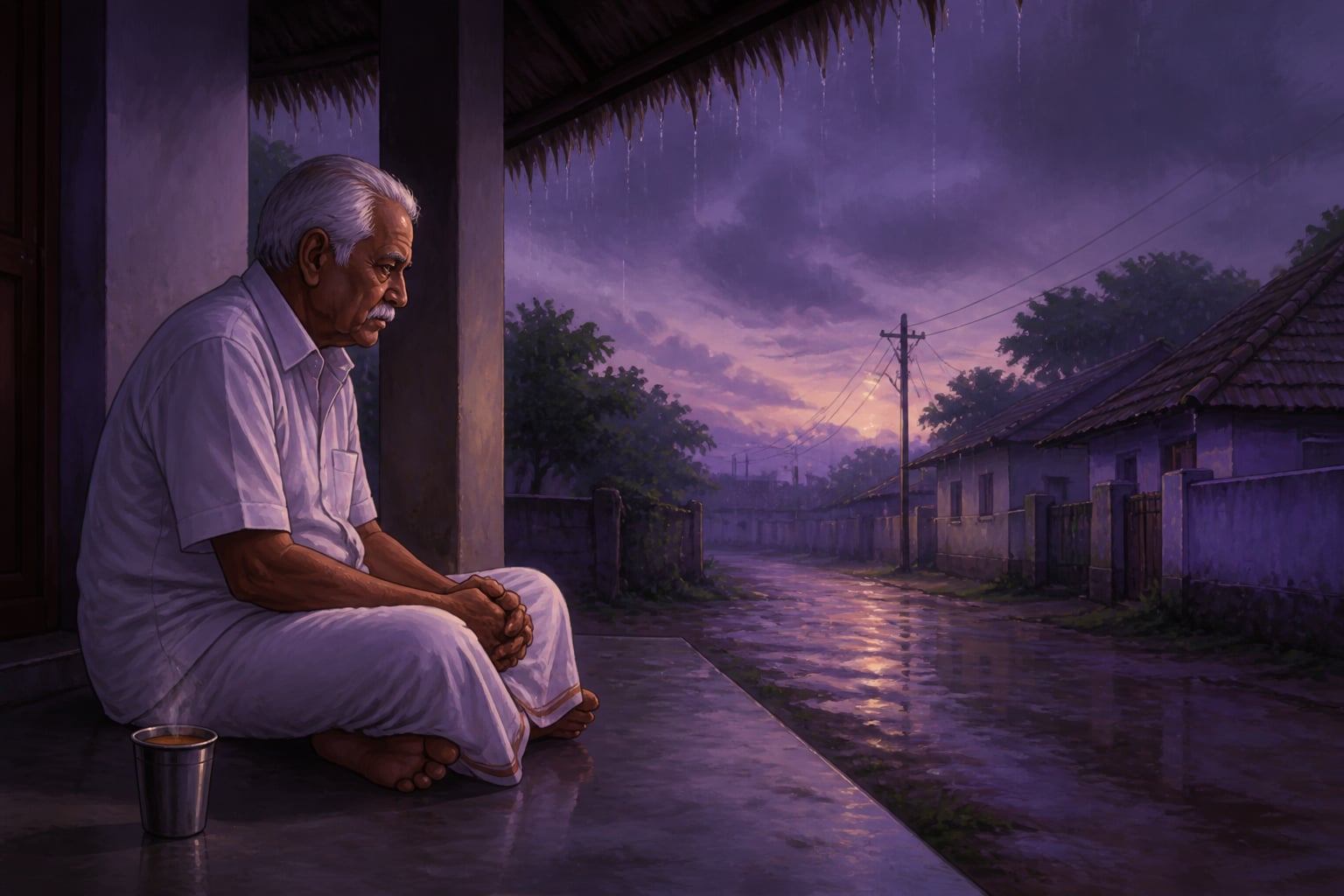
It is a Tuesday evening in the monsoon of 1987, on the verandah of a small house in Vellore. A man named Subramaniam is sitting on a wooden chair, looking at the rain on the courtyard tiles. He is sixty-one years old. He retired last week. The framed photographs on the wall behind him are of a boy in school uniform, a young engineer at a factory gate, a husband and wife at a Tirupati darshan, three children in graduation gowns. His wife is in the kitchen. The children live in three different cities. The factory whistle that used to mark his hours has not blown for him since Friday.
He has spent the afternoon trying to name what he is feeling. It is not grief. It is not failure. It is something quieter and stranger. A whole world has just ended. The world of being-needed-at-the-factory. The world of school-fees-and-rent-and-promotion. The world of the long middle of his life. It is gone. He does not know yet what comes next.
This lesson is for Subramaniam. The Shiva Purana has a name for what he is sitting in. It is called pralaya, dissolution, an ending that is not yet a beginning. The Purana lists four kinds, and it does something most modern self-help books refuse to do. It tells him, gently, that this ending is not the worst thing that has happened to him. It is one of the most important.
The Word Itself
Pralaya is two parts. Pra, forward, completely, away. Laya, from the root li, to dissolve, to merge, to disappear into. So pralaya is complete dissolving, merging away, disappearing into. The English word dissolution is closer than destruction. Things do not get smashed in a pralaya. They dissolve back into the source they came from. A salt crystal dropped into the sea is undergoing pralaya. The sea is not angry with the salt. The salt is going home.
This is the first thing the Shiva Purana wants the reader to feel before naming the four kinds. Pralaya is not punishment. The cosmos is not being destroyed because it has been bad. It is being absorbed because it is finished, the way a drawing is absorbed back into the chalkboard when the lesson is over and the next class is about to start. Shiva, the lord of pralaya, is not a god of cruelty. He is a god of conclusion. The previous lesson on cycles (Kalpa, Manvantara, Yuga) gave you the calendar. This lesson tells you what happens when each calendar runs out.
The Four Kinds
The Shiva Purana, the Vishnu Purana, the Bhagavata Purana, and the Linga Purana all give the same canonical list of four. The names vary slightly between Puranas; the meanings are stable.
| The pralaya | Scale | What ends |
|---|---|---|
| Nitya Pralaya | Daily | One person's waking world, every night |
| Naimittika Pralaya | One Kalpa | One cosmic day of Brahma, the three worlds dissolved |
| Prakritika Pralaya | One Maha-Kalpa | The whole created order, when Brahma himself dies |
| Atyantika Pralaya | Final | One soul, merging into Shiva, never to return |
Notice the structure. The list moves from the smallest scale to the largest, from the most familiar to the most absolute. The first one happens to you tonight. The last one is the goal of every Shaiva practice. The two in between are cosmic. The teaching is that the small endings are rehearsals for the large ones, and the large ones are rehearsals for the final one.
Nitya Pralaya: The End That Comes Every Night
Nitya means daily, regular, constant. Nitya Pralaya is the dissolution that every conscious being undergoes every night when she goes to sleep. The waking world of a person, the entire universe of her name, her relationships, her worries, her plans, her body, dissolves at the moment of deep sleep. The Shiva Purana takes this seriously, not as metaphor.
Think about what actually happens at the moment of falling asleep. The room goes. The body goes. The day goes. The name goes. Identity itself goes. For a few hours, you are not Subramaniam, retired engineer of Vellore. You are not anyone. You are pure existence without contents. Then, in the morning, the whole world reassembles itself in your awareness, beginning with the sound of the kitchen and the weight of the sheet, and you climb back into the construction called me.
The Mandukya Upanishad spends an entire short text on this. The Shaiva tradition adds one line. Sleep is the daily teacher of pralaya. Every night, the cosmos that is your life dissolves and is absorbed. Every morning, it is recreated. You have been doing pralaya practice your whole life without knowing.
The practical teaching: the way you fall asleep is the way you will die. A mind that goes to sleep agitated is rehearsing an agitated death. A mind that goes to sleep with a slow breath, a soft prayer, the name of Shiva on the tongue, is rehearsing the easier passage. This is why Shaiva householders end the day with a brief surrender, Om Namah Shivaya, I bow to that which is auspicious, before letting the day go. It is not a sentimental practice. It is dissolution training.
Naimittika Pralaya: The Cosmic Day Ends
Naimittika comes from nimitta, occasion, particular cause. Naimittika Pralaya is the dissolution caused by a specific occasion: the end of one Kalpa, one cosmic day of Brahma, which the previous lesson defined as 4.32 billion human years.
When Brahma's daytime ends, the three worlds (bhuh, bhuvah, svah; the earth, the atmosphere, the heavens) dissolve. The Shiva Purana describes the sequence. The sun grows seven times brighter. The oceans boil away. The earth cracks and is absorbed by water. Water is absorbed by fire. Fire is absorbed by air. Air is absorbed by space. Space is absorbed into the unmanifest. Brahma sleeps for one cosmic night, also 4.32 billion years long, on the cosmic ocean, on the body of Vishnu, who is reclining on the snake Ananta. When Brahma wakes, creation begins again.
The Pancha Bhuta of the previous chapter (Lesson 5.5 and 5.6) returns here, but in reverse. Earth into water into fire into air into space into the unmanifest. The five elements that the Ashtamurti taught us to honour in their unfolded form are, in Naimittika Pralaya, gathered back. The Shiva Purana is making a precise point. Creation and dissolution are the same act, run in two directions. The same elements that opened out are folded back in. The unfolding is called srishti. The folding is called pralaya. They are the in-breath and out-breath of the same cosmos.

Prakritika Pralaya: The End of Brahma Himself
Prakritika comes from prakriti, primordial nature, the unmanifest source. Prakritika Pralaya is the dissolution at the end of Brahma's entire life of one hundred Brahma-years, which the previous lesson worked out to be 311.04 trillion human years, one Maha-Kalpa.
This is not the end of one cosmic day. This is the end of Brahma himself. The creator-deity returns to the source. The whole created order, gods and worlds and elements and time itself, dissolves back into the unmanifest Prakriti from which it came. There is no sun, no moon, no earth, no Brahma. Only Shiva, the changeless awareness, and Shakti, his power, asleep together in the formless state the Vedas call Brahman.
A Maha-Kalpa of darkness follows, equal in length to Brahma's whole life. Then a new Brahma is born, a new creation begins, a new cycle of one hundred Brahma-years runs. The cycle has no beginning and no end. It has only its own returning.
This is the Shiva Purana's largest scale of dissolution within time. It is also the scale most frightening to the modern reader, because it tells the truth that no civilisation, no species, no planet, no star, no galaxy lasts. Everything you can name is on the way to its own pralaya. The Shaiva insistence is that this fact, fully received, is not depressing. It is liberating. The thing that does not end is not on this list. The thing that does not end is the awareness that knows the list. That is what the next pralaya names.
Atyantika Pralaya: The Final End
Atyantika means absolute, ultimate, final. Atyantika Pralaya is the only dissolution on the list that does not return. It is moksha, the merging of one soul into Shiva, the end of the cycle of birth and death for that particular awareness.
The other three pralayas are cosmic. Atyantika Pralaya is personal. The other three reset the universe. Atyantika Pralaya releases one being from it. The Shaiva tradition is precise here. Moksha is not the soul going somewhere else. It is the soul recognising that the somewhere else and the here are the same Shiva, and that the wave called me has always been the ocean called Shiva, and that there is therefore nowhere left to go and no one left to go there.
This is the only pralaya the seeker is asked to actively rehearse. The other three happen anyway. Sleep happens. Cosmic days end. Maha-Kalpas run their course. None of these need your participation. Atyantika Pralaya, by contrast, requires you. It is the dissolution you walk toward, slowly, by every practice in this course. The Linga that the worshipper bows to in Lesson 5.4 is, in this reading, the form Shiva takes to give the seeker something to merge into.
Every ending in your life is a small rehearsal of the one that finally sets you free. The night is rehearsing the cosmic day. The cosmic day is rehearsing the Maha-Kalpa. The Maha-Kalpa is rehearsing moksha. Pralaya is the most patient teacher in the universe.
Why This Is Mercy
The modern reader often finds this list disturbing. The cosmos ends. Brahma dies. Everything dissolves. How is this kind?
The Shaiva answer is direct. Imagine a cosmos in which nothing ended. The same Brahma forever. The same yuga forever. The same body forever. The same job forever. The same self-image forever. No one in their right mind would call that mercy. The capacity of a thing to end is the condition under which the next thing becomes possible. A flower that does not fall holds the place of the next flower. A king who does not die holds the throne of the next king. A self that does not undergo daily pralaya in sleep would, by the end of one week, be unbearable to itself.
Dissolution is the way the cosmos breathes. The Shiva Purana asks the reader to stop fighting the out-breath. The out-breath is what makes the next in-breath possible. The Atyantika Pralaya, the final dissolution into Shiva, is the longest exhalation, after which there is no more inhaling, because the breather has merged into the air.
For Subramaniam on his verandah, this is good news. The world of his middle life has just ended. He is, at sixty-one, sitting inside a small Naimittika Pralaya. The Shiva Purana would tell him that the boiling away, the cracking, the absorbing, are not happening to him. They are happening for him, so that whatever is next can begin. The retirement is a rehearsal of a larger letting-go. Each ending in his life, the school years that ended, the children leaving home, the factory whistle that has stopped, the old body slowing down, are nested rehearsals. He is being trained, slowly and kindly, by pralaya itself.

The Householder's Practice
The Shaiva tradition gives the householder a simple set of small pralaya practices, designed to convert the natural endings of life into rehearsals of the final one.
- At night: end the day with one minute of conscious dissolution. Lie down, take three slow breaths, mentally release the day, whisper Om Namah Shivaya, and let sleep take you. The day is being absorbed.
- At every transition: when you finish a project, leave a job, end a relationship, sell a house, finish raising a child, sit for ten minutes and consciously let the world that just ended go. Light a lamp. Say a brief prayer. This is a small Naimittika practice.
- Once a year: on Mahashivaratri, the night of dark moon in Phalguna, undertake the all-night vigil. The vigil is a Prakritika rehearsal: an extended sitting with the absence of all the comforts you usually rely on, food, sleep, distraction, in the company of Shiva alone.
- Across the lifetime: the Atyantika practice is the slow, lifelong cultivation of the awareness that you are not the one being dissolved. You are the one for whom the dissolutions happen. That awareness is Shiva. You have been him all along. Pralaya is the slow lifting of the veil that hid this from you.
Subramaniam, on his verandah in Vellore, does not yet know all this. But he will. The Shiva Purana, on the shelf inside the house, is patient. The rain, on the courtyard tiles, is the universe doing pralaya practice in front of him: drops dissolving back into puddles, puddles into the ground, the ground into the next breath of the monsoon. He is not separate from the demonstration. He is part of it. The teacher has been here all along.
Historical context
Late Vedic to Early Medieval India (roughly 1000 BCE to 1000 CE)
The pralaya doctrine has one of the longest continuous developments in Indian thought. The Vedic root is the Mandukya Upanishad's analysis of deep sleep (Nitya) and the Yajurvedic acknowledgement of cosmic dissolution. The Bhagavad Gita's Chapter 8 names the Naimittika cycle in a single shloka. The early Puranas (Vishnu, Shiva, Bhagavata, Linga, all roughly 200 to 500 CE) systematise the fourfold scheme that this lesson follows. By the time of Adi Shankara in the eighth century, the doctrine had been integrated with Advaita Vedanta. By the eleventh century, Abhinavagupta in Kashmir Shaivism had used the pralaya teaching as the basis for the doctrine of recognition (pratyabhijna): the seeker recognises that the awareness which survives all four pralayas is herself, and that herself is Shiva. The same teaching that the Vedic householder honoured at sandhya as a daily Nitya Pralaya was, two thousand years later, the philosophical centre of one of the most sophisticated Tantric systems ever produced.
Living traditions
The Shaiva teaching of pralaya is one of the dharmic frames being most actively rediscovered by twenty-first-century thinkers across disciplines. In ecology, the doctrine of dignified dissolution is being used by movements like Cauvery Calling and Save Soil to argue that the death and decomposition of organic matter is not waste but the continuous breathing of the Earth's pralaya. In medicine and palliative care, Shaiva-influenced hospices in India (Pallium India in Kerala, Karunashraya in Bengaluru, the cremation-ghat ministries of Kashi) practise a death-as-merging philosophy that draws directly on the pralaya teaching, treating dying as a guided dissolution rather than a medical defeat. In organisational thinking, the pralaya plan, the design of every project with its dignified end built in, has been written about by management thinkers including the late Sumantra Ghoshal and more recently by writers in the Indic management tradition. The 1923 Sanskrit-rooted Hindi novel Andha Yug by Dharamvir Bharati ends with a meditation on Yuga-pralaya that has become canonical in Indian theatre. The teaching that began in the late Vedic period, and was fixed by Kalidasa's contemporaries in the early Puranas, is now a quiet but spreading ethical resource in fields none of those original writers could have imagined.
- Mahashivaratri All-Night Vigil: The single most direct living rehearsal of pralaya in the Shaiva calendar. On the fourteenth night of the dark fortnight in Phalguna (February or March), devotees fast through the day, stay awake through the night, and chant the name of Shiva in four three-hour watches called praharas. The vigil is a deliberate small Prakritika rehearsal: a sustained period of staying present with the absence of the comforts the seeker normally relies on, food, sleep, distraction, in the company of Shiva alone. Tradition holds that the night Shiva first manifested as Mahadeva is also the night the seeker most easily merges into him; the vigil is the ritual form of that merging.
- Sandhya Vandana: The thrice-daily Vedic prayer at the three sandhi or junctions of the day: dawn, noon, and dusk. Each sandhi is a small daily pralaya, the moment when one phase of the day dissolves into the next. The traditional householder pauses at each junction to offer arghya (a libation of water to the sun), to chant the Gayatri mantra, and to consciously honour the dissolution and re-creation of the day. The practice is, in this lesson's vocabulary, a Nitya Pralaya practice performed three times rather than once.
- Manikarnika Ghat, Kashi: The most sacred cremation ghat in the Shaiva world, on the Ganga at Varanasi. Tradition holds that the cremation fire on Manikarnika has not been allowed to go out for at least three thousand years; one body's pyre is lit from the embers of the previous body's. The ghat is the most concentrated living teaching of Atyantika Pralaya in the world. Devotees believe that to die in Kashi and be cremated at Manikarnika is to receive moksha directly from Shiva, who whispers the Tarak mantra into the ear of the dying. To stand on the ghat as a witness, even briefly, is to see the Shaiva doctrine of pralaya enacted in real bodies, in real fire, in real time.
- Kashi Vishwanath Temple: The foremost Shiva temple of the subcontinent, presiding over the city where the pralaya teaching is enacted continuously on the ghats below. The temple's title Vishwanath, lord of the universe, is also a title that holds the four pralayas: lord of the universe at every scale of its dissolution. The 2021 Kashi Vishwanath Corridor reopened the temple's connection to the Ganga and the cremation ghats, recovering a sacred geography in which temple and pralaya are spatially adjacent. The pilgrim who has darshan at the temple and then walks down to Manikarnika has, in a single morning, walked the full arc of this lesson.
Reflection
- Which pralaya are you currently sitting inside, without having named it as such? Is it Nitya, Naimittika, Prakritika, or Atyantika in scale? What changes if you allow yourself to call this ending by its dharmic name?
- Why does the Shiva Purana arrange the four pralayas in the order Nitya, Naimittika, Prakritika, Atyantika, from smallest to largest? What is the teaching hidden in the order itself?
- If destruction is the inhalation of a breathing cosmos, and creation is its exhalation, what does the Shaiva tradition believe about the relationship between change and permanence?