Nataraja: The Dance That Holds the Worlds
Five acts in one pose
Deep in the Tillai forest, Shiva dances the dance that holds the worlds together. The Shiva Purana places this not as a single event but as the eternal background of every moment. This lesson walks the five acts encoded in that dance and follows the image from its Puranic source to the Chola bronze.
The Forest at Tillai
The Shiva Purana, in its Vayu Samhita and again in the Kotirudra Samhita, locates the dance of Nataraja in a specific place. The forest of Tillai, named for the dense mangrove of the same name that once covered the southern coast of what is now Tamil Nadu. The site is the modern town of Chidambaram, in the Cuddalore district. The temple complex there has been the iconographic home of Nataraja for over a thousand years.
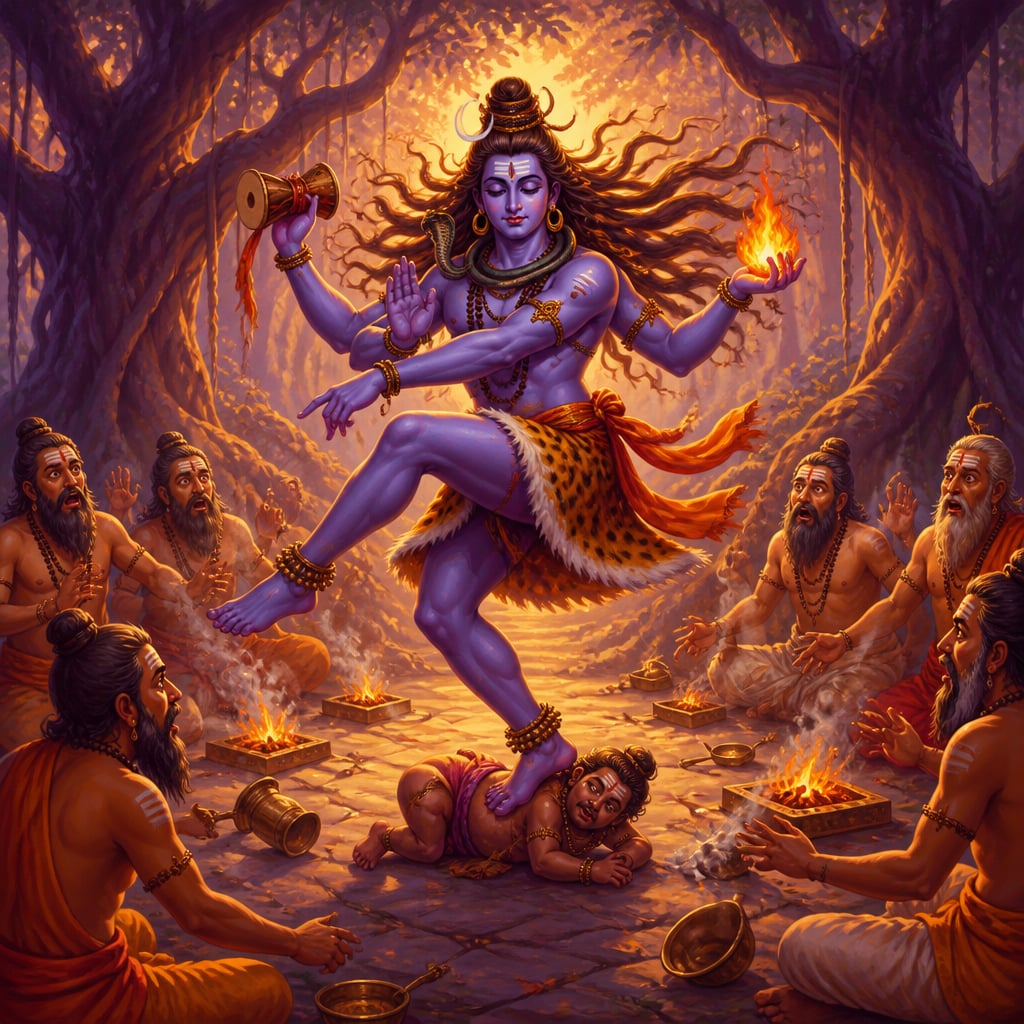
The Purana sets the scene with care. A circle of sages had been performing rituals in the forest, convinced that ritual alone, without the recognition of consciousness, could produce liberation. Shiva walked into their forest and confronted them. They responded by hurling a tiger, a serpent, and a fierce demon at him from their fire pit. Shiva took the tiger's skin as his garment, the serpent as his ornament, and the demon, named Apasmara, the personification of the unaware mind, he pinned beneath his right foot.
Then, on the back of Apasmara, Shiva began to dance.
The sages saw, in that dance, what their thousand rituals had not given them. They saw consciousness becoming the entire cosmos, holding it in a single rhythm, dissolving it back into itself, and through every step doing so freely, with no apparent effort. The Purana says they fell to the ground. The dance has not stopped since.
The Iconography Reads as a Sentence
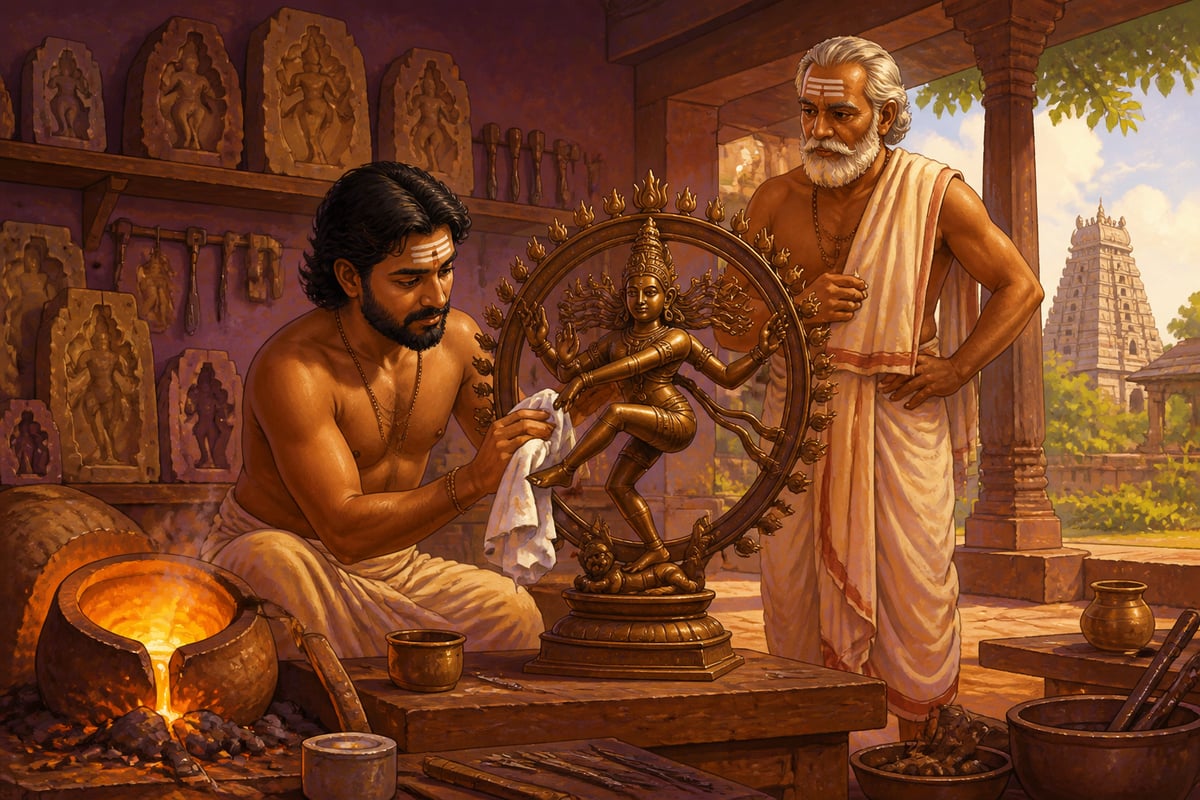
The Nataraja form, refined in the bronze workshops of the Chola dynasty between the ninth and the thirteenth century CE, is not a symbol with five separate meanings. It is a single sentence in which five clauses appear at once. The Sanskrit name for the five clauses is the panchakritya, the five cosmic acts.
Srishti is creation. Sthiti is preservation. Samhara is dissolution. Tirobhava is concealment, the veiling by which the absolute appears as the many. Anugraha is grace, the unveiling by which the many recognise themselves as the absolute.
The Purana names each act and the part of the Nataraja form in which it sits.
| Act | Sanskrit | Iconographic location |
|---|---|---|
| Creation | Srishti | The damaru drum in the upper right hand, sounding the first beat |
| Preservation | Sthiti | The lower right palm in abhaya mudra, the gesture of fearlessness |
| Dissolution | Samhara | The flame in the upper left hand |
| Concealment | Tirobhava | The right foot pressing down on Apasmara |
| Grace | Anugraha | The lifted left foot, indicated by the lower left hand |
The entire teaching of the Shiva Purana on cosmic order, the rest of this chapter, is a careful unpacking of this five-part sentence. The image holds the doctrine before any verse is read.
The Damaru and the First Beat
Srishti, creation, sits in the upper right hand. The hand holds a small two-headed drum called the damaru, shaped like an hourglass with two leather faces and a knotted cord between them. When the drum is rotated, the cord beats both faces in alternation.
The Purana's claim is precise. The cosmos does not arise from nothing. It arises from a pulse. The damaru's two faces are sometimes interpreted as the two principles of consciousness and matter, sometimes as the two halves of the breath, sometimes as the two phases of every wave. What matters is that creation is rhythmic, not singular. There was no single moment of creation. There is a continuous pulse, audible right now to anyone who listens, in which the cosmos is being beaten into existence breath by breath.
The physicist John Wheeler, at Princeton in the 1980s, argued that the universe is best described not as a static set of objects but as a participatory process in which each moment of observation contributes to what exists. The damaru, eight centuries earlier, said the same thing in less calculus.
The Palm of Fearlessness
Sthiti, preservation, sits in the lower right hand, held in the abhaya mudra. The palm faces the viewer. The fingers are straight. The gesture is one of the oldest in Hindu and Buddhist iconography. It says, simply, do not be afraid.
The Shiva Purana reads this mudra as the cosmic act of holding. Once a thing has been created, something must hold it in being. The atom must continue to be an atom. The breath must continue to be a breath. The nation must continue to be a nation. Preservation is not a single decision. It is a continuous reassurance, moment by moment, that what was made is still being held. The abhaya mudra is the cosmos's permanent message to its own contents. You may continue. You are held.
This is also why every Shaiva temple greets the devotee with this gesture in the central murti. The first thing the cosmos is saying to the entrant is the simplest thing it has to say.
The Flame of Dissolution
Samhara, dissolution, sits in the upper left hand. The hand holds a small flame in the shape of a tongue, called the agni. The dharmic tradition is unusual among the world's religious traditions in its open insistence that destruction is itself a divine act, equal in dignity to creation and preservation. Most traditions treat the end of things as a problem to be solved. The Shiva Purana treats it as one of the five necessary acts.
The Purana's reasoning is unsentimental. Without dissolution, the cosmos would jam. The old forms would crowd out the new. The cell that does not die holds the place of the cell that would have been. The dynasty that does not end keeps the throne from the dynasty that should have come. Dissolution makes room. The flame in Nataraja's left hand is not malicious. It is housekeeping at cosmic scale.
The Purana goes further. It claims that grace and dissolution are the same hand seen from different sides. To dissolve a form that has run its course is itself a kindness to what comes next, and to the form that is being released. This is the Shaiva inversion of the modern fear of endings. The flame is the friend.
The Foot on Apasmara
Tirobhava, concealment, sits in the right foot, which presses down on the small dwarf-figure of Apasmara. Apasmara is named in the Purana with care. The Sanskrit literally means one who has lost smriti, who has lost memory, who has forgotten. He is the personification of the obscuring mind, the noise of forgetfulness, the unaware reactivity that hides the chit, the consciousness, that the previous chapter named.
Apasmara is not killed. The Purana is explicit about this. He is pinned, but kept alive. The Shaiva commentary tradition gives a striking reason. The forgetfulness that obscures the absolute is itself part of the absolute's play. If Apasmara were killed, every being in the cosmos would instantly recognise its identity with Shiva, and the cosmic drama would end. The drama needs the veil to remain in place for as long as the dance continues. The right foot holds Apasmara down, but does not eliminate him. Concealment is part of the design.
This is the most subtle teaching in the iconography. The cosmos hides itself from itself, on purpose, and the foot of the dancer is what holds the veil in place.
The Lifted Foot of Grace
Anugraha, grace, sits in the lifted left foot. The lower left hand of Nataraja, held in the gajahasta mudra, the elephant-trunk gesture, points across the body towards this lifted foot. The viewer's eye is being directed.
The lifted foot is the place to which the seeker comes for refuge. The ancient Shaiva phrase for the goal of the spiritual life is charanam sharanam, the foot is the refuge. Where the right foot pins the obscurity, the left foot offers the lift out of it. The two feet together make the Shaiva map of liberation. Concealment is held down. Grace is lifted up. The dancer is doing both at once.
The Purana's tenderness here is worth noticing. The grace is not earned by the seeker through effort. It is offered, freely, by the same dancer whose foot is also holding the veil in place. This is why the Shaiva tradition can hold simultaneously that the cosmos hides itself on purpose and that grace, when it comes, is unconditioned. Both are acts of the same dancer.
The Ring of Fire
Around the entire form runs a circle of flames, the prabhamandala, sometimes called the tiruvasi in Tamil. The Purana names this circle as the boundary of the cosmos itself. The dance is not happening inside the cosmos. The dance is the cosmos. The ring is its outer edge.
The physicist Carl Sagan, in his 1980 Cosmos, observed that the Nataraja was the closest image he had encountered in any tradition to what cosmologists were beginning to suspect about the universe: a dancing pulse of energy, bounded by something like a ring of fire, in which creation, preservation, and dissolution are happening simultaneously rather than in sequence. A bronze of Nataraja stands today at the entrance of the CERN particle physics centre in Geneva, gifted by the Indian government in 2004, with a plaque citing this exact passage from Sagan.
The Hair, the Ganga, the Snake, the Crescent
The Purana adds three smaller details that complete the iconography.
The matted jata of Nataraja is shown in motion, flying outward as the dance turns. Tucked into the matted hair are three further images. A small figure of the goddess Ganga, the river that descends from heaven and which Shiva caught in his locks to spare the earth. A serpent, Vasuki, coiled around an arm or the matted hair, marking the mastery over time. A crescent moon, the chandra, on the head, marking the cycles of waxing and waning. Each of these is a smaller cosmic process held within the larger dance.
The entire form, taken as a single statement, is the Shiva Purana's most concentrated image. Five acts in one pose. The whole cosmology of the chapter, the next five lessons of which will unfold each act in turn, is already in the bronze.

The Modern Reading
The Nataraja iconography, refined by the Cholas in the bronze workshops of Swamimalai and Thanjavur between 850 and 1280 CE, became, by the twentieth century, one of the most-cited Hindu images in the world's intellectual life.
Ananda Coomaraswamy, the Sri Lankan Tamil philosopher writing at the Boston Museum of Fine Arts in the early twentieth century, gave the iconography its first sustained modern reading in his 1918 essay The Dance of Shiva. Coomaraswamy laid out the five acts and argued that the image was not decorative art but compressed philosophy, equivalent in density to any chapter of the Upanishads.
Fritjof Capra, the Austrian-born physicist working at the Lawrence Berkeley National Laboratory, picked up Coomaraswamy's reading in his 1975 book The Tao of Physics, where he proposed that the Nataraja was a more accurate image of the quantum vacuum than any diagram physics had produced at that point. Capra's reading was what led, eventually, to the bronze at CERN.
The rest of this chapter unpacks each of the five acts in turn. But the image stands at the head of the chapter on its own merits. Five acts in one pose. The whole cosmos in a bronze. Sufficient instruction, the Shiva Purana says, for any seeker who is willing to look at the dance long enough to begin to see what is being said.
Living traditions
The Nataraja iconography has had one of the most remarkable post-classical lives of any Hindu image. Ananda Coomaraswamy's 1918 essay The Dance of Shiva, written from the Boston Museum of Fine Arts, gave it its first sustained modern reading. Fritjof Capra's 1975 The Tao of Physics and Carl Sagan's 1980 Cosmos brought the iconography into mainstream Western intellectual life as a metaphor for the dancing pulse of the quantum vacuum. In 2004, the Indian government gifted a two-metre bronze of Nataraja to the CERN particle physics centre in Geneva, where it stands today at the main entrance with a plaque citing both Capra and Sagan. The Chola bronze workshops at Swamimalai continue to produce Nataraja images by the same lost-wax method used in the eleventh century. The annual Natyanjali festival at Chidambaram, founded in 1981, has become one of the largest gatherings of classical Indian dancers in the world. In contemporary Indian dance, the 108 karanas of Bharatanatyam, sculpted on the eastern gopuram of the Chidambaram temple, are the technical foundation of every Bharatanatyam dancer's training and connect every modern performance directly back to the dancing form this lesson teaches.
- Chidambaram Natyanjali: Each year in February, around Mahashivaratri, the Chidambaram Nataraja temple hosts the Natyanjali festival, a five-day classical dance offering attended by Bharatanatyam, Odissi, Kathak, Mohiniattam, Kuchipudi, and Manipuri dancers from across India and the diaspora. The dancers perform in front of the Nataraja shrine, treating the dance not as performance but as offering. The festival was founded in 1981 and has become one of the largest annual gatherings of classical Indian dancers in the world. Each evening's performances open with the Tandava Stotram and close with the dancers prostrating before the central murti.
- Arudra Darshan at Chidambaram: On the full moon of the Tamil month of Margazhi (December or January), under the Arudra (Tiruvadirai) star, the Chidambaram temple holds the Arudra Darshan, the most important annual festival of Nataraja. Devotees arrive overnight. The Nataraja bronze is brought out from the inner sanctum at dawn and bathed in 1008 vessels of sacred water, milk, ghee, and tender coconut. The abhisheka takes about three hours. Devotees fast through the day and break the fast only after the evening's procession. Margazhi Tiruvadirai is the canonical day on which Shiva is said to have first performed the cosmic dance, and the temple's energy on this day is considered the highest of the year.
- Nataraja Temple, Chidambaram: The principal temple of Nataraja and the iconographic home of the dancing form for over a thousand years. The temple complex covers about forty acres and includes the Chit Sabha (the hall of consciousness) where the Nataraja bronze is housed, the Kanaka Sabha (the golden hall), the thousand-pillared mandapa, the Shivaganga tank, and the Akasha Linga sanctum, the only one of the five Pancha Bhuta Linga sites where the linga is represented as empty space. The temple's main entrance gopuram on the east face is sculpted with all 108 karanas of Bharatanatyam, the foundational dance positions described in the Natyashastra. The temple is hereditarily managed by the Dikshitar Brahmin community, who have served as priests for many centuries.
- Brihadeeshwara Temple, Thanjavur: Built by Rajaraja Chola I in 1010 CE, the Brihadeeshwara is the cathedral-temple of the Chola dynasty and a UNESCO World Heritage site. The temple is not principally a Nataraja temple but holds one of the most magnificent Nataraja bronzes in existence in its bronze gallery. The walls of the temple are inscribed with the names of the dancers who served the temple in the eleventh century, the earliest documented record of the Devadasi dance tradition that preserved the Nataraja iconography in living form. The Brihadeeshwara is the architectural setting in which the Chola bronze workshops produced the canonical Nataraja form.
Reflection
- Of the five panchakritya acts, creation, preservation, dissolution, concealment, and grace, which act is most absent in your own life right now, and what would it look like to practise it for the next thirty days?
- Why is Apasmara, the figure of forgetfulness, pinned but never killed beneath Nataraja's foot, and what does this teach you about your own forgetting?
- What does it mean philosophically that creation, preservation, dissolution, concealment, and grace are happening simultaneously in a single pose, rather than as a sequence of cosmic eras?