Kalachakra: Kalpa, Manvantara, Yuga
The cosmic clock and why everything returns
When a Hindu priest begins a puja sankalpa, he names the current kalpa, manvantara, and yuga before he names the devotee. This lesson explains what those words mean. The Shiva Purana lays out a scale of time so large that a human lifetime is barely visible inside it, and asks what changes when you can hold that scale.
The Sankalpa
It is the morning of a Satyanarayan puja in a flat in Pune. The family has set up the small altar on a low table by the window. The pujari arrives, ties his dhoti, accepts the cup of water. He sits cross-legged, takes a betel nut and a flower in his right palm, and says, sankalpa karishye, I will state the intention.
What follows is not the family's address. What follows is a long Sanskrit chain that locates the moment in cosmic time. The pujari names the kalpa (the day of Brahma we are inside). He names the manvantara (the rule of the seventh Manu, Vaivasvata). He names the yuga (Kali Yuga). He names the year of the sixty-year Jovian cycle. He names the ayana (the half-year, north-going or south-going). He names the ritu (the season). He names the maasa (the lunar month). He names the paksha (the bright or dark fortnight). He names the tithi (the lunar day). He names the vaara (the day of the week). He names the nakshatra (the lunar mansion). And only then does he name the family, the city, and the house.
It takes ninety seconds. The family bows. The puja begins.
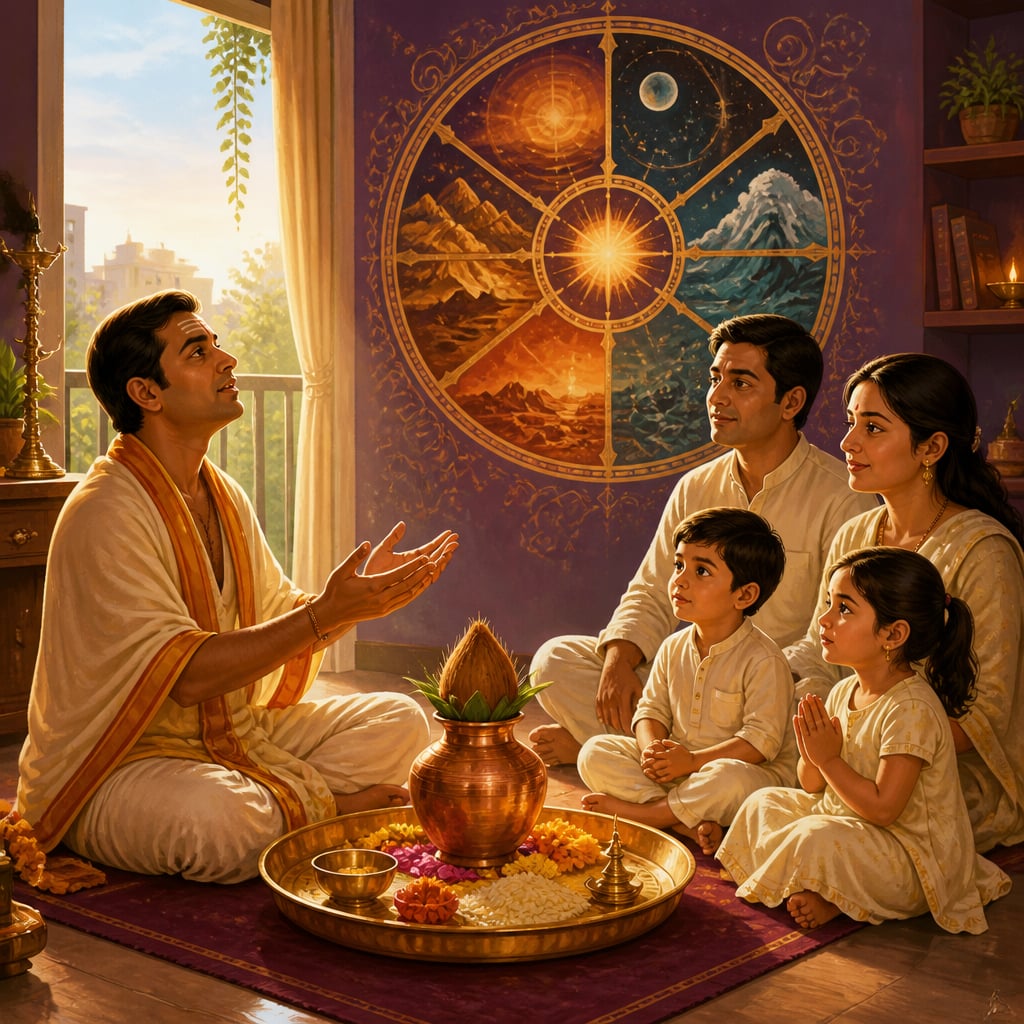
What the pujari has just done is one of the most striking acts in any living religious tradition on earth. He has located a small household event inside a time-frame of 4.32 billion years. The Shiva Purana, like the other Mahapuranas and the broader Vedic tradition, holds a cosmic time scheme so large that no other premodern civilisation comes close. The Greeks measured time in centuries. The Mayans measured in long counts of about five thousand years. The Hebrew calendar runs to about six thousand. The Hindu kalpa runs to four billion three hundred and twenty million years. And one kalpa, the tradition says, is one day of Brahma. The night that follows is just as long. Brahma's life is one hundred Brahma-years of such days and nights, which works out to a number with fifteen zeros.
This is not metaphor. The Shiva Purana gives the numbers in detail. This lesson reads the cosmic clock the tradition holds out and asks the question that matters. Why hold a time-scale this big at the centre of an everyday puja?
The Smallest Unit
The Shiva Purana's Vayaviya Samhita gives the cosmic clock in detail, drawing on the broader Puranic tradition codified in the Vishnu Purana, Bhagavata Purana, and Surya Siddhanta. The clock is built from the bottom up, from the smallest unit to the largest.
The foundation is the truti, an instant of time defined in some texts as one third-thousandth of the time it takes to blink an eye. From there the units rise. Nimesha (a blink). Kashtha (about three seconds in some reckonings). Kala. Muhurta (forty-eight minutes). Ahoratra (a day and night). Maasa (a month). Ritu (a season). Ayana (a half-year). Varsha (a year).
This is ordinary time, the time we live in. The clock does not stop here.
The Yuga
Above the year, time begins to scale exponentially. The four yugas, the cosmic eras, are not equal. They follow a 4:3:2:1 ratio that has fascinated readers since the eighteenth century when the numbers first reached European astronomy.
| Yuga | Length (years) | Quality of dharma |
|---|---|---|
| Satya Yuga (Krita Yuga) | 1,728,000 | Dharma stands on all four legs; truth, austerity, charity, compassion all whole |
| Treta Yuga | 1,296,000 | Dharma stands on three legs; one quarter of the original wholeness has slipped |
| Dvapara Yuga | 864,000 | Dharma stands on two legs; halfway through the descent |
| Kali Yuga | 432,000 | Dharma stands on one leg; the age of contention, fragmentation, and accelerated forgetting |
The four together make one chaturyuga or mahayuga, lasting 4,320,000 years.
The descending lengths are the tradition's way of saying that periods of greater wholeness last longer because they are more stable, and periods of fragmentation are shorter precisely because fragmentation cannot sustain itself for long. Kali Yuga is, in this reading, the brief and unstable bottom of the cycle, not its eternal condition.

The image of dharma as a bull standing on four legs in Satya Yuga, three in Treta, two in Dvapara, and one in Kali (the famous Dharma-vrishabha image of the Bhagavata Purana) is the visual key. The bull does not collapse. It goes lame, then more lame, then nearly falls. And then the cycle restarts with a fresh Satya Yuga and the bull stands fully again.
The Manvantara
Above the chaturyuga sits a much larger unit. Seventy-one chaturyugas make one manvantara, the rule of one Manu. A manvantara works out to roughly 306,720,000 years. There are fourteen manvantaras in a single day of Brahma. Each manvantara has its own Manu (the lawgiver of that age), its own Indra, its own seven sages, its own set of gods.
We are currently, the tradition says, in the seventh manvantara, called Vaivasvata, named after the seventh Manu, Vaivasvata Manu, the son of Surya. Six manvantaras have already been completed in this kalpa. Seven more remain.
The word manvantara literally means the interval of a Manu. The figure of Manu in this scheme is not a single historical person but the archetypal first king and lawgiver who appears at the start of each manvantara to re-establish dharma after the previous manvantara has dissolved. The Manu of our age, Vaivasvata, is the same Manu the Manusmriti is named after, and the same Manu who is sometimes identified with the Hindu equivalent of the great-flood survivor figure (the Matsya story, in which Vishnu as fish saves Manu's boat at the start of the new age).
The Kalpa
Fourteen manvantaras make one kalpa, one day of Brahma. The numbers work out to 4,320,000,000 years. Four billion three hundred and twenty million. This is one of the most remarkable numbers in the history of pre-modern thought, because it sits in the same order of magnitude as modern astronomy's measurement of the age of the Earth (about 4.5 billion years) and the age of the solar system (about 4.6 billion years).
The Shiva Purana arrived at this number more than a thousand years before geological dating could measure it. The number has often been celebrated by modern scientific thinkers, including Carl Sagan in his famous 1980 Cosmos episode on Hindu cosmology, where he noted that the Hindu calendar is the only ancient religious tradition that has time-scales matching the actual age of the universe in modern cosmology.
A kalpa, the day of Brahma, is followed by a pralaya of equal length, the night of Brahma. During the night, the universe rests in unmanifest form. At the dawn of the next day, manifestation begins again. The cycle is the Shiva Purana's image of the cosmic breathing. Brahma exhales: a kalpa. Brahma inhales: a pralaya. The breath is four billion years on each side.
A full Brahma-life is 100 Brahma-years, which works out to a number with fifteen zeros. After this, even Brahma dissolves, and the mahapralaya comes, the great dissolution. Then a new Brahma is born and the cycle begins again. Shiva alone, the Shiva Purana says, is what stands outside this. He is Mahakala, the great time. He is what is unaffected by even the largest cycles, because he is the awareness within which the cycles rise and fall.
Where We Are Right Now
The pujari's sankalpa is not vague. It places the moment exactly. As of 2026 CE, the cosmic location is:
- Kalpa: Shveta Varaha Kalpa (the white-boar kalpa, named after Vishnu's first appearance in this kalpa as the boar lifting the earth from the cosmic ocean)
- Manvantara: Vaivasvata, the seventh of fourteen, ruled by Vaivasvata Manu
- Chaturyuga: The 28th of 71 in the Vaivasvata Manvantara
- Yuga: Kali Yuga, the fourth and final yuga of the current chaturyuga
- Year of Kali Yuga: Approximately 5128 (Kali Yuga is held by the tradition to have begun on a date that maps to about 3102 BCE, computed from the conjunction of planets at the moment of Krishna's departure)
- Time remaining in Kali Yuga: Approximately 426,872 years
The last number is worth pausing over. The popular notion that we are at the end of Kali Yuga is, by the Shiva Purana's own arithmetic, mistaken. We are barely one percent into Kali Yuga. There are 426,000 more years of it ahead. The fragmentation we are currently inside is not the closing chapter of the cycle. It is the opening of a long chapter.
This is itself a teaching. The pessimistic Hindu reading of kaliyug aa gaya (Kali Yuga has come) as a complaint about modernity is shallow. Kali Yuga came over five thousand years ago. The deeper teaching is that we are very early in a long age that the tradition itself describes as the densest period of forgetting in any chaturyuga. The work of remembering, in such an age, is not a brief campaign. It is a long apprenticeship.
Why Hold A Clock This Big
The practical question is the only question that matters. Why does the tradition build a four-billion-year clock and put it at the centre of every household puja? Three reasons, all of them quietly transformative.
Reason one. Perspective. When you locate your morning sankalpa inside a 4.32 billion year kalpa, the things that felt enormous at breakfast (the email exchange, the difficult colleague, the property dispute, the political news) shrink to their actual size. They do not become unimportant. They become proportioned. The Shiva Purana is not telling you to ignore your difficulties. It is telling you to hold them inside a frame large enough that they cannot eat the day.
Reason two. Patience. The cosmic clock teaches that civilisations rise and fall on time-scales the human life cannot witness, and that this is normal. The Hindu tradition has watched empires come and go for several thousand years and has carried on. The clock is part of the equipment that allows that carrying on. A culture that thinks in centuries panics during a bad decade. A culture that thinks in kalpas absorbs centuries the way a kalpa absorbs centuries. Bharat's quiet civilisational endurance is not unrelated to the time scheme of its puja rooms.
Reason three. Cyclicality, not declinism. The Western religious traditions tend toward linear time (creation, fall, redemption, end). The Hindu tradition holds time as cyclical. This is not nostalgia. It is the recognition that wholeness comes back, that Satya Yuga follows Kali Yuga as surely as morning follows night. The bull of dharma stands on four legs again. The work of dharma is therefore not a desperate last stand but a contribution to a cycle that has run before and will run again. The Shiva Purana invites the practitioner to do their small piece without illusions either of permanent victory or of permanent defeat.

The Modern Echo
In 2026, the conversation between Hindu cosmology and modern science has become one of the most interesting interfaith conversations alive. Modern cosmology now estimates the age of the universe at about 13.8 billion years since the Big Bang. The age of the Earth at 4.5 billion years. The future life of the Sun at about 5 billion years before it expands into a red giant. These numbers were not available to any ancient civilisation. The Hindu tradition arrived at numbers in the same order of magnitude (the kalpa at 4.32 billion years is essentially the age of the Earth) by what the modern scientific eye must call inspired guesswork, but which the tradition itself would call darshana, direct seeing.
The Carl Sagan moment in Cosmos (1980) brought this convergence to global attention. More recently, Indian theoretical physicist Dr Subhash Kak at Oklahoma State University, the late astrophysicist Subrahmanyan Chandrasekhar in his quieter writings, and a growing literature in the philosophy of science have explored how the Hindu time-scheme prefigures rather than competes with modern cosmology. The pujari saying the sankalpa in Pune is naming numbers his counterpart in 2500 BCE was already saying, and which the Hubble Space Telescope's data on cosmic background radiation has not contradicted but joined.
In the next lesson, the same cosmology gives its account of the pralaya, the necessary end. Why dissolution is not a tragedy but a mercy. Why the four kinds of dissolution are the cosmos's own way of resetting itself. Why the Shiva of the cremation ground is the same Shiva of the new dawn. The clock that this lesson reads is the clock that the next lesson watches striking midnight.
Key figures
Brahma
The creator god whose day and night constitute the kalpa, the largest unit of regular Puranic time
Vaivasvata Manu
The seventh Manu, lawgiver of the present manvantara, after whom the Manusmriti is named
Mahakala
Shiva as the great time, the consciousness that stands beyond even the largest cosmic cycles
Historical context
The cosmic time scheme has roots in the late Vedic period (c. 800-500 BCE) and is consolidated in the Puranic age (c. 300-1400 CE) through the Vishnu Purana, Bhagavata Purana, Shiva Purana, Linga Purana, and the astronomical Surya Siddhanta
The Hindu cosmic time scheme is one of the most distinctive features of Indian philosophical heritage. While the Greeks measured time in centuries, the Mayans in long counts of about five thousand years, and the Hebrew tradition in roughly six thousand, the Hindu tradition routinely operated in billions of years. The numbers are remarkably consistent across Sanskrit sources separated by centuries. The Surya Siddhanta, the Aryabhatiya, the Vishnu Purana, the Bhagavata Purana, the Shiva Purana, and the Linga Purana all give essentially the same kalpa numbers. This consistency suggests the scheme was settled in the tradition before the surviving texts were composed, possibly in the late Vedic period when astronomical observation in the Indian subcontinent was already advanced. The integration of the cosmic time scheme into the daily sankalpa of every household puja is what kept the scheme alive across centuries of political upheaval. A culture that uses billion-year units in its breakfast ritual will not lose the scheme even when its texts are burned and its temples are razed.
Living traditions
The Hindu cosmic time scheme is enjoying an unusual modern revival. Carl Sagan's 1980 Cosmos episode brought the kalpa numbers to global scientific attention. Subsequent work by Indian theoretical physicists (notably Subhash Kak at Oklahoma State University) and by historians of science (B.V. Subbarayappa, Roddam Narasimha) has made the case that the Hindu time scheme is one of the most sophisticated pre-modern cosmological achievements anywhere. In contemporary India, the Maha Kumbh Mela of 2025 at Prayagraj, with approximately 660 million participants, was the largest single religious gathering in human history, and its twelve-year cycle is a direct expression of the kalachakra logic. The Mahakaleshwar Mahalok corridor, the Kashi Vishwanath Dham, the rebuilt Somnath, and the ongoing Kalachakra initiations by the Dalai Lama keep the cosmic-time inheritance actively transmitted. In wellness and personal-development circles globally, the practice of locating personal worries inside larger time-frames (decade, century, millennium) is being adopted as a mental-hygiene technique, often without acknowledgement of its Hindu source. The pujari saying the sankalpa in a Pune flat in 2026 is one carrier of a clock that may yet teach the planet to think in scales worthy of its actual size.
- The Sankalpa Before Every Puja: Every formal Hindu puja, from the smallest household Satyanarayan to the largest temple festival, begins with a sankalpa, the formal statement of intention. The sankalpa names the kalpa, the manvantara, the yuga, the Jovian-cycle year, the ayana, the ritu, the maasa, the paksha, the tithi, the vaara, the nakshatra, then the place, then the worshipper, then the intention. The whole recitation takes about ninety seconds and has remained essentially unchanged for centuries. It is the most widely performed daily exercise in cosmic-time consciousness in any living religion.
- The Bhasma Arati at Mahakaleshwar: Each morning at 4 AM at the Mahakaleshwar Jyotirlinga in Ujjain, the priests perform the Bhasma Arati, the bath of sacred ash. The ash, traditionally collected from the cremation grounds (now usually substituted with cow-dung ash for hygienic reasons, though the symbolism is preserved), is applied to the south-facing Linga as the central worship of the temple. The ritual is the daily reminder that Shiva is Mahakala, the master of time, and that what time consumes (the body, the kingdom, the era) is itself the substance of his daily worship.
- Mahakaleshwar Jyotirlinga: The temple of Shiva as Mahakala, the great time, on the banks of the Shipra. The only Jyotirlinga whose Linga faces south. The Bhasma Arati at 4 AM is one of the most charged ritual experiences in living Hinduism. The temple is also the headquarters of the Mahakal calendar, the panchanga used by traditional astronomers in central India to compute auspicious times. The recently completed Mahakaleshwar Mahalok corridor (inaugurated October 2022) has greatly expanded the temple precinct and made the cosmic-time iconography of the site available to many more pilgrims.
- Vedh Shala (Jantar Mantar), Ujjain: The astronomical observatory built by Maharaja Jai Singh II of Jaipur in the 18th century, on the banks of the Shipra at the very meridian (the Tropic of Cancer passes through Ujjain, and Ujjain has been the prime meridian of Indian astronomy since at least the time of the Surya Siddhanta in the 4th-5th century CE). The observatory has working instruments for measuring time, eclipse cycles, and planetary positions. Visiting the Vedh Shala alongside the Mahakaleshwar temple gives the pilgrim both the metaphysical and the empirical halves of Hindu cosmology, the temple of time and the instruments that measured it.
- Triveni Sangam, Prayagraj: The confluence of the Ganga, Yamuna, and the underground Saraswati. The site of the Maha Kumbh Mela every twelve years, including the 2025 gathering of approximately 660 million pilgrims. Bathing at the sangam at the time of the Kumbh is held by tradition to be the most powerful tirtha experience in Hindu India, partly because the Kumbh's twelve-year cycle is itself a small enactment of the kalachakra. Standing at the sangam at dawn during a Kumbh year is one of the few moments in modern life where one can feel, in the body, the cosmic clock the Shiva Purana describes.
- The Twelve Adityas at Konark: Although a Surya rather than a Shiva temple, the Konark Sun Temple, built in the 13th century by King Narasimhadeva I of the Eastern Ganga dynasty, is the most spectacular surviving architectural embodiment of the Hindu cosmic clock. The temple is built as a giant chariot with twelve wheels (the twelve months) and seven horses (the seven days of the week), each wheel calibrated as a sundial that can be read to fractions of a minute. The whole temple is the cosmic time scheme made stone. Visiting Konark is the most direct way to see the calendar of the Shiva Purana given architectural form.
Reflection
- If your most pressing current anxiety were placed inside a 4.32 billion year frame, would it stay the same size, get bigger, or get smaller, and what does the answer tell you about how you have been holding it?
- Why do you think the Hindu tradition placed the most expansive cosmic time-frame in any pre-modern religion at the centre of the most ordinary household ritual, and what does this say about how religion was understood to function in daily life?
- Modern cosmology arrives at numbers (the age of the universe at 13.8 billion years, the age of Earth at 4.5 billion) of the same order of magnitude as the Hindu kalpa scheme. What might it mean that a tradition without telescopes arrived at numbers a tradition with telescopes confirms?