Gangadhara: Catching the River of Heaven
Containment without ego
Bhagiratha has spent years on a single rock doing tapas to bring the Ganga down from heaven for his sixty thousand ash-covered ancestors. The river is willing. The problem is the force of her fall. No earth can take it. Shiva agrees to catch her in his matted hair, and the Ganga descends.
The Rock at Gokarna
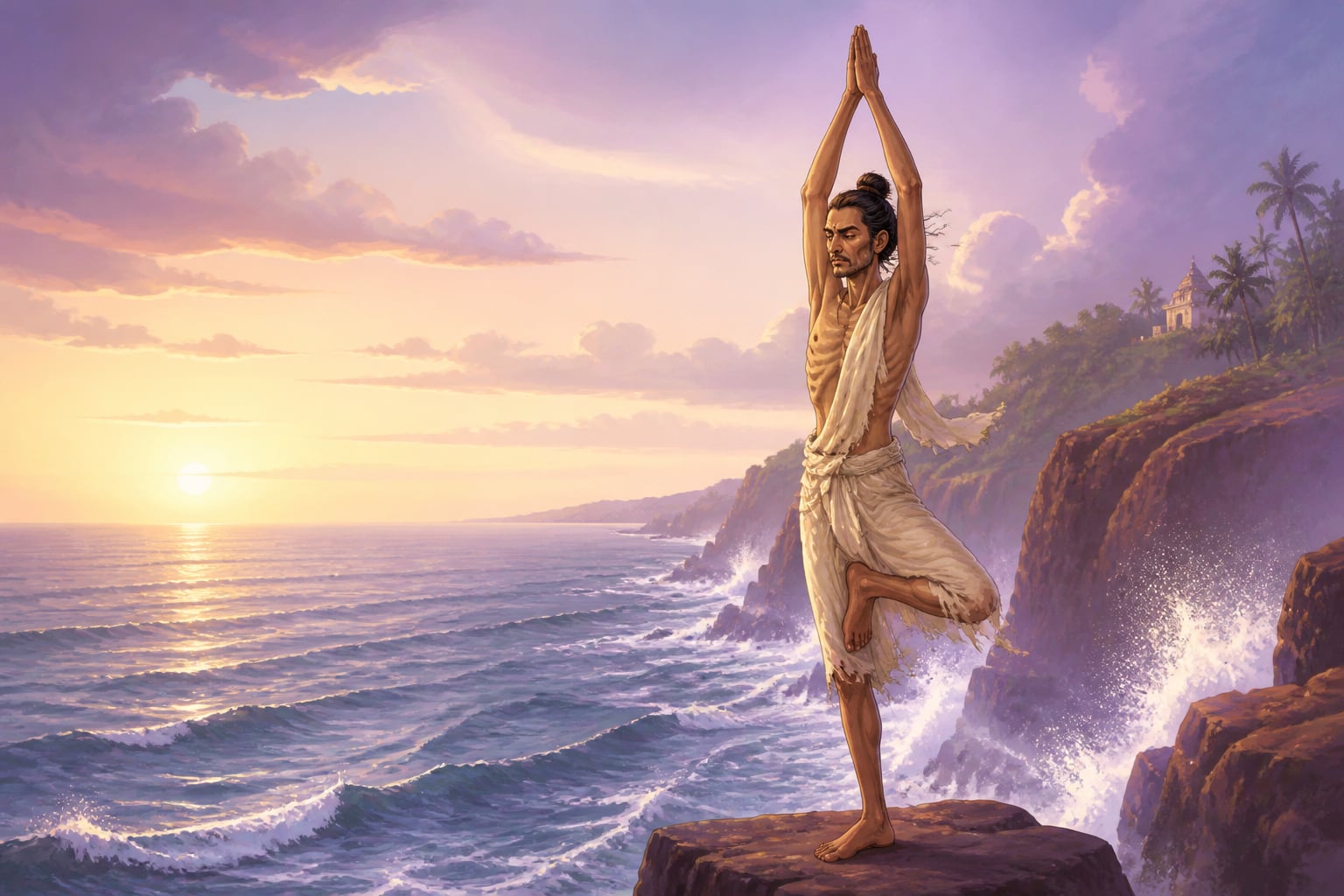
On the western coast of present-day Karnataka, where the Arabian Sea meets the laterite cliffs of the Uttara Kannada district, there is a small rocky outcrop above the high-tide line. The rock is dark, pitted, salt-streaked, warm under the soles even in winter. Coconut palms lean over it from the landward side. The sound of the surf is constant, the sound of the wind in the palms is louder, and the smell of brine carries on every breath. Sometime in the early ages of the world, a young man stands on this rock with both arms raised over his head. His name is Bhagiratha.
He is the great-great-grandson of King Sagara of the Ikshvaku dynasty, the lineage that will one day produce Rama. His own kingdom waits for him in the north. He has not been there in years. His feet have grown rough on the rock. His hair has matted. He eats one fruit a day, drinks rainwater from a small hollow in the stone, and stands with his arms up while the salt cakes on his shoulders. He is doing what the tradition calls tapas, the slow, deliberate burning of the small self until something larger can be asked of the cosmos.
What he is asking for is impossible. His sixty thousand great-uncles, the sons of Sagara, lie in a pit at Patala under the lower world, reduced to a heap of ash by a single glance from the sage Kapila. They had insulted Kapila while searching for a lost ritual horse. The curse on them is fixed. The only force in the cosmos that can lift their ash and send them home is Ganga, the river of the sky, who at present flows in heaven and has never come down. Brahma alone can release her. Bhagiratha, on a small rock above the Arabian Sea, is asking Brahma to do exactly that.
The Shiva Purana spends many verses on this scene. It does so because the lesson begins with what Bhagiratha is willing to spend. Years. A kingdom. A body. Three generations of his own line, all of whom tried this tapas before him and died, have already been used up by the same prayer. He is the fourth. He is willing to be the last.
What Brahma Agrees To
After long years, Brahma appears. The Purana describes his arrival as a quiet brightening of the air over the rock, the kind of light that does not have a source. He tells Bhagiratha what the prince already half-knows. Yes, I will release Ganga. She will fall. But there is a problem you have not yet solved.
Bhagiratha lowers his arms for the first time in years. He listens.
She is the river of heaven, Brahma says. She does not know the earth. When she falls, she will fall with the full weight of the upper world behind her. Her current alone could split the planet open. The earth, struck by her, will crack like a clay pot. Patala itself, where your ancestors lie, will be flooded out of recognition. No place on the earth can receive her directly.
Bhagiratha asks the only question worth asking. Then who can?
Brahma names one being. Only Shiva. Only his hair, the great matted lock, can absorb the fall. Go to him. Ask him to catch her.
This is the second turn of the story. The first turn was the price Bhagiratha had paid to have the river released. The second turn is that the release itself is not the gift. The gift is the catching. A grace that cannot be received is no grace at all. The Shiva Purana is making the move very early. The cosmos has been holding back, not because the gift was unavailable, but because the receiver was not yet built.
The Long Walk North
The Purana hurries the next part. Bhagiratha climbs down from the rock at Gokarna. He walks. The narrative does not linger on the journey, but the geography is real and reads, in Indian terms, as one of the longest dharmic walks in the literature. Gokarna sits on the western coast at roughly the latitude of Goa. Mount Kailasa sits in western Tibet, north of the Himalayan wall, at an elevation of more than six thousand metres. The walking distance, even on the most direct ancient route through the western Deccan, the Aravallis, the Gangetic plain, and the Garhwal Himalaya, is well over three thousand kilometres. Bhagiratha walks it.
He arrives at Kailasa worn down to the bone. He climbs the last slope. He stands at the foot of the mountain, where Shiva is sitting on a tiger skin, ash on his forehead, Parvati beside him, the small drum at his waist silent. Bhagiratha kneels.
He does not give a speech. The Purana writes the petition in three short lines. My ancestors lie in ash. The river is willing to fall. The earth cannot receive her. Brahma has sent me to ask you to catch her in your hair.
Shiva looks at the prince for a long time. The Purana does not record the contents of his thought. It records only what he says next.
I will catch her.
No conditions. No counter-request. No commentary on the cost. The Purana takes one quiet line for the agreement and moves on. The ease of the yes is itself the lesson. A god who has placed himself outside the cosmic court has nothing to weigh against the request. He says yes the way a mountain says yes to a river. The yes is the mountain itself.
The Catching
Bhagiratha returns down the long road to the plains. He stops near the source of where Ganga is to descend, at the snowfields above present-day Gangotri in Uttarakhand. He waits. The cosmos arranges itself. Brahma releases his hand. Ganga, in heaven, gathers herself.
The Purana describes her descent in sound first. A roar so deep that the mountains move. A wind from above that pushes the snow off the high ridges. Birds rise in vast flocks. Animals run for the lower valleys. Then the white column of water, falling through the upper sky, falling through the middle sky, falling toward the earth with a force that the Purana says could shatter every river-bed in the cosmos.
Ganga, falling, is also proud. The text is honest about this. She has been the river of heaven for ages. She has never fallen. She does not yet know that the earth has a catcher waiting for her. She thinks she will land where she pleases. The Shiva Purana lets her think it. The lesson is in the surprise.
She strikes the matted hair of Shiva.

And disappears.
The Purana lingers on this beat. The river, for the first time in her existence, is held. Not deflected. Not slowed. Held. The hair of Shiva, what looked from below like a knot of ash-grey locks, is in fact a forest of seven worlds, dense enough to absorb the entire current of the upper sky. Ganga flows into it and finds, to her own astonishment, that she does not come out. She winds. She doubles back. She runs through the locks for what the Purana calls many years of cosmic time, looking for an exit. She does not find one.
Bhagiratha, on the slope below at Gangotri, looks up. The mountain is silent. The river has not come out. He understands. He resumes his tapas at the foot of Kailasa.
After another long stretch of years, Shiva, in a single moment of recognition, releases a single thread of the river from his hair. That thread becomes the Bhagirathi, the small fierce stream that pours out at Gangotri and is named, even in present geography, after the prince who waited for her. She flows down to the plains. She joins the Alaknanda at Devprayag and becomes the Ganga of the central plains. She crosses the country. At Gangasagar in present-day West Bengal, where the river meets the sea, she finds the pit of ash that holds Bhagiratha's ancestors. She washes them. They rise.
What The Hair Was Doing
The central image of this lesson is the moment between the strike and the release. The river hits the hair. The river is gone. The hair holds her, soundlessly, for a long time. The Shaiva tradition has spent two thousand years on this image because it names a power most cultures have no word for.
The power is not the power to deliver. Brahma has the power to release. Ganga has the power to fall. Bhagiratha has the power to ask. The cosmos is full of beings who can deliver. What it has very few of is the being who can contain. The being whose body can absorb a force the size of the upper sky and not break, and not boast, and not deflect the force into someone else.
This is the meaning of the title Gangadhara. From Ganga plus the root dhṛ, to hold. The bearer of Ganga. The one who holds her. The bearing is the office. The Shaiva claim is that this office, the office of the holder, is harder than the office of the sender. Senders are common. Holders are rare. A cosmos without holders is a cosmos in which every gift becomes a wound.
Notice the further detail. Shiva does not advertise the catching. He does not call the devas to watch. He does not even speak after the strike. The Purana says he sat where he had been sitting and said nothing. The river, finding herself trapped, was the only one who knew, for years, that she had been caught at all. Containment without ego. No press release. No demand for thanks. The hair simply did what the hair was for.
This is one of the most quietly radical claims in the Shaiva tradition. The deepest power in the cosmos is the power that absorbs without announcement. The mother who absorbs the household's anxiety so the children can sleep. The teacher who absorbs the student's confusion so the next class can begin. The senior at work who absorbs the company's worst moments so the team can keep working. None of them are sending. All of them are catching. The Shaiva tradition would say that what they are doing, even on a small kitchen floor on a Tuesday evening, is what Shiva did at Kailasa when the river of heaven came down.
Why The Hair And Not The Hand
The Purana is precise about the body part. Not the hand. Not the chest. Not the trishula. The hair. The matted lock at the top of the head, called the jaṭā.
The choice is theological. The hand acts and can push back. The chest receives, but a force absorbed by the heart can wound the holder. The trishula deflects, which would have sent Ganga sideways and shattered some other part of the cosmos. The jata is none of these. It sits at the very top of the body, where the sahasrara chakra opens at the crown, the meeting of the body and the sky. A force absorbed there does not hurt the holder and does not get sent on. It becomes part of the holder's standing.
Three kinds of pressure arrive on a leader's desk. Some can be acted on, that is the hand. Some can be felt and worked through, that is the chest. Some can only be absorbed, held quietly at the top of the system, until they become posture. The jata is for the kind of force that has nowhere else to go.
Modern Echoes
The psychiatrist Donald Winnicott, in his 1960s clinical writing, described what he called the holding environment. A good-enough mother, Winnicott said, does not solve all of her infant's distress. She holds it, in her presence and her attention, until the infant's own nervous system can absorb it. The infant later grows into an adult who can hold his own difficult states without flying apart, because he was held in someone else's holding when he was small. The capacity to be a holder, Winnicott argued, is built by having been held. The Shaiva tradition would call this the slow weaving of one's own jata, lock by lock, through being on the receiving end of someone else's containment.
The contemporary research literature has converged on the same observation. The Harvard Study of Adult Development, the longest-running study of human flourishing, now in its eighth decade, has consistently found that the single strongest predictor of long-term wellbeing is not income, achievement, or status, but the presence of relationships in which the person feels reliably held. The director of the study, Dr. Robert Waldinger, in his 2015 TED talk, summarised the finding in one sentence. Good relationships keep us happier and healthier. The Shaiva claim is older. Good relationships are jata. They are the matted lock that catches the rivers that fall on every life.

Back at Gangotri
The Bhagirathi still pours out of the snout of the Gangotri glacier each summer. Pilgrims still walk the eighteen kilometres from Gangotri town to the actual glacier mouth at Gaumukh. The water comes out fast, white, very cold, and disappears down the boulder field toward Devprayag. The locals at Gangotri will tell you that the river you are looking at is the single thread Shiva released from his hair. The rest of her, they say, is still in there.
This week, you will be asked to catch something. A child's bad day at school. A friend's grief that has nowhere else to go. A teammate's anxiety in the meeting before the launch. A parent's worry on a Sunday phone call. The Shiva Purana would have you notice the moment. You do not have to solve it. You do not have to deflect it. You do not have to send it on. You only have to hold it, the way Shiva held Ganga, at the top of your own quiet, until the one who is falling realises that, this time, the earth had a catcher. The Bhagirathi, a single thread, will come out later. The most important thing the holder does is the long stretch of years before that, when the river is still inside the hair and no one knows.
Living traditions
The Ganga is a living presence in modern India. More than five hundred million people, roughly two-fifths of the population of India, live in her basin. The annual Kumbh Melas at Prayagraj, Haridwar, Nashik, and Ujjain remain the largest peaceful religious gatherings in the world, with the 2025 Maha Kumbh at Prayagraj drawing over sixty crore pilgrims across its six weeks. The daily Ganga aarti at Dashashwamedh Ghat in Varanasi and Har Ki Pauri in Haridwar is broadcast live on multiple devotional channels and is now visited by the prime ministers, heads of state, and global figures who pass through India. The Namami Gange Programme, launched by the Government of India in 2014 with an initial outlay of twenty thousand crore rupees, is the largest river-restoration effort in the country's history, with treatment plants, riverfront development, and ghat restoration projects across the basin. The Kashi Vishwanath Corridor, inaugurated in December 2021, has restored the unbroken pedestrian connection between the river and the linga that the Shiva Purana had been describing for two thousand years. The river that was caught at Kailasa and released as a single thread at Gangotri is, twelve thousand kilometres of human history later, still washing the heap of ash she was sent to lift.
- Ganga Snana: Bathing in the River: Hindu pilgrims travel from across India and the diaspora to bathe in the Ganga at one of her sacred sites: Gangotri, Haridwar, Rishikesh, Prayagraj, Varanasi, or Gangasagar. The bath is performed at sunrise after a short sankalpa (intention) naming the lineage being remembered, often followed by tarpana (libations of water for the ancestors) and a small offering of flowers, sesame seeds, or a clay lamp let go on the current. The practice is the household form of Bhagiratha's tapas. The seeker comes to the river to ask the same Ganga, who once redeemed sixty thousand ancestors, to wash the long sediment of their own lineage.
- Ganga Aarti at Sunset: Each evening at sunset, large public aartis are performed at the river's most sacred ghats. The most attended are at Dashashwamedh Ghat in Varanasi, Har Ki Pauri in Haridwar, Triveni Ghat in Rishikesh, and Parmarth Niketan (also Rishikesh). Seven young priests in saffron and white perform a synchronised offering with multi-tiered brass lamps, conch shells, dhoop, and bells, while pilgrims on the steps and on boats in the river hold small clay deepas (oil lamps) on leaf boats and let them go on the current at the climax. The chanting is often led by a priest with a microphone and is broadcast live by several Indian devotional channels.
- Tarpana and Pind Daan: On the Pitru Paksha fortnight each year (the dark fortnight of the lunar month Bhadrapada, usually September or October), descendants offer water (tarpana) and rice balls (pinda) to their ancestors at the bank of the Ganga or another sacred river. The most charged sites for pind daan are at Gaya in Bihar (along the Phalgu river, where Vishnu's footprint is venerated as the destination for the offerings) and at Gangasagar in West Bengal (where Bhagiratha's ancestors were finally washed). The ritual is the literal household reenactment of the redemption Bhagiratha asked for. The descendants stand at the same river, on the same banks, performing the same act for the same purpose.
- Gangotri and Gaumukh: Gangotri town, at 3,100 metres in the Garhwal Himalaya, is the upper road-head and the site of the Gangotri temple. The actual source of the Ganga, Gaumukh, is at the snout of the Gangotri glacier eighteen kilometres further upstream at 4,023 metres, reached on foot via the Chirbasa and Bhojbasa rest stops. The river emerges from a small ice cave under the glacier, white, fast, and cold enough to numb the hand within seconds. Tradition holds that this is the literal point at which the single thread of Ganga released from Shiva's hair touched the earth.
- Kashi Vishwanath Temple, Varanasi: One of the twelve Jyotirlingas and the most visited Shiva temple in India. The current shrine was rebuilt by Maharani Ahilyabai Holkar of Indore in 1780 after several earlier destructions. The Kashi Vishwanath Corridor, inaugurated in December 2021, has connected the temple directly to the Ganga at Lalita Ghat through a wide pedestrian plaza, restoring the ancient relationship between the linga and the river. Pilgrims now perform the Ganga snana at the ghat, carry the river water in a brass pot through the corridor, and pour it on the linga as abhisheka in a single uninterrupted movement. The act is the lesson made walkable. The river held in Shiva's hair is poured back over the linga that holds her.
- Gangasagar: The point at which the Ganga, after crossing the entire subcontinent, finally meets the Bay of Bengal. Tradition holds this as the exact site at which Bhagiratha's ancestors, the sons of Sagara, were finally washed and lifted by the river he had spent his life bringing down. The Kapil Muni temple on the island enshrines the sage whose curse had bound them, alongside small shrines to Bhagiratha and Ganga. The annual Gangasagar Mela on Makar Sankranti (mid-January) draws between fifteen and thirty lakh pilgrims for a single bathing day, making it the largest gathering on the Indian eastern coast.
Reflection
- What is the river currently falling on your life, and who in your life is silently catching it for you?
- Why does the Purana put the catching in the matted hair, and not in the hand or the chest?
- If the cosmos has many senders and few holders, what does that ask of those of us who happen to be able to hold?