Vanga Tantra Tribhuja: Bengal's Tantric Triangle
Bakreshwar, Nalahati, and Kiriteswari
Explore the lesser-known but powerful tantric triangle of Bengal. Visit Bakreshwar with its hot springs where Sati's mind (manas) fell, Nalahati where her throat fell, and Kiriteswari where her crown fell. Understand how these three form a tantric mandala.
The Sacred Triangle
In the heart of Bengal's Birbhum and Murshidabad districts lies a constellation of power that few pilgrims fully understand.
Three Shakti Peethas, Bakreshwar, Nalahati, and Kiriteswari, form a tantric triangle across the red-earth landscape. Unlike the famous sites of Kamakhya or Kalighat, these peethas remain relatively quiet, their villages small, their temples ancient. Yet for practitioners of tantra, this triangle represents something profound: a geographic mandala mapping the higher faculties of the Goddess onto the landscape itself.
When Sati's body was dismembered, different aspects of her being fell in different places. At Bakreshwar fell her manas, her mind. At Nalahati fell her kantha, her throat, the seat of expression. At Kiriteswari fell her kirita, her crown, representing sovereignty and transcendence. Together, these three sites trace the path from thought to speech to realization, from inner contemplation to outer expression to ultimate liberation.
Bakreshwar: Where the Mind Fell
The Peetha
Bakreshwar, roughly 24 kilometers from Dubrajpur in Birbhum district, is where Sati's manas (mind) fell to earth.
The name "Bakreshwar" comes from "Vakra" (crooked) and "Ishwar" (Lord), referring to Shiva as the crooked-limbed one, perhaps describing his grief-stricken form as he carried Sati's body. Here, the Goddess is worshipped as Mahishamardini, the slayer of the buffalo demon, a fierce form showing Durga's victory over the forces of ignorance and ego.
What makes Bakreshwar unique among Shakti Peethas is its hot springs. Seven natural thermal springs bubble up from the earth, their waters reaching temperatures of 65-70°C. These springs are not merely geological features, they are understood as the earth's own tapas (heat of spiritual practice), the ground itself burning with sacred energy.
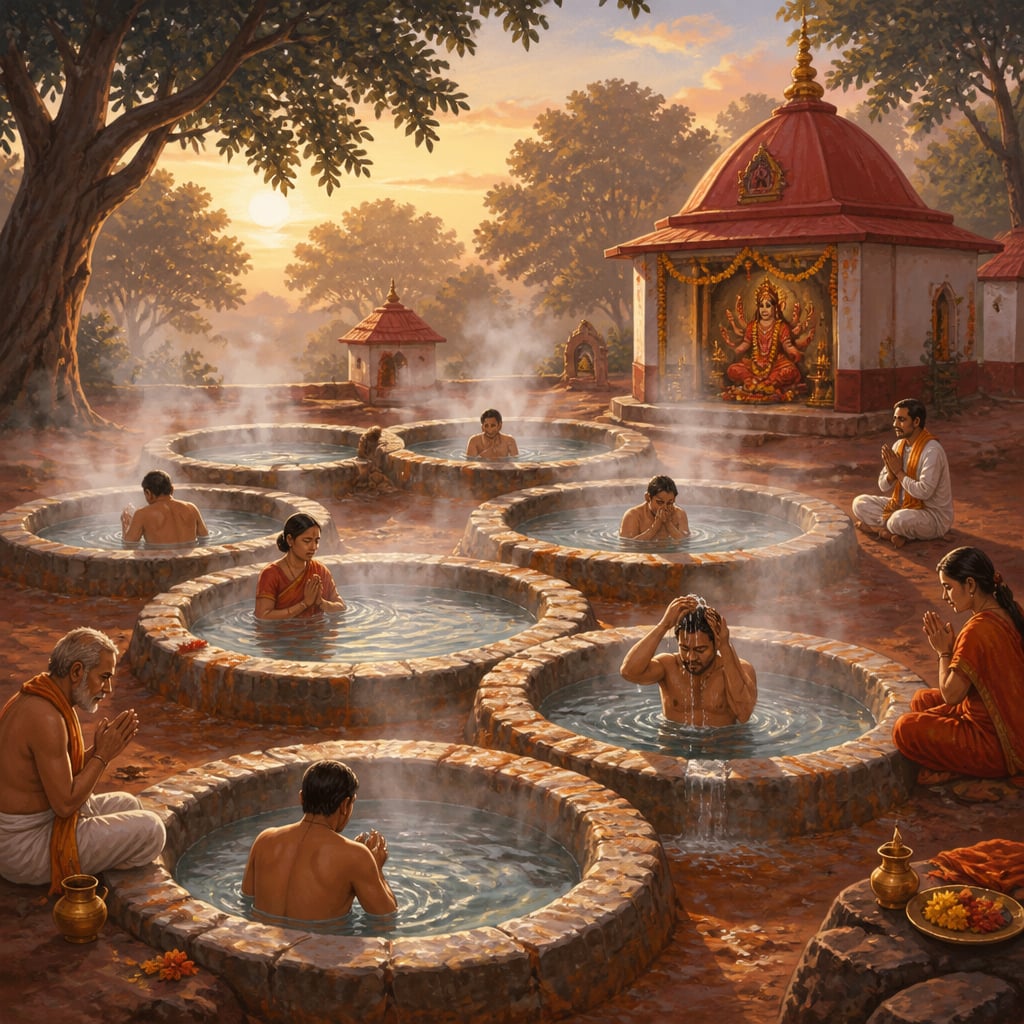
The Hot Springs: Agni Kunda
The seven hot springs at Bakreshwar are:
- Agni Kunda, The fire pool, hottest of all
- Brahma Kunda, Pool of the Creator
- Saubhagya Kunda, Pool of good fortune
- Dhupi Kunda, The smoking pool
- Bhairava Kunda, Pool of the fierce guardian
- Khar Kunda, The alkaline pool
- Panchanan Kunda, Pool of the five-faced (Shiva)
Pilgrims believe that bathing in these waters purifies both body and mind. The sulfurous minerals are said to heal skin conditions, but the deeper healing is psychological, the mind that fell here can be re-integrated through the transformative heat of these sacred waters.
The Goddess and Bhairava
The presiding deity is Mahishamardini Devi, a form of Durga famed for slaying the buffalo demon Mahishasura. In tantric interpretation, this demon represents the untamed, bestial mind, the manas dominated by instinct rather than wisdom. The Goddess's victory here thus has special significance: this is the place where mind is transformed from beast to devotee.
The Bhairava at Bakreshwar is Bhairava himself in his essential form, the fierce aspect of Shiva who guards the peetha. A separate temple honors him, and no worship of the Goddess is complete without acknowledging her protector.
Tantric Significance
The mind's fall at Bakreshwar carries profound teaching. In tantric physiology, the mind (manas) is one of the four aspects of the inner instrument (antahkarana): mind (manas), intellect (buddhi), ego (ahamkara), and memory (chitta). The mind is the doubter, the questioner, the part that oscillates between possibilities. At Bakreshwar, this oscillating faculty is anchored to the earth, to the heat of tapas, to the transformative power of the Goddess.
Practitioners visit Bakreshwar to heal mental disturbances, to find clarity in confusion, to still the restless waves of thought. The hot springs provide a physical analog: just as the earth's heat transforms water to steam, the Goddess's grace transforms scattered thoughts into focused devotion.
Nalahati: Where the Throat Fell
The Peetha

Approximately 50 kilometers from Bakreshwar, in Birbhum district, lies Nalahati, where Sati's kantha (throat) fell.
The throat is the seat of Vishuddha Chakra in tantric anatomy, the energy center governing communication, expression, truth-speaking, and creative power. When the Goddess's throat fell here, this landscape became charged with the power of sacred speech, of mantra, of the word that creates and destroys worlds.
The Goddess here is worshipped as Kalika, a form closely related to Kali, but with her own distinct presence. The temple is relatively small, nestled in a quiet village, but its energy is palpable to sensitive visitors.
The Temple
Nalahati temple is ancient, though the present structure has been renovated over centuries. The inner sanctum houses the sacred stone representing the throat of the Goddess. Unlike grander peethas, Nalahati maintains an intimate atmosphere, fewer crowds, simpler rituals, more space for genuine contemplation.
The temple sits near a tank (water reservoir) where pilgrims bathe before darshan. Local tradition holds that this water was blessed by the Goddess's throat falling nearby, giving it special power to purify speech, both the lies we have told and the truths we have suppressed.
The Goddess and Bhairava
Kalika Devi presides here, a fierce form of the Goddess associated with time, transformation, and the power of sound. The name "Kalika" shares roots with "Kala" (time), this is the Goddess who speaks the future into existence, whose words become reality.
The Bhairava at Nalahati is Yogesh, the Lord of Yoga, a meditative aspect of Shiva associated with the control of subtle energies. This pairing is significant: the throat's expression (Kalika) is balanced by yogic discipline (Yogesh). Speech without control is mere noise; control without expression is suppression. Together, they represent the ideal of truthful, disciplined communication.
Tantric Significance
The throat chakra (Vishuddha) is where sound becomes meaning, where the formless vibration of consciousness takes shape as words. In tantric practice, mantra works primarily through this center, the practitioner's voice becomes a vehicle for divine energy.
Nalahati is thus a place of power for those who work with sound: mantra practitioners, singers, teachers, writers, anyone whose spiritual path involves communication. Pilgrims come here to receive the blessing of eloquent and truthful speech, to heal wounds caused by harsh words (given or received), and to purify the voice as an instrument of the Divine.
The throat that fell here belongs to the Goddess who spoke all mantras into existence. To receive Nalahati's blessing is to participate in that original creative speech.
Kiriteswari: Where the Crown Fell
The Peetha

The third point of the triangle is Kiriteswari, located in Murshidabad district, where Sati's kirita (crown) fell.
The crown represents sovereignty, the highest point, the seat of the thousand-petaled Sahasrara chakra that connects individual consciousness to cosmic consciousness. When the Goddess's crown fell here, this place became charged with the energy of ultimate transcendence, the leap from human to divine, from limited to unlimited.
The Goddess here is worshipped as Kiriteswari (Sarvamangala), the one whose crown (kirita) fell, the auspicious one (Sarvamangala) who blesses all who approach her.
The Temple
Kiriteswari temple stands on the banks of the Bhagirathi River (a distributary of the Ganges), adding the purifying power of sacred water to the site's crown-energy. The temple is older than historical memory, with the present structure dating to renovations over several centuries.
The inner sanctum houses a stone that glows with vermillion, representing the fallen crown. Local traditions speak of miraculous powers, wishes granted, diseases healed, spiritual visions received. These reports cluster particularly around certain auspicious days and during specific planetary alignments.
The Goddess and Bhairava
Kiriteswari Devi (also called Sarvamangala) is the presiding form, the crowned one, the sovereign mother who bestows blessings. Her iconography often shows her with a crown or a radiant head, emphasizing the crown-connection.
The Bhairava here is Bhairava in his protective aspect. Some traditions identify him as Madhava (a name of Vishnu), suggesting an interesting theological blend, the site may have been a Vaishnavite-Shakta fusion temple at some point in history.
Tantric Significance
The crown chakra (Sahasrara) is where individual soul meets universal consciousness. In tantric physiology, it is the point of liberation, the doorway through which kundalini energy exits the body-system and merges with the infinite.
Kiriteswari represents the culmination of the tantric triangle's journey: from mind (Bakreshwar) to expression (Nalahati) to transcendence (Kiriteswari). The pilgrim who visits all three traces the path of consciousness itself, from the churning of thought, through the crystallization into speech, to the final liberation beyond all form.
The crown that fell here belongs to the Goddess who rules all creation. To receive Kiriteswari's blessing is to touch, however briefly, that sovereign awareness that is our true nature.
The Triangle as Mandala
Geographic Spirituality
In tantric tradition, sacred geography is not metaphorical, it is real. The earth itself is the body of the Divine, and certain configurations of temples, rivers, and mountains function as energetic circuits.
The Bengal tantric triangle demonstrates this principle. If you draw lines connecting Bakreshwar, Nalahati, and Kiriteswari on a map, you create a triangle. This triangle is a yantra, a sacred geometric form that concentrates and channels divine energy. Pilgrims who visit all three sites "activate" this yantra within their own being.
The Journey's Teaching
The triangle maps the inner journey:
- Bakreshwar (Mind): Where we begin, with all our doubts and oscillations
- Nalahati (Throat): Where inner truth becomes outer expression
- Kiriteswari (Crown): Where all distinctions dissolve into sovereign awareness
This is also the path of mantra practice:
- First, the mind receives the mantra
- Then, the throat speaks it aloud
- Finally, the crown-consciousness realizes its meaning beyond sound
And it maps the tantric teaching on levels of reality:
- Mind corresponds to the manas level, the world of thought
- Throat corresponds to the madhyama level, the world of subtle speech
- Crown corresponds to the para level, transcendent silence beyond all speech
How to Undertake the Pilgrimage
Traditionally, the triangle is visited in a specific order, though practices vary by lineage:
Traditional Order (Bottom to Top):
- Begin at Bakreshwar, purify and stabilize the mind
- Continue to Nalahati, transform thought into sacred speech
- Conclude at Kiriteswari, offer everything to the transcendent
Each site has its specific mantras and practices, ideally received from a guru. For the lay pilgrim, simple worship at each temple, bathing in sacred waters (particularly Bakreshwar's hot springs), and circumambulation of each site is sufficient.
The journey can be completed in 2-3 days by car. Serious practitioners often spend longer, performing extended sadhana at each location before moving to the next.
Historical context
Ancient origins (likely predating historical records); temples renovated multiple times, with current structures from medieval to modern periods
Living traditions
The tantric triangle remains an important pilgrimage circuit for serious practitioners, though less famous than individual sites like Kamakhya or Kalighat. Its relative obscurity is valued by tantrikas who prefer quieter sites for intense sadhana. The hot springs of Bakreshwar have also attracted interest from geologists and health tourists, creating an unusual blend of pilgrims seeking spiritual purification and visitors seeking therapeutic bathing.
- Tri-Peetha Yatra: A pilgrimage covering all three sites of the tantric triangle, ideally completed in a specific order with mantras and rituals at each location.
- Hot Spring Bathing (Bakreshwar): Ritual bathing in the seven hot springs, particularly Agni Kunda (the hottest) and Brahma Kunda. Pilgrims recite mantras while bathing to amplify purification.
- Mantra Japa at Nalahati: Extended mantra recitation at Nalahati, where the Goddess's throat fell. Practitioners believe mantras chanted here carry exceptional power.
- Ganga Snana at Kiriteswari: Ritual bathing in the Bhagirathi River before temple darshan. The combination of river purification and crown-chakra blessing creates a powerful culmination to the triangle pilgrimage.
- Bakreshwar Temple & Hot Springs: The main temple housing Mahishamardini Devi, surrounded by seven natural hot springs. The hot springs are the unique feature, nowhere else in Bengal does sacred water emerge from the earth at nearly boiling temperatures.
- Nalahati Temple: The intimate temple of Kalika Devi where Sati's throat fell. Quieter than other Bengal peethas, ideal for contemplation and mantra practice.
- Kiriteswari Temple: The crown peetha on the banks of the Bhagirathi River. The combination of Shakti Peetha and Ganga water makes this site particularly powerful for purification rituals.
- Tarapith: Only 30 km from Bakreshwar, Tarapith is often combined with the triangle pilgrimage. Together, these four sites form the heart of Bengal's tantric geography.
Reflection
- The triangle maps mind → throat → crown (thought → speech → transcendence). Where in your own life is the flow blocked? Do you think things you never say? Say things that don't lead anywhere? What would complete alignment feel like?
- At Bakreshwar, hot springs purify the mind. What 'heat' in your own life has served to purify your thinking? Difficulty, crisis, intense experience? How did these burning moments transform confusion into clarity?
- The crown chakra represents sovereignty, true self-rule. In what areas of your life do you genuinely feel like the sovereign? In what areas do you feel subject to external forces? What would it mean to 'wear your crown' more fully?