Jivita Tantra: Living Tantra Today

Ambubachi Mela, Kali Puja, and how pilgrims can participate

Experience how tantric traditions remain vibrantly alive at Shakti Peethas today. Witness Ambubachi Mela at Kamakhya, the most intense tantric gathering in India. Understand Kali Puja in Bengal. Meet the tantric priests who maintain ancient practices, and learn how pilgrims can respectfully participate.

A Living Tradition

Tantra is not a historical curiosity. It lives.

At this very moment, somewhere in India, a tantric priest is performing rituals unchanged for centuries. Somewhere, a sadhaka is meditating in a cremation ground. Somewhere, devotees are gathering to honor the fierce goddess in ways their ancestors would recognize.

This chapter brings us from theory to practice, from understanding tantra philosophically to witnessing how it actually manifests today at Shakti Peethas. We will visit Ambubachi Mela, experience Kali Puja, meet the people who maintain these traditions, and understand how respectful pilgrims can participate.

Ambubachi Mela: The Goddess Menstruates

The Festival

Every June, at the Kamakhya Temple in Guwahati, Assam, something remarkable happens.
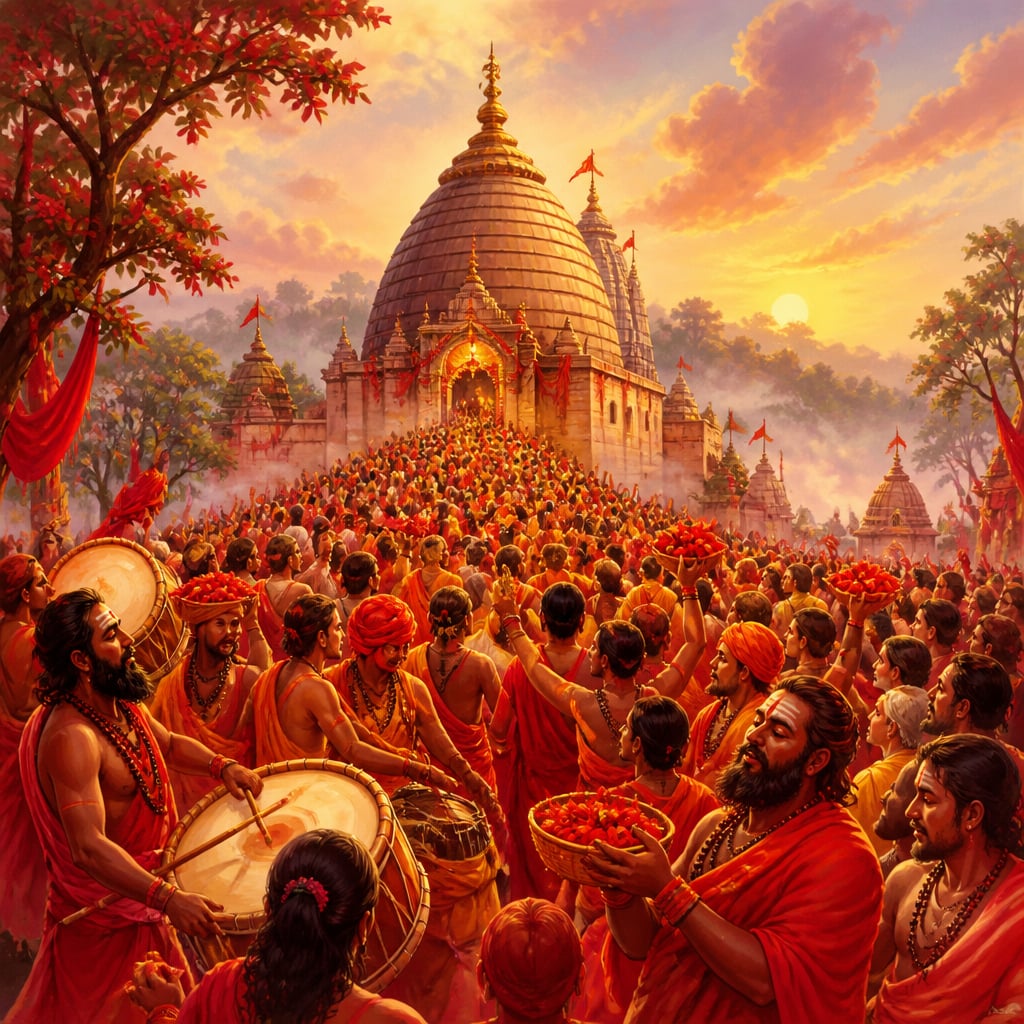
Ambubachi Mela pilgrims at Kamakhya

For three days, the temple doors close. No worship is performed. The reason? The Goddess is menstruating.

This is Ambubachi Mela, perhaps the most explicitly feminine religious festival on Earth. The tradition holds that during these three days (typically June 22-24, aligned with monsoon's arrival), the Goddess Kamakhya goes through her annual menstrual cycle. The earth itself is considered to be menstruating, making it unfit for plowing or sowing. And hundreds of thousands of pilgrims, tantric practitioners, devotees, curious visitors, converge on Kamakhya for what becomes one of India's largest religious gatherings.

What Happens

Day 1-3 (Closure): The temple doors are sealed. The stone yoni in the inner sanctum, which naturally turns red at this time (due to iron oxide in the spring water), is covered with red cloth. No pujas are performed inside. The Goddess rests.

Outside, however, the atmosphere is electric. The hillside fills with tents and temporary structures. Tantric sadhus arrive from across India, aghoris, kaulas, shaktas of various lineages. Many practice openly: meditations, rituals, fire ceremonies. Some engage in practices that shock conventional sensibilities; others perform simple devotional worship. The entire spectrum of tantric tradition is on display.

Day 4 (Opening): On the fourth day, the temple doors open with tremendous ceremony. The red cloth that covered the yoni (now stained deep red) is cut into small pieces and distributed as rakta vastra, the "blood cloth", one of the most powerful tantric talismans. Devotees wait for hours for a tiny piece of this cloth, believed to carry the Goddess's menstrual blessing.

The scene is overwhelming: hundreds of thousands pressing toward the temple, drums beating, priests chanting, devotees weeping with emotion. For those who experience it, Ambubachi can be transformative, a direct encounter with the divine feminine in her most primal, biological, unapologetic form.

The Teaching

Why celebrate menstruation? In most cultures, menstruation is taboo, something to hide, to treat as "impure." Ambubachi deliberately inverts this.

The tantric logic is profound: the menstrual cycle represents the creative power of the feminine, the ability to generate life. Blood is not impure; it is shakti made visible. By honoring the Goddess's menstruation, Ambubachi honors the creative power of all women, all wombs, all biological processes that mainstream religion often treats as unclean.

For tantric practitioners, Ambubachi is also a time of exceptional power. When the Goddess menstruates, her creative energy is at its peak. Practices performed during these days are believed to bear exceptional fruit. The three days of closure are not inactivity but intensified inner practice; the opening marks the release of accumulated shakti into the world.

Participating in Ambubachi

For pilgrims considering Ambubachi:

Practical considerations:

Spiritual preparation:

What you can do:

Kali Puja: Bengal's Dark Night of the Soul

The Festival

Kali Puja midnight aarati at Tarapith temple

While most of India celebrates Lakshmi on Diwali night, Bengal worships Kali.

Kali Puja falls on the new moon night of the month of Kartik (October-November), the darkest night of the year. On this night, Kali temples across Bengal blaze with lights against the surrounding darkness. The juxtaposition is intentional: Kali is the light found within darkness, the liberation found within death.

At Shakti Peethas like Kalighat and Tarapith, Kali Puja is the most important night of the year. Elaborate rituals run from sunset to sunrise. The Goddess receives special offerings, special mantras, special adornments. Many tantric practitioners choose this night for their most intensive practices.

What Happens

Evening: As the sun sets, temples are decorated. Clay images of Kali, created over weeks by specialized artists, are installed in temples and pandals (temporary structures) throughout Bengal. The images are fierce: Kali standing on Shiva's corpse, tongue lolling, garland of skulls, skirt of severed arms. Yet devotees approach with tender affection, addressing the terrifying goddess as "Ma" (Mother).

Night: Pujas begin at nightfall and continue until dawn. At major sites like Kalighat:

At Tarapith, the cremation ground is particularly active on Kali Puja night. Sadhus perform rituals that would shock ordinary visitors, yet do so in a spirit of intense devotion.

Dawn: As the first light appears, many devotees have stayed awake through the entire night. The successful completion of "jagaran" (staying awake in worship) is considered especially meritorious. In the morning, the clay images are taken in procession and immersed in rivers or ponds, returning the Goddess to her formless state.

The Teaching

Why worship on the darkest night? Why invoke the most terrifying goddess?

Kali Puja embodies the tantric principle that liberation lies through, not around, what we fear. The devotee who can face Kali, death herself, and address her as "Mother" has conquered fear. The practitioner who can worship through the darkest night discovers that darkness itself is Shakti.

The festival also teaches that the fierce and the tender are not opposites. Kali's tongue drips blood; yet devotees offer her sweets. She wears skulls; yet she is addressed with love. The relationship between Bengali devotees and Kali is remarkably intimate, she is not distant and terrifying but close and maternal, even in her most fearsome form.

Participating in Kali Puja

Where to experience:

What you can do:

What to expect:

The Tantric Priests: Guardians of Living Tradition

Who Are They?

At every Shakti Peetha, certain individuals maintain the tantric traditions from generation to generation. These are not merely temple employees but initiated practitioners who have received diksha, learned the specific rituals of their site, and dedicated their lives to serving the Goddess.

Types of tantric specialists:

Their Daily Life

A tantric pujari performing morning havan at a Shakti Peetha

A temple pujari at a major Shakti Peetha typically:

This schedule continues year-round, with intensification during festivals. The pujari is the living link between the Goddess and the devotees, their worship maintains the site's spiritual power.

Meeting Them

Pilgrims can interact with tantric practitioners, but respect is essential:

Do:

Don't:

How Pilgrims Can Participate

Levels of Participation

Tantric traditions at Shakti Peethas are open to various levels of participation:

Level 1: Simple Darshan The most basic participation, visiting the temple, having darshan of the deity, receiving blessings. Anyone can do this regardless of background. This is how most pilgrims engage.

Level 2: Participating in Puja A deeper level, requesting a puja be performed on your behalf or joining a public ceremony.

Level 3: Festival Participation Joining major events like Ambubachi Mela or Kali Puja, experiencing the tradition at its most intense.

Level 4: Receiving Initiation For those seriously drawn to tantric practice, formal diksha (initiation) from a qualified guru.

What the Tradition Offers Pilgrims

Visiting tantric sites can provide:

Energetic blessing: The accumulated shakti at Peethas is palpable. Many visitors report feeling energized, clarified, or emotionally moved by the experience.

Perspective shift: Encountering the fierce goddess, witnessing cremation-ground practices, seeing taboos treated as sacred, these experiences can shift how you see the world.

Inspiration: Seeing practitioners who have dedicated their lives to realization can inspire your own practice, whatever form it takes.

Direct blessing: The Goddess at each peetha is believed to grant boons to sincere devotees. You can bring your needs to her.

Liberation: The tradition teaches that sincere worship at a Shakti Peetha can burn karma and accelerate spiritual progress.

Cautions for Pilgrims

Be genuine: The Goddess, it is said, sees the heart. Don't come as a spiritual tourist seeking exotic experiences.

Don't romanticize: Tantric sites are not sanitized for visitors. Accept reality as it is.

Respect boundaries: Some practices are closed to non-initiates. Some areas are restricted. Respect these boundaries.

Be discerning: Unfortunately, some people exploit religious settings. Use common sense.

Integrate slowly: Intense experiences can destabilize unprepared visitors. Give yourself time to integrate.

The Tradition's Future

Living tantra faces challenges: commercialization, misrepresentation, and modernization pressures. Yet the tradition persists. Living lineages continue to initiate disciples. Daily worship continues at Peethas as it has for centuries. Festivals draw larger crowds than ever.

The Shakti Peethas remain what they have always been: living laboratories where human beings engage the divine feminine in her most powerful forms. The tradition evolves, adapts, faces challenges, but it lives. And as long as sincere seekers approach these sites with devotion, the Goddess will continue to offer her transformative blessing.

Historical context

Festivals like Ambubachi and Kali Puja have been celebrated for centuries. Kamakhya's Ambubachi traditions are attested from at least the medieval period; Kali Puja in its current form developed mainly in the 18th-19th centuries.

Living traditions

Living tantric traditions at Shakti Peethas face challenges (commercialization, misunderstanding) but also opportunities (global interest, scholarly attention). The key is maintaining authenticity while welcoming sincere seekers. As long as genuine practitioners maintain traditions and genuine seekers approach with humility, the transmission continues.

Reflection

More in Tantra Peethas: Where the Fierce Goddess Lives

All lessons in Tantra Peethas: Where the Fierce Goddess Lives ยท The Shakti Peethas course