Tarapitha: Abode of Tara

The skull, Bamakhepa, and living tantric practices

Enter Tarapith in Birbhum, West Bengal, the most important seat of tantric Tara worship. Learn about Bamakhepa, the mad saint who lived in the cremation grounds, the unique skull worship, and why this remains India's most active tantric center.

The Peetha of the Third Eye

In the red-earth lands of Birbhum, West Bengal, stands a temple unlike any other in India.

Tarapith is not a place of conventional piety. Here, skulls line the worship area. Tantric sadhus smear themselves with cremation ash. Animal sacrifice continues openly. And yet, for those who understand, this is one of the most sacred Shakti Peethas in existence, a place where the boundary between death and life, fear and fearlessness, dissolves entirely.
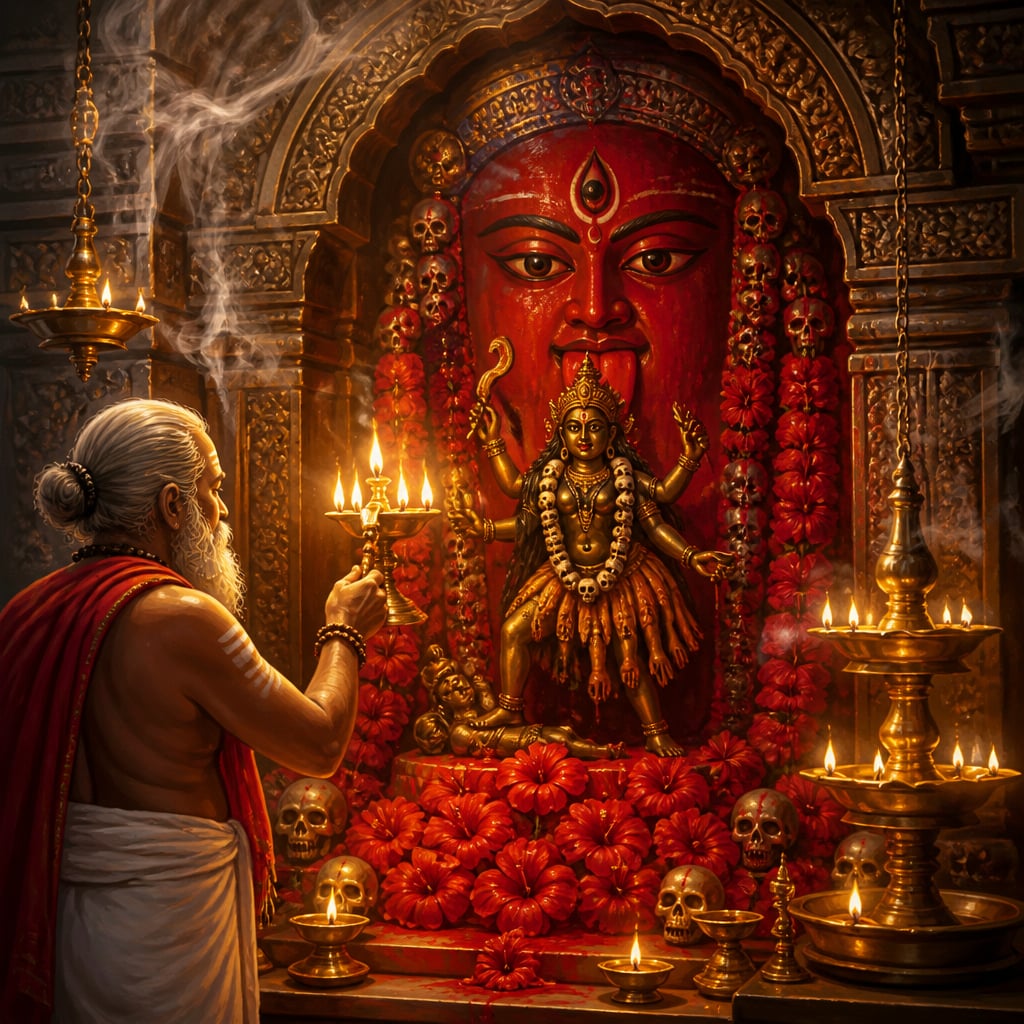
Tara sanctum at Tarapith

According to tradition, when Sati's body was dismembered by Vishnu's Sudarshana Chakra, her third eye (the eye of wisdom and transcendence) fell here. Some texts say it was her eyeball; others say it was the tara, the pupil, the very center of vision. Either way, Tarapith became the seat of a goddess who sees beyond ordinary sight, who illuminates what is hidden, who guides her devotees across the ocean of existence.

The Goddess Tara

Tara is not a gentle mother figure. She is fierce, primal, and transformative.

In the temple's inner sanctum, the primary image is striking: a stone covered in vermillion, representing the Goddess, with a metal image of Tara placed before it. But the most famous image shows Tara in her nursing form, the goddess breastfeeding Shiva, who lies across her lap like an infant. This image, called Shava-Sadhana Tara, encapsulates a profound tantric teaching: even Shiva, the cosmic consciousness, draws his power from Shakti. Without her, he is shava (a corpse); with her, he is Shiva (the auspicious one).

Tara's iconography is deliberately fierce. She typically has four arms, carrying a sword, a severed head, scissors, and a lotus. Her skin is blue-black, representing the void from which all creation emerges. She wears a garland of skulls and stands on a corpse. To the uninitiated, this is terrifying. To the tantric practitioner, every element carries deep meaning:

Bhairava: The Guardian

Every Shakti Peetha has its Bhairava, the male consort who guards the site and the goddess.

At Tarapith, the Bhairava is Chandrashekhar, literally, "the one with the moon in his hair," an epithet of Shiva. But here, Chandrashekhar takes on a particularly intense form. He is worshipped as the protector of tantric practices, the one who stands at the threshold between the cremation ground and the temple.

The relationship between Tara and her Bhairava reflects the central tantric teaching: Shakti (dynamic power) and Shiva (pure consciousness) are inseparable. Tara acts; Chandrashekhar witnesses. She transforms; he provides the ground of being in which transformation occurs.

The Temple and Its Grounds

Mahasmashan cremation ground at Tarapith at dusk

Tarapith temple sits adjacent to one of the most active cremation grounds in Bengal, the Maha Smashan.

This is not coincidental. Tantra deliberately chooses the cremation ground as a place of practice because it strips away all pretense. In the smashan, wealth means nothing. Social status disappears. Beauty decays. Only the essential remains. For the tantric practitioner, meditating among burning bodies is the ultimate practice of vairagya (dispassion), not because life is meaningless, but because clinging to impermanent things causes suffering.

The temple itself is relatively modest by Indian standards, a red-painted structure with a distinctive charchala (curved four-cornered) roof typical of Bengal. Inside, the atmosphere is thick with incense, the air heavy with devotion. Priests perform elaborate rituals involving red hibiscus flowers (Tara's favorite), bell-metal vessels, and mantras passed down through generations of tantric lineages.

Outside, the smashan is equally alive with activity. Sadhus sit in meditation, some wearing nothing but ash. Fire pits glow through the night. The boundary between temple and cremation ground is deliberately blurred, both are spaces of transformation.

Bamakhepa: The Mad Saint

No discussion of Tarapith is complete without Bamakhepa (1837-1911), the saint who made this peetha famous across India.

Born Bamacharan Chattopadhyay in a poor Brahmin family, Bama showed early signs of spiritual eccentricity. He was drawn irresistibly to Tarapith's cremation ground, eventually making it his permanent home. He would eat food left for corpses, sleep among half-burned bodies, and speak in riddles that seemed like madness to ordinary people.

But his devotion to Tara was absolute. He spent hours in meditation, sang to the Goddess like a child to its mother, and attained spiritual states that attracted seekers from across Bengal. When the wealthy came seeking blessings, Bama would often chase them away with abuse. When the poor and sincere came, he would weep with compassion and share whatever he had.

One famous story tells of a time when Bama was caught eating the prasad (sacred food) meant for the Goddess before it was offered. The temple priests beat him and threw him out. That night, the head priest dreamed of Tara, who appeared furious: "You beat my child? He was not eating my prasad, I was eating through him." From then on, Bama had complete freedom in the temple.

Bamakhepa's samadhi (memorial shrine) stands in the cremation ground, still visited by thousands who seek his blessings. His life demonstrated the tantric principle that true devotion transcends all social conventions, that madness in the eyes of the world may be the highest sanity.

The Skull Worship: Mundamala Sadhana

Mundamala skull sadhana at the Tarapith cremation ground

One of Tarapith's most distinctive practices is mundamala sadhana, spiritual practice with skulls.

Human skulls, carefully collected from the cremation ground, are used in advanced tantric rituals. The practice may seem macabre, but its purpose is profound: the skull represents the container of consciousness. By meditating on a skull, the practitioner contemplates the nature of mind itself, where thoughts arise, where they dissolve, what remains when the body is gone.

This is not ancestor worship or necromancy. It is a radical confrontation with mortality meant to liberate the practitioner from fear. The tantric logic is simple: what you fear controls you; what you embrace liberates you. By making friends with death, the sadhaka becomes fearless in life.

The Shakti Tattva: What Tarapith Teaches

Every Shakti Peetha offers a unique spiritual teaching. Tarapith's teaching is about transformation through direct confrontation with what we fear.

Most spiritual paths counsel avoidance, don't think about death, stay away from impure things, maintain boundaries between sacred and profane. Tantra takes the opposite approach. At Tarapith, the cremation ground is the temple. Death is the teacher. What society calls impure is the very material of transformation.

This is Tara's gift. Her name means "star" but also "one who carries across." She is the goddess who helps us cross the ocean of samsara (worldly existence) not by denying its depths but by giving us the courage to swim. At Tarapith, devotees learn that liberation comes not from escaping darkness but from finding the light within it.

The third eye that fell here represents prajna, transcendent wisdom that sees beyond dualities. Where ordinary eyes see only death, the third eye sees transformation. Where ordinary eyes see only a corpse, the third eye sees the dance of Shakti taking one form and becoming another. This vision is Tarapith's ultimate teaching.

Historical context

Ancient origins (possibly pre-Vedic tribal goddess worship), formalized as Shakti Peetha by medieval period, made famous in 19th-20th century through Bamakhepa

Living traditions

Tarapith remains India's most active tantric center. While many tantric sites have become sanitized or touristic, Tarapith retains its intensity, skull worship continues, animal sacrifice is practiced, and sadhus live in the cremation ground as Bamakhepa did. The temple has become a pilgrimage site for those seeking to understand authentic tantric tradition, attracting scholars, spiritual seekers, and devoted householders alike.

Reflection

More in Tantra Peethas: Where the Fierce Goddess Lives

All lessons in Tantra Peethas: Where the Fierce Goddess Lives ยท The Shakti Peethas course