Nepal Devi: Nepal's Goddess Tradition

Guhyeshwari, Kumari, and the Pashupatinath connection

Discover Nepal's living Shakti tradition. Visit Guhyeshwari temple in Kathmandu where Sati's knees fell, understand the unique Kumari tradition of worshipping a living goddess, and explore how these traditions integrate with Pashupatinath worship.

The Kingdom of the Goddess

Nepal has long been called the only Hindu kingdom in the world, and it remains one of the most intensely goddess-worshipping regions on earth. Here, Shakti is not abstract theology but living presence. The Goddess walks in the streets in the form of the Kumari, presides over the Kathmandu Valley from hilltop temples, and dwells in a hidden sanctum directly connected to Pashupatinath himself.

Nepal's Shakti traditions are unique: a blend of Hindu and Buddhist tantric practice, preserved royal rituals, and indigenous Newar culture. Here we explore the country's most important Shakti Peetha and the remarkable living-goddess tradition that makes Nepal a place where the divine feminine is not only worshipped but embodied.

Guhyeshwari: The Secret Goddess

On the banks of the Bagmati River, less than a kilometer from the great Pashupatinath temple, lies Guhyeshwari, the "Secret Goddess." Here, according to tradition, Sati's knees (janu) or hips (nitamba) fell when Vishnu's discus dismembered her body.

The temple's very name announces its esoteric nature: guhya means secret, hidden, mysterious. Unlike most Hindu temples where images of deities are displayed, Guhyeshwari's inner sanctum is forbidden to all but initiated tantric practitioners. What is worshipped there is a kalasha (water vessel) representing the Goddess in her formless state.
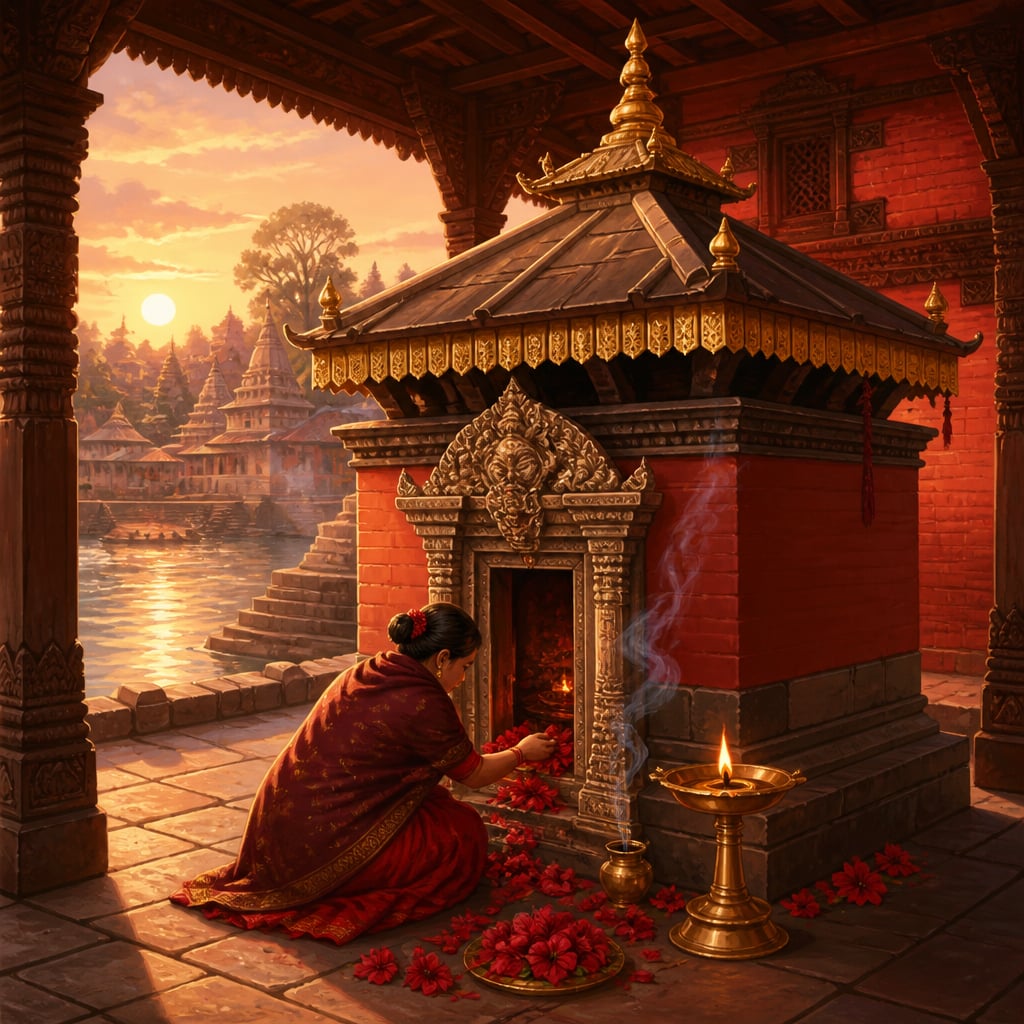
Guhyeshwari temple courtyard on the banks of the Bagmati at first light

The Shiva-Shakti Unity

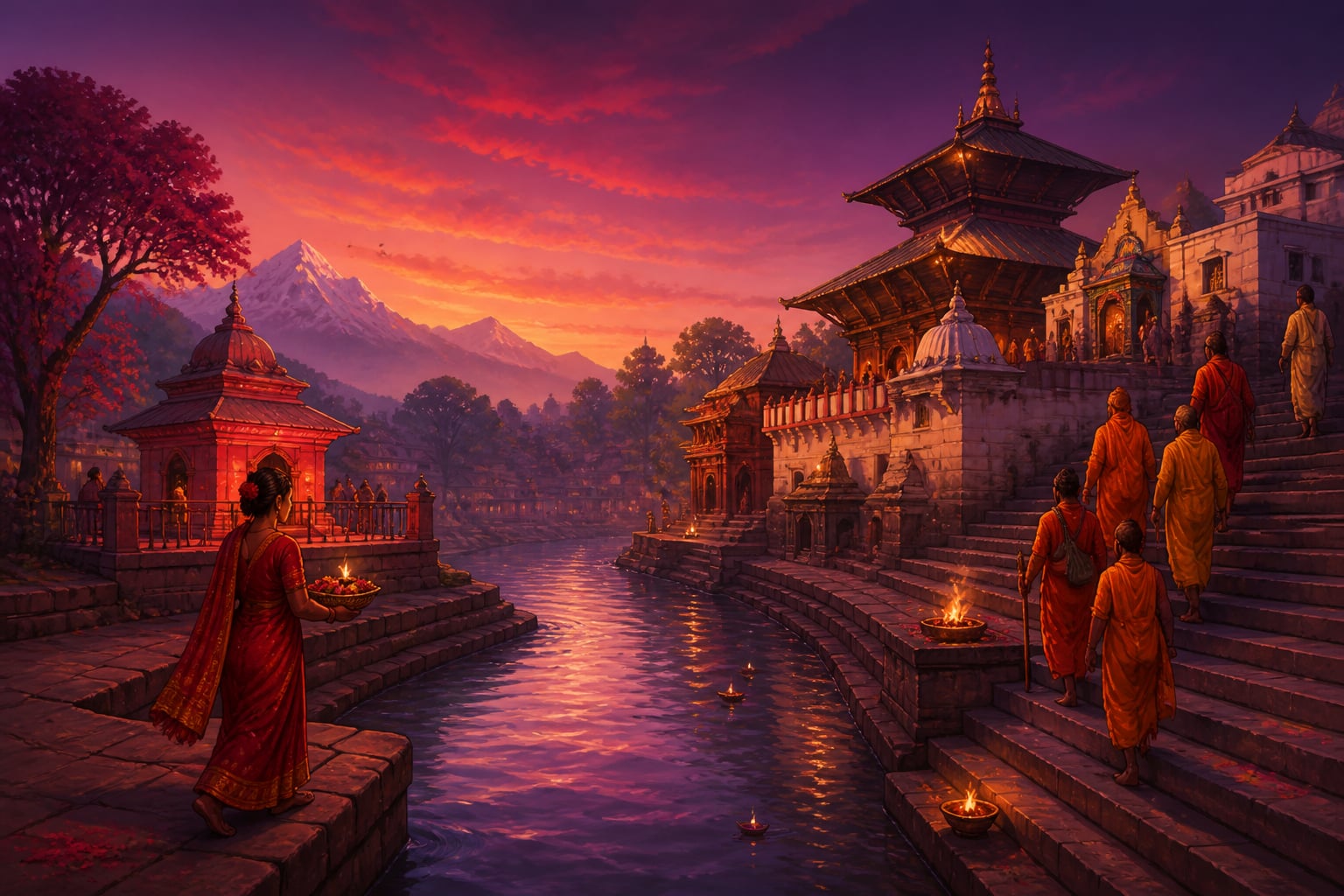
The Bagmati River connecting Pashupatinath and Guhyeshwari at dusk

Guhyeshwari and Pashupatinath form a sacred pair, the Goddess and the Lord, Shakti and Shiva, directly connected by the Bagmati River that flows between them. Pilgrims visiting Pashupatinath traditionally include Guhyeshwari in their circuit, understanding that without Shakti, Shiva is shava (corpse), inert, powerless.

This pairing echoes tantric philosophy: consciousness (Shiva) and energy (Shakti) are ultimately one reality experiencing itself as two. To worship one without the other is incomplete. The Nepal Valley's sacred geography embodies this unity physically, you cannot fully experience Pashupatinath without Guhyeshwari, cannot understand Shakti without Shiva.

The Bhairava: Kapali

The Bhairava at Guhyeshwari is Kapali, "the skull-bearer," one of Shiva's most fearsome forms. Kapali represents the divine madman, the one who has transcended all social conventions and carries a skull bowl as symbol of having conquered death.

This fierce Bhairava pairs with a Goddess whose very name means "secret." Together they guard the mysteries of tantric practice, hidden not to exclude but to protect teachings that require preparation to receive.

The Kumari: Living Goddess

The Royal Kumari seated at her ceremonial window in the Kumari Ghar

Nowhere else in the world is a human being worshipped as a goddess in quite the way Nepal worships its Kumaris. These are young girls, selected through rigorous tests, who become the living embodiment of the goddess Taleju (a form of Durga) until they reach puberty.

The Royal Kumari of Kathmandu is the most famous, but several Kumaris exist in the Kathmandu Valley, each representing the goddess for their community. The practice demonstrates the deepest implication of Shakta philosophy: if the Goddess is present in all beings, why should she not manifest fully in a chosen vessel?

Selection and Life

Kumaris are selected from the Newar Buddhist Shakya community, a remarkable interfaith dimension, as Buddhist girls embody a Hindu goddess. The selection process tests for thirty-two physical perfections and psychological qualities including fearlessness. The chosen girl must show no disturbance when surrounded by severed buffalo heads during a night of testing.

Once selected, the Kumari lives in the Kumari Ghar (Kumari House) near Durbar Square. She appears at her window for darshan, is carried in procession during festivals, and blesses the king (or now the president) annually. Her feet must never touch the ground outside her palace; she is carried everywhere.

When she reaches puberty or sheds blood for any reason, she reverts to ordinary status and a new Kumari is selected. Former Kumaris often face difficulties adjusting to ordinary life, imagine having been worshipped as a goddess throughout childhood.

Theological Meaning

The Kumari tradition makes explicit what Shakta philosophy implies: the Goddess is not elsewhere, not only in temples and images, but can manifest in living human form. The girl becomes the Goddess through ritual consecration, her body, her eyes, her presence become divine.

This is radically embodied theology. The Kumari's glance (dristi) is believed to bestow blessings or curses. Her selection tests include examining the eyes for particular qualities associated with the Goddess. When devotees receive her blessing, they are not receiving blessing from a representative but from the Goddess herself, temporarily housed in human form.

The Temple Network

Beyond Guhyeshwari and the Kumari tradition, Nepal's Kathmandu Valley contains dozens of goddess temples forming an interconnected sacred geography:

Dakshinkali, A major Kali temple where animal sacrifice continues, located south of Kathmandu. Particularly active on Tuesdays and Saturdays.

Swayambhunath, The "Monkey Temple" contains Ajima shrines, indigenous Newar grandmother goddesses later identified with tantric Shakti forms.

Changu Narayan, Contains significant goddess iconography alongside Vishnu worship.

The Navadurga, Nine temples surrounding Bhaktapur representing the nine forms of Durga, activated in sequence during Dashain festival.

Each of these sites connects to tantric lineages that blend Hindu and Buddhist elements in ways unique to Nepal.

The Tantric Dimension

Nepal's Shakti worship is deeply tantric, not in the sensationalized Western understanding, but in the original sense: systematic practices for experiencing divine energy directly. The Newar priests who serve temples like Guhyeshwari are initiated into lineages (guru-parampara) transmitting specific mantras, rituals, and meditative practices.

These traditions include:

Chakra puja, Worship of the energy centers in both the human body and the cosmic body of the Goddess.

Mantra initiation, Receiving sacred sounds directly from guru, empowering the practitioner to invoke specific forms of Shakti.

Bhairava-Shakti sadhana, Practices uniting the Goddess energy with the Bhairava consciousness within one's own being.

Much of this remains hidden from casual observation, guhya, secret. But the outer forms of worship visible to all pilgrims carry these inner dimensions for those who have received initiation.

Nepal Today

Nepal became a secular republic in 2008, ending the Hindu monarchy. But Shakti worship continues unabated, perhaps even strengthened as an expression of cultural identity. The Kumari still receives the president's blessing. Guhyeshwari still draws tantric practitioners. Dashain remains the major national festival, celebrating Durga's victory.

For pilgrims from India, Nepal offers both accessibility and distinctiveness. These temples were never disrupted by Partition or by the iconoclastic waves that affected some Indian sites. Guhyeshwari's secrets remain intact; the Kumari tradition continues unbroken for centuries.

Nepal reminds us that the Goddess is not a museum exhibit but a living force, embodied in chosen young girls, hidden in secret sanctums, paired with Shiva across temple compounds, and pervading the entire sacred valley that cradles Kathmandu.

Historical context

Ancient origins (Licchavi period c. 400-750 CE), medieval development (Malla period 1200-1768 CE), continuous to present

Nepal's Shakti traditions developed in constant dialogue with Indian tantra, particularly the Bengal-Assam Shakta milieu. Texts, teachers, and practices flowed across the Himalayan passes. Yet Nepal's isolation preserved practices that sometimes changed or disappeared in India. The Newar community of Kathmandu Valley maintained tantric lineages with less interruption than most Indian regions experienced.

Nepal matters to the Shakti Peetha tradition because it offers living continuity. The Kumari is not a museum exhibit but an actual goddess walking the streets. Guhyeshwari's tantric worship continues exactly as it has for centuries. For pilgrims and practitioners seeking connection to unbroken tradition, Nepal offers what India's disrupted history often cannot: the goddess exactly where she has always been, worshipped exactly as she has always been worshipped.

Living traditions

Nepal's Shakti traditions remain remarkably intact despite dramatic political change. The monarchy that sustained the Kumari tradition for centuries ended in 2008, yet the Kumari continues, now blessing the president instead of the king. Guhyeshwari's esoteric worship continues unbroken; tantric lineages transmit their practices. Unlike in India where colonial and political disruptions affected many traditions, Nepal's isolation preserved continuity. Today, Nepal offers pilgrims a glimpse of living Shakta practice largely unchanged for centuries, the Goddess still walks the streets, still hides in secret sanctums, still pairs with her Lord across the sacred river.

Reflection

More in Sarvadeshiya Peethas: Beyond Borders

All lessons in Sarvadeshiya Peethas: Beyond Borders ยท The Shakti Peethas course