Hinglaj: Pakistan's Living Peetha
The head of Sati in Balochistan
Journey to Hinglaj Mata temple in Pakistan's Balochistan province, where Sati's head (Brahmarandhra) fell. Discover how Hindu pilgrimage continues despite political boundaries, the annual yatra that crosses borders, and the remarkable interfaith respect shown by local Muslims.
The Confession at the Mud Volcano
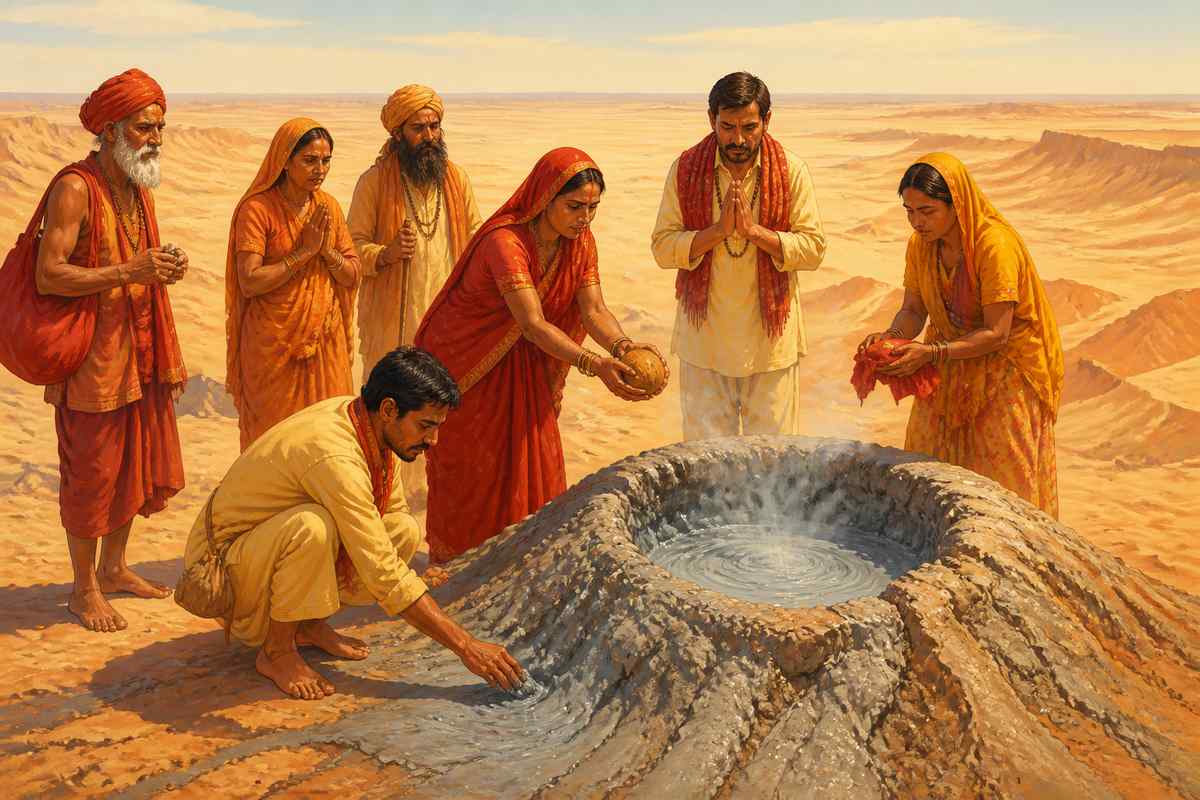
Picture a Sindhi farmer from the Thar desert, call him Mohan. It is a spring morning in Balochistan, and he stands barefoot at the rim of a low grey cone of cold mud. He has not eaten since the day before. Below him, Chandragup bubbles and breathes. It is a mud volcano that throws up no fire, only slow cold sludge. A few hundred pilgrims wait around him, dusty from days on the road.
When his turn comes, Mohan does something that would feel impossible at home. He calls out his full name and his village. Then, in front of all these strangers, he confesses his wrongs aloud. Only after the confession may he climb. He carries a small roti, baked from flour that every pilgrim pooled together, and a coconut. At the top he offers them to the mud and throws the coconut into the crater, like a wish let go.
This is not the end of his journey. It is the gate. Beyond Chandragup lies the cave he has walked for, and a question worth holding: why would hundreds of thousands of people cross one of the harshest deserts in South Asia to reach a goddess who has no statue, in a country where they are a small and often frightened minority?
Where the Crown Fell
The cave Mohan seeks is the shrine of Hinglaj Mata, hidden in a gorge of the Hingol river valley, about 250 kilometres from Karachi. To understand why it pulls him so hard, you have to go back to the story that begins every Shakti Peetha.
The goddess Sati married Shiva against her father Daksha's wishes. When Daksha held a great fire sacrifice and insulted Shiva before the gods, Sati walked into the flames rather than bear the shame. Shiva, wild with grief, lifted her burnt body and danced a dance that began to shake the worlds apart. To stop him, Vishnu sent his discus to cut the body into pieces. Wherever a piece fell, a Shakti Peetha, a seat of the goddess, was born.
At Hinglaj, tradition says, fell the brahmarandhra: the crown of Sati's head.
ब्रह्मरन्ध्रं महापीठं हिंगुलायां प्रतिष्ठितम् | कोट्टरी भैरवश्चात्र देवी हिंगलजेश्वरी ||
Brahmarandhraṃ mahāpīṭhaṃ Hiṅgulāyāṃ pratiṣṭhitam Koṭṭarī Bhairavaścātra devī Hiṅgalajeśvarī
The great seat of the crown of the head is fixed at Hingula. Here Bhimlochan is the Bhairava, and the Goddess is the Lady of Hinglaj.
Shakti Peetha Stotram
In the old list of the peethas called the Pithanirnaya, Hingula is named first of all the seats. Many devotees call her the Adi Peetha, the very first, though great shrines like Kamakhya in Assam carry the same loving claim. The meaning, though, is not in doubt. The crown chakra, the sahasrara, is where yogis say the small self opens into the infinite. That the goddess's crown came to rest at the far western edge of the land makes Hinglaj, on the map of the body and the map of the country, a place of final opening.
A Temple Without an Idol
Unlike the carved stone temples of India, Hinglaj Mata's sanctum is plain almost to nothing. It is a small mud structure inside a natural cave in the Hingol hills. The goddess is worshipped as a small natural rock, with no human shape and no carving. There is only the stone, and the belief that the crown came to rest here.

The cave is reached through a hard land of desert mountains, dried riverbeds and bubbling mud. The difficulty is not an accident. As pilgrims say, the journey itself becomes tapasya, a discipline that wears you down to the essential. The harder the road, the more it asks you to surrender before you arrive.
Every Shakti Peetha has its Bhairava, the fierce form of Shiva who guards the goddess. At Hinglaj he is Bhimlochan, "the one with terrible eyes." His shrine stands near the cave, and pilgrims greet him first. The name points to Shiva as the witness, the gaze that sees through every illusion. The crowned goddess above and her fierce guardian below stand for the full meeting of Shakti and Shiva at the highest point of the body.
The Goddess With Two Names
Here is what makes Hinglaj unlike any other peetha. The local Baloch Muslims also love this cave. They call her Nani, or Bibi Nani, the grandmother, and they call the pilgrimage Nani ki Haj. The shrine is cared for by both Hindu priests and Muslim khadims (caretakers).
This is not cold tolerance. It is shared reverence. Baloch families from the nearby villages bring offerings and ask the grandmother for protection and for children, alongside Hindu pilgrims who have walked for days. Some scholars wonder whether the name "Nani" holds a faint memory of Nanaia, an ancient goddess of the old Iranian world. That link is a guess, not a settled fact, but the shared devotion in front of the cave is real and old.

The Yatra Across the Desert
Every spring, in the Hindu month of Chaitra (March to April), the desert fills with pilgrims for the Hinglaj Yatra. They are not, as is sometimes claimed, crowds of Indians crossing the Wagah border. They are Pakistan's own Hindus: Sindhi and Baloch families from Tharparkar, Umerkot, Karachi and the Makran coast, where most of the country's small Hindu minority lives. For many of them Hinglaj is the kuldevi, the clan goddess, of communities like the Charans, the Sodha Rajputs and the Brahmakshatriyas.
For most of history the last stretch was over a hundred kilometres of desert crossed on foot. That changed around 2004, when the Makran Coastal Highway linked Karachi to the coast and brought the cave within a day's bus ride. The pilgrim numbers grew fast. A gathering once counted in the tens of thousands now draws around 300,000 people over three spring days, the largest Hindu pilgrimage in Pakistan. Much of the work of organizing it falls to the Pakistan Hindu Council, founded in 2005 by Ramesh Kumar Vankwani, a member of the National Assembly.
The route still keeps its old stations:
- Chandragup, the mud volcano of confession, where Mohan began
- The Hingol river, where pilgrims bathe before the final approach
- An eternal flame said to rise from the earth itself near the shrine
Faith Without a Passport
The psychologist Gordon Allport spent his life studying prejudice. His "contact hypothesis," published in 1954, argued that distrust between groups fades when they work side by side, as equals, toward a shared goal. Hinglaj is that idea worn smooth by centuries. A Muslim caretaker and a Hindu priest tending the same stone, in a region cut by hard divisions, are not reading Allport. They are living what he could only describe.
That is the quiet teaching of the crown peetha. The Partition of 1947 drove a border straight through ancient pilgrimage routes. Wars have been fought across it. And still, in a cave in Balochistan, a Hindu minority and their Muslim neighbours keep the same lamp lit. The goddess, it seems, recognizes no passport.
Back at the rim of Chandragup, Mohan throws his coconut into the cold grey crater and begins to climb. He has said his name and his wrongs out loud to strangers. What waits beyond is a rock with no face, in a land not always kind to him, that he has crossed a desert to call mother.
Historical context
Ancient to Present (references from early centuries CE, continuous worship documented from medieval period)
Hinglaj's inclusion in the Shakti Peetha network connected the far western reaches of the subcontinent to the larger sacred geography. Ancient trade routes passed through this region, and the site may have been a waypoint for travelers seeking divine protection before crossing the harsh Makran coast and desert. The local Baloch tribal codes (riwaj) that protect guests and sacred sites have helped preserve Hinglaj through many political changes.
Hinglaj challenges simple narratives about Hindu-Muslim relations, religious nationalism, and the nature of sacred sites. In an age when religion is too often used to divide, Hinglaj models organic co-existence, not through theological compromise but through shared reverence that transcends doctrinal differences. The site demonstrates that political boundaries cannot contain the sacred, that pilgrimage can persist through partition and war, and that ordinary people of different faiths can care for shared holy ground.
Living traditions
Hinglaj stands as perhaps the most powerful symbol of faith transcending politics. In an era when India-Pakistan relations can be tense, the annual yatra continues, protected by Pakistani forces, welcomed by local Baloch communities, undertaken by devoted pilgrims who see no border when the Goddess calls. The site has become a model for 'people-to-people diplomacy', ordinary believers maintaining connections that states cannot break. Efforts are ongoing to preserve the site's unique interfaith character against both Hindu and Muslim exclusivists who would claim it for their tradition alone.
- Hinglaj Yatra: The annual pilgrimage to Hinglaj, traditionally undertaken in the month of Chaitra (March-April). Modern yatras are organized by the Pakistan Hindu Council with government support, involving travel from India, ceremonial border crossing, and a multi-day journey through the desert to the cave shrine.
- Chandragup Snan: Ritual bathing and application of volcanic mud from the Chandragup mud volcano. Pilgrims collect the mineral-rich mud and apply it to their bodies for purification before approaching the main shrine.
- Agni Kund Darshan: Visiting the natural eternal flame that burns from gas vents in the earth. Pilgrims offer prayers, light lamps from the sacred fire, and circumambulate the flame.
- Muslim-Hindu Joint Worship: Local Baloch Muslims participate in worship at Hinglaj, calling the Goddess 'Bibi Nani' and making offerings for wishes and protection. Hindu priests and Muslim khadims work together to maintain the shrine.
- Hinglaj Mata Temple (Cave Shrine): The main cave shrine containing the sacred rock representing Sati's brahmarandhra. Simple mud construction, no idol, the rock itself is the Goddess. Bhimlochan Bhairava shrine nearby.
- Chandragup Mud Volcano: One of the world's largest mud volcanoes, continuously active. The bubbling mud pools and mineral deposits create an otherworldly landscape. Pilgrims bathe in/apply the mud for purification.
- Agni Kund (Eternal Flame): Natural gas vents creating eternal flames. The fire has burned for centuries without human intervention. Pilgrims offer prayers and light lamps from the sacred fire.
- Kalighat Kali Temple: Another of the four Adi Peethas, where Sati's right toe fell. Kalighat is one of the most accessible Shakti Peethas for those who cannot make the journey to Hinglaj. Together, Hinglaj (crown/head) and Kalighat (toe/feet) represent the complete body of the Goddess from top to bottom.
- Kamakhya Temple: Where Sati's yoni (womb) fell, the most esoteric of the Adi Peethas. Kamakhya and Hinglaj represent opposite ends of the spectrum: one worships the creative source (yoni), the other the gateway to transcendence (brahmarandhra). Together they complete the full arc of Shakti from manifestation to liberation.
Reflection
- The brahmarandhra, the crown of the head, represents the highest point of consciousness in yogic anatomy. What does it mean that Sati's crown fell in such an inaccessible, difficult-to-reach place? What might this suggest about the nature of highest spiritual attainment?
- Hinglaj Mata has no idol, just a natural rock in a cave. Yet for millennia, pilgrims have crossed deserts to touch this stone. What does this suggest about where divine presence actually resides? In objects, in places, in the devotee's heart, or somewhere else entirely?
- Muslims and Hindus worship the same site by different names, Bibi Nani and Hinglaj Mata. Neither group insists the other is wrong. What allows this co-existence, and what might threaten it? What does Hinglaj teach about the relationship between names and the reality they point toward?