Purvadesha: The Eastern Belt

Bahula, Phullara, and the Mithila peethas

Explore the Shakti Peethas of the eastern belt. Visit Bahula in Birbhum where Sati's left arm fell, Phullara where her lips fell, and the Mithila region peethas connected to Sita's homeland. Discover how these sites preserve ancient goddess worship traditions.

The Land of Red Earth and Rice

The eastern belt of India, spanning West Bengal, Bihar, and Jharkhand, is Shakti country par excellence. While famous sites like Kalighat and Tarapith draw millions, numerous lesser-known peethas dot this landscape, each holding unique traditions and teachings. This region, called Purvadesha (the eastern land), has been goddess-worshipping country since before recorded history.

The geography shapes the spirituality: monsoon-drenched rice fields, laterite soil that bleeds red like the blood offerings once given to the Goddess, and rivers that flood annually in a cycle of destruction and renewal that mirrors Shakti herself. Here, the line between agricultural fertility cult and sophisticated Tantric practice was never clearly drawn.

Bahula: Where the Left Arm Fell

The Body Part and Site

At Bahula (also known as Bahulasthan) in the Birbhum district of West Bengal, tradition holds that Sati's left arm fell when Vishnu dismembered her corpse. The name 'Bahula' itself means 'abundant' or 'much', suggesting the prolific, overflowing nature of Shakti that gives endlessly.

The village is located near Ketugram, in the heart of Bengal's countryside. Unlike urban peethas, Bahula retains a rural character that connects goddess worship to agricultural life. The Goddess here is not separate from the cycles of planting and harvest.
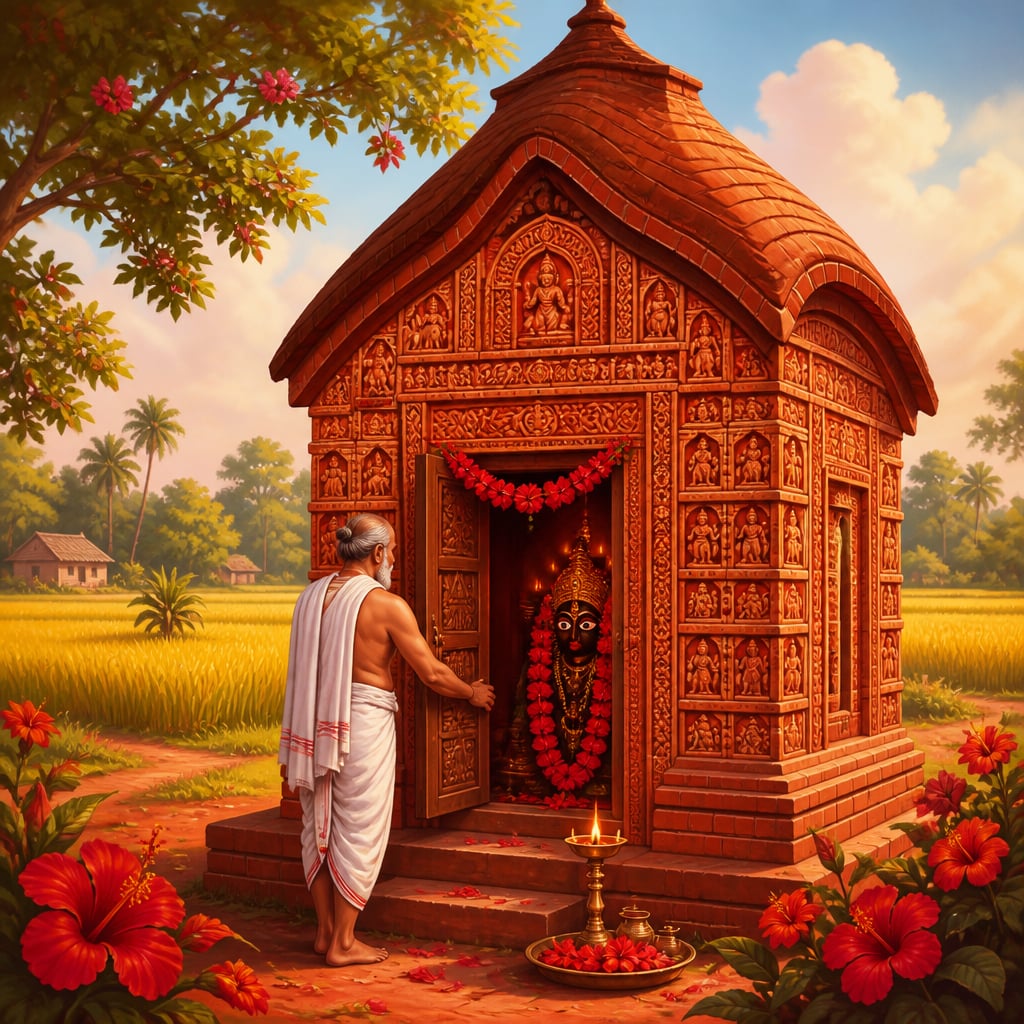
Bahula Devi terracotta temple in Birbhum, Bengal

The Temple and Goddess

The presiding deity is Bahula Devi, also called Bahulakshi ('she of abundant eyes' or 'she who sees abundantly'). She is worshipped with her Bhairava, Bhiruk (a local form of Bhairava whose name suggests protection and fearlessness).

The temple itself is modest, red brick, terracotta decorations in the Bengal style, and a sanctum that holds the sacred stone representing where the arm fell. The simplicity is deceptive; the power here is palpable to those who come with open hearts.

The Arm Symbolism

Why the left arm? In Tantric symbolism, the left side represents Shakti, the feminine principle, while the right represents Shiva, the masculine. The left arm is the arm of action in the Shakti aspect, it is with this arm that the Goddess embraces, fights, and creates.

Bahula's teaching: Shakti's power is not passive. The 'arm' that fell here represents the Goddess's active intervention in the world. She doesn't merely exist; she acts, embraces, and transforms. Devotees come here seeking the Goddess's active help in their lives, her arm extended in blessing and protection.

Local Traditions

Bahula is particularly associated with healing. Local belief holds that the Goddess here can cure diseases, especially those affecting the arms and hands. Farmers with injured limbs, artisans with hand ailments, and those seeking strength for their labor all come seeking her grace.

The annual Bahula Amavasya festival draws thousands from surrounding villages. The new moon night is considered especially auspicious, and the Goddess is said to be particularly accessible to devotees who fast and pray through the darkness.

Phullara: The Lips of the Goddess

The Body Part and Legend

A Tantric sadhaka practicing attahasa at the Phullara shrine

At Phullara (also spelled Phullora) in Birbhum district, Sati's lower lip fell. This intimate body part, the organ of speech, of kissing, of tasting life, creates a unique theological emphasis. The lips are where inner becomes outer, where breath becomes word, where the intimate becomes communicative.

The name 'Phullara' may derive from 'phulla' (blooming, blossoming), suggesting that the Goddess's words cause reality to bloom into existence. What she speaks, comes to be.

The Temple Site

Phullara's temple is in Attahas (or Attahasa), whose name dramatically means 'loud laughter.' The site is associated with the Goddess's fierce laughter that shakes the cosmos, the laugh of one who knows the ultimate joke, who sees through maya's illusions.

The Goddess here is called Phullara Devi, and her Bhairava is Vishwesh (the 'lord of the universe'). The combination of the lips (speech, communication) with laughter (transcendence of ordinary seriousness) creates a powerful teaching.

The Teaching of Speech

Phullara's teaching concerns the power of speech. In Tantric tradition, vak (speech) is one of Shakti's primary manifestations. The Sanskrit alphabet is considered the body of the Goddess, each letter a form of her. The lips that articulate these sounds are therefore supremely sacred.

The lesson: your words carry creative power. What you speak shapes reality. The Goddess's lips fell here to remind us that we too create worlds with our speech. Careless words wound; conscious words heal. The mantra is the purest form of this creative speech, sounds that, properly uttered, invoke divine power.

The Laughing Goddess

The association with 'loud laughter' (attahasa) is distinctively Tantric. The Goddess laughs at death, laughs at our fears, laughs at the cosmic game of hide-and-seek between consciousness and form. This isn't cruel laughter but liberating laughter, the laughter of one who has seen through the illusion and found only joy beneath.

Phullara invites devotees to develop this cosmic perspective: life is both utterly serious and ultimately a divine play. The ability to laugh, truly, from the belly, with recognition, is a sign of spiritual maturity.

The Mithila Peethas: Sita's Homeland

Sacred Geography of Mithila

Mithila, the region spanning present-day Bihar and Nepal's Terai, holds a special place in goddess geography. This is Sita's homeland, the daughter of King Janaka who emerged from the earth and became Rama's wife. While not typically listed among the 51 formal Shakti Peethas, several sites in Mithila claim peetha status based on local traditions.

The Mithila peethas link the Shakti Peetha tradition to the Sita-centered goddess worship that characterizes this region. Here, Sati and Sita merge, both are forms of the Earth Goddess, both demonstrate supreme devotion, both undergo trials that prove their purity.

Ugra Chandi at Sitamarhi

Sitamarhi, identified as Sita's birthplace, hosts the temple of Ugra Chandi, the 'fierce goddess.' Some local traditions claim this as a peetha where a portion of Sati's body (often identified as her brow or forehead) fell.

The Goddess here is worshipped as both the gentle Sita (ideal wife, mother) and the fierce Chandi (warrior, destroyer of evil). This dual aspect, gentleness and ferocity united, characterizes much of Mithila goddess worship.

Janaki Temple at Janakpur

Just across the border in Nepal, the Janaki Temple at Janakpur is one of the largest in the region. While primarily a Vaishnava site celebrating Sita's marriage to Rama, goddess worship here carries distinctly Shakta elements. Sita is approached not just as Rama's wife but as Bhumi-devi, the Earth Goddess in her own right.

Pilgrims from the Indian Mithila peethas often include Janakpur in their circuit, creating a cross-border sacred geography.

The Mithila Painting Tradition

A Mithila woman painting a goddess yantra in a Bihar village courtyard

Mithila's famous painting tradition, practiced by women for centuries, is deeply connected to goddess worship. The traditional paintings (madhubani) depict goddess figures, sacred geometries, and ritual scenes. Originally painted on walls and floors for weddings and festivals, they represent a living tradition of encoding divine presence in art.

The paintings themselves function somewhat like yantras, not merely decorative but invoking the Goddess's presence. When Mithila women paint Durga or Kali on their walls, they are performing a kind of worship, making the home itself a shrine.

The Eastern Goddess Tradition

Shakta Bengal

The eastern belt's goddess worship must be understood against the broader context of Shakta Bengal. This region has been Tantric country for over a millennium. The 10th-12th century Pala dynasty patronized Buddhist and Hindu Tantra simultaneously. When the Sena dynasty followed, goddess worship became even more prominent.

The British encountered this tradition with bewilderment and often disgust, the blood offerings, the fierce iconography, the rejection of conventional purity. They labeled it 'tantric excess' without understanding its sophisticated philosophical foundations. Despite colonial disapproval, the tradition survived and thrives today.

The Integration of Tribal and Classical

As in the Northeast, the eastern belt's goddess worship integrates tribal and classical elements. The Santal, Munda, and other Adivasi communities have their own goddess traditions that predate Sanskrit texts. These were gradually incorporated into the Shakti Peetha system, the local goddesses identified as forms of Sati, their shrines added to pilgrimage lists.

This wasn't cultural imperialism in a simple sense. The tribal goddesses gained prestige and protection by being linked to pan-Indian traditions. The Sanskritic tradition gained vital energy from the raw power of indigenous goddess worship. Both benefited, though tensions remained.

Women's Traditions

What distinguishes eastern belt goddess worship is the prominent role of women's traditions. The Mithila paintings, the vratas (fasting rituals) observed by women, the songs sung during goddess festivals, these constitute a parallel religious world that runs alongside male-dominated temple Hinduism.

Women in this region have maintained goddess worship through their own means: art, song, fasting, domestic ritual. The peethas are publicly prominent, but the daily goddess presence in eastern homes is largely women's work.

The Tantric Dimension

Birbhum: Land of Red Laterite

Birbhum district, where both Bahula and Phullara are located, is one of India's most intensely Tantric regions. The red laterite soil seems to embody Shakti's blood-red power. Tarapith, the great Tara temple and cremation ground, is also in Birbhum.

The concentration of peethas and Tantric sites in this small area is remarkable. Within a few hours' travel, one can visit sites sacred to multiple Mahavidyas and multiple Shakti Peethas. Serious practitioners sometimes spend months here, moving between shrines.

Cremation Ground Spirituality

Several eastern peethas are associated with cremation grounds (shmashana). This isn't morbid but profoundly Tantric. The cremation ground is where distinctions dissolve, rich and poor, beautiful and plain, all become ash. It is the great equalizer, the reminder of impermanence, the site where ego burns away.

The Goddess of the cremation ground is not death itself but the consciousness that persists through death. She waits at the boundary between life and death, offering liberation to those who can face their mortality without flinching.

The Tantric Teaching

The eastern belt's teaching is about embracing the full spectrum of existence. The same Goddess who blesses the rice harvest also dances in the cremation ground. The same power that enables life also takes it away. There is no escape from this totality, only the possibility of understanding it, embracing it, and finding liberation within it.

For practitioners, this means developing what Tantrics call 'equality vision' (samatva), seeing the divine in all circumstances, pleasant and unpleasant, beautiful and terrifying. The eastern peethas train devotees in this vision, presenting the Goddess in all her aspects without softening or selection.

Living traditions

The eastern belt's goddess traditions continue to thrive. Durga Puja is now globally celebrated, with Kolkata's festivities recognized by UNESCO. Madhubani painting has become an international art form, bringing Mithila's goddess iconography worldwide. Meanwhile, the village peethas maintain their ancient practices, relatively unchanged by modernization.

Reflection

More in Gupta Peethas: The Hidden Sacred Sites

All lessons in Gupta Peethas: The Hidden Sacred Sites ยท The Shakti Peethas course