Pragjyotisha: The Northeast Circuit

Tripura Sundari, Ugratara, and the Yogini sites

Explore the Shakti Peethas of Northeast India. Visit Tripura Sundari in Tripura - one of the most important Mahavidya seats, Ugratara in Guwahati, and the mysterious Chatuhshasti Yogini sites. Understand the unique blend of tribal and Sanskritic traditions.

The Land Where the Sun Rises First

Northeast India, ancient Pragjyotisha, 'the land of eastern light', holds some of the most powerful yet least visited Shakti Peethas. While pilgrims crowd Kamakhya and Kalighat, these hidden temples preserve traditions that predate Sanskritic Hinduism, blending tribal goddess worship with Tantric philosophy in ways found nowhere else.

This region was once the kingdom of Pragjyotishpura, ruled by the asura king Narakasura and later by the Varman and Pala dynasties who were devoted patrons of Shakti worship. The very geography, mist-shrouded hills, dense forests, and rivers that swell with monsoon power, seems to embody the wild, untamed aspects of the Goddess.

Tripura Sundari: The Beautiful Goddess of the Three Cities

The Body Part and Its Fall

According to the Shakti Peetha tradition, when Vishnu's Sudarshana Chakra dismembered Sati's body, her right foot fell at Udaipur in present-day Tripura. The site became known as Tripura Sundari Peetha, one of the 51 Maha Peethas.

But the name 'Tripura Sundari' carries deeper meaning. 'Tripura' means 'three cities' or 'three worlds', the physical, subtle, and causal realms. The Goddess who is 'beautiful across all three' transcends ordinary categories of form. She is the beauty that underlies all beautiful things, the consciousness that illuminates all three states of waking, dreaming, and deep sleep.
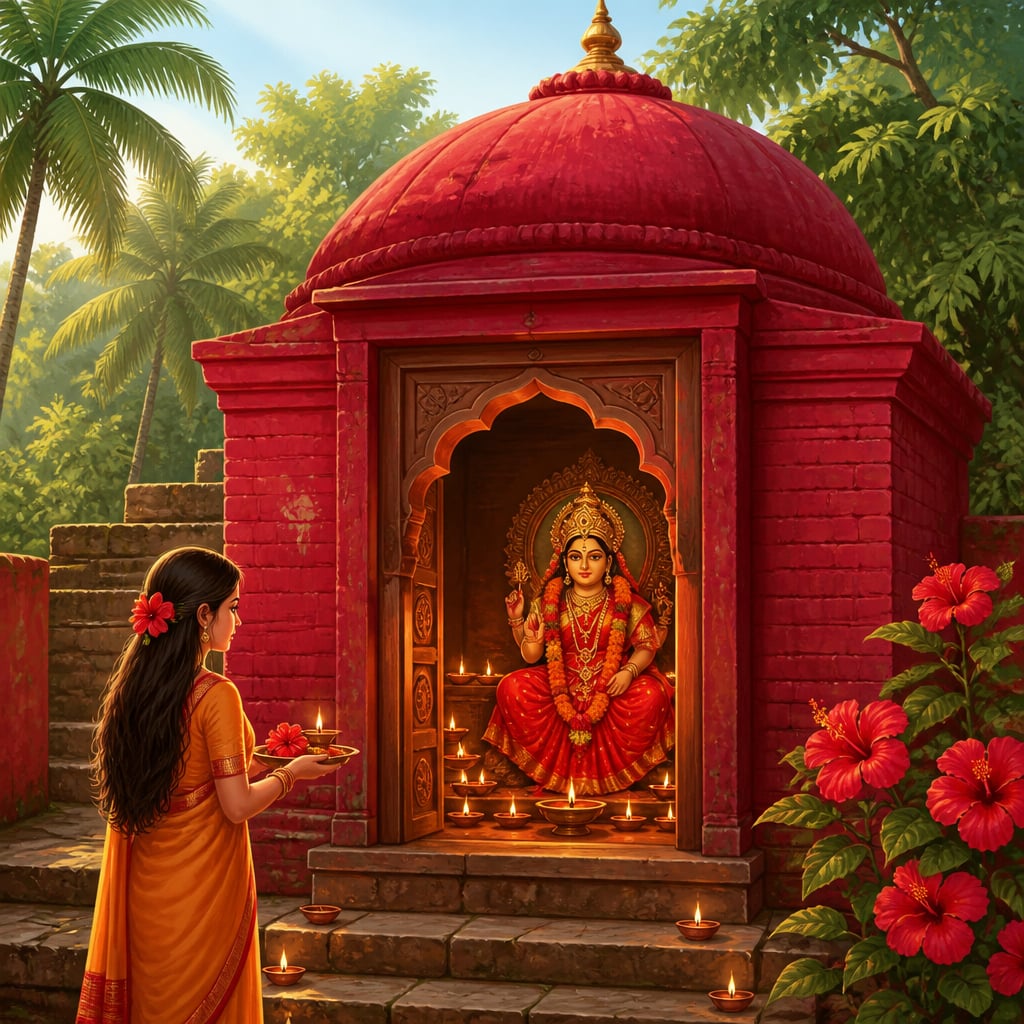
Tripura Sundari shrine at Udaipur in Tripura

Temple History and Architecture

The present temple at Udaipur dates to the reign of Maharaja Dhanya Manikya (1490 CE), though worship at the site is far older. The temple sits atop the Udaipur hills, its distinctive Bengali-style curved roof visible from miles around.

Unlike the imposing stone structures of South Indian temples, Tripura Sundari's shrine has an intimate quality, brick and mortar covered with lime plaster, the architecture reflecting Bengal's terracotta tradition. The inner sanctum houses a small kunda (sacred pool) where the Goddess is worshipped in the form of a geometric yantra rather than an anthropomorphic image.

This is significant. Tripura Sundari is one of the Dasha Mahavidyas (Ten Great Wisdom Goddesses), and her worship is primarily through the Sri Yantra, the most complex and sacred of all geometric mandalas. The yantra represents the body of the Goddess herself, each triangle a facet of her cosmic form.

The Goddess and Her Bhairava

The presiding deity is Tripura Sundari, also known as Shodashi ('the sixteen-year-old') and Lalita ('the playful one'). She embodies the peak of feminine beauty, not in a superficial sense but as the aesthetic perfection of consciousness itself. The number sixteen is significant, it represents the fullness of the lunar cycle, complete manifestation, the moment before anything wanes.

Her Bhairava is Tripuresh, 'Lord of the Three Cities', a form of Shiva who complements her sovereign power. Together they represent the ultimate union of consciousness (Shiva) and energy (Shakti).

The Tantric Teaching

Tripura Sundari's esoteric significance lies in Sri Vidya, the 'auspicious knowledge' that is considered the highest form of goddess worship. Unlike paths that reject the world, Sri Vidya embraces beauty, pleasure, and worldly life as expressions of the divine.

The teaching: what you seek outside, beauty, love, fulfillment, already exists within. The Goddess is not elsewhere; she is the very power that allows you to perceive, to desire, to love. When you recognize this, every beautiful thing becomes a doorway rather than a distraction.

Ugratara: The Fierce Savior

Location and Mythology

Ugratara sanctum at dusk with a Tantric sadhaka in meditation

Near Guwahati, beyond the famous Kamakhya temple, lies the temple of Ugratara, 'the fierce Tara' or 'the fierce savior.' While Kamakhya draws millions, Ugratara remains relatively quiet, visited mainly by dedicated Tantric practitioners.

The mythology connects Ugratara to the Buddhist Tara, reflecting Northeast India's syncretic history. Tara, 'she who helps cross over', is a savior goddess in both Hindu and Buddhist traditions. The 'ugra' (fierce) aspect indicates her power to destroy obstacles, including the ultimate obstacle: ignorance of our true nature.

The Temple and Its Practice

Ugratara's temple is modest in appearance but intense in energy. The Goddess is worshipped here in her fierce aspect, with protruding tongue, skull garland, and cremation-ground associations that mark her as a Mahavidya (Great Wisdom Goddess) of the Kali family.

The primary practice here is Tara Sadhana, intense meditation on the Goddess as the one who ferries devotees across the ocean of samsara. Practitioners report that the site has a particularly 'active' quality, meditation experiences come quickly, but so do confrontations with one's shadow.

Tantric Significance

Ugratara teaches that salvation doesn't come from avoiding the difficult. She is fierce precisely because she loves, like a surgeon who must cut to heal. Her teaching is especially relevant for those who have tried to 'transcend' their difficult emotions only to find them returning with greater force.

The message: what you resist persists. What you embrace with full awareness transforms. Ugratara's fierceness is the fierceness of truth, the refusal to let devotees stay comfortable in their illusions.

The Yogini Temples: Circles of Power

The Chatuhshasti Yogini Tradition

A circular Chausath Yogini temple at twilight

Scattered across Northeast and Central India are the remains of remarkable circular temples dedicated to the 64 Yoginis, semi-divine female beings who represent the full spectrum of feminine power. These open-air, hypaethral temples have no roof, their circles of 64 goddess images arranged to receive the sky's energy directly.

While the most famous Yogini temples are in Odisha (Hirapur) and Madhya Pradesh (Khajuraho, Bhedaghat), the tradition has strong roots in Pragjyotisha. The 64 Yoginis are considered attendants of the Goddess, or alternatively, 64 aspects of her single power, like facets of a diamond.

Architecture and Cosmology

The circular design is deliberate. Unlike linear temples that draw devotees toward a central image, Yogini temples place the worshipper at the center of a circle of divine feminine beings. This architecture embodies a different theology: you are not approaching the Goddess; you are surrounded by her.

Each of the 64 Yoginis has a distinct name, appearance, and power. Some are beautiful, some terrifying; some human in form, some animal-headed; some gentle, some wrathful. Together they represent the completeness of Shakti, not just the acceptable feminine but ALL aspects of feminine power, including those that patriarchal societies prefer to suppress.

The Esoteric Teaching

The 64 Yoginis correspond to the 64 arts (chatuhshashti kalas) that a complete human being should master, from music and dance to logic, medicine, and the art of war. They also correspond to the 64 tantric practices that lead to liberation.

The teaching: wholeness requires embracing multiplicity. We cannot become complete by rejecting parts of ourselves or of life. The Yogini temples stand as stone reminders that the Goddess is not one thing but sixty-four things, or rather, she is the one power that manifests as all sixty-four.

The Syncretic Genius of the Northeast

Tribal and Sanskritic Fusion

What makes Northeast India's goddess worship unique is its fusion of indigenous tribal traditions with Sanskritic Tantra. Long before Brahmanical priests arrived, the hill tribes of this region worshipped powerful female spirits associated with forests, rivers, and mountains.

When Tantric teachers came, they didn't replace these traditions, they recognized the tribal goddesses as forms of Shakti and incorporated their worship into systematic practice. The result is a living tradition that maintains the raw power of primal goddess worship while adding the philosophical sophistication of Tantric metaphysics.

Modern Relevance

These temples teach something our compartmentalized modern world struggles to understand: the sacred doesn't have to look 'religious.' The tribal priestesses who still tend some of these shrines are not theologians; they are women who embody the Goddess's power in their bearing, their presence, their fearlessness.

The pilgrimage to Pragjyotisha's hidden peethas is ultimately a journey toward integrating what we've separated, the wild and the cultivated, the tribal and the classical, the fierce and the beautiful.

Living traditions

Northeast India's syncretic goddess traditions have influenced contemporary feminism and eco-spirituality. The region's acceptance of fierce feminine power, worshipped rather than suppressed, offers an alternative to patriarchal religious models. Academic centers globally now study the Yogini temples as evidence of historical female religious authority.

Reflection

More in Gupta Peethas: The Hidden Sacred Sites

All lessons in Gupta Peethas: The Hidden Sacred Sites ยท The Shakti Peethas course