Anga Nyasa: Body-Part Symbolism
Mapping all 51 body parts to sacred geography
A comprehensive deep-dive into the body-cosmos mapping of Shakti Peethas. Understand how Sati's 51 body parts correspond to 51 sacred sites, the tantric anatomy concepts, the nyasa ritual that invokes these correspondences, and the esoteric meaning of the subcontinent as the goddess's body.
The Body as Map, The Land as Goddess
The Shakti Peetha tradition rests on a profound insight: the human body and the sacred land are mirrors of each other. When Sati's body was scattered across the subcontinent, it didn't merely sanctify random locations, it revealed that the land itself was always her body. The 51 peethas are not arbitrary points on a map but organs in a vast living body that is the Goddess herself.
This lesson explores the deepest layer of Shakti Peetha symbolism: how each body part corresponds to a specific site, what this mapping reveals about Tantric anatomy, and how practitioners use the nyasa ritual to internalize this cosmic geography within their own bodies.
The Number 51: Sanskrit Alphabet as Body
Why 51 Peethas?
The number 51 is not random. It corresponds to the letters of the Sanskrit alphabet, the varnamala or 'garland of letters.' In Tantric tradition, the Sanskrit alphabet is itself the body of the Goddess. Each letter is a form of Shakti; together they constitute her complete manifestation.
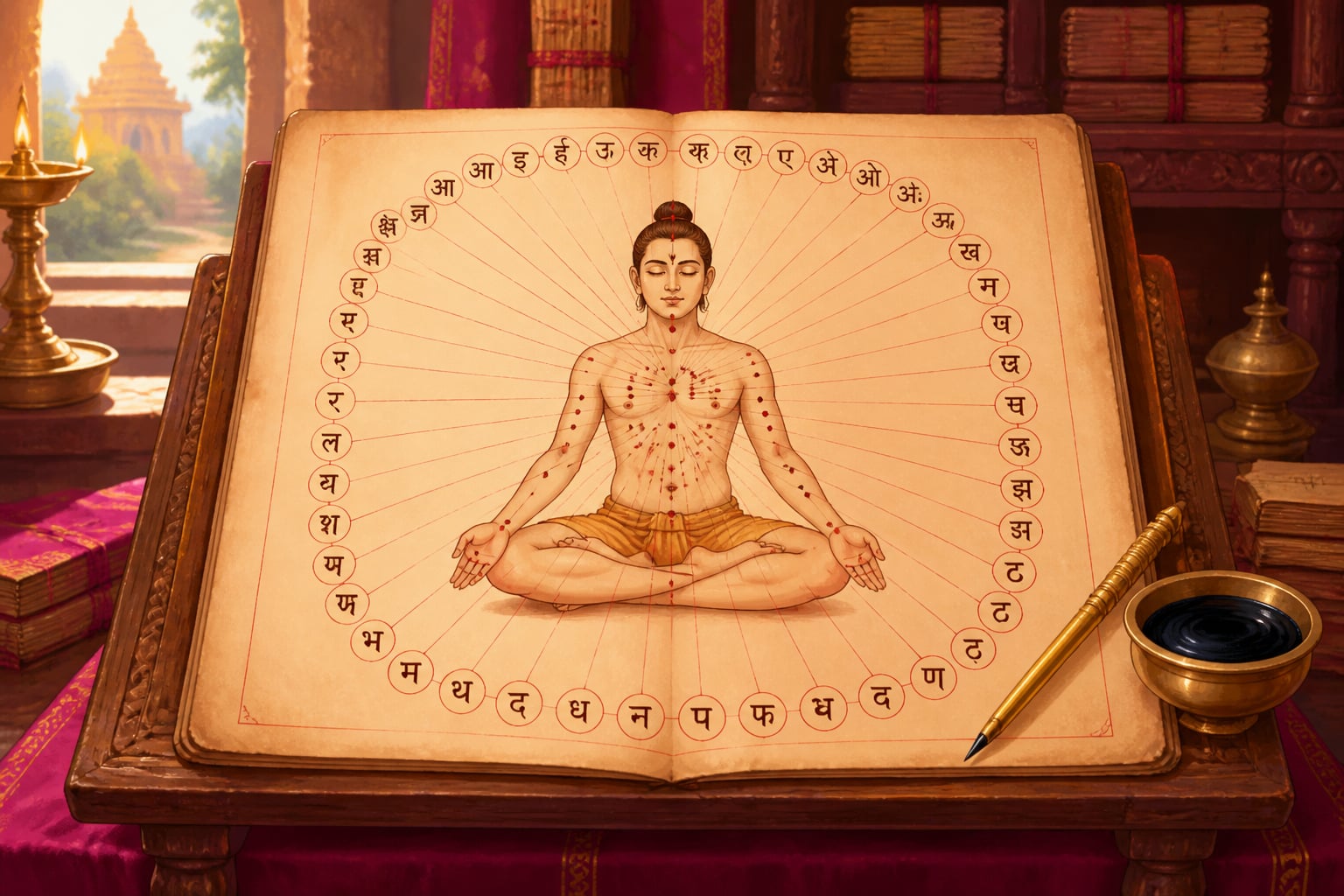
The standard Sanskrit alphabet contains:
- 16 vowels (svara): a, ā, i, ī, u, ū, ṛ, ṝ, ḷ, ḹ, e, ai, o, au, aṃ, aḥ
- 25 consonants (vyanjana): the five vargas from ka to ma
- 10 additional consonants: ya, ra, la, va, śa, ṣa, sa, ha, kṣa, jña
This gives approximately 51 phonemes, though different texts count slightly differently (some list 50, some 52). Each phoneme corresponds to one peetha, the sites where Sati's body fell are literally the alphabet of divine manifestation.
The Goddess as Language
This equation of body parts with letters reflects the Tantric understanding that consciousness manifests through sound. Before the universe was form, it was vibration, the primordial hum of Shakti becoming audible. Language is not arbitrary symbols for things; it is the very structure of reality.
When we speak or chant, we are literally invoking the Goddess's body. The letter 'a' (अ), the first vowel, considered the origin of all sounds, corresponds to a specific peetha. To chant 'a' with awareness is to invoke that site, that body part, that aspect of Shakti.
The Complete Body-Peetha Mapping
Head and Sense Organs
The most sacred sites correspond to the head and its organs:
Crown (Brahmarandhra), Varanasi's Vishalakshi temple, where Sati's face or head fell. The crown is the point of connection to the infinite, the thousandpetaled lotus of the sahasrara chakra.
Third Eye (Ajna), Kamakhya, where Sati's yoni fell. Paradoxically, the yoni (source of creation) corresponds to the third eye (source of inner vision). Both are portals: one for souls entering the world, one for consciousness transcending it.
Eyes, Multiple sites claim the eyes. Nainital is associated with Sati's eyes (naina = eyes). Each eye represents a mode of seeing, the left (lunar) and right (solar), the inner and outer vision.
Ears, Where the Goddess hears the prayers of devotees. Ears represent receptivity, the willingness to listen before speaking, the discipline of hearing what the universe is trying to communicate.
The Vital Organs
Heart, Often associated with Ujjain's Harsiddhi temple. The heart is the seat of devotion (bhakti), the cave where the individual soul meets the divine.
Navel, The center of the body's energy, corresponding to the manipura chakra. Navel sites represent the fire of transformation, the digestive power that converts gross matter into subtle energy.
Womb/Yoni, Kamakhya is the supreme yoni peetha. The womb is the ultimate creative power, the source from which all beings emerge. Its sanctification as a peetha affirms the sacredness of female generative power.
Limbs and Extremities
Arms and Hands, Sites like Bahula (left arm) represent the Goddess's active intervention. The hands that bless, protect, and fight for devotees. Different fingers correspond to different powers.
Feet, The Goddess's feet are supremely sacred. Sites like Tripura Sundari (right foot) represent the foundation, the ground from which all action rises. To touch the Goddess's feet is the ultimate act of surrender.
Fingers and Toes, Some lists detail individual fingers and toes, each with its own peetha. This granular mapping suggests that no part of the body is mundane, the Goddess is present even in the smallest extremity.
Tantric Anatomy: The Subtle Body
The Chakra System
The Shakti Peetha geography mirrors the chakra system of the individual subtle body. Just as the chakras are energy centers arranged along the spine, the peethas are energy centers arranged across the landscape.
Muladhara (Root), Corresponds to southern peethas near the tip of the subcontinent Svadhisthana (Sacral), Peethas in the pelvic region of the land Manipura (Solar Plexus), Central Indian peethas Anahata (Heart), Peethas in the heart of the subcontinent Vishuddha (Throat), Northern peethas approaching the Himalayas Ajna (Third Eye), Himalayan peethas Sahasrara (Crown), The highest Himalayan sites, approaching the transcendent
This mapping means that pilgrimage to the peethas is simultaneously a journey through the chakras. The external geography encodes an internal itinerary.
Nadis: The Energy Channels
The rivers of the subcontinent correspond to the nadis, subtle energy channels within the body. The Ganga, Yamuna, and Saraswati mirror the three primary nadis: ida, pingala, and sushumna.
Where these rivers meet (like Prayagraj/Allahabad), powerful peethas exist. These confluences represent the internal meeting points where left (lunar/feminine), right (solar/masculine), and central (transcendent) energies merge.
Marma Points
Ayurveda and martial arts traditions identify 107 marma points, vital spots where life energy concentrates. These correspond roughly to the peethas multiplied by two (for left and right sides of the body). Stimulation or protection of marma points affects health; pilgrimage to the corresponding peethas affects spiritual development.
The Nyasa Ritual: Internalizing the Geography
What is Nyasa?
Nyasa (from the Sanskrit root 'nyas', to place, to install) is a ritual practice of touching body parts while chanting mantras, 'placing' divine energy at each point. Through nyasa, the practitioner transforms their ordinary body into the body of the deity.
In the context of Shakti Peethas, nyasa maps the 51 sites onto the practitioner's own body. Each touch, each mantra, invokes the power of a specific peetha at the corresponding body location.

Anga Nyasa: The Six-Point Practice
The most common nyasa touches six body parts:
- Heart (hridaya), with the mantra OM
- Head (shiras), invoking crown consciousness
- Crown tuft (shikha), the point of transcendence
- Arms (kavaca, meaning 'armor'), protection and action
- Eyes (netra), vision, both physical and spiritual
- Palms (astra), the weapons of the deity, representing power
This abbreviated nyasa prepares the body for worship. More elaborate forms touch 51 points, fully replicating the peetha geography.
The Complete 51-Point Nyasa
Advanced practitioners perform nyasa on all 51 body points corresponding to the 51 peethas. This practice:
- Takes 30-60 minutes when done properly
- Requires knowledge of each peetha's mantra
- Transforms the body into a living mandala
- Prepares for deep meditation or ritual
The practitioner becomes, through this ritual, the body of the Goddess herself. The geography of pilgrimage is internalized; you carry all 51 peethas within you.
The Subcontinent as Goddess
Bharat Mata: Mother India

The Shakti Peetha tradition is the oldest form of what later became the concept of 'Bharat Mata', India as Mother. Long before modern nationalism, the subcontinent was understood as the Goddess's body.
This isn't mere metaphor. The mountains are her bones, the rivers her blood, the forests her hair, the fields her skin. When we damage the land, we wound the Goddess. When we heal the land, we honor her.
This ecological dimension of Shakti Peetha worship is increasingly relevant. The tradition offers a powerful framework for environmental protection: the land is not a 'resource' to exploit but a divine body to revere.
Pilgrimage as Circumambulation
Complete pilgrimage to all 51 peethas is called 'eka peetha yatra', the one-peetha journey. This phrase reveals the tradition's understanding: though there are 51 sites, they constitute one body. Visiting them all is not visiting 51 different places but circumambulating one vast form.
This circumambulation (pradakshina) mirrors the way devotees walk around temples. The entire subcontinent becomes the temple; the pilgrimage path becomes the circumambulation route.
The Unity Beneath Diversity
The Shakti Peetha tradition offers a vision of unity that respects diversity. The 51 sites are in different states, speaking different languages, following different customs. Yet all are part of one body. They cannot exist without each other; the Goddess is incomplete without all her parts.
This theological vision has practical implications. Regional rivalries look foolish when every region hosts a vital organ of the same divine body. The head cannot say to the feet, 'I have no need of you.'
The Practice Dimension
Why This Matters for Practice
Understanding body-cosmos mapping transforms Shakti Peetha pilgrimage from religious tourism into genuine sadhana. With this knowledge:
- Visiting a peetha activates the corresponding point in your own body
- Meditating on a peetha (even from home) connects you to that site's power
- Nyasa practice makes pilgrimage accessible even when physical travel isn't possible
- The entire tradition becomes an integrated system rather than disconnected site visits
Integrating the Teaching
The advanced practitioner works with body-cosmos correspondence in multiple ways:
Physical pilgrimage, Visiting sites in sequence that corresponds to a journey through the chakras, from root to crown.
Visualization practice, Mentally visiting peethas during meditation, invoking each site at the corresponding body point.
Nyasa ritual, Daily or periodic practice of touching the 51 points with mantras, maintaining the body as sacred geography.
Breath work, Pranayama practices that circulate energy through the 'peethas' within, purifying and awakening each center.
The Goal: Peetha Within
The ultimate teaching is that you don't need to travel to external peethas once you've realized the peethas within. Your own body is the subcontinent; your own consciousness is the Goddess.
This doesn't devalue external pilgrimage, the outer journey often catalyzes the inner realization. But it does suggest that the final destination is not geographic but spiritual: recognizing that you yourself are the temple, the peetha, the Goddess's body in miniature.
Living traditions
The body-cosmos mapping of Shakti Peethas has influenced modern Indian environmental movements, providing a religious framework for land protection. The concept of 'Bharat Mata' (Mother India) draws directly on this tradition. In diaspora communities, the principle that any goddess temple can be a 'peetha' has allowed Shakti worship to establish itself globally.
- Daily Anga Nyasa: Tantric practitioners perform nyasa before any worship or meditation. The 6-point abbreviated form takes about 2 minutes; the complete 51-point form takes 30-60 minutes. Touch is accompanied by specific mantras invoking the Goddess at each point.
- Eka Pitha Yatra: Complete pilgrimage to all 51 peethas. Traditionally undertaken once in a lifetime, the journey can take months to years depending on pace. Modern pilgrims sometimes complete it over multiple trips.
- Begin with a Local Peetha: Before undertaking extensive pilgrimage, visit the peetha nearest to you. Understand this as connecting to one point on the Goddess's body. Build a relationship with this site before expanding to others.
- The Four Adi Peethas: Some traditions identify four 'Adi Peethas' (original peethas) that are especially powerful. Visiting these four is considered a condensed version of the complete pilgrimage. Each represents a major body part and a cardinal direction.
- Local Temples as Mini-Peethas: Even temples not on formal peetha lists are considered 'peethas' in a broader sense, any place where the Goddess is established and worshipped. Local temples are satellites of the great peethas, allowing access to Shakti even when major pilgrimage isn't possible.
Reflection
- The Shakti Peetha tradition teaches that the land itself is the Goddess's body. How might this understanding change your relationship to the natural environment where you live?
- The correspondence between 51 letters and 51 peethas suggests that language creates reality. How might this understanding change how you use words, in speech, writing, or even thought?
- Nyasa practice transforms the body into a temple by touching each point with awareness. What parts of your own body have you been neglecting, rejecting, or treating as 'less sacred' than others?