Pralaya Tandava: Shiva's Grief Dance

Virabhadra's fury and Shiva carrying Sati's corpse

Experience Shiva's devastating response to Sati's death. From the creation of the fearsome Virabhadra who destroys Daksha's yajna, to Shiva's inconsolable grief as he wanders the universe carrying his beloved's body, performing the Pralaya Tandava.

The Moment Everything Changed

On Mount Kailash, Shiva sat in meditation. But this was not the deep samadhi of cosmic consciousness. This was waiting. Watching. He had let Sati go, knowing what Daksha intended, knowing she needed to face her father herself. Some lessons cannot be learned by proxy.
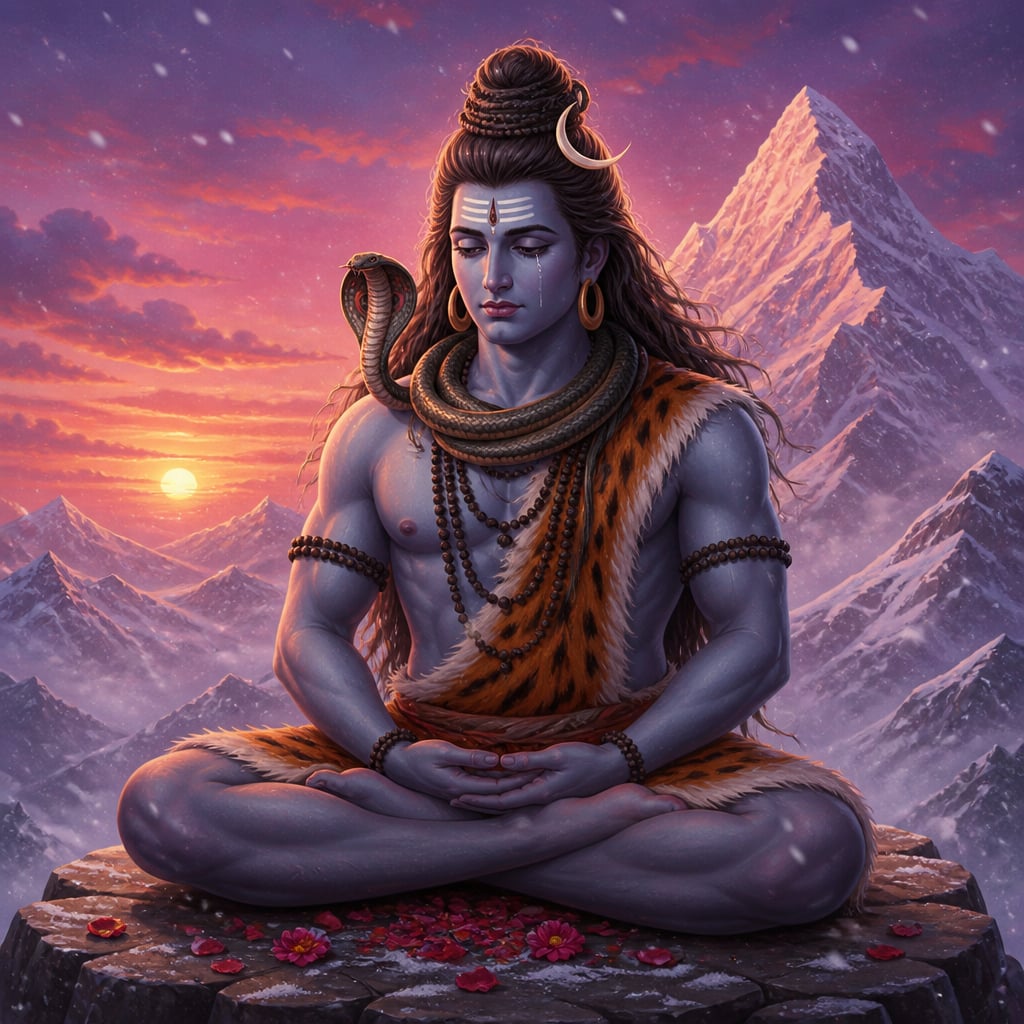
Shiva on Kailash as the bond breaks

And then, across the fabric of the universe, he felt it.

The thread that connected him to Sati, the bond between consciousness and power, between Shiva and Shakti, snapped.

She was gone.

The Yogi Who Loved

What happened next reveals something profound about the nature of divine consciousness.

Shiva is Mahayogi, the supreme ascetic who has transcended all attachment. He is Sthanu, the immovable one. He is Sthitaprajna, established in wisdom beyond the fluctuations of pleasure and pain. By all accounts, he should be beyond grief.

But Shiva loved Sati. Not with the possessive love that grasps, but with the complete love that makes two into one. When she departed, part of him departed. The supreme consciousness, it seems, is not beyond love, it is love itself.

And when love loses its beloved, even the cosmos trembles.

Shiva's grief was not weakness. It was proof that the ultimate reality includes, rather than excludes, the full range of experience. The divine is not cold perfection. The divine loves, loses, and grieves, and in doing so, teaches us that our own grief is sacred.
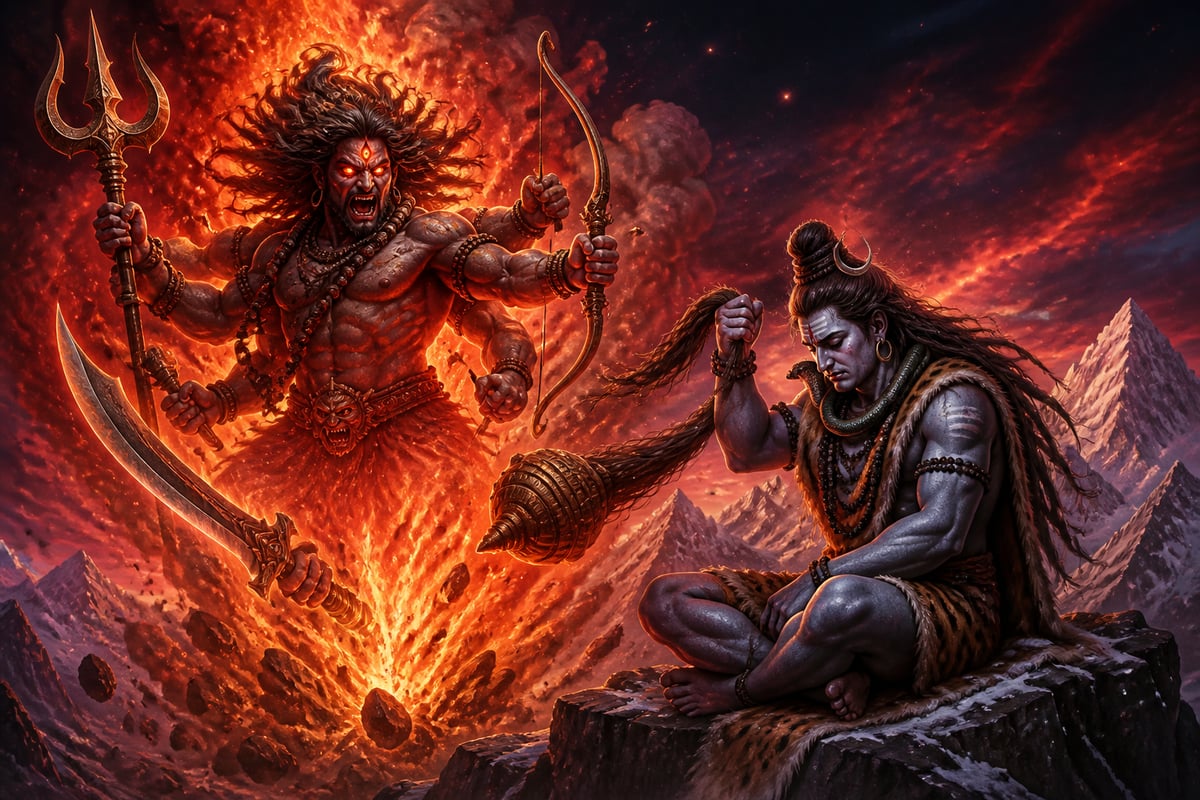
Virabhadra emerging from Shiva's torn lock of hair

The Birth of Virabhadra

But before grief came rage.

Shiva's fury at Daksha's betrayal needed expression. From his matted locks, the jata that hold the Ganga, he tore out a single strand and dashed it against the ground.

From that strand arose Virabhadra, the most terrifying being the universe had ever seen.

Virabhadra was Shiva's wrath given form. He stood tall as a mountain, with a thousand arms wielding every weapon known to creation. His face was terrible, his eyes blazing like the fire of dissolution. He was surrounded by millions of ganas, Shiva's attendants, all armed, all furious, all ready to destroy.

"Go," Shiva commanded. "Destroy the yajna of Daksha. Let no one escape who insulted my beloved."

Virabhadra bowed and descended like a storm upon Daksha's gathering.

The Destruction of the Yajna

The texts describe what followed in vivid, horrifying detail.

Virabhadra and the ganas fell upon the yajna like wolves upon a flock. The elaborate ritual that Daksha had constructed so carefully was torn apart. The sacred fires were scattered. The offerings were trampled. The priests fled screaming.

The gods themselves, Brahma, Vishnu, Indra, all the celestials who had accepted Daksha's invitation, were attacked. They fought back, but Virabhadra was Shiva's concentrated rage, and no one could stand against him.

Indra was struck down. The Adityas were routed. Even Vishnu, who engaged Virabhadra in combat, was unable to stop him. Brahma cowered. The yajna, which was meant to demonstrate Daksha's power and Shiva's insignificance, became a scene of cosmic devastation.

And at the center of it all stood Daksha, the proud patriarch who had orchestrated everything.

Virabhadra beheading Daksha at the ruined yajna

Daksha's Fate

Virabhadra found Daksha and dragged him to the center of his own ruined yajna.

"You," Virabhadra said, "who insulted my Lord. You who drove his beloved to death. You who thought your rituals could exist without the one who makes all rituals possible."

With a single motion, Virabhadra severed Daksha's head.

The head was thrown into the very sacrificial fire Daksha had lit, the fire that had consumed Sati. The yajna meant to humiliate Shiva ended with Daksha himself as the final offering.

The cosmos had answered Daksha's hubris.

Shiva Descends

When Virabhadra returned to report his mission complete, Shiva descended from Kailash.

He did not come in triumph. He did not come to survey the destruction. He came for one reason only: to find Sati.

In the smoking ruins of the yajna, Shiva found what remained of his beloved's body. The texts differ on whether her body had been partially burned in the sacrificial fire or preserved by her yogic power, but all agree on what happened next:

Shiva gathered Sati's body into his arms and held her.

The Lord of the Universe, who had just destroyed the greatest yajna ever attempted, who had humbled the gods themselves, now stood weeping over the body of his wife.

This is the image that defines the next stage of the story: Shiva holding Sati, refusing to let go.

The Pralaya Tandava

What followed was not the Ananda Tandava, the dance of bliss that Shiva performs at the center of the cosmos. This was its shadow: the Pralaya Tandava, the dance of dissolution.

Shiva began to dance. But this was not creation, it was unmakng.

With Sati's body on his shoulder or in his arms, Shiva wandered the three worlds. His steps shook mountains. His grief rippled across dimensions. Wherever he danced, the fabric of reality trembled.

He was not merely mourning. He was threatening to destroy everything. Without Shakti, what was the point of existence? Without his beloved, what was there to preserve?

The gods watched in terror. The Pralaya Tandava was the dance that ends cycles of creation. If Shiva did not stop, the universe itself would dissolve.

The Inconsolable Lord

Days passed. Weeks. Some texts say years. Time itself became uncertain in the presence of Shiva's grief.

The gods approached him, one by one, trying to console him. None could reach him. Brahma, who had helped create Sati in the first place, tried to speak of cosmic cycles, of rebirth, of the eternal nature of the soul. Shiva did not hear him.

Other devas spoke of duty, of dharma, of the need to maintain cosmic order. Shiva continued dancing.

Even the sages, with their accumulated wisdom of eons, could not penetrate his grief. The supreme teacher had become the supreme mourner, and no teaching could reach him.

The universe watched its lord lose himself in sorrow, and no one knew how to bring him back.

Why This Matters

We might ask: Why did Shiva grieve so deeply? He knew Sati was the Goddess, that she would be reborn, that their separation was temporary. Why not simply wait for her return?

The answer reveals the nature of love itself.

Love does not calculate. Love does not say, "I will see you again, so I need not grieve now." Love feels the absence of the beloved as a wound in reality itself. Shiva's grief was not ignorance, it was the complete experience of loss, honored fully.

This teaching contradicts the common spiritual bypass: "If you're truly enlightened, you won't feel grief." Shiva, the most enlightened being, grieved most deeply. His example says: Feel it all. Let loss move through you completely. Do not rush past grief into premature acceptance.

The Shakti Peethas exist because Shiva could not let go. His love was so complete that even cosmic wisdom could not make him release his beloved's body. The sacred geography of India is, quite literally, a map of grief so profound it reshaped the world.

The Setup for What Comes Next

But the universe needed to continue. Shiva's grief, however sacred, was threatening dissolution of all that existed.

Something had to be done.

The gods convened. They needed a plan, not to diminish Shiva's grief, but to transform it into something that wouldn't destroy creation. They needed a way to separate Shiva from Sati's body without dishonoring his love.

They turned to Vishnu, the preserver, whose very nature was to maintain cosmic balance.

Vishnu had a plan. It involved his Sudarshana Chakra, the divine discus that never misses its mark.

What followed would transform a corpse into sacred geography, grief into pilgrimage, and loss into eternal worship.

The Shakti Peethas were about to be born.

Living traditions

The story of Virabhadra and Shiva's grief continues to influence South Indian culture, particularly in Karnataka and Andhra Pradesh where Virabhadra worship remains strong. The narrative is invoked in discussions of righteous anger, the limits of tolerance, and the sacredness of grief. Modern interpretations emphasize that Shiva's grief wasn't weakness but the complete experience of love, and that feeling deeply is compatible with, not opposed to, spiritual development.

Reflection

More in Daksha Yajna: The Tragedy That Created Sacred Geography

All lessons in Daksha Yajna: The Tragedy That Created Sacred Geography ยท The Shakti Peethas course