Apamana: The Yajna of Humiliation

Daksha's sacrifice and Sati's self-immolation

Witness the fateful day when Daksha performed a great yajna excluding Shiva. Learn why Sati, despite being uninvited, chose to attend, and how her father's insults led to her ultimate sacrifice in the sacred fire.

The Wound That Would Not Heal

Years had passed since Sati left for Kailash with Shiva. On the snow-capped peaks, she lived in bliss, two halves of the ultimate reality reunited. But far away, in Daksha's realm, a wound was festering.

Daksha could not forget. Could not forgive. His daughter had chosen an ash-smeared wanderer over the respectable matches he had envisioned. His authority had been defied. His worldview had been rejected. And every day that Sati remained happily married to Shiva was another day that reminded Daksha of his defeat.

What happens when a powerful man cannot let go of his wounded pride?

He plans a revenge that will shake the cosmos.
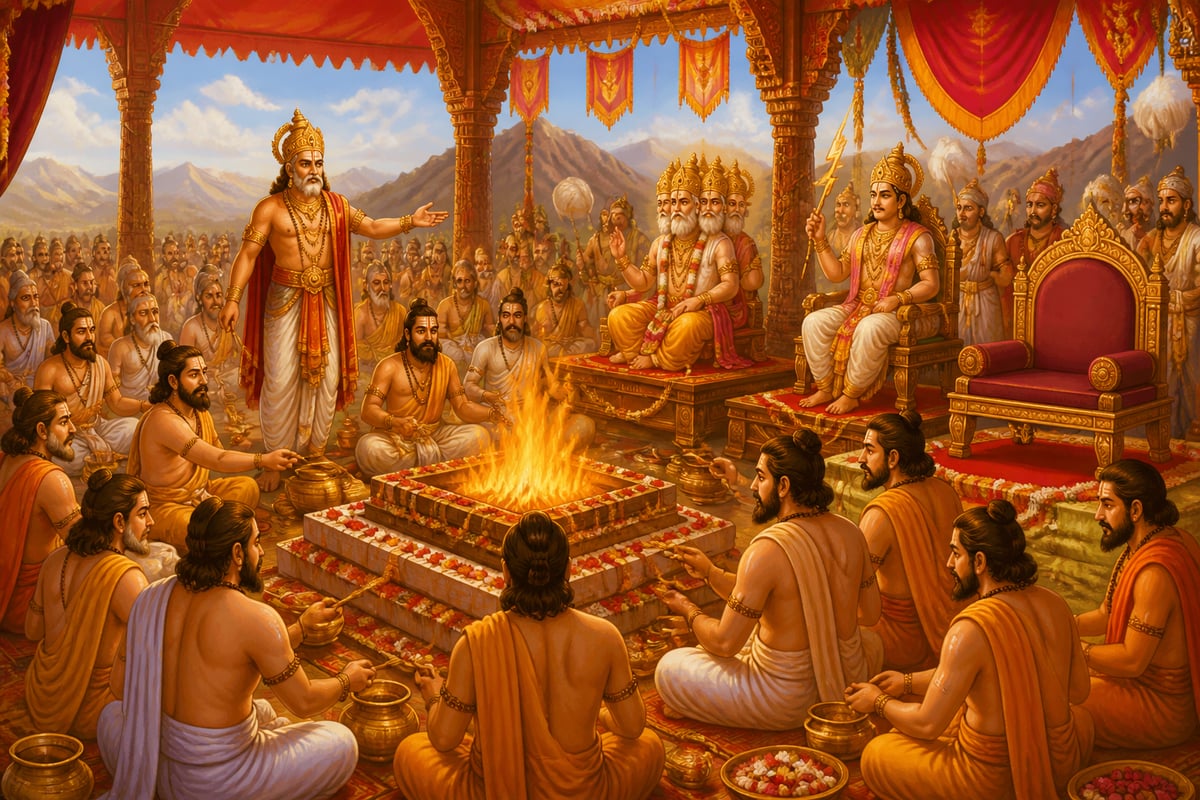
Daksha's grand yajna with gods gathered and Shiva absent

The Grand Yajna

Daksha announced a Brihaspati Yajna, one of the greatest sacrificial ceremonies possible. He invited everyone.

Brahma, the creator. Vishnu, the preserver. The Devas in their thousands. The Rishis with their wisdom. The Gandharvas with their music. Kings and celestials from every corner of the universe received ornate invitations to witness Daksha's magnificent ritual.

Everyone.

Except Shiva.

This was no oversight. Daksha made certain that every being of consequence knew that the Lord of Kailash was deliberately excluded. The invitation list itself became a public statement: Shiva was not worthy of respect. Shiva was an outcast. And by extension, anyone who loved Shiva had chosen poorly.

The message to Sati was unmistakable: Your husband is nothing. Your choice was wrong. Come back to respectability, or be nothing yourself.

Sati Learns of the Yajna

On Kailash, Sati noticed something strange. Celestial beings were streaming across the sky, all heading in the same direction. Their vehicles and ornaments sparkled against the mountains. There was clearly a great gathering somewhere.

She asked Shiva: "Where is everyone going?"

Shiva, who knew exactly what was happening, answered simply: "Your father is performing a great yajna."

Sati's heart leaped. A yajna at her father's house! Surely this meant... surely she could...

"Did we receive an invitation?" she asked.

Shiva's silence was answer enough.

Sati and Shiva on Kailash before her departure

The Debate on Kailash

What followed was one of the most poignant conversations in Hindu scripture. Sati, despite everything, wanted to attend. Her reasoning was both emotional and traditional:

"A daughter does not need an invitation to her father's house. I can go without being called. Perhaps my presence will heal the rift. Perhaps when my father sees me, his heart will soften."

Shiva, seeing clearly what Daksha intended, tried to dissuade her:

"Your father's hatred for me has not diminished, it has grown. If you go uninvited to this yajna, you will face humiliation. Going where one is not welcome only brings sorrow."

But Sati's longing to see her family, her hope that love might still bridge the divide, was too strong. She insisted.

Finally, Shiva relented. He would not stop her. But he would not accompany her either. He sent some of his ganas (attendants) with her for protection, knowing in his cosmic awareness that what was about to unfold could not be prevented.

Some tragedies must simply be lived through.

Arrival at Daksha's Yajna

When Sati arrived at the yajna, the reception confirmed Shiva's warnings.

Her sisters, Daksha's other daughters, greeted her with cold formality. None of the warmth of family. None of the joy of reunion. They had been instructed, it seemed, not to embrace the one who had shamed their father.

The guests avoided her eyes. The priests continued their rituals as if she hadn't arrived. The message was clear: You are not welcome here.

But Sati was the Goddess herself. She had not come to be welcomed. She had come to see her father.

Daksha's Poison

When Sati finally faced Daksha, there was no pretense of paternal affection. The Prajapati, in front of all the assembled guests, unleashed years of accumulated resentment.

He called Shiva a shamshana-vasi, a dweller in cremation grounds. He called him kapali, one who carries skulls. He called him digambara, naked, shameless. He called him bhutanatha, lord of ghosts and goblins.

Each epithet was technically accurate, Shiva does dwell in cremation grounds, does wear skulls, does go naked in his ascetic form, does command bhootas. But Daksha used these truths as weapons, stripping them of their spiritual significance and presenting them as evidence of degeneracy.

Worst of all, Daksha declared that Shiva was unfit for worship. That any offerings made to Shiva polluted the sacrifice. That by excluding Shiva, he was actually purifying the yajna.

Sati stood listening as her husband, the Supreme Lord of the Universe, was slandered as if he were the lowest of beings.

The Moment of Choice

What do you do when the person who gave you life attacks everything you love?

Sati could have argued. Could have defended Shiva with words, pointing out that the very gods Daksha had invited were all devotees of Shiva, that Brahma himself worshipped Mahadeva, that Vishnu considered Shiva his beloved.

But Sati saw something Daksha could not: words would not reach him. His hatred had calcified into something impervious to reason. The man who had once prayed to Adi Shakti for a daughter was now using that daughter's presence to publicly humiliate her husband.

Sati could not change Daksha.

But she could demonstrate, in a way that would echo through eternity, that some insults cannot be borne in silence.

The Fire Within

Sati spoke. Her voice was steady, but it carried the weight of cosmic truth:

"You have insulted Lord Shiva, who is beyond all insult. You have called pure what is actually polluted, this yajna, tainted by your hatred. And you have called impure what is actually the source of all purity, Mahadeva."

"I will not carry this body, given to me by you, for one more moment. This body which has witnessed such dishonor to my Lord, I reject it."

Then Sati did something that demonstrated the true meaning of her name, she who is, she who embodies truth.

She sat in padmasana, turned her consciousness inward, and through the fire of her own yogic power, she set her body ablaze. Some texts say she leaped into the yajna fire; others say she generated the fire from within through her tapasya. Either way, before the horrified eyes of the assembled guests, the Goddess consumed herself.

Sati stepping into the yajna fire

The body Daksha had given her became ash. But Sati, the eternal Shakti, simply departed from a form that had become intolerable.

The Meaning of Self-Immolation

This is not a story that glorifies suicide. Sati's act must be understood on several levels:

Mythologically: Sati is the Goddess herself. She cannot truly die. What burned was only the body she had borrowed from Daksha, a body she returned to him in the most dramatic way possible. She would be reborn as Parvati, again marry Shiva, and continue her eternal dance with consciousness.

Symbolically: Sati's self-immolation represents the principle that Shakti cannot remain where she is dishonored. This is not weakness but cosmic law. Creative power, life force, inspiration, all forms of Shakti, withdraw from spaces that do not honor them.

Psychologically: Sati demonstrates that there are limits to what should be endured. Witnessing constant abuse of what you love most is itself a form of death. Sometimes the only authentic response to unbearable dishonor is radical departure.

The Condition Remembered

Remember what Adi Shakti told Daksha when she agreed to become his daughter:

"I will remain only as long as you honor me. The moment you show me disrespect, I will depart."

Daksha had forgotten. But the cosmos had not.

By insulting Shiva, who was inseparable from Sati, Daksha had insulted the Goddess herself. The condition was fulfilled. Adi Shakti departed from his life.

And in doing so, she set in motion the events that would transform the geography of the subcontinent.

The yajna was over. The guests stood in shocked silence. Daksha's triumph had turned to ash.

And far away on Kailash, Shiva felt his heart break.

Living traditions

The story of Daksha's yajna continues to be invoked when discussing the dangers of pride, the corruption of religious forms by ego, and the principle that Shakti will not remain where she is dishonored. Modern teachers use this narrative to explore boundaries, integrity, and the difference between external performance and inner truth.

Reflection

More in Daksha Yajna: The Tragedy That Created Sacred Geography

All lessons in Daksha Yajna: The Tragedy That Created Sacred Geography ยท The Shakti Peethas course