Peetha Utpatti: Birth of Sacred Geography

Vishnu's Sudarshana and the 51 body parts

Understand how Vishnu's Sudarshana Chakra dismembered Sati's body to end Shiva's cosmic grief. Learn the profound concept of body-cosmos mapping, how 51 parts of the Divine Mother fell across the subcontinent, creating the sacred geography of Shakti Peethas.

The Universe Holds Its Breath

Shiva wandered. Days became weeks became months, or perhaps years. Time itself grew uncertain in the presence of inconsolable grief.

The Supreme Lord, carrying his beloved's body, danced the Pralaya Tandava across the three worlds. His steps shook mountains. His tears fell as rain. His grief rippled through the fabric of reality, threatening to unravel everything.

The gods watched in growing terror. This was no longer just mourning, this was cosmic destabilization. If Shiva's dance continued, the universe would dissolve. Not at the appointed end of the cycle, but prematurely, tragically, from the weight of divine sorrow.

Something had to be done. But who could approach the grieving Lord of Destruction? Who could tell Shiva, of all beings, to let go?

The Gods Convene

Brahma, still shaken from the destruction of Daksha's yajna, called an emergency assembly of the gods. The question was urgent: How to save the universe without dishonoring Shiva's grief?

Suggestions came and went. Some proposed distracting Shiva with new tasks. Others suggested awakening him to the philosophical truth that Sati would return. Still others recommended simply waiting until his grief naturally exhausted itself.

None of these would work. Shiva was beyond distraction, beyond philosophy, beyond exhaustion. His love for Sati was so total that no argument could reach him.

Then Vishnu spoke.

Vishnu, the Preserver, whose very nature was to maintain cosmic order. Vishnu, who had been present at Daksha's yajna and had watched the tragedy unfold. Vishnu, who understood that sometimes preservation requires radical action.
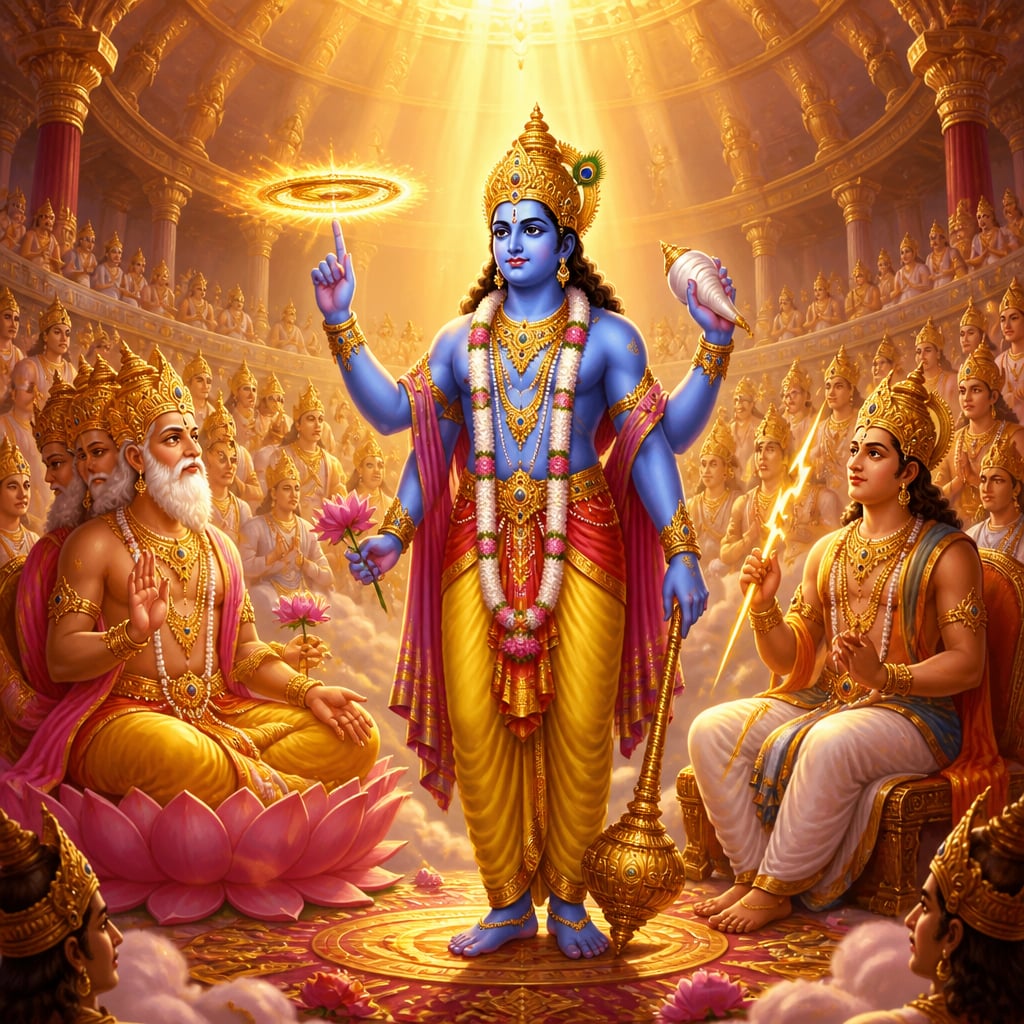
Vishnu addressing the council of devas

"The problem," Vishnu said, "is not Shiva's grief. Grief is sacred. The problem is that his grief has attached to a form. He carries Sati's body because it is all he has left of her. If we want him to release his grief, we must show him that Sati is not limited to that body, that she is everywhere."

The Plan

Vishnu's plan was audacious. Using his Sudarshana Chakra, the divine discus that never misses and never fails, he would follow Shiva unseen. Each time Shiva turned or moved, the Chakra would slice away a piece of Sati's body.

Piece by piece, the corpse would diminish. Piece by piece, Shiva's grip would loosen. And each piece that fell would become a sacred site, a place where the Goddess herself dwelt permanently, accessible to all devotees forever.

Sati's body would not simply decay or be cremated. It would become geography. Her death would create pilgrimage. Her corpse would transform into eternal presence.

This was not destruction, it was distribution. The Goddess, concentrated in one form, would be dispersed across the land, becoming accessible to all.

A fragment of the Goddess landing on an Indian hilltop

The Sudarshana's Work

Vishnu followed Shiva as he wandered. The Sudarshana Chakra, blazing with divine fire, moved silently behind the Lord of Kailash.

And it began.

A finger fell in what would become Kalighat. A toe dropped at Bahula. Eyes fell at Nainativu. Gradually, imperceptibly at first, Sati's body began to scatter across the subcontinent.

Shiva noticed, of course. He was Mahadeva, nothing escaped his awareness. But something strange happened as piece after piece fell away:

Each place where a part of Sati landed began to glow. The Goddess was not diminishing, she was multiplying. Each fragment became a complete presence. Where before there was one Sati, now there were two, then ten, then dozens.

The land itself was becoming her body.

A Shakti Peetha shrine with Bhairava guardian

The Fifty-One Peethas

By the time the Sudarshana completed its work, Sati's body had been divided into 51 parts, or 52 or 108, depending on the tradition. Each part fell at a different location, sanctifying that spot forever.

These are the Shakti Peethas, the "seats of Shakti", the places where the Divine Mother physically touched the earth.

Different texts list different body parts and locations. The variations are not contradictions but multiplications, the Goddess is too vast to be limited to a single list. But the core teaching is consistent:

Each body part carries its own power. Each Peetha specializes in a particular aspect of the Goddess. Together, they form a complete map of divine feminine energy spread across the Indian subcontinent.

Body as Cosmos

This is one of the most profound concepts in Hindu sacred geography: the body-cosmos mapping.

In this understanding, the human body is not separate from the cosmos, it IS the cosmos in miniature. And the cosmos is the divine body in macrocosm. When Sati's body fell across India, it revealed what was always true: the land itself is her body.

The Himalayas are her head. The rivers are her veins. The forests are her hair. The plains are her lap. Every mountain, every river, every village exists within the Goddess's form.

To visit a Shakti Peetha is therefore not just pilgrimage to a holy site, it is visiting a part of the Divine Mother's own body. The devotee who circumambulates all 51 Peethas has literally touched every part of the Goddess.

This is why Shakti Peetha pilgrimage is considered so powerful. You are not just visiting temples. You are caressing the body of the Mother.

Shiva's Transformation

As the last piece of Sati's body fell, Shiva stopped dancing.

He looked at his empty arms. He looked at the glowing land around him, everywhere he had walked, the Goddess now dwelt permanently. His grief had not been negated; it had been transformed.

Sati was gone from his arms. But she was everywhere.

In that moment, Shiva understood what Vishnu had done. It was not an interference with his mourning but a completion of it. The Goddess could not be contained in a single corpse. She was too vast. She needed to be distributed, made accessible, planted in the very soil of the land.

Shiva's grief had created sacred geography.

He returned to Kailash to wait. He knew Sati would come back to him, as Parvati, daughter of the Mountain. Their eternal dance would continue. But now, wherever he looked across the subcontinent, he could see pieces of his beloved, glowing with presence, welcoming devotees.

The universe had been saved. And in its saving, it had been sanctified beyond measure.

The Bhairava Connection

At each Shakti Peetha, along with the Goddess, there is a Bhairava, a fierce form of Shiva who guards that spot.

Why? Because wherever Sati's body fell, Shiva's attention followed. Each Peetha has its own form of the Goddess (Shakti) and its own form of her consort (Bhairava). They are inseparable, even in distribution.

This is the final teaching of the origin story: Shiva and Shakti cannot be truly separated. Even when her body was cut into 51 pieces, each piece retained its connection to consciousness. Each Shakti Peetha is a complete union of the divine masculine and feminine, not half a whole, but a complete marriage in miniature.

The Invitation

The Shakti Peethas are not just ancient history. They are living sites, active temples, thriving pilgrimage destinations.

From Kamakhya in the east to Hingula in the west, from Jwala Ji in the north to Kanyakumari in the south, the Goddess waits in 51 places for her children to visit.

Each Peetha has its own character, its own rituals, its own festivals. Some are grand temples with millions of visitors; others are small shrines in remote locations. Some are famous; others are known only to local devotees.

But all share the same origin: a daughter who loved absolutely, a father who could not let go of his pride, a husband who could not let go of his grief, and a plan that transformed tragedy into eternal blessing.

The Shakti Peethas exist because of love, loss, and the ultimate alchemy that transforms death into undying presence.

What Comes Next

In the following chapters of this course, we will visit the Shakti Peethas themselves. We will learn which body part fell where. We will explore the temples, their histories, their practices, their unique forms of the Goddess.

But always remember where they came from: a corpse, carried by a grieving god, gradually dispersed across the land until the whole subcontinent became a single sacred body.

This is the origin. This is the meaning. This is why the Shakti Peethas are among the most sacred sites in all of Hinduism.

The Goddess is not somewhere else. She is here, in the land beneath your feet, waiting for you to recognize her.

Living traditions

The Shakti Peetha concept remains deeply influential in Hindu practice. Millions of pilgrims visit these sites annually. The underlying teaching, that the land itself is the Goddess's body, shapes Hindu environmental ethics, pilgrimage culture, and goddess worship across traditions. Modern temples sometimes consciously model their geography on the body-cosmos mapping, and the Shakti Peetha network inspires similar sacred geography projects in other traditions.

Reflection

More in Daksha Yajna: The Tragedy That Created Sacred Geography

All lessons in Daksha Yajna: The Tragedy That Created Sacred Geography · The Shakti Peethas course