The Three Fasts That Order the Year

Ekadashi, Navratri, and Karva Chauth: three vrats that turn fasting from a wellness fad into a calendar of body, devotion, and bond

Twice a month, the Hindu skips a meal so the gut can rest. Twice a year, for nine nights at a time, the Hindu eats one sattvic plate a day so the body can be hollowed out for the Goddess. Once a year, the Hindu wife watches the moon rise through a sieve and sips her first water of the day. This lesson unpacks the three layered fasts that turn the year into a structure: Ekadashi as the fortnightly cellular reset, Navratri as the seasonal soul reset, and Karva Chauth as the annual relational reset. Scripture, symbolism, habit science, modern research, and a six hundred million dollar intermittent fasting industry all meet at the same calendar.

A Grandmother Who Refused the Curd Rice
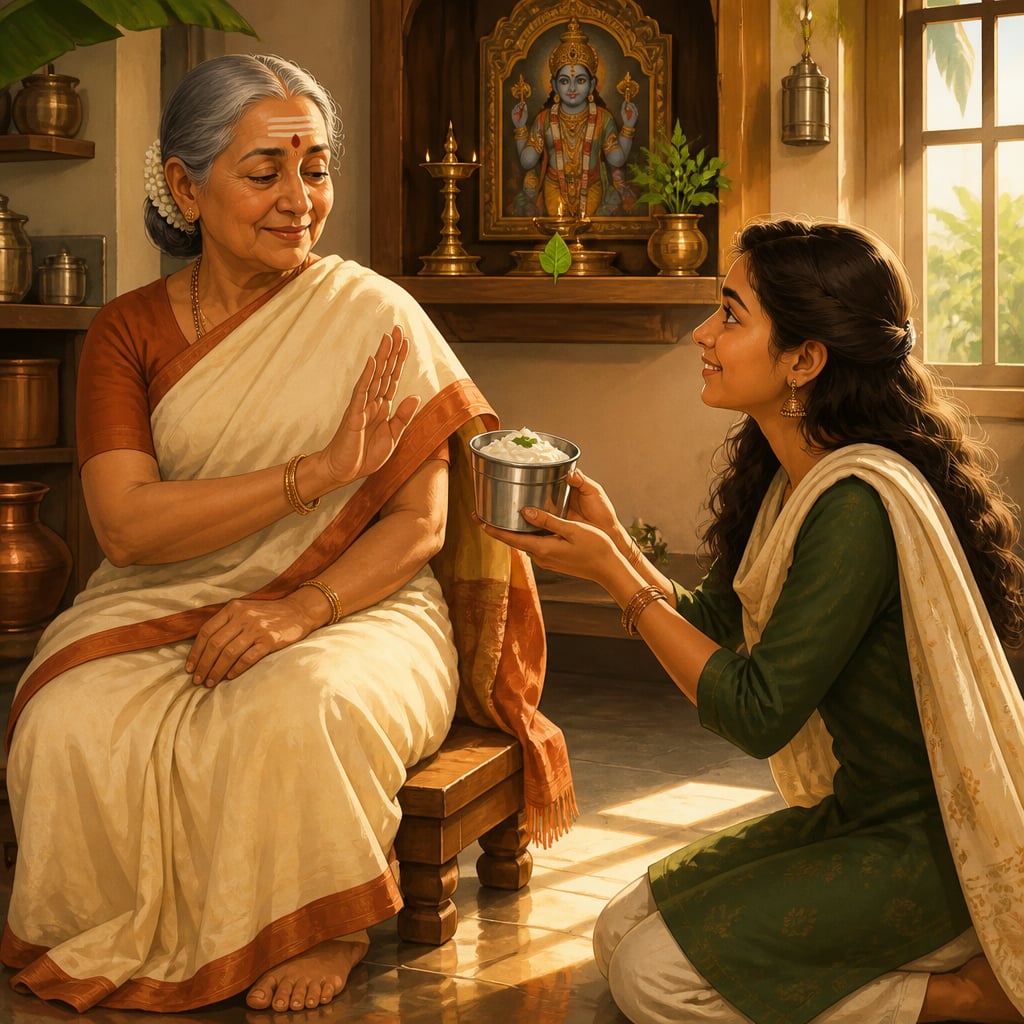
Grandmother refusing curd rice on Ekadashi

In a flat in Mylapore, on a Tuesday afternoon in October, a granddaughter has just finished college classes and is walking home. The house smells of sambar and freshly cooked rice. Her paati, eighty one years old, is in the kitchen serving lunch. She places a heaped plate in front of the granddaughter and a small steel tumbler of water in front of herself. Just water. The granddaughter looks at her plate, then at the empty placemat across the table.

'Paati, are you not eating?'

The old woman shakes her head once. 'It is Ekadashi.' She says it the way another grandmother might say the day of the week. No drama. No display. She has done this on the eleventh tithi of every fortnight, twenty four times a year, for sixty years. The granddaughter knows the word. She has heard it her whole life. She has never once asked what it is for. Her paati sits down across from her with the empty plate and the tumbler of water, and watches her eat.
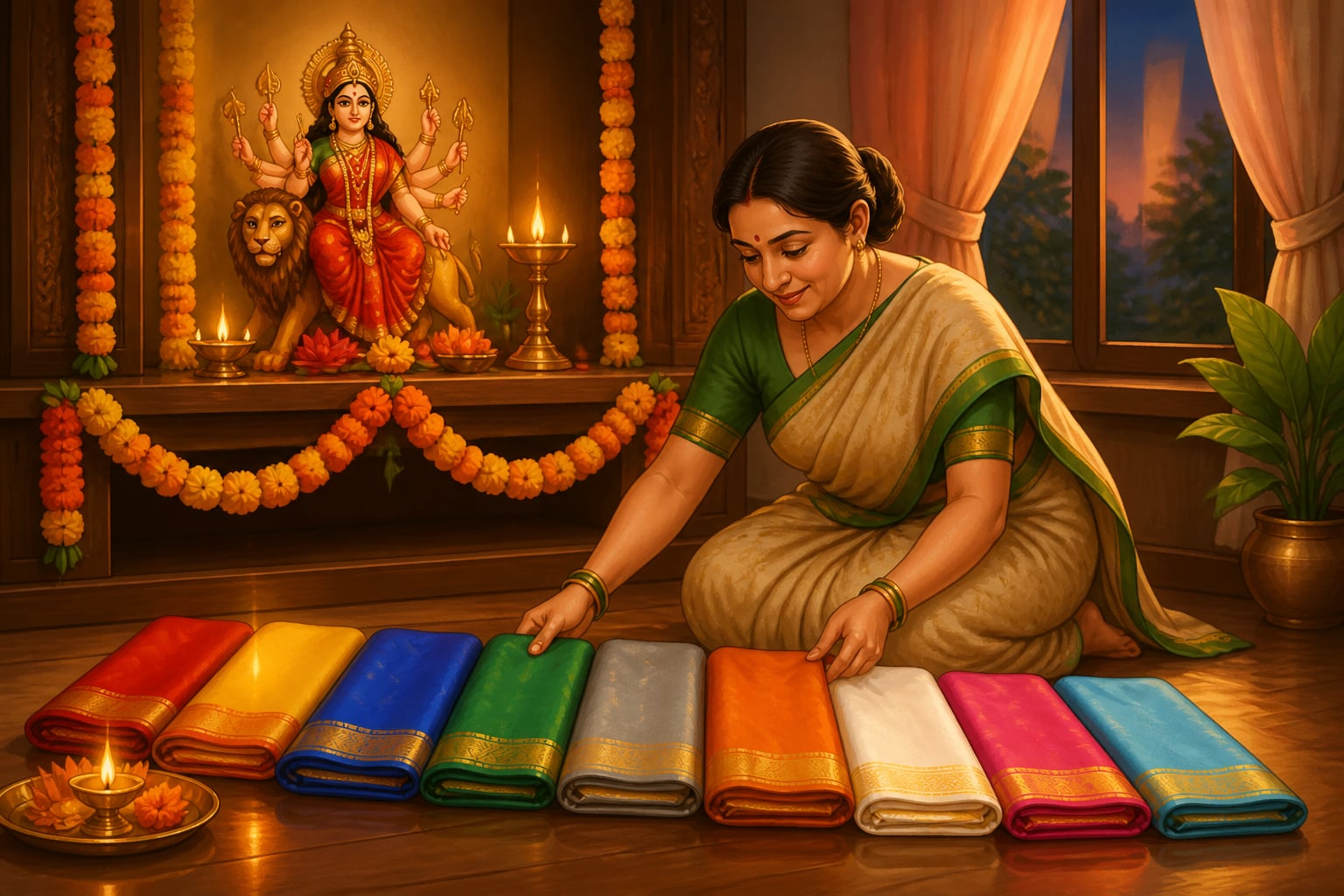
Pune mother laying out nine saris for Navratri

At the same hour, a thousand kilometres north in Pune, a middle aged mother is laying out nine sets of fresh clothes, each in a different colour. Tomorrow is the first day of Navratri. For nine nights she will keep a kalasha in the living room, eat one fruit-and-singhara plate a day, and wear the colour assigned to that day.
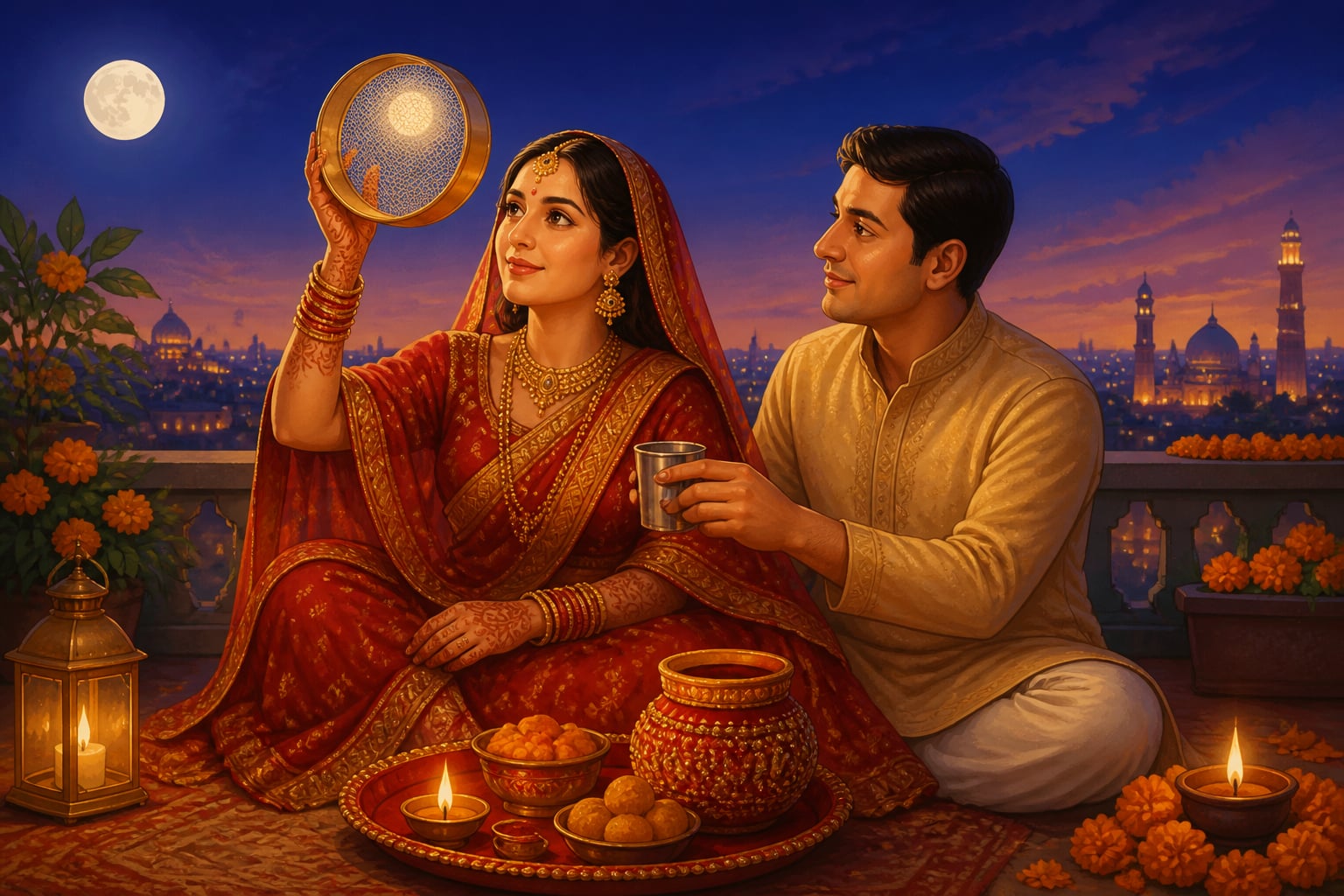
A wife viewing the Karva Chauth moonrise through a brass sieve

And in Karol Bagh in Delhi, a young wife is laying out a small sieve and a red and gold thali. In ten days, on the fourth night after the full moon of Kartik, she will not eat or drink from sunrise until she sees the moon. She will look at the moon through the sieve, then at her husband through the same sieve, and break the fast with the first sip of water from her husband's hand.

Three women. Three fasts. One civilisation. The fortnight, the season, the marriage. Each has its fast. The world pays for an app that approximates the first.

The Practice, Across India

The word vrata means a sacred vow undertaken by the householder, kept for a fixed period, with food restriction at its centre and a deity at its head. It is older than the Mahabharata. It is structured differently from a Western fast. A Western fast is usually a private health protocol or a religious season. A Hindu vrata is calendar-locked, deity-locked, and household-locked at once. The body fasts. The mind worships. The kitchen rearranges itself around the vow. The whole house knows it is happening.

Ekadashi is the fortnightly fast. It is observed on the eleventh tithi of both the bright half (shukla paksha) and the dark half (krishna paksha) of every lunar month. Twenty four Ekadashis fall in a year, with one extra during the adhik maas, the inserted thirteenth lunar month. The fast begins at sunrise on Dashami eve and ends at sunrise on Dwadashi, after the householder has paaranam, the ceremonial breaking of the fast. The strictness varies. The orthodox keep nirjala Ekadashi, no food and no water, especially on the Bhima Ekadashi of Jyeshtha. The moderate keep phalahara, only fruit, milk, and singhara flour. The lenient skip only grains and pulses. The deity at the head of the vrata is Vishnu. Every Ekadashi has its own name, its own legend in the Padma Purana, its own promise of a particular merit.

Navratri is the nine night fast. It is observed twice a year. Sharad Navratri arrives in Ashwin (September to October), the autumnal one most known to the diaspora. Vasanta Navratri arrives in Chaitra (March to April), the spring one celebrated in the north as the build up to Ram Navami. Two further Navratris, called Gupt Navratris, fall in Magha and Ashadha, observed by tantric and Devi-focused lineages. For nine nights the householder keeps a single sattvic meal a day, lights a kalasha or akhand jyot, and turns to the Goddess in her nine forms: Shailaputri, Brahmacharini, Chandraghanta, Kushmanda, Skandamata, Katyayani, Kalaratri, Mahagauri, Siddhidatri. In Bengal the same nine nights are folded into Durga Puja, with the goddess as Mahishasura Mardini at the centre. In Gujarat the nights are filled with garba and dandiya. In Tamil Nadu they are kept as Golu, the doll display. In Karnataka the festival closes with the great Mysuru Dasara. One vrata. Many regional faces.

Karva Chauth is the annual day-long fast kept on the fourth tithi of the dark fortnight of Kartik (October to November). It is kept by married Hindu women across north India: Punjab, Haryana, Delhi, western UP, Rajasthan, Himachal, parts of Madhya Pradesh, and the Punjabi diaspora across the world. The fast is nirjala from sunrise to moonrise. The fast is broken only after the wife sights the moon through a sieve, then her husband's face through the same sieve, and accepts the first sip of water from his hand. The deity at the head is Gauri, the goddess of the marriage bond, with Ganesha invoked at the start. The legend recited during the day is the story of Veervati, whose brothers tricked her into breaking her fast early and whose husband died as a consequence, only to be revived by her renewed vow.

The Scripture Says

Ekadashi's scriptural anchor is the Padma Purana, in the Uttara Khanda, where the deity Ekadashi appears as a form of Vishnu and the merit of each of the twenty four fasts is enumerated. The Skanda Purana and Vishnu Purana repeat the framing. The verse most often recited at the start of an Ekadashi vrata is from the Padma Purana, where Vishnu himself declares the day his own.

एकादश्यां न भुञ्जीत पक्षयोरुभयोरपि। उपवासेन तेनैव विष्णुलोकं स गच्छति॥

ekādaśyāṃ na bhuñjīta pakṣayor ubhayor api upavāsena tenaiva viṣṇu-lokaṃ sa gacchati

On the eleventh of both fortnights one should not eat. By that fast alone the soul reaches the realm of Vishnu.

Padma Purana, Uttara Khanda

Navratri's primary scriptural anchor is the Devi Mahatmya, also called the Durga Saptashati, embedded in the Markandeya Purana. Seven hundred verses across thirteen chapters narrate the goddess's three great victories, over Madhu and Kaitabha, over Mahishasura, and over Shumbha and Nishumbha. The text is recited once a day across the nine nights, one section at a time, in temples and homes from Kashi to Kanyakumari. The vrata of nine nights is a parikrama through this text.

Karva Chauth has no single primary scripture. Its narrative core is the Veervati Katha, preserved in regional vrata kathas of Punjab and Haryana and recited at sunset by the gathered women of the household. The fast itself is described in compendia like the Vrata Raja and the Vrata Khanda of the Hemadri, a thirteenth century encyclopedia of vows compiled at the court of the Yadava king Mahadeva. Hemadri lists Karva Chauth among the suhagan vrats, the vows of the auspiciously married woman.

The Symbolism

Each fast points the body in a different direction.

Fast Cycle Body Move Aim
Ekadashi Fortnight Empty the gut Cellular reset
Navratri Season Hollow the body Make room for the Goddess
Karva Chauth Year Tighten the bond Re-vow the marriage

Ekadashi is timed to the moon's eleventh phase because, in the lunar reading of the body, the moon's pull is at a particular angle on that day and the fluid balance of the gut is most easily reset by skipping a meal. The number eleven matters. There are ten organs of action and perception in classical Samkhya, plus the mind, totalling eleven. Ekadashi is the day all eleven are turned away from food and toward the divine. The vrata is a one-day inventory of the senses.

Navratri's nine nights are read as a graduated journey through the three gunas. The first three nights are given to Durga, the destroyer of tamas. The middle three are given to Lakshmi, the cultivator of rajas into purposeful action. The final three are given to Saraswati, the awakener of sattva. The body is not the point. The body is the vessel that has to be cleaned to receive each form in turn. The fasting is not punishment. The fasting is housekeeping.

Karva Chauth, sometimes dismissed as patriarchal performance, is in its scriptural form a mutual vow. The husband traditionally fasts as well in the Veervati katha. He breaks his fast only after she breaks hers. The sieve is the symbol that the wife sees the husband as she sees the moon: through a layer that softens the gaze and reminds her she is looking at something celestial. The first sip from his hand is the renewed marriage. Once a year, the bond is taken out, dusted, and re-tied in front of the moon.

Why the Body Responds

The habit architecture of these three fasts is a masterclass in cued behaviour.

Cue. The cue is never internal willpower. It is the calendar. The eleventh tithi arrives whether you remember or not. The first day of Ashwin shukla paksha arrives whether you are ready or not. The fourth tithi of Kartik krishna paksha arrives at the same moonrise every year. The cue is astronomical, public, unmissable. Wendy Wood's research at USC on habit formation, summarised in her 2019 book Good Habits Bad Habits, argues that the most durable habits are the ones with stable environmental cues. Hindu civilisation built its fasting calendar on the most stable environmental cue available, the lunar phase.

Routine. The routine is fixed. The kitchen pre-prepares the singhara, the sabudana, the kuttu, the milk and fruit. The household around the faster reorganises. There is nothing to decide on the day. The decision was made by the calendar.

Reward. The reward is layered. There is the immediate physiological reward of a lighter body. There is the social reward of being seen by the household as one who keeps the vrata. There is the identity reward of belonging to a long line of women and men who have done this on this day for two thousand years. James Clear, in Atomic Habits, calls identity-based habits the most durable kind. A solo fast is hard. A household fast is easy. When the kitchen knows and the temple bell rings the breaking time, the fast keeps itself.

What the Labs Found

Ekadashi has the deepest research vindication of any single Hindu ritual. The mechanism it triggers, sustained intermittent fasting on a 24 to 36 hour cycle twice a month, is the same mechanism studied under the name autophagy by Yoshinori Ohsumi, who won the 2016 Nobel Prize in Physiology or Medicine for his work on cellular self-eating. Mark Mattson at the National Institute on Aging published a comprehensive review in the New England Journal of Medicine in 2019 confirming that intermittent fasting protocols induce autophagy, improve insulin sensitivity, raise BDNF, and reduce oxidative stress. The cellular renewal argument that Adi Shankaracharya made in his Vishnu Sahasranama bhashya in the eighth century, calling the practice dhatu-parishuddhana or tissue purification, was vindicated by the Nobel committee twelve hundred years later.

Navratri has its own research record. Two seasonal nine-night fasts a year correspond to the two transitional seasons in the Indian climate, ritu sandhi, when immune function is most stressed and gut microbiome variation is highest. Sonnenburg and colleagues at Stanford, writing in Cell in 2022, documented that seasonal dietary variation directly improves gut microbiome diversity. The sattvic Navratri plate, light and grain-restricted, mirrors the seasonal-reset diets that the gut microbiome literature now prescribes.

Karva Chauth's research vindication is in the literature on social bonding rituals and oxytocin. Dunbar at Oxford has shown that synchronised group rituals raise oxytocin and strengthen pair-bonds. The collective sighting of the moon, the shared sieve, and the first sip from the partner's hand combine three of the strongest oxytocin cues we know: synchrony, shared deprivation, and partner-mediated relief. The wife in Karol Bagh and the husband across the table from her are running, on the fourth tithi of Kartik krishna paksha, a clinically validated pair-bond renewal protocol.

What the World Calls It Now

The global intermittent fasting industry was estimated by Allied Market Research at over six hundred million United States dollars in 2023, projected to cross two billion by 2030. The Zero app has more than five million downloads. Noom's intermittent fasting module charges seventy dollars a month. Valter Longo's ProLon kit retails at two hundred and fifty dollars for a five-day cycle. Mark Mattson's NEJM paper has been cited tens of thousands of times in the popular press as the science of fasting. Almost none of these citations name Ekadashi. Almost none of them note that the sixteen-to-thirty-six-hour fasting window the apps recommend is exactly the window an Ekadashi observer has been keeping, twice a month, for the last two thousand years.

Navratri's modern echo is more diffuse. The wellness industry sells seasonal cleanses at a few thousand dollars a week at retreats from Ojai to Bali. The gut microbiome literature recommends seasonal dietary resets. Dosha-based eating apps charge subscription fees for personalised seasonal menus. Andrew Huberman's Stanford podcast prescribes light fasting at the equinoxes. The nine-night sattvic vrata at Ashwin and Chaitra is exactly this protocol, free, scripted, and embedded in a thousand-year-old festival.

Karva Chauth has no commercial echo yet. The wellness industry has not figured out how to package a fasting-based pair-bond renewal ritual for sale. Couples therapists already prescribe synchronised practice and shared deprivation as bonding tools. The wife in Karol Bagh has been running the protocol her great-grandmother ran, for free, with a clay karva and a steel sieve.

What to Call It Yourself

From this lesson onward, when an app prescribes a 16:8 window, call it Ekadashi. When a wellness retreat advertises a seasonal cleanse, name the older protocol. When a couples therapist prescribes a synchronised pair ritual, use the older words. Ekadashi. Navratri. Karva Chauth. Three vrats, three cycles, one calendar.

Modern Echoes

Mark Mattson at NIH, Yoshinori Ohsumi at Tokyo, Robin Dunbar at Oxford, Justin Sonnenburg at Stanford. Four laboratories on three continents, between 2016 and 2022, vindicated the mechanisms of three Hindu fasts the Padma Purana, the Devi Mahatmya, and the Hemadri's Vrata Khanda had already named. Adi Shankara called Ekadashi dhatu-parishuddhana in 750 CE. Ohsumi won the Nobel for autophagy in 2016. The argument was a thousand years old when the Nobel committee voted.

Back at the table in Mylapore, the granddaughter has finished her sambar and rice. The paati has finished her tumbler of water. The granddaughter glances at the wall calendar with the lunar tithis printed on it, the one her grandmother bought from the Kapaleeshwarar temple stall. She counts forward. The next Ekadashi falls on a Saturday. She thinks, for the first time in twenty two years, that she might keep it.

Key figures

Adi Shankaracharya

circa 700 to 750 CE

Hemadri Pandit

circa 1260 to 1309 CE

Yoshinori Ohsumi

born 1945

Case studies

Adi Shankaracharya's Eighth Century Argument for Ekadashi

In his bhashya on the Vishnu Sahasranama, written sometime in the first half of the eighth century, Adi Shankaracharya frames the Ekadashi fast as dhatu-parishuddhana, tissue purification. The body, kept regularly hungry on a fortnightly cycle, undergoes a complete digestive reset every two weeks. The argument is offered as a philosophical defence of why a Vaishnava observance should be kept by Advaitins as well, and circulates through the four Mathas Shankara establishes.

Ekadashi is not merely abstinence from food. It is the day on which the body, by being emptied, becomes a fit vessel for the contemplation of Vishnu. The cellular renewal argument is the lower of the two reasons. The contemplative alignment is the higher. Both are real.

The argument enters the bhashya tradition that all four sampradayas read. By the medieval period, Ekadashi is kept across Vaishnava, Shaiva, Shakta, and Smarta households alike, on the same tithi, in the same way.

The cellular renewal argument for Ekadashi was made in 750 CE, not 2016. The science is twelve centuries late.

Every modern article that frames intermittent fasting as a discovery of the last twenty years should be read alongside this bhashya. The argument is not new. The vocabulary is.

Shankara, Vishnu Sahasranama Bhashya, c. 750 CE; the bhashya circulates through the four Mathas of Sringeri, Dwarka, Puri, and Joshimath.

The Six Hundred Million Dollar Intermittent Fasting Industry

Allied Market Research valued the global intermittent fasting market at over six hundred million United States dollars in 2023, projected to reach two billion by 2030. The Zero app, founded in 2019, has more than five million downloads. Noom's intermittent fasting module retails at seventy dollars a month. Valter Longo's ProLon kit, marketed as a fasting-mimicking diet, sells for two hundred and fifty dollars per five-day cycle. The protocol all of them recommend, sixteen to thirty six hours of fasting on a regular cadence, is exactly the Ekadashi window kept twice a month for the last two thousand years.

The mechanism is not new. The packaging is. Ekadashi is the same protocol with a deity at its head, a calendar at its base, and a household around it. The wellness app is the protocol stripped of all three.

The intermittent fasting industry continues to grow without ever crediting the Hindu calendar. Almost no commercial wellness brand cites Ekadashi. The grandmother in Mylapore keeps the protocol for free.

Intermittent fasting is the most lucrative commercial rediscovery in this course. The original is older, fuller, and free.

The Hindu in the diaspora paying seventy dollars a month for an intermittent fasting app is paying a subscription fee for a fragment of her grandmother's calendar.

Allied Market Research, Intermittent Fasting Market Report 2023; Zero app 5M+ downloads; Noom IF module $70/month; ProLon $250 per 5-day kit.

Ohsumi's Nobel and Mattson's NEJM Review

Yoshinori Ohsumi won the 2016 Nobel Prize in Physiology or Medicine for his identification of the autophagy genes and the demonstration that cells digest their own damaged components under nutrient stress. Mark Mattson, then at the National Institute on Aging, published a comprehensive review in the New England Journal of Medicine in 2019 confirming that intermittent fasting protocols on a sixteen to thirty six hour cadence induce autophagy, raise BDNF, improve insulin sensitivity, and reduce oxidative stress.

The Padma Purana, the Skanda Purana, and Adi Shankaracharya's bhashya all framed Ekadashi as a fortnightly cellular reset. The deity Ekadashi was understood as the impeller of this reset. The Nobel committee in 2016 vindicated the cellular mechanism. The deity remains the framing the Nobel committee did not address.

Mattson's NEJM paper has been cited tens of thousands of times in popular health writing. Ekadashi is named in almost none of these citations.

The Nobel Prize and the NEJM review directly vindicate the cellular argument for Ekadashi. The vindication is one thousand two hundred years late.

Every Hindu reading the New England Journal of Medicine review on intermittent fasting is reading, in laboratory English, what her grandmother already knew in lunar Sanskrit.

Ohsumi, Nobel Prize in Physiology or Medicine 2016; Mattson MP, de Cabo R, NEJM 381:2541-2551, 2019; Sonnenburg ED et al, Cell 185:3009-3027, 2022 (seasonal microbiome) supports the Navratri layer.

Historical context

From the late Vedic period (c. 1000 BCE) through the Puranic codification (c. 300 to 1000 CE) and the medieval encyclopedic period (c. 1100 to 1400 CE)

Living traditions

Use the original names. Ekadashi for the fortnightly fast, not 16:8 intermittent fasting. Navratri for the seasonal nine-night reset, not seasonal cleanse. Karva Chauth for the annual pair-bond renewal, not couples fasting trend. The wellness app is selling fragments. The calendar is selling the whole system. Choose the calendar.

Reflection

More in Anna: Food, Fast, Fire

All lessons in Anna: Food, Fast, Fire · Samskaras: The Sanatan Operating System course