The Banana Leaf and the Right Hand
The Vijayanagara Plate, the Five-Finger Sense, and the Silence That Holds the Meal
Before the steel thali, before the porcelain plate, before the disposable foam tray, the Hindu meal sat on a green leaf cut from the courtyard tree, was eaten with the fingers of the right hand, and was held in silence until the last morsel. The world is now selling all three: biodegradable leaf plates funded by venture capital, mindful eating apps with five-finger guidance, and silent retreats at thousand-dollar price points. The grandmother knew. The labs are catching up. The plate, the hand, and the silence are one design.
The Leaf on the Floor
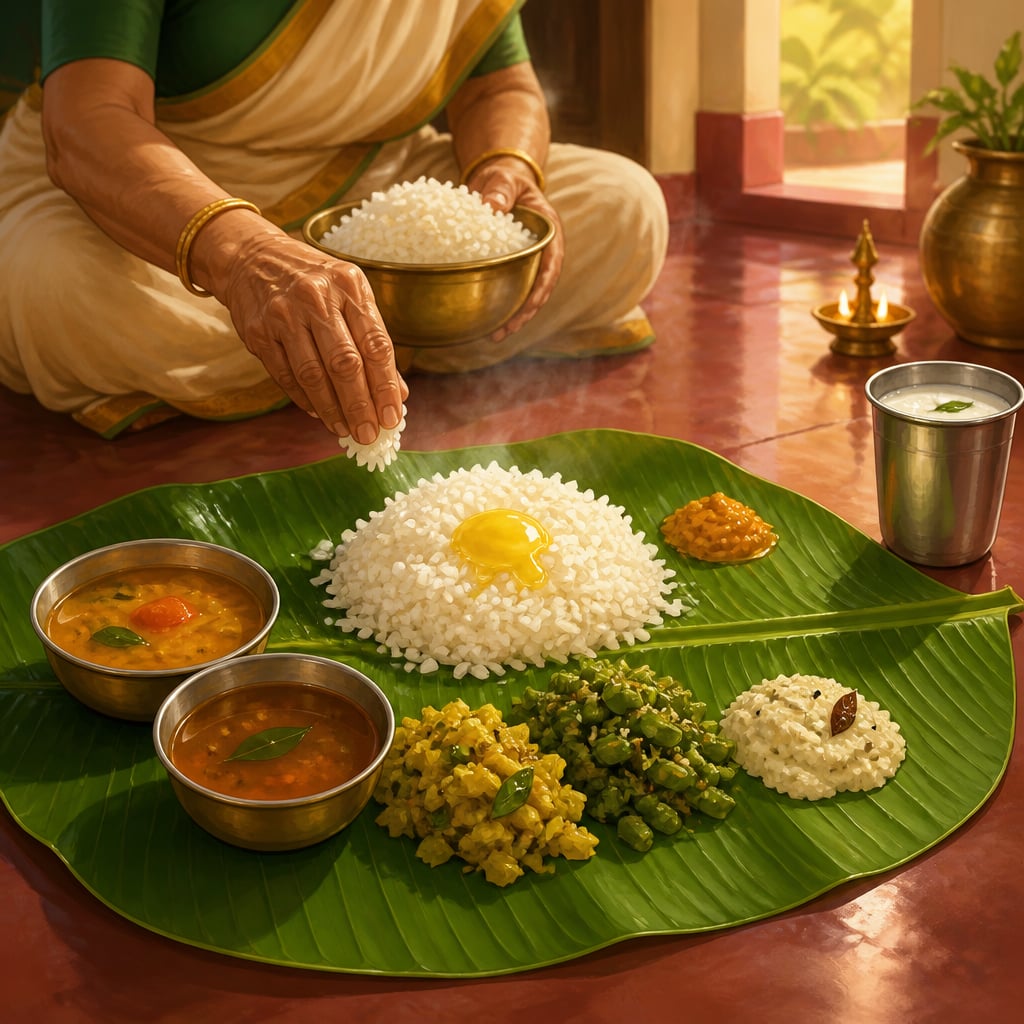
The paati in Mylapore is seventy-eight years old. The grandchild is six. It is a Sunday afternoon in the visiting month, and lunch has been laid out on the terracotta floor of the inner courtyard. The grandchild has been told to wash his hands, sit cross-legged, and wait. A long, glossy banana leaf is brought from the kitchen, the broad end placed to his left, the narrow tip to his right. A small lota of water is sprinkled around it in a quick clockwise circle. A pinch of rice is placed at the top corner of the leaf, not for him, but for the crow that will come later. Then the food arrives. Sambar from the left. Rice from the left. Pickle, then poriyal, then a spoon of ghee, then payasam at the very end. He is told to sit straight, to use only his right hand, to fold the leaf inward at the close, and to eat without speaking. He asks why. The paati does not answer. She refills his rice.
This lesson is the answer she did not owe him. Three rituals braided into one meal: the leaf as plate, the hand as utensil, and the silence that holds them both. Each has scripture behind it. Each has a body-mechanism that the labs have only recently named. And each has been quietly extracted, repackaged, and sold back to the world by someone who has never sat on a courtyard floor in Mylapore.
The Plate That Grows on a Tree
The banana plant is one of the few plants in Bharat that the householder can grow at the edge of the courtyard, harvest a leaf from in the morning, and replant in the same season. In Sanskrit it is kadali patra, the leaf of the kadali. In Tamil vaazhai elai. In Malayalam vaazha ila. In Bengali kola pata. The same leaf, six names, one design.
The protocol is precise. The leaf is placed with the stem end to the diner's left and the tip to the right. In Tamil tradition, the broad uncut surface faces the eater; in Kerala temple feasts, the rim is folded once. A small portion of water is sprinkled on the leaf and wiped with the right hand. This is not hygiene theatre. The water cools the surface, releases trapped sap, and signals the leaf is now a vessel of food. Items are served in a fixed order around the leaf's perimeter, with rice and the main grain in the center.
The Bhagavad Gita gives the offering rule that sits underneath every meal in this tradition.
पत्रं पुष्पं फलं तोयं यो मे भक्त्या प्रयच्छति। तदहं भक्त्युपहृतमश्नामि प्रयतात्मनः॥
patraṃ puṣpaṃ phalaṃ toyaṃ yo me bhaktyā prayacchati tad ahaṃ bhakty-upahṛtam aśnāmi prayatātmanaḥ
A leaf, a flower, a fruit, water. Whoever offers these to me with devotion, I accept that offering of the pure-hearted devotee.
Bhagavad Gita 9.26
The verse names the leaf first. Patram. The leaf is enough. The leaf is the offering. By the time the same leaf reaches the household meal, it has already been the temple's primary plate for at least two thousand years.
Hampi, 1520

The scale of this design is not a village memory. The Portuguese traveller Domingo Paes arrived at the Vijayanagara capital in 1520 and watched the court of Krishnadevaraya feed an army on banana leaves daily. Paes' chronicle, preserved in the Lisbon archives and translated by Robert Sewell in A Forgotten Empire (1900), records feasts of fifty thousand people seated in long rows, each in front of a fresh leaf, eating in disciplined silence. The leaves were composted at the end of each meal. The next day, fresh leaves came from the temple gardens. There was no plate to wash. There was no plate to throw away. There was a tree.
This was royal protocol, not rural improvisation. The colonial-era reading that the banana leaf was a poor person's substitute for porcelain runs into the Hampi receipts. Vijayanagara was the richest empire of its century. It chose the leaf.
Leaf Republic, 2015
In 2015, a German startup called Leaf Republic raised €1.2 million in seed capital to manufacture compostable plates from leaves stitched together with palm fibre. Their Series A pitch deck describes the product as the future of sustainable dining. The biodegradable plate market they were chasing is projected to reach $6.7 billion by 2027. The Leaf Republic website cites Indonesian and Thai precedents. There is no mention of Hampi. There is no mention of Krishnadevaraya. There is no mention that the world's largest documented disposable-plate system was running, at the institutional scale of fifty thousand meals per sitting, five centuries before the seed round closed.
What the world calls a startup, the grandmother calls Tuesday. Vaazhai elai, not biodegradable plate.
The Five-Finger Utensil

The second ritual is the right hand itself. Hasta bhojana. To eat with the hand, on a leaf, in the right order, is to use a tool the body grew for the purpose.
The Apastamba Dharma Sutra, one of the older Grihya manuals, lays down the rule that food should be taken with the right hand only, the left hand resting on or beside the leaf. The right hand was reserved for the clean acts of life: eating, greeting, giving, writing scripture. The left was reserved for the unclean: bodily cleansing in the absence of paper, holding the lota at the well. This was not superstition. It was a two-tool design in a culture that had not yet outsourced cleaning to running water and disposable tissue. The right hand stayed clean by being assigned only the clean acts.
The finger work matters. The thumb, index, and middle finger pick up the morsel. The ring and little finger steady the rice ball. As the morsel comes to the mouth, the thumb pushes it inward in a single fluid motion. This is panchanguli bhojana, the five-finger meal. Each finger, in the mudra vocabulary of the temple, is associated with one of the five elements: thumb (fire), index (air), middle (space), ring (earth), little (water). The morsel passes through all five before it reaches the tongue.
Why the Body Responds
The modern research is named and dated. Studies on vagal-nerve activation during eating (see, for example, the work on tactile feeding and digestive enzyme secretion summarised in the Journal of Ayurveda and Integrative Medicine) show that contact between the food and the fingers triggers signals to the brain through the vagus nerve. The brain, alerted by touch a fraction of a second before the morsel reaches the mouth, releases salivary amylase, gastric acid, and pancreatic enzymes in advance. The same meal eaten with a fork lands in a stomach that has not been primed.
This is the cue-routine-reward loop, written into the meal at the level of biology. The cue is the touch of the morsel. The routine is the chew. The reward is the digestion that follows without bloat or heaviness. The grandmother who slapped your wrist for using a spoon was not being old-fashioned. She was protecting the loop.
Mindful Eating, Inc.
The modern echo is a billion-dollar industry. The Headspace and Calm apps both ship guided mindful eating programs that instruct users to feel the food, slow the morsel, and pay attention to the hand. The Center for Mindful Eating, a US-based nonprofit, runs corporate workshops at $5,000 per session. None of these programs use the words hasta bhojana or panchanguli. They describe a five-finger contact protocol the Hindu meal has run, on the floor, every day, for at least three thousand years.
What the world calls mindful eating, the grandmother calls eating properly. Hasta bhojana, not finger-food therapy.
The Active Plate
The banana leaf is not a passive surface. The 2012 study by Sathyanarayana Rao and colleagues, published in the Journal of Phytochemistry, reported that hot food placed on a fresh banana leaf leaches measurable quantities of epigallocatechin gallate (EGCG) into the meal. EGCG is the same polyphenol that makes green tea a global health product. It is antimicrobial, antioxidant, and anti-inflammatory. Separate research on banana-leaf surfaces has documented polyphenol oxidase activity that suppresses bacterial growth on contact.
The leaf is not a plate. The leaf is an ingredient.
This is the part the Leaf Republic deck cannot replicate. A leaf stitched with palm fibre and pressed flat for shipping is a sustainable dish. A fresh leaf cut that morning, sprinkled with water, and warmed by hot rasam is a polyphenol delivery system. The Vijayanagara feast was eating EGCG with every meal, five centuries before Lipton built a brand around it.
The Silence That Holds the Meal
The third ritual is the easiest to miss. Mauna bhojana. The meal is taken in silence.
Manusmriti 2.56 instructs the householder not to speak while eating. The Apastamba and Baudhayana Grihya Sutras add that conversation, laughter, and quarrel during the meal corrupt the food itself. The rule is not Victorian etiquette. It is digestive policy.
When the diner speaks, the body splits its attention between two parasympathetic acts: speaking and digesting. Both run on the vagus nerve. Both compete for the same neural bandwidth. The talking meal is the bloated meal. Modern gastroenterology has a name for this: post-prandial dyspepsia, the heaviness that follows a meal eaten in conversation. The Charaka Samhita described the same syndrome under the name ajirna twenty-two centuries earlier and prescribed mauna bhojana as the first remedy.
The Taittiriya Upanishad seals the frame.
अन्नं न निन्द्यात्। तद् व्रतम्। अन्नं न परिचक्षीत। तद् व्रतम्।
annaṃ na nindyāt. tad vratam. annaṃ na paricakṣīta. tad vratam.
Do not despise food. That is the vow. Do not refuse food. That is the vow.
Taittiriya Upanishad, Bhrigu Valli 3.7
Food is brahman. The plate, the hand, and the silence are the three gestures by which the diner agrees to that proposition for ten minutes a day.
The Silent Retreat at $1,200
In the present decade, the Vipassana Research Institute at Igatpuri runs ten-day silent retreats free of cost. American wellness centres, including the 1440 Multiversity in California and Esalen in Big Sur, charge between $1,200 and $4,000 for week-long silent eating programs. The pitch is the same: silence at the meal restores the parasympathetic system. The bibliographies do not cite Manu. They cite a 2014 Harvard Business Review article on mindful work.
What the world calls a silent retreat, the grandmother calls lunch. Mauna bhojana, not silent dining.
What the Labs Are Saying Now
The research stack on the meal is now named and stable. Sathyanarayana Rao on EGCG in banana leaf. Vagal-tone literature on tactile feeding and enzyme priming. Charaka's ajirna confirmed by post-prandial dyspepsia studies in the American Journal of Gastroenterology. The biodegradable plate market projected at $6.7 billion. The mindful eating market at roughly $4 billion and rising. The silent retreat market at upwards of $200 million annually. Each line item is a fragment. The Hindu lunch is the whole.
The Vijayanagara court was running the whole. The Mylapore grandmother is still running the whole. The labs are catching up.
Circle-Back
The grandchild in Mylapore did not get an answer that Sunday. He got a refilled plate. He got the leaf folded inward at the close. He got the silence. The answer was being delivered through his fingers and his stomach, ten minutes at a time, while the words waited.
The Hindu meal is one design in three pieces. Vaazhai elai, the active plate. Hasta bhojana, the five-element utensil grown into the body. Mauna bhojana, the silence that lets the body do its work. Call them by their names. Eat the leaf, with the hand, in the silence. The next time someone offers you a biodegradable plate, a mindful eating app, or a silent retreat at four figures, smile and refill your own rice.
Case studies
Hampi, 1520: The Vijayanagara Banana-Leaf Feast at Royal Scale
In 1520, the Portuguese horse-trader Domingo Paes arrived at the Vijayanagara capital under Krishnadevaraya. His chronicle, preserved in Lisbon and translated by Robert Sewell in A Forgotten Empire (1900), describes daily court feasts at which up to fifty thousand diners sat in disciplined rows on the floor, each before a fresh banana leaf cut that morning from temple-managed gardens. The leaves were arranged with stem to the diner's left and tip to the right, sprinkled with water, and served in a fixed order. At the close of the meal, the leaves were folded inward and composted. The next day, fresh leaves arrived. There was no plate to wash. There was no plate to discard. Vijayanagara was the richest empire of its century.
The meal at Hampi was not subsistence dining. It was institutional ritual. The leaf, the right hand, and the silence were running at the scale of a small city, in the protocol of the Bhagavad Gita 9.26 and the Apastamba Grihya Sutra, in the same posture the householder maintained on the courtyard floor. The empire and the village were running the same operating system.
Paes' chronicle survives and is now considered one of the most reliable external accounts of a working Hindu empire. The banana leaf as institutional plate is a documented royal practice from the sixteenth century, not a colonial-era invention or a poverty substitute. The same protocol still runs at Tirumala Tirupati Devasthanams, where free meals are served to tens of thousands of pilgrims daily on fresh leaves.
Scale does not break the design. The leaf, the hand, and the silence work for fifty thousand as well as for five. The Hindu meal was institutionally engineered for both the household and the empire, by the same logic, with the same materials.
When modern caterers ask whether biodegradable disposables can scale to corporate-cafeteria volumes, the answer was settled in 1520. The infrastructure was tree, leaf, water, fire, compost. It worked at empire scale then. It still works at temple scale now.
Up to 50,000 diners per sitting at Krishnadevaraya's court (Paes, 1520, in Sewell, A Forgotten Empire, 1900). Tirumala Tirupati Devasthanams currently serves over 100,000 free meals per day on banana leaves at its Annaprasadam complex.
Sathyanarayana Rao 2012: The Banana Leaf Is Not a Plate, It Is an Ingredient
In 2012, a research team led by Sathyanarayana Rao, publishing in the Journal of Phytochemistry, examined the chemistry of fresh banana leaves used as serving surfaces for hot food. They reported that the leaves leach measurable quantities of epigallocatechin gallate, the same polyphenol that makes green tea a global health product, into the meal. Separate studies have documented polyphenol oxidase activity on banana-leaf surfaces that suppresses bacterial growth on contact, and additional flavonoid transfer when ghee or hot rasam is poured directly onto the leaf.
The Charaka Samhita and the Bhagavad Gita 9.26 named the leaf as a valid vessel for food fit for the divine. The Apastamba Grihya Sutra prescribed the protocol of sprinkling water on the leaf before serving, which the modern reading now identifies as a step that releases sap and primes polyphenol availability.
The 2012 study and its successors have shifted the academic framing of the banana leaf from passive sustainable substrate to active functional food surface. The leaf is now classified, in food-science literature, as an ingredient that interacts with the meal, not merely a plate that holds it.
The Hindu plate is not a passive surface. The plate is an ingredient. The grandmother who insisted on a fresh leaf and not a reheated one was protecting a polyphenol delivery system whose chemistry has only recently been named.
Every cafeteria switch from foam to recycled paper plate reduces waste. Every switch from paper plate to fresh banana leaf, where the climate allows, also adds a polyphenol fraction to the meal. The leaf is the only plate that improves what it holds.
Sathyanarayana Rao et al, Journal of Phytochemistry, 2012. EGCG leaching from fresh banana leaf into hot served food at measurable, functional concentrations. EGCG is the lead compound in the global green tea functional-food market, valued at over $20 billion annually.
Leaf Republic, 2015: Five Centuries Behind Hampi
In 2015, a German startup called Leaf Republic raised €1.2 million in seed capital to manufacture compostable plates from leaves stitched together with palm fibre. The company describes the product, in its investor materials, as the future of sustainable dining. Their projections target the biodegradable plate market, valued at roughly $1.4 billion in 2020 and projected to reach $6.7 billion by 2027. The Leaf Republic site cites Indonesian sirih and Thai banana-leaf wrapping as design inspirations. There is no mention of Hampi. There is no mention of Krishnadevaraya. There is no mention of Tirumala Tirupati Devasthanams' daily 100,000-meal banana-leaf operation, the largest disposable-plate system on the planet, running uninterrupted for centuries.
Vijayanagara was running the institutional banana-leaf feast at fifty-thousand-diner scale in 1520. Tirumala Tirupati Devasthanams currently runs it at a hundred-thousand-meal-per-day scale. The Hindu temple economy has solved, at empire and population scale, exactly the engineering problem Leaf Republic is now selling back to European cafeterias as a venture-funded innovation.
The biodegradable plate market is on track to surpass $6.7 billion by 2027. The Leaf Republic seed round was followed by similar funding for compostable-tableware startups across the United States, Europe, and Australia. None of the prominent player materials cite Indian precedents. The naming of the original system has not been recovered in the global market.
What the world is now selling as innovation, the Hindu temple economy is running as Tuesday. The work for the practitioner is not to be impressed by the venture round. The work is to use the original name. Vaazhai elai, not biodegradable plate.
The next time a sustainable-cafeteria pitch deck arrives, ask one question: does it mention Hampi. If not, the design has been cropped from its source. Use the name. Vaazhai elai.
Leaf Republic, founded 2014 in Munich, raised €1.2 million seed in 2015. Biodegradable plate market: $1.4B (2020), projected $6.7B (2027), per Allied Market Research. Tirumala Tirupati Devasthanams Annaprasadam complex: over 100,000 daily meals on fresh banana leaves, the largest documented disposable-plate operation on the planet.
Historical context
From the Bhagavad Gita's offering verse 9.26 (c. 400 BCE-200 BCE compositional layer) and Manusmriti 2.56 (c. 200 BCE-200 CE) on the conduct of the meal, through the Charaka Samhita's chapters on ajirna and mauna bhojana (c. 600 BCE-200 CE), to the Vijayanagara court's documented banana-leaf feasts under Krishnadevaraya (1509-1529), to the German Leaf Republic seed round (2015), to the present-day mindful eating industry.
Living traditions
The names matter. When a sustainable-cafeteria startup pitches biodegradable plates, the original name is vaazhai elai or kadali patra. When a wellness app sells mindful five-finger eating, the original name is hasta bhojana. When a corporate retreat sells silent-eating sessions at four figures, the original name is mauna bhojana. The user's work is to use the original names in everyday speech and to invite friends and family to a meal, on a leaf, with the hand, in silence, at least once a season. The grandmother's protocol becomes the household's protocol, becomes the friend group's protocol, becomes the workplace lunch table's protocol. The receipts for the design are at Hampi, in the Charaka Samhita, in the Sathyanarayana Rao 2012 paper, and in the Tirumala Annaprasadam complex. The user does not need to argue. The user only needs to keep the practice and use the name.
- Tirumala Tirupati Devasthanams Annaprasadam Complex: The largest free-meal operation on the planet. Over 100,000 pilgrims a day are served a full meal on fresh banana leaves cut that morning from temple-managed gardens at the foot of the seven hills. The protocol is unbroken: stem to the left, tip to the right, water sprinkled, items served in fixed order, silence at the meal. The leaves are composted at the close. Visit during a peak weekend to see the ritual run at scale that no caterer in Europe or America has matched.
- Hampi (Vijayanagara) Archaeological Site: The UNESCO World Heritage site of the Vijayanagara capital, where Domingo Paes watched Krishnadevaraya's court feed tens of thousands on banana leaves in 1520. The royal kitchen complex, the temple feeding-houses, and the bazaar quarters can still be walked. Read Paes' chronicle (in Sewell's A Forgotten Empire) before the visit and the stones speak.
- Sabarimala and Guruvayur Temple Feeding Halls: Two of the most active temple-feeding traditions in Kerala, where every pilgrim is served a sadya on a fresh banana leaf. The Onam sadya at Guruvayur is the canonical demonstration of the full protocol, with up to twenty-six items served around the leaf in a fixed sequence, eaten with the right hand, in silence.
Reflection
- Of the three rituals in this lesson, the leaf as plate, the hand as utensil, and the silence at the meal, which one is most absent from your current eating life, and what is the smallest version of it you could install this week without disruption to your household or workplace?
- Sit with this image for two minutes before answering. The Vijayanagara emperor in 1520, the Tirupati pilgrim in 2024, and your grandmother on a Sunday afternoon are all eating from the same plate. What do you feel when you place yourself in that line, and what changes about your relationship to the next meal you eat?
- The Taittiriya Upanishad's Bhrigu equation, annam brahma, food is brahman, treats the meal as a daily encounter with the divine. If that proposition is taken seriously, what does it ask of the way the meal is prepared, the way it is served, the way it is eaten, and the way leftovers are treated, in your own kitchen, this week?