Ghee, Buttermilk, Haldi Doodh

The three white liquids of the Hindu kitchen, and the receipts the world is selling them back as

Three white liquids sit at the centre of the Hindu kitchen. Clarified butter, fermented buttermilk, and turmeric milk. Each is named in the Charaka Samhita. Each is codified in Vagbhata's Ashtanga Hridayam in the seventh century. Each has been rebranded since 2014 by a Western brand that left the Sanskrit name out of the packaging. This lesson is the namesake lesson of the course. The receipts are on the table.

The Brass Pot at Five in the Afternoon
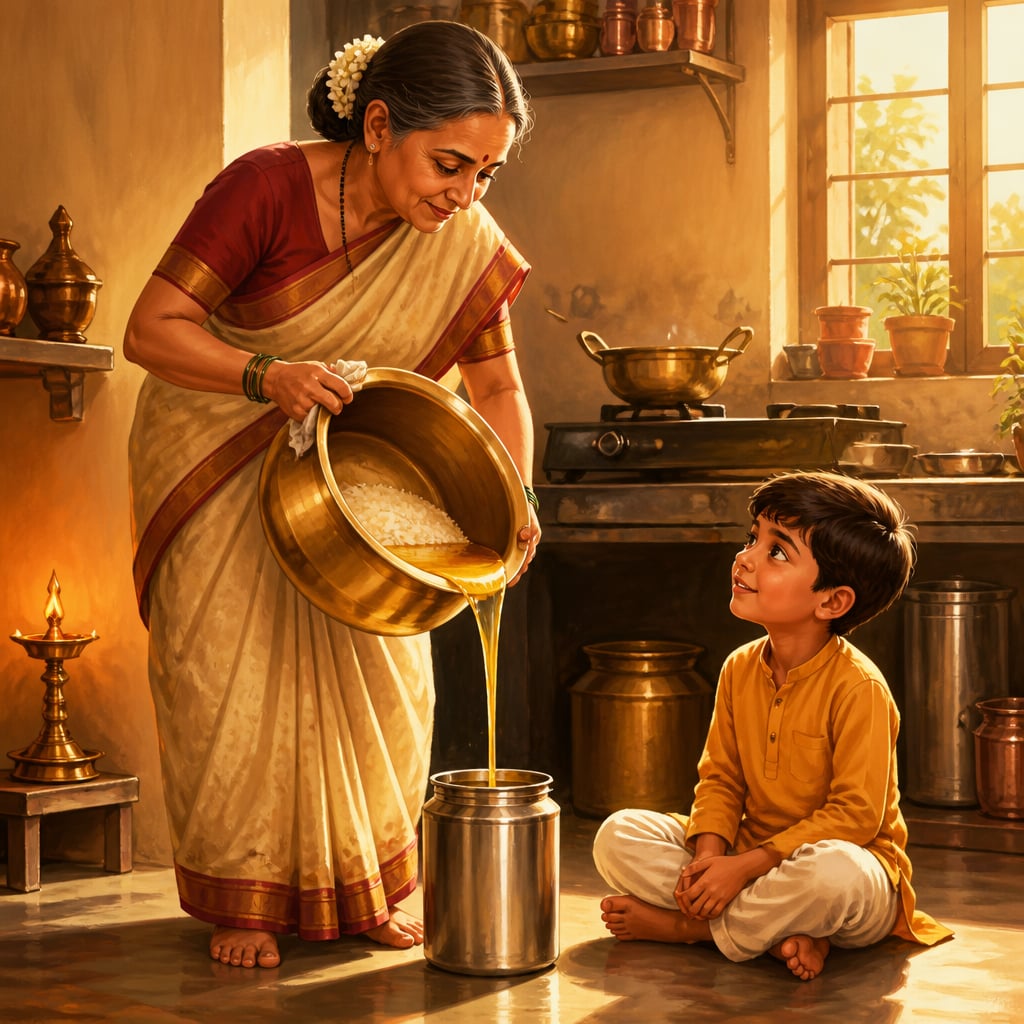
Aaji pouring clarified ghee into a steel jar in Pune

In a small kitchen in Pune, sometime around 1996, an eight-year-old boy is sitting cross-legged on the cement floor. The afternoon light comes in slanted through the iron grille of the window. His aaji is at the gas stove, leaning over a heavy brass pot. Inside the pot, a pale yellow liquid is moving in slow circles. The smell is the smell of the kitchen at its most settled, nutty, sweet, almost like roasted almond.

The aaji lifts the pot off the flame. She lets it rest for a minute. Then she pours the clear golden liquid through a thin muslin cloth into a small steel jar. The white residue on the cloth, the burnt milk solids, she scrapes into a tin. "This," she says, holding up the jar, "is tup. One spoonful in the rice. One spoonful in the dal. One spoonful on the chapati." She does not say it is medicine. She does not mention the Charaka Samhita. She does not say that the same liquid will be sold, twenty-five years later, at Whole Foods in Austin for thirty-two dollars a jar under the name "grass-fed ghee."

This lesson is about three white liquids that pass through that brass pot. Ghrita, the clarified butter the aaji made every Sunday. Takra, the fermented buttermilk she served after lunch. Haldi Doodh, the turmeric milk she boiled for the boy when his throat began to ache. Each of them was specified, by name, in the Charaka Samhita. Each was codified in Vagbhata's Ashtanga Hridayam in the seventh century. Each has been quietly rediscovered by a global wellness brand in the last fifteen years.

The course is named after the third one. Haldi Doodh, sold today as the turmeric latte, is the cleanest documented case of an Ayurvedic preparation reaching mainstream Western shelves with the Sanskrit name surgically removed. The receipts are on the table. The aaji's brass pot is the source.

Ghrita: The Clarified Butter

The practice. Cow's milk is set with curd at room temperature overnight. The next morning the curd is churned with a wooden ravi until the butter rises and separates. The butter is collected, rinsed in cold water, and cooked on a slow flame until the water boils off and the milk solids settle at the bottom of the pot in a soft brown layer. The clear golden liquid above is poured through muslin into a steel jar. This is ghrita, in Sanskrit, tup in Marathi, ghee in Hindi, neyyi in Tamil and Telugu.

The regional textures vary. In Punjab and Haryana, ghee is made from buffalo milk and has a paler colour. In Gujarat and Rajasthan, cow's ghee is preferred, with a deep yellow tint from the carotene in the grass-fed milk. In Kerala, ghee is often niranjana ghrita, made from the milk of cows fed on specific medicinal herbs. In Karnataka and Tamil Nadu, it is the neyyi poured first into the rice mound at every wedding feast. The Sanskrit term ajya is used in the Vedas specifically for the ghee poured into the homa fire.

The scripture. The Charaka Samhita, Sutrasthana 27.232, names ghrita as the foremost of all fats and lists eight specific qualities: it improves digestion (agni), nourishes the seven tissues (sapta-dhatu), strengthens memory (smriti), kindles the intellect (buddhi), increases lifespan (ayu), and is the only fat that does not lose its potency with age. Vagbhata, in the Ashtanga Hridayam, Sutrasthana 5, codifies one hundred medicated ghee preparations (ghritakalpa) for specific conditions. The Atharva Veda calls ghrita ghritapurnam ojas, the fullness of vital essence.

सर्पिः शीतं वातपित्तविषोन्मादशोषज्वरापहम्।

sarpiḥ śītaṃ vāta-pitta-viṣa-unmāda-śoṣa-jvara-apaham

Ghee is cooling, and removes vata, pitta, poison, mania, wasting, and fever.

Charaka Samhita, Sutrasthana 27.232

The symbolism. Ghrita is the only food substance that is also a sacrament. It is poured into the homa fire as the principal offering. It anoints the murti at abhishekam. It is the medium in which navadhanya is fried for prasadam. The substance that fuels the home kitchen is the same substance that feeds the temple flame. The dharmic household does not separate the kitchen from the altar; ghrita is the joint.

Why the body responds. The cue is the steel jar in the kitchen. It sits on the counter or in the upper shelf, ready for the spoon. The routine is daily and small: a teaspoon in the rice, a teaspoon in the dal, a teaspoon on the chapati. The reward is taste, satiety, and the warm settled feeling Ayurveda calls tarpana, the lubrication of the body's channels. James Clear's habit-loop framing applies cleanly: a small, pleasurable, repeated input that compounds across decades. The Hindu kitchen has been running this loop for three thousand years.

What the labs found. Sharma et al, AYU 2010, recorded that medicated ghee containing turmeric and tulsi crossed the blood-brain barrier in rat models, vindicating the Ayurvedic use of brahmi ghrita for cognitive support. Cheskin et al, in earlier American Heart Association reviews, found that traditionally clarified ghee, contrary to mid-twentieth-century saturated-fat orthodoxy, did not raise LDL when consumed in measured quantities and showed favourable effects on the omega-3 to omega-6 ratio. The 2014 Annals of Internal Medicine meta-analysis by Chowdhury et al, surveying seventy-two studies and over six hundred thousand participants, concluded that saturated fat consumption was not associated with cardiovascular disease, quietly retiring the entire post-1970 American campaign against ghee.

What the world calls it now. In 2014, the wellness writer Mark Hyman published a Time magazine cover story titled "Eat Butter," reversing forty years of cardiology orthodoxy. The same year, Dave Asprey's Bulletproof Coffee, blended with grass-fed butter and MCT oil, became a venture-funded brand. By 2020, the global ghee market crossed five billion dollars annually. Pure Indian Foods sells thirty-two-dollar jars of "grass-fed ghee" at Whole Foods. 4th and Heart, a Los Angeles brand, sells turmeric-flavoured ghee at twenty-eight dollars a jar. Trader Joe's stocks ghee in its own packaging. The Indian aunty who made it for free in 1996 in a brass pot is rediscovered as a category at Whole Foods at thirty-two dollars a jar. The Charaka Samhita is mentioned on none of the labels.

What to call it yourself. Ghrita if you want the Sanskrit. Tup in Marathi. Ghee in Hindi and English. Neyyi in Tamil and Telugu. "Clarified butter" is technically correct but loses the medicinal frame. When the marketing copy says "grass-fed butter alternative," the answer is one word, in any of four Indian languages.

Takra: The Buttermilk

Churning buttermilk with a wooden ravi in a courtyard kitchen

The practice. The buttermilk that remains after ghee-making is too rich to drink. The household buttermilk is a separate preparation. Curd (dadhi) is set from cow's milk. The next day, a portion of the curd is taken into a clay pot, water is added in a one-to-three or one-to-four ratio, and the mixture is churned with a wooden ravi for two to three minutes until it foams. A pinch of rock salt, a few cumin seeds, fresh coriander, and sometimes a green chilli are added. The result is takra, the household buttermilk, drunk at the end of the midday meal in nearly every Hindu home in India.

In Maharashtra it is taak. In Gujarat it is chaas. In Punjab it is lassi when sweet, namkeen lassi when salted. In Tamil Nadu and Kerala it is moru, often tempered with curry leaves, ginger, and a small dried red chilli (kaachiya moru). In Andhra and Telangana it is majjiga. In Bengal it is ghol. The differences are seasonings and consistency; the underlying preparation is the same.

The scripture. Charaka, Sutrasthana 27.225-228, places takra in the highest category of post-meal drinks. Vagbhata, in the Ashtanga Hridayam Sutrasthana 5.32, declares: "As ambrosia (amrita) is to the gods, so is takra to humans." The Bhavaprakasha Nighantu, the seventeenth-century Ayurvedic materia medica, dedicates an entire chapter to takra-vidhi, the rules of buttermilk: which constitution drinks which dilution, in which season, with which seasonings.

न तक्रसेवी व्याधिभिः न तक्रसेवी दुर्जरैः।

na takra-sevī vyādhibhiḥ na takra-sevī durjaraiḥ

One who drinks takra is not afflicted by diseases, nor by poor digestion.

Bhavaprakasha Nighantu, Takra Varga

The symbolism. Takra closes the meal. Where ghee opens the meal, lubricating the digestive channels for the food that follows, takra closes them, breaking down the heaviness of rice, lentils, and ghee into a lighter post-meal balance. The dharmic kitchen treats the meal as a small yajna: opening offering, body of the rite, closing offering. Ghee is the opening libation. Takra is the closing libation. The meal between them is, structurally, a sacred sequence.

Why the body responds. The cue is the bell of the meal ending, or in modern households, the empty thali. The routine is small: a steel tumbler of takra, drunk in two or three swallows. The reward is immediate relief from the heaviness of the meal, a settled stomach, and the slight cooling that the buttermilk brings to the agni. The household philosophy is concrete: end the meal lighter than the food made you.

What the labs found. A 2019 review in the Journal of Ethnic Foods surveyed the microbiology of Indian buttermilk and found populations of Lactobacillus plantarum, Lactobacillus acidophilus, and Saccharomyces strains that are now sold individually as probiotic supplements. Marco et al, Current Opinion in Biotechnology 2017, identified fermented dairy as one of the most stable sources of gut microbiome diversity in traditional diets. Charaka's prescription that takra is drunk daily, year-round, with seasonal variations in dilution, maps onto exactly the kind of low-dose, high-frequency probiotic exposure the modern microbiome literature now recommends.

What the world calls it now. In 2018, Lifeway Foods, an American brand, expanded its kefir line into salted savoury variants priced at four to six dollars per bottle. The global probiotic-drinks market crossed sixty billion dollars by 2024. Kombucha, kefir, and "functional buttermilk" became the three pillars of the American fermented-beverage aisle. Indian-American startups have attempted to re-import takra under the name "savoury yogurt drink" at premium pricing. None of the labels read takra, chaas, or majjiga. None mention Vagbhata's seventh-century declaration that takra is to humans what amrita is to the gods.

What to call it yourself. Takra in Sanskrit. Chaas in Hindi and Gujarati. Taak in Marathi. Majjiga in Telugu. Moru in Tamil and Malayalam. Ghol in Bengali. The English word "buttermilk" is acceptable; "savoury yogurt drink" is what someone reaches for when they have lost the original.

Haldi Doodh: The Turmeric Milk

A warm tumbler of haldi doodh on a kitchen stool at night

The practice. Whole milk is brought to a slow boil. A quarter teaspoon of turmeric powder (haridra, haldi) is added, along with a pinch of black pepper (maricha), a small piece of crushed ginger, sometimes a single black peppercorn, and at the end a teaspoon of ghee. The mixture is simmered for three to five minutes, taken off the flame, and stirred with a touch of jaggery or honey. It is drunk warm, in the evening, when a child has a cold, when an adult has a sore throat, when a body is recovering from injury, or as a daily winter restorative.

In northern India it is haldi doodh. In Tamil Nadu and Andhra it is manjal paal or pasupu paalu. In Kerala it is manjal paalu. In Maharashtra it is sometimes called halad doodh. The variations are in the fat carrier (ghee in the north, sesame oil added in some southern households), and in the sweetener (jaggery, honey, or palm sugar).

The scripture. The Charaka Samhita, Sutrasthana 4 (the dravyadi-vimana on materia medica), names haridra as a primary cleansing agent and lists it among the lekhaniya (scraping) and kushtaghna (skin-disease-removing) groups of substances. Vagbhata's Ashtanga Hridayam, Uttarasthana, prescribes haridra-kshira-paka (turmeric-milk decoction) for upper respiratory infections, post-partum recovery, and joint inflammation. The Bhavaprakasha Nighantu codifies the preparation with the exact ratio of turmeric to milk and specifies the addition of maricha (black pepper) for what we now call bioavailability.

हरिद्रा कफपित्तघ्नी वर्णकृत् त्वग्दोषनाशिनी।

haridrā kapha-pitta-ghnī varṇa-kṛt tvag-doṣa-nāśinī

Turmeric subdues kapha and pitta, improves complexion, and removes diseases of the skin.

Bhavaprakasha Nighantu, Haritakyadi Varga

The symbolism. Yellow is the colour of the dharmic body at its most auspicious. Turmeric is applied to the bride before the wedding (haldi ceremony), to the murti at every puja, to the threshold paste of new homes, and to the body of the newborn at jatakarma. The same substance that anoints the body from outside enters it from inside in haldi doodh. The household philosophy is unbroken: what is sacred enough to bless the bride is medicinal enough to heal the throat.

Why the body responds. The cue is the throat that has begun to scratch, the cold that has just announced itself, the evening of a long day. The routine takes seven minutes from milk to glass. The reward is the warmth, the slight bitterness of the turmeric softened by the jaggery, and the next morning's noticeable reduction in the symptom. The grandmother does not give a presentation on bioavailability. She adds the pinch of black pepper because that is the recipe.

What the labs found. This is the most heavily documented research vindication in the entire course. Aggarwal et al, BMC Cancer 2007, established curcumin (the active alkaloid in turmeric) as a potent anti-inflammatory agent acting on multiple pathways relevant to cancer, cardiovascular disease, diabetes, and arthritis. The paper has been cited over six thousand times. Shoba et al, Planta Medica 1998, demonstrated that the bioavailability of curcumin increases by approximately two thousand percent when co-administered with piperine (the active alkaloid in black pepper). The Bhavaprakasha Nighantu specified the maricha addition by experience six hundred years before the Shoba paper measured it. Hewlings and Kalman, Foods 2017, summarised over a hundred clinical trials confirming curcumin's anti-inflammatory, antioxidant, and neuroprotective activity. The fat base of the milk-and-ghee carrier is what allows the lipophilic curcumin to be absorbed at all. The grandmother's recipe is, line for line, the pharmacology paper.

What the world calls it now. This is the namesake echo of the course. In 2015, the Australian wellness blogger Sarah Britton popularised "golden milk" on her food blog. In 2016, Starbucks launched a "Turmeric Latte" in its UK and European stores at three to four pounds per cup. By 2020, the global "golden milk" market crossed fifty million dollars annually, with brands including Gaia Herbs, Moon Juice, Four Sigmatic, and Pukka selling powdered mixes at twenty to forty dollars a jar. Whole Foods stocks five different golden-milk powders. None of the brands, with one or two minor exceptions, names haldi doodh, haridra, or the Charaka Samhita on the packaging. The Bhavaprakasha Nighantu, which specified the recipe in the seventeenth century, is mentioned by none. When the course title says "Haldi Doodh," not "Turmeric Latte," this is the receipt being filed.

What to call it yourself. Haldi doodh in Hindi. Manjal paal or pasupu paalu in the south. Haridra-kshira-paka if the Sanskrit is what the conversation needs. The English phrase "golden milk" is a wellness-aisle phrase. The phrase the boy in the kitchen heard from his aaji was three syllables long. Use them.

The Three White Liquids and the Architecture of the Hindu Kitchen

Ghrita opens the meal, takra closes it, and haldi doodh attends to the body when the day has run rough. The three white liquids are not unrelated. They emerge from the same animal, the cow, processed at different stages of fermentation and clarification. The dharmic kitchen treats the cow not as a meat source but as a daily pharmacy: butter, ghee, curd, buttermilk, and milk are five distinct medicines from one daily yield. The panchagavya of the temple ritual is the same logic at the altar: cow's milk, curd, ghee, urine, and dung as the five sacred substances. The kitchen and the altar are running the same protocol.

The wellness aisle, since 2014, has rediscovered each one. Bulletproof Coffee with grass-fed butter is ghrita's modern echo. Lifeway kefir and "savoury yogurt drinks" are takra's echo. Starbucks' Turmeric Latte and the fifty-million-dollar golden-milk market are haldi doodh's echo. Each rediscovery has improved the science of the substance and stripped the lineage from the label. Each receipt confirms that the substance was correct. The brass pot in Pune was not a peasant utility. It was the lab.

The Charaka Samhita is not a curiosity. The Ashtanga Hridayam is not folklore. The Bhavaprakasha Nighantu is not pre-scientific. Each was a medical text, peer-reviewed by centuries of clinical practice across millions of households, and each correctly specified the carrier, the dose, the seasoning, and the timing of three of the most studied compounds in twenty-first-century nutritional pharmacology.

In the Pune kitchen, the aaji finishes pouring the ghee, screws the lid on the steel jar, and places it on the upper shelf. The boy is watching. He will not, for another fifteen years, hear the word "curcumin" or "bioavailability." He will hear the words tup, taak, and halad doodh every week of his childhood. Twenty-five years later, in another country, he will see a thirty-two-dollar jar of grass-fed ghee at Whole Foods, a six-dollar bottle of "savoury yogurt drink" at a Whole Foods cooler, and a four-pound Turmeric Latte on the Starbucks chalkboard. He will recognise all three. He will smile. The aaji had them in the brass pot for free, all along.

The namesake lesson of the course closes with the namesake instruction. When they call it the turmeric latte, smile. The original word is haldi doodh, and the recipe was written down a thousand years before the word "latte" existed. Call it that, and the lineage stays attached to the gesture for one more generation.

Key figures

Vagbhata

c. 6th-7th century CE

Bhavamisra

16th century CE (c. 1500-1600)

Bharat B. Aggarwal

Active 1989-present; principal curcumin work published 2003-2015

Case studies

Vagbhata, the Ashtanga Hridayam, and the Bayt al-Hikma

In the seventh century CE, in Sindh and Kashmir, Vagbhata composed the Ashtanga Hridayam, a synthesis of the entire Ayurvedic tradition into a single pedagogically refined manual. Sutrasthana 5 codified one hundred medicated ghee preparations (ghritakalpa), each a specific base of clarified butter cooked with herbs for a specific condition: brahmi-ghrita for memory, triphala-ghrita for the eyes, panchatikta-ghrita for skin disorders. Sutrasthana 5.32 contained the most-cited verse in the takra literature: that buttermilk is, for the human body, what amrita is for the gods. A century later, in the early eighth century, the Abbasid caliphs in Baghdad established the Bayt al-Hikma (House of Wisdom) and commissioned the translation of foreign scientific texts into Arabic. Among the texts translated were Indian medical works including portions of the Ashtanga Hridayam and the Charaka Samhita. The Arabic versions, transmitted through the trans-Mediterranean trade routes, reached medieval Europe in fragments, principally through the Salerno medical school in southern Italy.

Ghrita's medical status was not a regional Indian curiosity. It was recognised across civilisations as a foundational pharmacological substance. The transmission to the Bayt al-Hikma is one of the few documented cases of Ayurvedic pharmacology entering the medieval Islamic and European medical record before the colonial era. The dharmic kitchen's principal substance was, for a period of two centuries, also a substance studied at the most prestigious learned institution of the Abbasid caliphate.

The Salerno medical school, the principal medical authority in early-medieval Europe, included clarified butter and turmeric-based preparations in its materia medica, attributable in part to the Indian transmission via the Bayt al-Hikma. The Ashtanga Hridayam itself remained the principal Ayurvedic textbook in active use across India through the medieval and modern periods and is the foundational text in every BAMS (Bachelor of Ayurvedic Medicine and Surgery) curriculum today, twelve hundred years after its composition.

Indian medical scholarship had measurable global reach long before the colonial era. The framing of Ayurveda as a parochial or pre-scientific tradition is itself a colonial-era construct. The receipts for ghrita's transcontinental status are in the eighth-century Arabic translation record.

Every modern claim that ghee is a 'newly discovered' wellness substance can be answered with one citation. The Bayt al-Hikma had it twelve centuries ago. The Ashtanga Hridayam had it a century before that.

The Ashtanga Hridayam codifies one hundred medicated ghee preparations (ghritakalpa) in Sutrasthana 5. The text was translated into Arabic at the Bayt al-Hikma in Baghdad in the eighth century and remains the most widely-taught Ayurvedic textbook in India today, one thousand three hundred years after its composition.

Starbucks Turmeric Latte and the Fifty-Million-Dollar Golden-Milk Market

In 2015, the Australian wellness blogger Sarah Britton popularised 'golden milk' on her food blog 'My New Roots,' presenting the recipe as a wellness innovation drawn loosely from 'ancient traditions.' The post went viral. In 2016, Starbucks launched its Turmeric Latte in UK and European stores at three to four pounds per cup, marketing it as a 'warming, nourishing alternative to coffee.' By 2020, the global golden-milk powder market crossed fifty million dollars annually, with brands including Gaia Herbs (twenty-five dollars per jar), Moon Juice ('Golden Moon Milk' at thirty-eight dollars per jar), Four Sigmatic ('Turmeric Adaptogen Latte' at twenty dollars per jar), and Pukka Herbs ('Turmeric Latte' at fifteen dollars per box) entering the category. Whole Foods stocks five different golden-milk powders in its wellness aisle. The recipes are, in their essential structure, identical to the Bhavaprakasha Nighantu's haridra-kshira-paka: turmeric and black pepper boiled in milk with a fat carrier and a sweetener. The Sanskrit name haldi doodh appears on none of the major brand labels. The Bhavaprakasha Nighantu, which specified the recipe in the sixteenth century, is mentioned on none.

The Starbucks Turmeric Latte is the cleanest documented case in the modern record of an Ayurvedic preparation reaching mainstream Western shelves with the Sanskrit name surgically removed. The recipe is intact: turmeric, milk, fat, pepper, sweetener. The lineage is removed: no haldi doodh, no haridra, no Bhavaprakasha. The course title 'Haldi Doodh, not Turmeric Latte' is the receipt being filed. The substance is correct. The naming has been replaced. The tradition that built the recipe across one and a half thousand years is now selling it back to the kitchens that always had it.

The global golden-milk market is fifty million dollars annually as of 2024 and growing. The Indian aunty who made haldi doodh for her grandchildren in a steel saucepan in 1996 is now buying a Starbucks Turmeric Latte in 2024 for the equivalent of three hundred and twenty rupees per cup. Most consumers of the latte would not recognise the words haldi doodh or haridra-kshira-paka. The Bhavaprakasha recipe and the Aggarwal-Shoba research are equally unknown to them.

The market rewards the rebrander, not the source. The dharmic household's job is not to sue Starbucks. The job is to use the original word. Haldi doodh, not turmeric latte. Haridra, not turmeric. Pasupu paalu in Telugu, manjal paal in Tamil. The naming is the lineage. The lineage is the receipt.

Use the original word in conversation. When the cafe menu says Turmeric Latte, you say haldi doodh. When the wellness brand says golden milk, you say haridra-kshira-paka. The labs are catching up; the tradition is winning the long argument; the only thing that completes the loop is the name.

The global golden-milk market crossed fifty million dollars in 2020 and continues to grow at an estimated fifteen percent annually. Starbucks UK launched the Turmeric Latte in 2016 at three to four pounds per cup. The Bhavaprakasha Nighantu's haridra recipe predates the Starbucks launch by approximately four hundred and fifty years. The Bhavaprakasha is mentioned on zero golden-milk product labels.

Aggarwal 2007 and Shoba 1998: The Pharmacology of Haldi Doodh

In 1998, the Indian researcher G. Shoba and her colleagues published a paper in Planta Medica titled 'Influence of Piperine on the Pharmacokinetics of Curcumin in Animals and Human Volunteers.' The paper measured the bioavailability of curcumin (the active alkaloid in turmeric) when consumed alone and when consumed in combination with piperine (the active alkaloid in black pepper). The result: piperine increased curcumin bioavailability by approximately two thousand percent. In 2007, Bharat Aggarwal and his colleagues at the MD Anderson Cancer Center in Houston published 'Curcumin: The Indian Solid Gold' in BMC Cancer, establishing curcumin as a potent multi-pathway anti-inflammatory agent active against cancer, cardiovascular disease, diabetes, arthritis, Alzheimer's, and inflammatory bowel disease. The paper has been cited over six thousand times. A 2017 review by Hewlings and Kalman in the journal Foods summarised over one hundred clinical trials confirming the activity. The fat carrier of the milk-and-ghee base is what allows the lipophilic curcumin to be absorbed at all. The full pharmacological picture: turmeric in fat with black pepper in milk, simmered for several minutes, drunk warm. This is, line for line, the Bhavaprakasha Nighantu's haridra-kshira-paka, written down in the sixteenth century.

The grandmother's recipe for haldi doodh is the modern pharmacology paper. Each component of the recipe corresponds to a measured pharmacological function: the turmeric is the active substance, the black pepper is the bioavailability enhancer, the fat in the milk is the lipid carrier for the lipophilic active, the warm milk is the slow-release matrix, the simmering activates the curcumin. The Bhavaprakasha specified each of these by experience six hundred years before the Shoba paper measured them. The Atharva Veda referenced haridra as a medicinal substance two and a half thousand years before. The research vindication is total: the substance is correct, the carrier is correct, the dose is correct, the bioenhancer is correct, the temperature is correct.

Curcumin is now one of the most-studied substances in modern nutritional pharmacology, with over fifteen thousand peer-reviewed papers as of 2024. The bioavailability problem the Shoba paper documented led to the development of multiple modern formulations (BCM-95, Theracurmin, Meriva), each of which is, structurally, an industrial reproduction of what the Bhavaprakasha already prescribed: combine the curcumin with a bioenhancer in a fat carrier. The household haldi doodh achieves the same result in seven minutes for the cost of a glass of milk.

The case for the tradition does not need to wait for the lab. The lab, when it arrives, will confirm what the tradition recorded. The Bhavaprakasha specified the recipe in the sixteenth century. The Shoba paper measured the mechanism in 1998. The Aggarwal review documented the clinical effect in 2007. Three independent records, four hundred years apart, point to the same warm cup of haldi doodh on the kitchen counter.

Three thousand years of practice, six hundred years of recipe specification, and one hundred clinical trials all point to the same evening cup of warm yellow milk. The grandmother does not need to read the papers. She has the recipe. The papers are the receipt.

Shoba et al (Planta Medica, 1998) measured an approximately two-thousand-percent increase in curcumin bioavailability when combined with piperine. Aggarwal et al (BMC Cancer, 2007) is cited over six thousand times. As of 2024, over fifteen thousand peer-reviewed papers on curcumin exist. The Bhavaprakasha Nighantu specified the recipe in the sixteenth century, four hundred and fifty years before the first measurement.

Historical context

Vedic dairy origins (c. 1500 BCE) through Ayurvedic codification (c. 4th century BCE - 7th century CE) and late-medieval pharmacopoeia (16th century CE)

The three white liquids of the Hindu kitchen are among the most stable institutions in Indian civilisation. Across three thousand years, through Mauryan, Gupta, Pala, Chola, Vijayanagara, Mughal, Maratha, and colonial periods, the household kept making ghee on Sundays, drinking takra after lunch, and boiling haldi doodh for sore throats. The practice was preserved across regions, varnas, and economic classes through household transmission, not through state mandate. The colonial dietary campaigns of the late nineteenth and early twentieth centuries attempted to displace ghee with hydrogenated vanaspati and takra with British milk, with significant urban success and almost no rural penetration. The kitchen kept the originals. The 2014-2024 Western rediscovery of ghee, fermented dairy, and turmeric milk is the most documented case in the modern record of an indigenous food system being rebranded with the Sanskrit names removed; the namesake lesson of this course exists to file the receipt.

Living traditions

The three white liquids of the Hindu kitchen are no longer a Hindu secret. Bulletproof Coffee with grass-fed butter is ghrita's modern echo. Lifeway kefir and the sixty-billion-dollar probiotic-drinks market are takra's echo. Starbucks' Turmeric Latte and the fifty-million-dollar golden-milk market are haldi doodh's echo. The dharmic tradition's job is small and clear: when the wellness brand says 'grass-fed ghee,' you say ghrita. When the cafe menu says 'savoury yogurt drink,' you say takra or chaas or majjiga. When the chalkboard says Turmeric Latte, you say haldi doodh. Use the names. The labs have arrived. The Aggarwal review arrived in 2007. The Shoba paper arrived in 1998. The Bayt al-Hikma had the Ashtanga Hridayam in the eighth century. The grandmother is still winning the argument she never bothered to start. Call it haldi doodh, not turmeric latte, and the lineage stays attached to the gesture for one more generation. Talapatram's Sanatan Operating System course is the manual for the kitchen the brass pot belongs to. Every ritual, every receipt.

Reflection

More in Anna: Food, Fast, Fire

All lessons in Anna: Food, Fast, Fire · Samskaras: The Sanatan Operating System course