Offer Before You Eat
Naivedya, Prasadam, and the Two Minutes That Turn a Plate Into a Sacrament
Before any plate is touched and any spoon is lifted, a small portion of the meal is set aside, carried to the deity, and only then brought back to the table. The act has a name, naivedya, a verse anchor in the Bhagavad Gita, and a daily institutional proof at the Jagannath Temple in Puri where six hundred priest cooks have run fifty-six offerings a day for nine hundred years. Calm and Headspace now sell the same two-minute pause as a subscription.
The Brass Plate at the Doorway
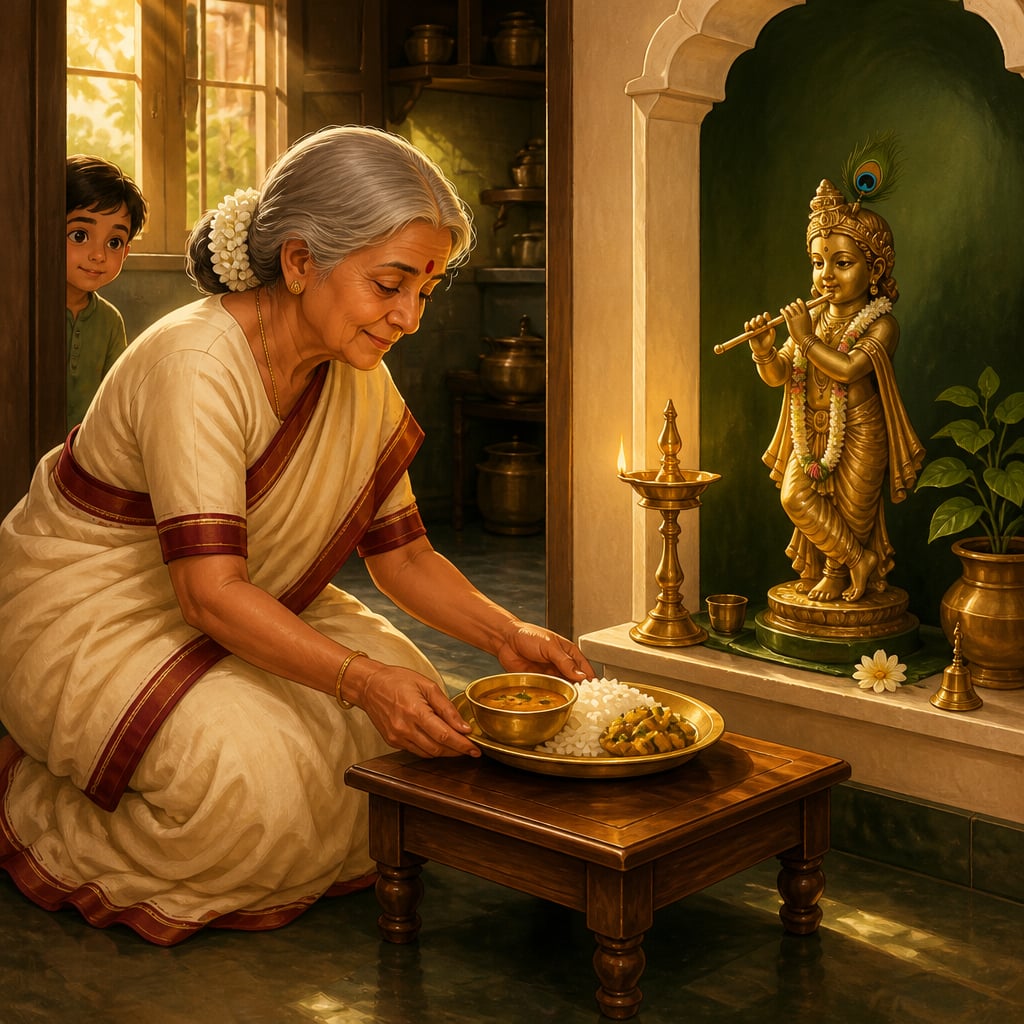
A small kitchen in Mylapore, Madras, on a Sunday afternoon in 1988. A woman of fifty-five has finished cooking. The lunch is laid out on the floor in front of the puja shelf in steel and brass: a mound of rice, a small cup of sambar, a curry of plantain, a piece of mango pickle, a banana, a glass of water. None of it has been touched. No one in the house has eaten yet, and no one will, until the plate at the puja shelf has been picked up by the deity and put down again.
She places the plate on a low wooden stool before the small brass Krishna. She closes her eyes. She rings a small bell three times. With her right hand she sprinkles a few drops of water around the plate. She folds her palms and recites a verse under her breath. The verse is twenty seconds long. She rings the bell once more, opens her eyes, and waits in silence for the count of one minute. Only then does she pick up the plate, carry it back to the kitchen, mix the rice and the sambar with what she has now begun to call prasadam, and call the family to eat.
Her grandson, eight years old, watches from the doorway with a hunger that has been waiting an hour. Twenty years later he will sit at a wellness retreat in California and be told to pause for thirty seconds in gratitude before eating. He will recognise it, and pay seventy dollars a year for the app that taught it to him. The verse his grandmother recited was free.
The Practice, Across India
Naivedya is the formal offering of food to the deity before any human eats. The word is from ni-vedayati, to make known, to present formally. The food becomes prasadam, that which has been received as grace, only after the offering is complete. Until that moment, even the cook does not taste what she has made. The discipline is not the cooking. The discipline is not eating until the plate has been offered.
The practice runs from the smallest household to the largest temple in the country, and the size of the operation does not change the unit. In a Tamil Brahmin home in Mylapore, the offering is one steel plate set on a low stool for a single brass image. In a Marwari home in Calcutta, the offering is a thali of seven items placed in front of a wooden cabinet that opens to reveal a small Shrinathji. In a Gaudiya Vaishnava temple kitchen in Vrindavan, the offering is a full chappan bhog, fifty-six items, laid out on banana leaves before Krishna.
The verse spoken changes by tradition. Vaishnavas in the south recite the Gita's brahmārpaṇaṃ brahma haviḥ. Smartas use a shorter Vaikhanasa Agama mantra. Shaktas in Bengal sing an Annapurna stotra. Lingayats touch the plate to the forehead before placing it before the ishtalinga at the neck. Pushtimarg Vaishnavas stage a full daily bhog with courses, fans, music, and a curtain that opens around the deity. The grammar is the same in every house. The food is offered, received, and shared.
The seating direction is also old. The eater sits facing east at lunch and facing north at dinner. The Manusmriti and the Apastamba Dharmasutra both prescribe the orientation. The Ayurvedic logic is solar: the rising sun is the source of prana, and the digestive fire of the body, jatharagni, aligns with the sun's energy at midday. The discipline survives as a small brass diya placed in the eastern corner of the traditional dining room.
The Scripture Says
The scriptural anchor sits in the third chapter of the Bhagavad Gita. Krishna lays out a strict frame for eating in five short verses. The most quoted is verse thirteen.
यज्ञशिष्टाशिनः सन्तो मुच्यन्ते सर्वकिल्बिषैः। भुञ्जते ते त्वघं पापा ये पचन्त्यात्मकारणात्॥
yajña-śiṣṭāśinaḥ santo mucyante sarva-kilbiṣaiḥ bhuñjate te tv aghaṃ pāpā ye pacanty ātma-kāraṇāt
The good, who eat what remains of the offering, are released from every wrong. Those who cook only for themselves eat only their own error.
Bhagavad Gita 3.13
The verse is one of the strongest in the Gita. Eating without offering is named as a moral failure, not a missed nicety. The cook who feeds only herself is, in Krishna's word, a thief. The cook who offers first becomes the household priest by the act of offering, regardless of caste, gender, or age.
Four chapters later, in chapter nine, Krishna lowers the bar to the floor. He names the smallest possible offering and accepts it on the same terms as the largest temple bhog.
पत्रं पुष्पं फलं तोयं यो मे भक्त्या प्रयच्छति। तदहं भक्त्युपहृतमश्नामि प्रयतात्मनः॥
patraṃ puṣpaṃ phalaṃ toyaṃ yo me bhaktyā prayacchati tad ahaṃ bhakty-upahṛtam aśnāmi prayatātmanaḥ
A leaf, a flower, a fruit, water. Whatever is offered with love by a pure heart, that I accept and eat.
Bhagavad Gita 9.26

A leaf, a flower, a fruit, a glass of water. The Gita lists the offering at the size of what any household can produce on its worst day. The bar is set so low that no income, no kitchen, and no festival is required.
The Taittiriya Upanishad, in the Bhrigu Valli, takes one more step and names food itself as the form the divine takes in the household.
अन्नं ब्रह्मेति व्यजानात्।
annaṃ brahmeti vyajānāt
He understood that food is brahman.
Taittiriya Upanishad, Bhrigu Valli, III.2
If food is brahman, then the cook is a priestess, the kitchen is a sanctuary, and the plate is an altar. The naivedya offering is not adding a religious gesture to a meal. It is making explicit what the kitchen already is.
The Symbolism
Three gestures run inside the two minutes the offering takes.
The bell rung at the start is the Vedic announcement. Sound is the oldest invitation in the dharmic frame. The same bell that opens a temple aarti opens the household offering. The grammar is identical at both scales.
The drops of water sprinkled around the plate are the parishechana, the ritual purification that frames the meal as sacrifice. The same water-circle is drawn around the homa fire before the offering of ghee. The plate becomes, for two minutes, a small homa kund.
The silent waiting after the verse is bhoga-samarpana, the period during which the deity is understood to receive. The food is not changed in chemistry. It is changed in standing. What was a plate of rice is now prasadam. The household has shifted the food from the column of consumption to the column of grace and is now eating the surplus left over by the deity.
Facing east closes the symbolism. The body is oriented to the source of the day's energy, the plate to the deity, the household to the cosmos. Three orientations, two minutes, one brass plate.
Why the Body Responds
The behavioural science of naivedya is precise. The cue is the laid-out plate. The routine is the bell, the water, the verse, the silent minute. The reward is the rice eaten as prasadam, marked in taste and memory as something the deity has touched. The cue, routine, and reward run on a fixed daily schedule that does not depend on the eater's mood.
The identity layer is stronger than the behavioural layer. Charles Duhigg in The Power of Habit and James Clear in Atomic Habits both argue that durable habits are not built around outcomes but around identity. The cook who offers naivedya every day is not a person trying to eat more mindfully. She is a person whose kitchen is a sanctuary. The identity is fixed by the daily act. The act is fixed by the identity. The loop closes at three years and never reopens.
The pre-meal pause also recruits the parasympathetic nervous system before the first bite. The sixty seconds of silent waiting drop the eater out of sympathetic arousal, the fight-or-flight state most office workers carry into lunch, and into the rest-and-digest state. The vagus nerve, which controls digestive secretion, fires only in the rest-and-digest state. The grandmother who waits in silence for one minute is priming her own vagus nerve before her first mouthful. The body that eats prasadam is a body whose digestive fire has already been lit.
The gratitude layer is older than the science. The Gita verse is, in the language of modern positive psychology, a daily gratitude practice with a specific recipient and a specific cadence. The daily recipient is the most stable form of gratitude. The cadence is the most stable form of practice.
What the Labs Found
The research catches up to the grandmother in three streams.
Emmons and McCullough, in the Journal of Personality and Social Psychology in 2003, ran the canonical experiment on daily gratitude practice. Subjects who wrote three things they were grateful for each day reported significantly higher well-being, lower stress markers, better sleep, and more frequent prosocial behaviour than the two control groups. The effect was strongest when the practice was paired with a fixed daily cue. The naivedya plate is the fixed daily cue. The verse is the gratitude expression. The Emmons and McCullough paper is, by accident, the laboratory write-up of what the grandmother in Mylapore was already doing.
Wansink and colleagues, in the journal Appetite in 2006, studied pre-meal practices across two thousand subjects and found that those who paused and prayed before eating reported twelve percent higher meal satisfaction and consumed roughly eight percent fewer calories per meal compared to controls. The mechanism, the authors argued, was a shift from mindless eating, which is governed by external cues like portion size and screen distraction, to mindful eating, which is governed by internal cues like satiety and pleasure. The naivedya pause is a pre-installed mindful-eating switch.
Kristeller and Wolever, in Eating Disorders in 2011, ran a randomised controlled trial of mindfulness-based eating awareness training and showed that a thirty-second pre-meal pause reduced binge episodes by sixty percent. The naivedya pause is two minutes. The clinical evidence covers the practice and then some.
The vagal-tone literature underwrites the digestion case. Porges and Fredrickson have shown across two decades that pre-meal calming practices raise heart-rate variability before eating and improve glycaemic response after. The grandmother's one-minute silence is a glucose-curve intervention.
What the World Calls It Now
The wellness market noticed in the late 2010s.
Headspace launched a "Mindful Eating" course in 2018 as a premium feature of its app. The instructions are explicit: pause before the first bite, take three slow breaths, name three things you are grateful for, eat the first bite slowly. The annual subscription is seventy dollars in the United States. The course is one of Headspace's most-completed mini-series.
Calm launched an "Eating Meditation" track in 2019 with the same instructions packaged in calmer voiceover. The price is seventy dollars a year. Calm reached a two billion dollar valuation in 2020, partly on the back of these short, daily, single-purpose meditations.
Insight Timer carries more than four hundred audio tracks under the search term "gratitude before meal". The Japanese pre-meal phrase itadakimasu, the Buddhist gatha, and the Christian grace are all cited in the app metadata. The Hindu naivedya is not. The Bhagavad Gita is not. The Jagannath Puri chhappan bhog is not. The Bhrigu Valli is not.
The wellness retreat circuit, from Esalen in California to the global Goop summits, now teaches a thirty-second pre-meal gratitude pause as a flagship technique. The price for the weekend at Esalen is roughly twelve hundred dollars. The ashram in Mayavati or the Iskcon kitchen in Vrindavan teaches the full two-minute version, with a verse, a bell, and a plate, for the price of the bus ticket.
The extraction is well underway. The names are gone. The frame is gone. The lineage is gone. The practice is selling.
What to Call It Yourself
From now on, the renaming is small and exact. When the wellness app says mindful eating, you say naivedya. When it says pre-meal gratitude pause, you say bhoga-samarpana. When it says blessed food, you say prasadam. When the magazine column on intuitive eating tells you to face the rising sun for breakfast, you smile and remember that the Apastamba Dharmasutra prescribed east-facing meals two and a half thousand years ago.
The practice itself is portable to the smallest kitchen. Cook the meal. Set aside a small portion on a clean plate. Place it in front of any image, any photograph, or any flame in the household. Ring a bell or clap softly three times. Sprinkle a few drops of water around the plate. Recite the patraṃ puṣpaṃ phalaṃ toyaṃ verse, or any verse from any tradition you carry. Wait one minute in silence. Mix the offered portion back into the meal. Eat facing east at lunch and north at dinner. Two minutes a day, every day, for fifty years. The kitchen becomes a sanctuary. The plate becomes an altar. The cook becomes a priestess.
Modern Echoes and the Receipts on the Other Side
The convergence is real. Emmons and McCullough 2003 vindicate the daily gratitude verse. Wansink 2006 vindicates the pre-meal pause and its eight-percent caloric effect. Kristeller and Wolever 2011 vindicate the binge-reduction power of the same pause. The Hindu kitchen has been running the protocol for at least three thousand years.
The market has noticed and packaged. Headspace and Calm together exceed five billion dollars in valuation. The mindful-eating segment of the wellness industry is now a billion-dollar category in its own right. Each number is a fragment of the naivedya plate extracted from its source and sold without attribution.

The largest demonstration of the original is in Puri, where the Jagannath Temple has run a fifty-six-item chhappan bhog since the twelfth century, with six hundred priest cooks on wood fires. The Mahaprasad is then distributed to everyone at the temple, free of charge. The continuity across nine hundred years and four kinds of regime change is one of the most documented unbroken liturgical-cooking traditions on earth, and the largest non-commercial mindful-eating program ever run.
Back in the small Mylapore kitchen, the grandmother has finished. The bell has been rung. The water has been sprinkled. The verse has been read. The minute has passed. The plate has been carried back. The grandson has been called. He sits down on the floor facing east, with his palms on the plate, and waits for her to begin. The plate that was rice is now prasadam. The kitchen that was a kitchen is now a sanctuary. The morning has been closed by the tulasi, the dhoop, and the verse. The afternoon is now closed by the naivedya. The day, by the time the family sits down to eat, has already been offered.
Case studies
Jagannath Puri's Chhappan Bhog: 56 Items a Day for 900 Years
The Jagannath Temple in Puri, Odisha, runs the largest unbroken naivedya operation on earth. Since the temple's completion under Anantavarman Chodaganga Deva of the Eastern Ganga dynasty in the 12th century CE, the deity has received fifty-six daily food offerings, the Chhappan Bhog, prepared by approximately six hundred priest cooks on wood fires in earthen pots. The kitchen, called the Anand Bazaar, is the largest temple kitchen in the world. Every item is cooked daily from scratch, in seven stacked earthen pots over a single fire, in a system that has not been mechanised in nine centuries. After the offering, the food becomes Mahaprasad and is distributed to whoever is present at the temple, including the poorest pilgrims and the highest royalty, on the same terms, free of charge. The continuity of the operation has survived the Afghan incursions of the 16th century, the colonial period under the British, the modern Odisha temple board administration, and four major famines.
The Chhappan Bhog is the institutional version of what the Bhagavad Gita 3.13 names as the household discipline. The verse says the good eat what remains of the offering. The Puri kitchen turns that verse into a daily public infrastructure that has fed pilgrims, kings, and the destitute on the same terms for nine hundred years. Naivedya is not a personal mindfulness exercise. It is, at its largest scale, a social-economic system that converts the surplus of agriculture into a sacrament shared across class, caste, and origin.
The Chhappan Bhog is one of the most documented unbroken liturgical-cooking traditions on earth. The Anand Bazaar kitchen produces enough food for between 25,000 and 100,000 people on a normal day and over a million people on Snana Yatra and Ratha Yatra festival days. The Mahaprasad distribution system is the longest-running free public-kitchen in human history, operated by a single institution, by orders of magnitude.
Naivedya at scale is not religious decoration. It is a tested civilizational technology for converting agricultural surplus into shared sacrament. The single-plate offering in a Mylapore kitchen and the fifty-six-item Chhappan Bhog at Puri are running the same protocol with different inputs. The protocol has held across nine hundred years and four kinds of regime change. No private restaurant chain, no government meal program, and no philanthropic foundation in human history has matched its continuity.
The Jagannath Temple's Anand Bazaar kitchen serves between 25,000 and 100,000 people a day on normal days and up to 1.2 million on festival days, free of charge, on the same terms for everyone, since c. 1135 CE.
Headspace and Calm: Mindful Eating at $70 a Year
Headspace, the meditation app valued at three billion dollars, launched a 'Mindful Eating' course in 2018 as a premium feature. The course instructs subscribers to pause before the first bite, take three slow breaths, name three things they are grateful for, and eat the first bite slowly. Calm, the meditation app valued at two billion dollars, launched 'Eating Meditation' in 2019 with the same protocol. Both are priced at seventy dollars per year. Insight Timer, with over twenty million users, carries more than four hundred audio tracks under 'gratitude before meal'. The app metadata cites Japanese itadakimasu, the Buddhist gatha, and the Christian grace. The Hindu naivedya, the Bhagavad Gita 3.13, the Taittiriya Upanishad's annaṃ brahma, and the Puri Chhappan Bhog are not cited.
The Bhagavad Gita 9.26 states that a leaf, a flower, a fruit, or a glass of water offered with love is enough. The bar is set deliberately at the floor of household income, free for the poorest cook, and the same terms apply to a king. The wellness app version takes the same protocol, removes the recipient and the verse, charges seventy dollars a year, and calls it innovation. The clinical effect on satiety, satisfaction, and digestion is real. The lineage is missing.
The mindful-eating segment of the wellness market is now valued at over a billion dollars in the United States alone. Headspace and Calm have a combined valuation of five billion dollars and over one hundred million subscribers. The naivedya practice they have, in effect, repackaged is performed daily by several hundred million Indian households at zero subscription cost.
When indigenous knowledge is monetised abroad without attribution, the dharmic answer is articulation, not anger. Subscribe to Calm if it helps you start. The graduation point is the day you set down a plate in front of any image at home, ring a bell three times, say a verse, wait one minute, and call the food prasadam. The annual savings are seventy dollars. The practice depth, after thirty days, is unbridgeable.
Headspace 'Mindful Eating' and Calm 'Eating Meditation' are priced at $70 per year each. Mahaprasad at the Puri Anand Bazaar costs ₹0 to anyone present at the temple, in a daily system running since the 12th century.
Emmons, McCullough, and Wansink: The Lab Catches the Grandmother
Emmons and McCullough, in the Journal of Personality and Social Psychology in 2003, ran the canonical experiment on daily gratitude practice. Subjects who recorded three things they were grateful for each day, paired with a fixed daily cue, reported significantly higher subjective well-being, lower stress markers, better sleep, and more frequent prosocial behaviour than two control groups. Three years later, Wansink, Cheney, and Chan, in the journal Appetite in 2006, studied two thousand subjects across pre-meal practices and found that those who paused and prayed before eating reported twelve percent higher meal satisfaction and consumed roughly eight percent fewer calories per meal compared to controls. Kristeller and Wolever, in Eating Disorders in 2011, ran a randomised controlled trial showing that a thirty-second pre-meal pause reduced binge episodes by sixty percent. None of the three papers cite the Bhagavad Gita, the Apastamba Grihya Sutra, or the Hindu household practice.
The Bhagavad Gita 3.13 prescribed the practice three thousand years ago and called the alternative a moral failure. The Apastamba Grihya Sutra named the daily household meal a yajna, complete with bell, water-circle, verse, and silent pause. The Hindu household ran the protocol every day for several hundred million practitioners across four millennia, on a fixed daily cue, in a parasympathetic state, with a specific recipient for the gratitude. The papers describe the protocol as if discovering it in a Stanford lab. The continuity of the household practice is the largest natural experiment on earth.
The research base for pre-meal pause practices is now extensive. Daily gratitude practice is one of the best-documented interventions in positive psychology, with effect sizes that are larger and more replicable than most pharmaceutical interventions for mild depression. The mindful-eating protocol is now a recommended adjunct in clinical guidelines for binge eating, type 2 diabetes management, and stress-related digestive disorders.
When the labs vindicate a household practice, the right response is not surprise. It is recognition. The grandmother in Mylapore did not need Wansink to confirm the eight-percent caloric effect or Emmons to confirm the gratitude-and-sleep correlation. She had the verse, the bell, the plate, and fifty years of daily evidence. The journals catching up are welcome, and they make the case to a generation that trusts the journal more than it trusts the grandmother. The practice is the same in both directions.
Emmons and McCullough 2003: significantly higher well-being and prosocial behaviour from daily gratitude, JPSP. Wansink et al 2006: twelve percent higher satisfaction, eight percent lower calories from pre-meal prayer, Appetite. Kristeller and Wolever 2011: sixty percent fewer binge episodes from a thirty-second pre-meal pause, Eating Disorders.
Historical context
From the Taittiriya Upanishad's annaṃ brahma teaching (c. 700-500 BCE) and the Bhagavad Gita's offering verses (c. 400 BCE to 200 CE), through the establishment of the Jagannath Puri Chhappan Bhog (12th c. CE) and the Pushtimarg eight-bhog protocol (16th c. CE), to the present.
Naivedya is the household-scale version of the Vedic yajna. The Apastamba and Baudhayana Grihya Sutras name the daily meal as the householder's yajna, with the cook as priestess and the plate as homa kund. The same protocol scales upward, by orders of magnitude, to the Jagannath Puri Chhappan Bhog. The two ends of the spectrum, the single steel plate in a Mylapore kitchen and the fifty-six-item temple offering at Puri, share the same grammar. The continuity of the practice across four thousand years and across every regional, sectarian, and economic context inside Bharat is itself the proof that the system works.
Living traditions
The mindful-eating segment of the global wellness industry is now over a billion dollars a year. Headspace and Calm have a combined valuation of five billion dollars on the back of a daily two-minute pre-meal pause. The naivedya household practice that they have, in effect, repackaged runs free of cost in several hundred million Indian kitchens. Re-Sanskritize: when the wellness app says mindful eating, you say naivedya. When it says pre-meal gratitude pause, you say bhoga-samarpana. When it says blessed food, you say prasadam. When the magazine column says intuitive east-facing breakfast, you say the Apastamba Dharmasutra prescribed it two and a half thousand years ago. Use the names at home, in your shopping, in your speech. Names carry meaning. Meaning carries lineage.
- Jagannath Temple, Puri: The largest temple kitchen in the world. The Anand Bazaar produces the daily Chhappan Bhog of fifty-six items in seven stacked earthen pots over wood fires. Mahaprasad distribution begins shortly after the noon offering and continues through the afternoon. Visit during the morning Mangala Aarti and follow the cooking through to the noon naivedya to see the full operation.
- Shrinathji Temple, Nathdwara: The flagship Pushtimarg shrine, founded by the Vallabhacharya tradition in the 17th century. The eight daily bhogas are presented to Shrinathji behind a curtain that opens and closes at fixed hours. Visit during Rajbhog (around noon) to see the full naivedya protocol with music, fans, and the curtain ritual. The Annakut festival the day after Diwali is the most concentrated naivedya event in the Pushtimarg year.
- Iskcon Annamrita Kitchen, Mumbai: The flagship kitchen of the Annamrita mid-day-meal program, which delivers prasadam to over 1.2 million Indian schoolchildren a day across thirteen Indian states. The kitchen is one of the largest naivedya operations in the world by daily-meal output and represents the modern industrial scaling of the Bhagavad Gita 9.26 protocol.
Reflection
- Of your three meals tomorrow, which one would be the easiest to install a two-minute naivedya pause in front of, and what is the smallest version, by the Bhagavad Gita 9.26 standard, that you can run on day one?
- Why might the Bhagavad Gita 3.13 frame the cook who feeds only herself as a thief, rather than as a person who has merely failed to be polite?
- If a Headspace 'Mindful Eating' subscriber and a Mylapore grandmother both pause for two minutes before lunch and recite a line of gratitude, in what sense are the two practices the same and in what sense are they different?