Prasāda: Restoring Mental Clarity

How the Mind Returns to Light

Exploring prasāda, the grace of clarity that returns when conditions are right. The Rishis understood that mental restoration follows patterns as reliable as the seasons. This lesson examines the technologies of restoration: rest, simplification, practice, and the paradox of receiving what effort cannot produce.

The winter had been long. Not in the lands, though snow still covered the peaks, but in the mind. The old Rishi had experienced it before: months when the mantras felt hollow, when meditation produced nothing, when the inner light seemed permanently dimmed.

But this morning, something had shifted. He woke before dawn as always, but instead of the familiar fog, there was space. The verses came easily. The flame of the morning fire seemed brighter than it had in months. He hadn't done anything different. Yet the clarity had returned, as surely as spring returns after winter.
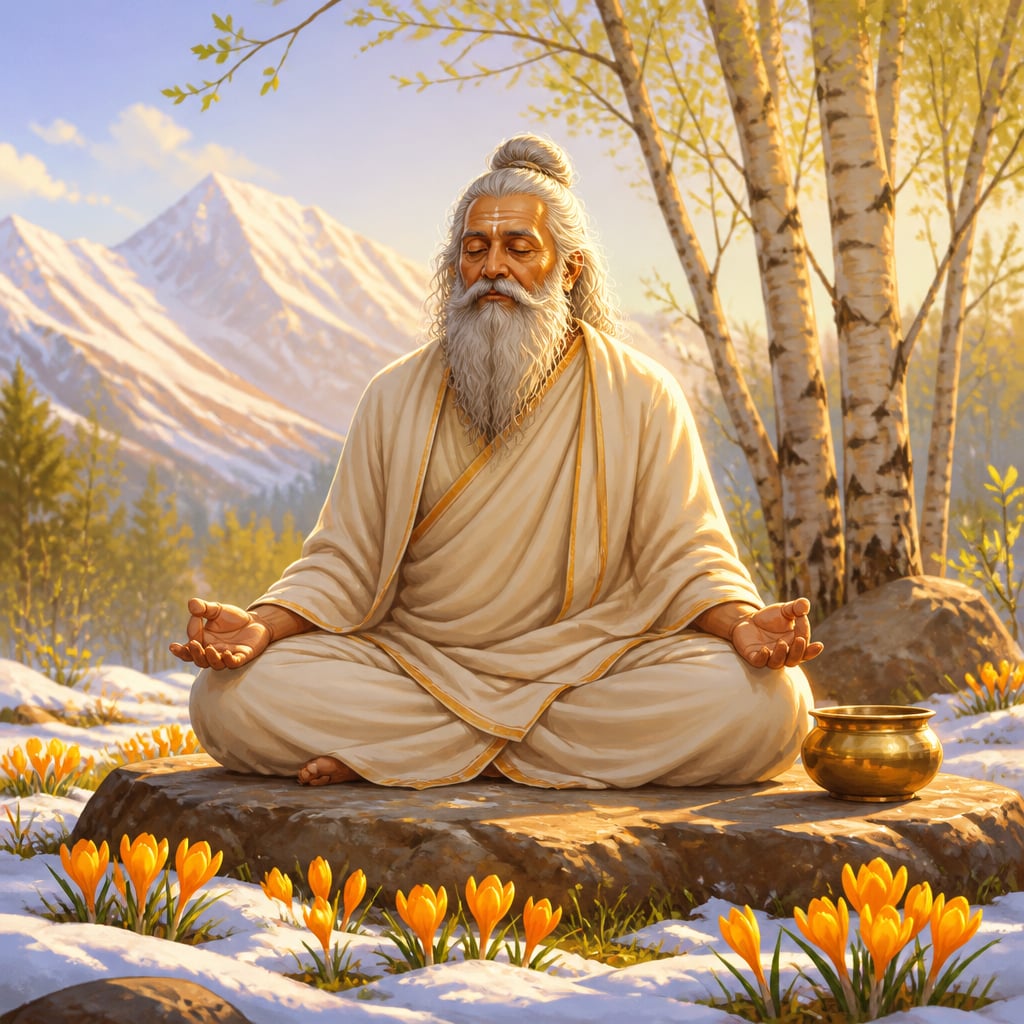
Old forest Rishi in meditation as spring grace returns to the clearing

His student, who had watched him struggle through those dark months, asked the question: "What did you do? How did it come back?"

The Rishi smiled. "I did not bring it back. I stopped preventing its return. Clarity is the natural state. Our job is not to create it but to remove what blocks it, and then to wait. The mind has its seasons, and spring always comes."

Prasāda: The Grace of Clarity

We live in a culture that valorizes constant effort and pathologizes rest. The Vedic understanding of prasāda offers essential correction: restoration is not weakness but wisdom, not inefficiency but necessity. In an age of burnout, the technologies of restoration, rest, simplification, rhythm, nature, practice, surrender, are not luxuries but survival skills. The Rishis' balanced approach to effort and receptivity addresses one of our time's most pressing needs.

The Sanskrit word prasāda means grace, clarity, serenity, and blessing, all at once. It comes from the root sad (to sit) with the prefix pra (forth), suggesting something that 'settles forth' or 'comes to rest.' Prasāda is what happens when the mind's agitation subsides and clarity naturally emerges.

The Rig Veda speaks of this restoration:

"ā no bhadrāḥ kratavo yantu viśvataḥ" "May good thoughts come to us from all sides."

This isn't a request for thoughts to be created but for them to come, to arrive when conditions allow. The Rishis understood that certain mental states can be cultivated but not forced. Clarity is one of them.

This is a profound psychological insight: we cannot manufacture clarity through effort alone. We can create conditions for its emergence, but the emergence itself is received, not achieved. This is why the tradition calls it prasāda, a term that also means 'divine gift.'

A forest hillside turning from winter into spring

The Seasonal Mind

The Rishis observed that consciousness has seasons, periods of light and darkness, clarity and confusion, productivity and fallow rest. Just as winter is not a failure of the earth but a necessary phase of renewal, mental darkness is not personal failure but part of consciousness's natural cycle.

This observation liberated them from a common trap: believing that darkness should never happen, and fighting it when it does. Fighting winter doesn't bring spring faster; it exhausts you for when spring arrives.

The metaphor extends further. Spring doesn't come because we do something. It comes because we allow natural processes to unfold. The ground warms, the ice melts, the seeds germinate, all on their own schedule. Our job is not to force spring but to be ready when it arrives.

Similarly, mental clarity often returns not through effort but through the removal of what blocks it. The Rishis developed specific practices for this removal, and specific practices for waiting.

The Technologies of Restoration

The tradition identifies several approaches to restoring clarity:

Rest (Viśrama): Perhaps the most undervalued restoration technology. When the mind is exhausted, no amount of technique restores clarity, only rest does. The Rishis built rest into their daily rhythm (sandhyā practices, afternoon rest) and yearly cycle (seasonal retreats). Modern research confirms: sleep is the primary restorer of cognitive function.

Simplification (Sādhanā): Complexity exhausts the mind. The Rishis lived simply not as ascetic denial but as psychological hygiene. Reducing inputs, commitments, and stimuli creates space for clarity to return. This is why retreats work, they simplify.

Rhythm (Ṛta): Regular patterns support mental stability. The Vedic emphasis on ritual at specific times wasn't superstition but recognition that irregular life creates an irregular mind. Consistent sleep, meals, and practice times help restore and maintain clarity.

Nature (Prakṛti): Time in natural environments consistently restores cognitive function. The Rishis lived close to rivers, forests, and mountains, not escaping society but recognizing that nature's rhythms help restore the mind's rhythms.

Practice (Abhyāsa): Not intense effort but consistent, gentle return. The practice of meditation, mantra, or contemplation maintained even through dark periods creates the conditions for clarity's return. We practice not to force clarity but to be ready for it.

Surrender (Śaraṇāgati): The recognition that we cannot manufacture clarity but can receive it. This isn't passive resignation but active receptivity, doing what we can, then releasing attachment to results.

Traditional Wisdom on Restoration

The Yoga Sūtra addresses this directly:

"citta-prasādanaṃ" "The clarification of the mind."

Patañjali uses prasādana, making clear, making serene, as a technical term for mental restoration. He lists specific practices that support this clarification: cultivating friendliness, compassion, joy, and equanimity; breathing practices; focusing on inner light; contemplating realized beings.

Notice what's not on the list: forcing clarity, fighting confusion, or criticizing yourself for mental darkness. The approach is always cultivation and receptivity, never force.

The Bhagavad Gita echoes this:

"prasāde sarva-duḥkhānāṃ hānir asyopajāyate" "With clarity (prasāda), there arises the destruction of all sorrows."

The word 'arises' (upajāyate) is significant, sorrows don't end because we destroy them but because clarity arises and they naturally dissolve in that light. The approach is not to attack darkness but to invite light.

The Paradox of Effort

The Rishis recognized a paradox: effort is necessary, but effort alone cannot produce clarity. We must practice, but practice doesn't guarantee results. We must create conditions, but conditions don't force outcomes.

This is the meaning of prasāda as 'grace.' We do our part (puruṣārtha), but the fruit comes in its own time (daiva). The farmer plants, waters, and tends, but cannot make the crop grow. Growth happens when conditions are right.

This understanding prevents two common errors:

The Error of Passivity: Believing that since clarity is grace, we should do nothing. This ignores our responsibility to create conditions. The farmer who doesn't plant gets no harvest.

The Error of Force: Believing that more effort produces more clarity. This ignores the nature of consciousness. The farmer who yanks on sprouts doesn't speed growth, she destroys the plants.

The middle way: persistent effort held lightly. We practice daily, maintain discipline, create conditions, but without gripping for results. This combination of effort and surrender is the key to restoration.

Living This Today

Sleeping figure beneath moonlight and patient stars

Matthew Walker, neuroscientist at UC Berkeley and author of Why We Sleep, has spent decades studying sleep's role in cognitive function. His research reveals something the Rishis would recognize: sleep is not merely rest but active restoration.

During sleep, the brain literally cleans itself. The glymphatic system flushes out metabolic waste accumulated during waking hours. Sleep consolidates learning, processes emotional experiences, and restores the prefrontal cortex's capacity for clear thinking. Without adequate sleep, cognitive function degrades measurably, decision-making suffers, emotional regulation deteriorates, and the capacity for insight diminishes.

Walker's research shows that no amount of caffeine, willpower, or motivation can substitute for sleep. You cannot think your way to clarity if the brain hasn't been restored. This confirms the Vedic insight: certain restoration requires receptivity, not effort. Sleep is the original prasāda, grace that comes when we surrender to the natural cycle of rest.

The implications are profound for our always-on culture. We've built economies that war against sleep, treating rest as weakness rather than restoration. Walker's research suggests this is not just unhealthy but cognitively counterproductive. We're degrading the very clarity we need for our most important work.

Your Restoration Practice

The Rishi whose clarity returned with spring had not been idle during winter. He maintained his practices, not intensely, but consistently. He simplified his commitments. He rested more. He spent time by the river. He surrendered his attachment to when clarity would return.

When it came, he was ready, not because he had forced it but because he had prepared the ground.

This is the practice of prasāda: create conditions, maintain practice, simplify life, rest adequately, and release attachment to timing. Clarity returns not on our schedule but on its own. Our job is to be ready when it arrives.

The tradition offers a reassurance: spring always comes. The mind, like the earth, has remarkable restorative capacity. Darkness is temporary. Confusion is temporary. The light that seems lost is only obscured, it remains, waiting for conditions that allow its return.

If you're in a period of mental winter, the Rishis' counsel is: don't fight it. Create conditions for restoration. Maintain practice without forcing results. Simplify. Rest. Wait with patience and without blame. And trust, because the trust itself creates conditions for what you're waiting for.

Clarity is your nature. What blocks it is temporary. Prasāda is available to everyone willing to prepare for its arrival and patient enough to wait.

Research on incubation periods shows that stepping away from problems often produces solutions that direct effort couldn't achieve. The mind continues processing unconsciously, and insight 'arrives' when conditions allow. This is cognitive prasāda.

The most innovative organizations build in restoration time, sabbaticals, thinking days, protected creative periods. Google's famous '20% time' recognized that breakthrough ideas can't be scheduled but can be made more likely through conditions that support their emergence.

Systems under continuous stress lose resilience. Restoration periods, organizational retreats, post-project breaks, seasonal slowdowns, aren't luxuries but necessities for sustainable function. Systems need prasāda too.

Matthew Walker's sleep research shows that sleep isn't passive but active restoration. The brain clears metabolic waste, consolidates memory, and repairs. This isn't doing nothing, it's doing the most important cognitive maintenance possible.

Leaders who model rest give permission for restoration throughout organizations. The always-on leader creates always-on cultures that burn out. Demonstrating that rest is not weakness but wisdom transforms organizational health.

Agricultural systems that never rest, continuous cropping, no fallow periods, eventually fail. The Vedic insight about rest applies to all living systems: periods of non-production are essential for sustained production.

Case studies

Matthew Walker: The Science of Sleep as Prasāda

Matthew Walker spent years wondering why we sleep, a state that seems to offer only disadvantages for survival. His research at UC Berkeley revealed the answer: sleep is active restoration. During sleep, the glymphatic system flushes metabolic waste from the brain; memory consolidation transfers learning from short to long-term storage; emotional processing integrates the day's experiences; and the prefrontal cortex is restored for clear thinking. His book *Why We Sleep* (2017) documented something striking: we cannot substitute for sleep. No drug, stimulant, or willpower compensates for sleep deprivation. Clarity requires rest as surely as hunger requires food.

Walker's research is scientific confirmation of prasāda. Sleep is grace, it restores what effort depletes, and it cannot be forced or bypassed. The brain's self-cleaning during sleep is physical prasāda: restoration that happens when we stop efforting and allow natural processes. His finding that we cannot substitute for sleep, that rest itself is necessary, confirms the Vedic understanding that certain things must be received, not achieved.

Walker's research has influenced health policy, business practices, and individual behavior. Organizations have begun taking sleep seriously as performance optimization. Athletes now protect sleep as seriously as training. The insight that restoration cannot be skipped or shortcut has begun reshaping how we think about productivity itself.

Sleep is the original prasāda, grace that comes when we surrender to natural rhythm. The Rishis' emphasis on rest, built into daily and seasonal cycles, anticipated what science now confirms: restoration is not optional, and it cannot be forced. Clarity requires periods of non-effort.

Sleep deprivation costs the global economy over $400 billion annually in lost productivity, yet hustle culture continues to glorify 4-hour sleep schedules. Walker's research confirms what the Vedic tradition embedded in daily rhythms: rest is not wasted time but the process through which the mind consolidates learning, repairs itself, and prepares for clarity. Protecting sleep is protecting cognitive performance.

Walker's research shows that after 17-19 hours without sleep, cognitive impairment equals that of being legally drunk. We cannot think our way around the need for rest.

Sri Aurobindo: From Revolutionary Confusion to Integral Clarity

By 1908, Aurobindo Ghose was India's most wanted revolutionary. A Cambridge-educated intellectual, he had thrown himself into the independence struggle with intensity that led to arrest and trial for sedition. Facing possible execution, he was held in Alipore Jail for a year. In that forced pause, something transformed. He began meditating intensely, experiencing what he would later describe as a complete restructuring of consciousness. When acquitted in 1909, he was no longer the same person. Within a year, he withdrew from politics entirely, moving to Pondicherry where he spent the remaining four decades of his life developing what he called Integral Yoga, a synthesis of clarity that exceeded anything his revolutionary period could have produced.

Aurobindo's transformation illustrates prasāda through forced simplification. The jail stripped away all his usual activities, creating conditions where something deeper could emerge. His revolutionary intensity, pure puruṣārtha (self-effort), had produced results but also confusion. The year of enforced rest allowed prasāda: a clarity that effort couldn't produce but that conditions made possible. His subsequent work, *The Life Divine* and *Savitri*, became some of the most profound expressions of Vedic wisdom in modern times, impossible without that period of restoration.

Aurobindo's integral vision influenced not just spirituality but education, psychology, and Indian nationalism. His ashram in Pondicherry became a living laboratory for his teachings. His interpretation of the Rig Veda (in *The Secret of the Veda*) revealed psychological depths that academic scholars had missed. None of this was possible from his revolutionary mode, it required the restoration that transformed confusion into integral clarity.

Sometimes life forces the simplification we wouldn't choose. Aurobindo's jail time wasn't planned retreat, it was imposed. Yet he used it for restoration. His story suggests that periods of restriction, if approached rightly, can become periods of prasāda. The revolutionary became the sage not despite the pause but because of it.

Forced career breaks, whether from layoffs, health crises, or burnout, are often experienced as disasters. Aurobindo's example reframes involuntary pauses as potential turning points. Many successful entrepreneurs, artists, and leaders trace their biggest breakthroughs to periods of imposed stillness that they did not choose but learned to use.

Aurobindo spent approximately 40 years in Pondicherry after his prison experience, producing over 30 volumes of philosophical and literary works that synthesized Vedic psychology with evolutionary theory.

Reflection

More in Prakāśa: Clarity, Confusion & Perception

All lessons in Prakāśa: Clarity, Confusion & Perception · Rig Vedic Psychology course