Prakāśa: Light and Darkness as Mental States

Why the Rishis Used Dawn and Night to Map the Mind

Exploring the Vedic understanding of prakāśa (light/clarity) and tamas (darkness/obscurity) as fundamental qualities of consciousness. The Rishis mapped the mind through the metaphor of dawn and night, not poetic fancy, but precise psychological observation.

"Guru-ji, why does my mind sometimes feel like a clear sky at dawn, and other mornings like a moonless night?"

The student had asked the question that would occupy him for years. He had noticed it first during his studies, some days the mantras flowed effortlessly, their meanings crystallizing like dew on grass. Other days, the same verses felt like stones in his mouth, their significance obscured.

The old teacher smiled. He had been waiting for this question. "You have noticed something the Rishis noticed thousands of years ago. The mind has its own sun and its own night. Learning to work with this, that is the beginning of wisdom."
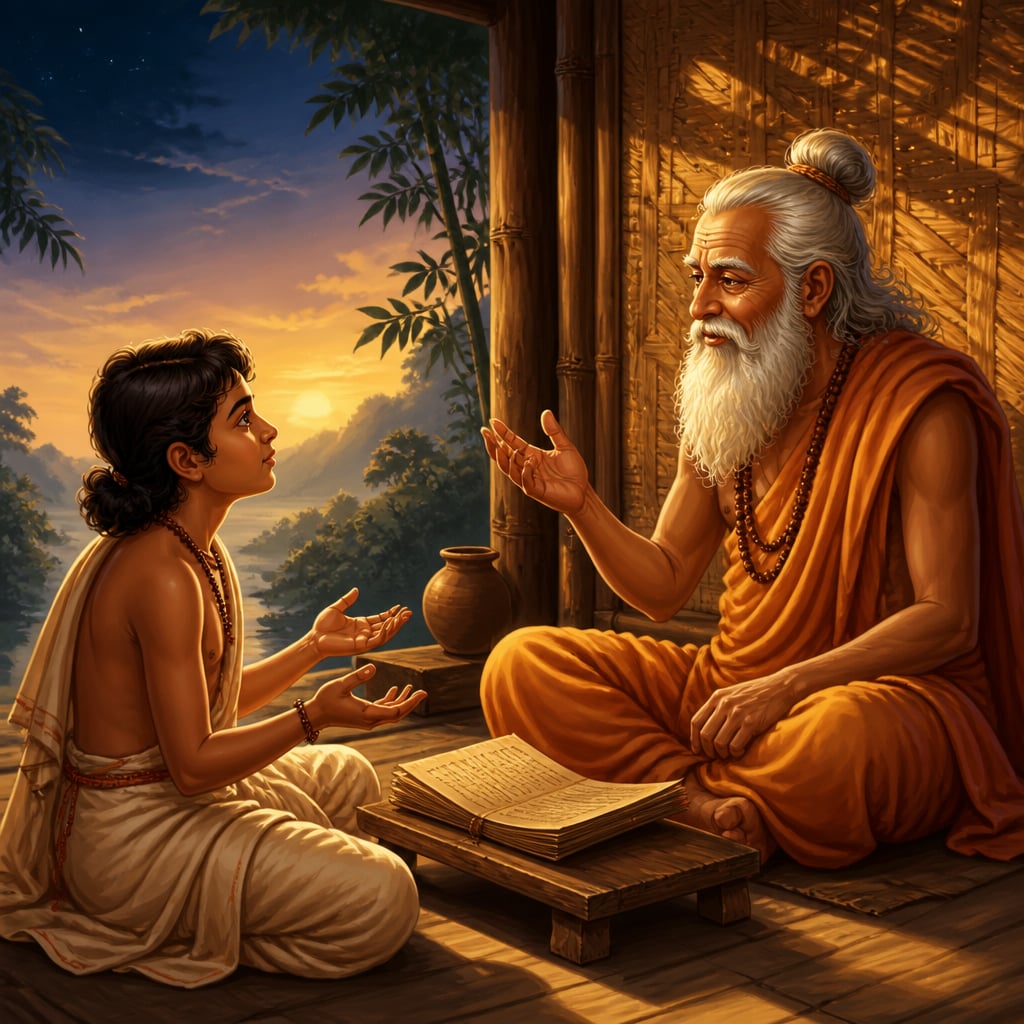
Vedic student and his guru at dawn discussing the mind's light and darkness

The Vedic Psychology of Light

Understanding prakāśa and tamas as natural states of consciousness, not moral judgments, transforms how we relate to our own mental life. The Rishis' insight that clarity can be cultivated and darkness doesn't define us is as relevant for managing modern attention challenges as it was for ancient seekers. Their psychology of light offers practical wisdom for anyone struggling with mental fog, distraction, or the inability to think clearly.

The Rishis were careful observers of consciousness. Living close to nature, rising before dawn for rituals, they watched the transition from darkness to light daily, and recognized it as a mirror of the mind's own states.

Prakāśa, from the root pra (forth) and kāś (to shine), meant more than physical light. It referred to the quality of consciousness when things become visible, when understanding dawns, when confusion lifts. Sri Aurobindo, in The Secret of the Veda, interprets the Vedic dawn goddess Uṣas as representing exactly this: the psychological illumination that makes knowledge possible.

The opposite state they called tamas, derived from tam (to be exhausted, to choke). Tamas wasn't simply ignorance; it was the quality of consciousness when things become invisible, when the mind feels heavy, when even familiar truths seem obscured.

As the Rig Veda declares:

"tamaso mā jyotir gamaya" "Lead me from darkness to light."

This wasn't a prayer about physical blindness. It was a recognition that the mind itself moves between states of clarity and obscurity, and that this movement can be understood, and influenced.

The Dawn Within: Uṣas and Mental Clarity

Ushas opening the cosmic doors of dawn

The Rishis dedicated over twenty hymns to Uṣas, the Dawn. Sayana's commentary reveals they saw in the daily sunrise something more than astronomy. When the hymns say:

"uṣā uchad vi duro na āvaḥ" "Dawn has opened the doors like a house."

They meant the mind itself. Just as dawn opens the world to visibility, mental clarity opens understanding to us. The "doors" are the gates of perception and comprehension that tamas keeps shut.

But here is the crucial insight: the Rishis noticed that this clarity wasn't constant. Even the brightest minds experienced periodic darkness. Even the most realized seers had moments when understanding dimmed. This wasn't failure, it was the nature of consciousness itself, moving through cycles like the sky moves through day and night.

This observation freed them from a common trap: believing that confusion is a personal defect rather than a natural state that comes and goes.

Traditional Wisdom: Seeing in the Dark

Sayana, the great 14th-century commentator, interprets the light-darkness imagery throughout the Rig Veda as referring to jñāna (knowledge) and ajñāna (ignorance). But he's careful to note that these aren't permanent conditions. A person in tamas can move toward prakāśa; a person in clarity can slip into confusion. The movement is constant.

Sri Aurobindo takes this further. In his reading, the Vedic battle between light and darkness, Indra fighting the demons who withhold the light, is essentially psychological. The forces of obscuration (Vṛtra, Vala) are aspects of our own consciousness that block clarity. Indra's victory is the breakthrough moment when understanding dawns.

This means every human being carries both the darkness and the light. The question isn't whether you have tamas, everyone does. The question is whether you can recognize it, work with it, and find your way back to clarity.

Living This Today

A modern scholar in deep work at his desk

Cal Newport, the Georgetown professor and author of Deep Work, has spent years studying what allows people to produce their best cognitive work. His research consistently shows that clarity of mind isn't random, it's cultivated through specific conditions: uninterrupted time, freedom from distraction, and most importantly, what he calls "attention residue" management.

When you switch between tasks, Newport found, part of your attention remains stuck on the previous task. This creates exactly what the Rishis called tamas, a fog that obscures clear thinking. His prescription? Extended periods of single-focus work, which he argues restores the mind to what Vedic psychology would call prakāśa.

The parallel is striking. Newport discovered through modern research what the Rishis knew through observation: mental clarity is a condition that can be created or destroyed through how we use our minds. The dawn doesn't happen by accident, certain conditions must be met. The same is true for mental clarity.

Consider your own experience. When do you feel mentally clear? Probably after rest, after focused work, after stepping away from scattered attention. When do you feel foggy? After constant interruption, after sleep deprivation, after trying to do too many things at once. The pattern isn't mysterious, it's prakāśa and tamas, playing out in your daily life.

The Practice of Dawn

The Rishis didn't just observe these states, they developed practices to cultivate clarity. The pre-dawn rituals (Brahma muhūrta practices) weren't arbitrary tradition. They recognized that the transition from night to day offered a window when the mind could more easily shift from tamas to prakāśa.

But more than timing, they emphasized attention itself as the source of light. Where you place your attention determines whether the mind brightens or dims. Scattered attention creates fog; focused attention creates clarity. This is why the Vedic practices, mantra recitation, fire offerings, meditation, all share one thing: they gather and focus attention.

You don't need to become a Vedic priest to use this insight. Notice when your mind feels clear and when it feels foggy. Notice what precedes each state. Begin to treat clarity not as luck but as something you can cultivate, and confusion not as failure but as a passing weather pattern in the sky of your mind.

The student who asked his guru about the clear and foggy mornings eventually became a teacher himself. Years later, he would tell his own students: "The darkness is not your enemy. It is the canvas on which the light becomes visible. Learn to recognize both, and you become free of both."

Cal Newport's research on 'deep work' shows that cognitive clarity requires extended periods of uninterrupted focus. His concept of 'attention residue', mental fog from task-switching, maps precisely to tamas caused by scattered attention.

Leaders who protect their team's focus time report higher quality decisions. Microsoft Japan's experiment with 4-day workweeks showed 40% productivity gains, less time, but more prakāśa.

Organizations have collective tamas, the confusion that comes from too many meetings, initiatives, and distractions. Clarity emerges when leaders remove unnecessary complexity, not add more.

Research on 'cognitive load' shows that decision fatigue creates mental fog. The solution isn't to fight through it but to recognize it and reduce load, the Vedic approach of accepting tamas and creating conditions for prakāśa.

Leaders who acknowledge when they're not thinking clearly make better decisions than those who push through fog. Saying 'I need to sleep on this' respects the reality of tamas.

Complex problems often can't be solved when first encountered. The mind needs time to process unconsciously. Incubation periods, letting problems sit, often produce clarity that forcing cannot.

Case studies

Cal Newport: Rediscovering Vedic Attention in the Digital Age

By 2012, Cal Newport noticed something troubling. His students at Georgetown were intelligent but seemed unable to think deeply. They could process information rapidly but couldn't sustain focus on hard problems. He began researching what he would call 'deep work', the ability to focus without distraction on cognitively demanding tasks. His findings were striking: the ability to concentrate deeply was becoming increasingly rare exactly as it was becoming increasingly valuable. The knowledge economy demands clarity, yet digital environments systematically destroy the conditions for it.

Newport had rediscovered what the Rishis knew: prakāśa requires specific conditions. Constant interruption, whether from smartphones or from ancient tribal distractions, creates tamas. His prescription of extended single-task focus mirrors the Vedic emphasis on ekāgratā (one-pointedness). The Rishis structured their days around protecting attention; Newport argues modern knowledge workers must do the same or lose access to their highest cognitive capacities.

Newport's books *Deep Work* (2016) and *A World Without Email* (2021) became influential in business and education. Companies like Basecamp restructured communication to protect deep work time. Individuals reported dramatic improvements in both productivity and satisfaction by applying his principles. His work demonstrates that the Vedic understanding of prakāśa and tamas isn't ancient philosophy, it's practical psychology that works in 2025.

Mental clarity is not random or genetic, it's created by conditions. The Rishis knew this millennia ago; modern research confirms it. Protect the conditions for prakāśa, and clarity becomes reliable rather than accidental.

The average professional now spends 2.5 hours per day on email and another 2 hours in meetings, leaving barely 3 hours for focused work. Newport's 'deep work' framework is essentially a modern restoration manual for the Vedic clarity the Rishis cultivated. Anyone who protects even one hour of uninterrupted focus daily will outperform peers who spend entire days in shallow multitasking.

Newport cites research showing it takes an average of 23 minutes to return to full focus after an interruption, quantifying how easily tamas is created through scattered attention.

Yajnavalkya's Light: The Dialogue That Defined Consciousness

In the court of King Janaka, the sage Yajnavalkya faced a series of questions about the nature of the self. His wife Maitreyi had earlier asked him: 'If all this wealth cannot give me immortality, what shall I do with it?' Yajnavalkya responded by teaching her about the ātman, the self that is the true light of awareness. But in Janaka's court, he was pushed further. Janaka asked: 'What is the light of a person?' Yajnavalkya answered: 'The sun.' 'When the sun sets?' 'The moon.' 'When the moon sets?' 'Fire.' 'When fire goes out?' 'Speech.' 'When speech ceases?' Then Yajnavalkya gave his revolutionary answer: 'The ātman alone is the light of a person.'

This dialogue from the Bṛhadāraṇyaka Upaniṣad takes the Rig Vedic concept of jyotis (light) to its ultimate conclusion. The Rishis had observed that consciousness has its own illumination, we are aware even in complete darkness. Yajnavalkya's teaching reveals that all external lights depend on an inner light: the light of awareness itself. This is prakāśa at its deepest, not the clarity that sees objects, but the seeing itself that makes all perception possible.

This dialogue became foundational for Vedantic philosophy. Adi Shankaracharya built much of Advaita Vedanta on Yajnavalkya's teachings. The insight that consciousness is self-luminous, it doesn't need another light to be seen, influenced Buddhist, Jain, and later philosophical traditions. Maitreyi is remembered as one of the earliest female philosophers in recorded history, and her questions to Yajnavalkya prompted some of the deepest teachings on consciousness.

Beyond the prakāśa that illuminates thoughts and objects lies a deeper light: awareness itself. The Rishis' exploration of mental clarity led them to discover that consciousness is inherently luminous, it is the light by which all other lights are known.

The explosion of psychedelic therapy research, where patients report experiencing 'pure awareness' distinct from their thoughts and emotions, echoes Yajnavalkya's discovery of consciousness as self-luminous. Whether through meditation, therapy, or contemplation, the recognition that awareness itself is the foundation of mental clarity remains the most transformative insight available.

The Brihadaranyaka Upanishad's dialogue between Yajnavalkya and Maitreyi contains the earliest known systematic analysis of consciousness as self-luminous, predating Western phenomenology by over 2,500 years.

Reflection

More in Prakāśa: Clarity, Confusion & Perception

All lessons in Prakāśa: Clarity, Confusion & Perception · Rig Vedic Psychology course