Kṣānti: Living With Partial Clarity

Navigating by Starlight When the Sun Won't Rise

Exploring kṣānti, the patience and forbearance to act wisely despite incomplete understanding. The Rishis knew that perfect clarity is rare; most of life is navigated by starlight, not sunlight. This lesson examines how to move forward with integrity when full illumination isn't available.

The traveler had waited three days for the clouds to clear. He needed to cross the mountain pass, but the sky had been overcast since he arrived. Finally, on the fourth night, the storm moved on, but dawn was still hours away.

His guide studied the stars. "We can go now. I don't know this pass as well as the lowland roads, and the starlight is faint. But I know enough. We'll move slowly, check each step, and reach the other side by morning."

"Shouldn't we wait for sunrise?" the traveler asked.

"We could. But the weather may turn again. Sometimes we must travel by starlight, not because it's ideal but because waiting for perfect light means never moving at all."
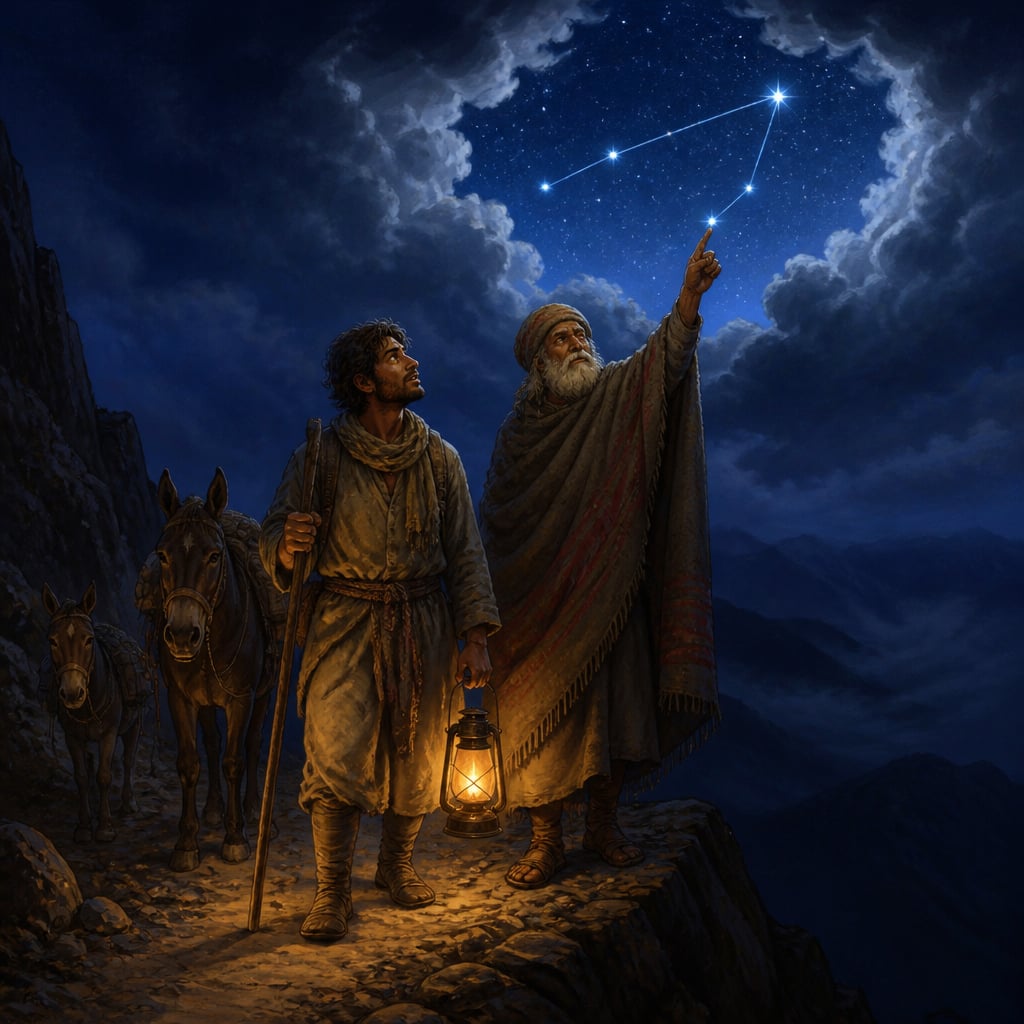
Traveler and mountain guide walking a ridge path by faint starlight

This is the condition of most of our lives. We want the sun, complete clarity, certain knowledge, unambiguous paths. But we're given stars, partial illumination, uncertain knowledge, paths we can only see a few steps ahead. The question isn't whether to have perfect clarity. The question is how to navigate wisely without it.

The Wisdom of Partial Light

We live in an age of both information abundance and fundamental uncertainty. Climate change, technological disruption, geopolitical shifts, the future is genuinely uncertain. The demand for certainty produces paralysis or false confidence. The Vedic wisdom about navigating with partial clarity offers a middle way: honest acknowledgment of limits combined with skillful action despite them. This balance is urgently needed.

The Rig Veda acknowledges that even the Rishis didn't have complete clarity:

Ancient Rishi gazing at the great cosmic mystery

"ko addha veda ka iha pra vocat | kuta ājātā kuta iyaṃ visṛṣṭiḥ" "Who truly knows? Who can proclaim it here? From where was it born, from where this creation?"

This is the famous Nāsadīya Sūkta, a hymn that admits profound uncertainty about the origin of existence itself. The Rishis who wrote it weren't confused beginners but the tradition's most revered seers. Their willingness to say "we don't know" was itself a form of wisdom.

The Sanskrit word kṣānti captures the quality needed here. Usually translated as "patience" or "forbearance," kṣānti is the capacity to bear with difficulty, including the difficulty of not knowing. It's the psychological strength to act without certainty, to move forward without guaranteed outcomes, to live without demanding that every question be answered.

Kṣānti isn't resignation or passivity. It's the active patience of the night traveler, moving carefully forward, using what light is available, neither paralyzed by darkness nor reckless in the absence of full vision.

Why We Rarely Have Full Clarity

The tradition offers several reasons why complete clarity is uncommon:

Complexity: Reality is intricate beyond any individual mind's capacity. The Rig Veda describes the universe as a vast interconnected web (tantra) where effects ripple in ways we cannot fully trace. Our clarity is always partial because reality exceeds our cognitive grasp.

Perspective: We see from a particular location, time, and set of experiences. As the story goes: the blind men touching an elephant each perceive truth, but partial truth. No single perspective captures the whole. Even accumulated perspectives remain incomplete.

Change: Reality moves. By the time we understand something, it has already shifted. The map never fully matches the territory because the territory is always changing. Our clarity is partial because we're chasing a moving target.

Depth: Understanding has layers. What seems clear at one level reveals complexity at another. The Upanishads describe levels of reality (kosha), each containing truth but none containing all of it. We're always partially into understanding, never finished.

Mystery: Some things may be inherently beyond conceptual knowing. The Rishis distinguished between what can be known through intellect (jñāna) and what can only be experienced directly (vijñāna). Clarity of concept is not the only kind of clarity, and conceptual clarity has limits.

None of these is a defect to be overcome but a feature of being finite minds in an infinite reality. Demanding complete clarity is demanding the impossible.

The Dangers of Demanding Perfect Clarity

The insistence on certainty creates its own problems:

Paralysis: Waiting for perfect clarity before acting means never acting. The important decisions, career, relationships, values, can never be made with complete information. Those who demand certainty before choosing often find life has chosen for them.

False Certainty: When we can't tolerate partial clarity, we often manufacture false certainty. We become rigidly attached to positions, ignore contrary evidence, and mistake confidence for correctness. Fundamentalism of all kinds arises from intolerance of uncertainty.

Missed Opportunities: The moment of possibility doesn't wait for our full understanding. The guide who waits for perfect light misses the weather window. Kairos, the opportune moment, often arrives before full clarity does.

Spiritual Bypassing: Pretending to certainty we don't have is a form of dishonesty. The Rishis who admitted "who truly knows?" were more honest than teachers who claim complete cosmic understanding. Genuine spirituality includes authentic acknowledgment of what we don't know.

The remedy isn't abandoning clarity as a goal but releasing the demand that clarity be complete before we proceed.

Acting in Partial Light

How do we act wisely when we don't fully understand? The tradition offers guidance:

Use What Light You Have: The stars aren't the sun, but they illuminate. Work with the clarity you do have rather than lamenting what you lack. Partial understanding, carefully applied, can navigate surprisingly well.

Move Incrementally: The night traveler checks each step before committing. In uncertainty, smaller steps with frequent reassessment beat large leaps based on assumed clarity. This is the principle of iteration, learn as you go rather than planning everything upfront.

Hold Conclusions Lightly: What seems clear today may be revised tomorrow. The Rishis called this viveka, discrimination, but viveka includes discriminating between degrees of certainty. Some things we know well; some we suspect; some we guess. Knowing the difference is itself wisdom.

Attend to Feedback: The night traveler watches for signs, the feel of the path, sounds of running water, the brightening eastern sky. In partial clarity, attention to feedback matters more than initial planning. Stay responsive to what reality teaches.

Act on Values: When facts are unclear, values provide direction. The traveler doesn't know every rock on the path but knows where he's trying to go. Dharma, living in alignment with deeper truth, guides action when surface clarity is absent.

Accept Mistakes: Partial clarity means some errors are inevitable. The tradition distinguishes between errors of ignorance (which teach) and errors of carelessness (which shame). The first is inherent to limited beings; the second is avoidable. Do your best, learn from what happens.

C V Raman splitting light through a glass prism

Living This Today

Venture capitalists make decisions that would terrify most people: investing millions in companies where most will fail, based on information that is radically incomplete. Yet the best VCs produce remarkable returns. How?

Research on expert decision-making under uncertainty reveals a pattern that mirrors Vedic wisdom. Top investors don't pretend to know what they can't know. They acknowledge that most investments will fail. They make smaller bets across multiple opportunities rather than betting everything on false certainty. They iterate quickly, investing in stages, learning from early results, adjusting strategy based on feedback.

Most importantly, they act despite uncertainty. Waiting for certainty in venture capital means never investing. The successful VCs have developed kṣānti, the capacity to bear uncertainty and act anyway. Not recklessly, not randomly, but with disciplined humility about the limits of what they can know.

This extends beyond investing. Every significant life decision, whom to marry, what career to pursue, where to live, what to believe, is made with partial information. Those who thrive aren't those who achieve certainty but those who develop the capacity to navigate productively without it.

Partial Clarity as Spiritual Practice

The Rishis didn't see partial clarity as merely a limitation but as itself a practice. Living with "not knowing" develops qualities that complete clarity might never require:

Humility: Acknowledging we don't know cultivates genuine humility, not false modesty but accurate self-assessment. This humility is spiritually valuable in itself.

Faith: Moving forward without certainty requires a kind of faith, not in specific beliefs but in the process of engaged living. This faith, tested by uncertainty, is deeper than untested conviction.

Presence: When we can't rely on pre-planned paths, we must attend more carefully to the present moment. Partial clarity forces presence in a way certainty doesn't.

Wisdom: The deepest wisdom isn't knowing everything but knowing how to act well with whatever we know. This practical wisdom, prajñā, is developed precisely through navigating with partial light.

The Nāsadīya Sūkta ends with a striking statement: perhaps even the overseer of creation in highest heaven doesn't fully know. This is not despair but liberation. If complete knowing isn't available even to the cosmic overseer, then our partial knowing is not a personal failure but the condition of finite existence, and navigating it well is our proper work.

The Patience of Stars

The night traveler reached the other side by morning. The path had been uncertain, the light inadequate, the footing sometimes treacherous. But he had arrived, not because he saw everything clearly but because he moved forward with what vision he had.

The sunrise, when it came, revealed a landscape he could never have imagined from the descriptions he'd been given. The reality was richer than any map. His partial clarity hadn't shown him this, but it had brought him to where he could see it for himself.

This is the promise of kṣānti: that patient movement through partial light eventually brings us to places where new light becomes available. We don't wait for full understanding; we travel toward it, and the traveling itself produces understanding we couldn't have had while waiting.

Clarity is good. We should seek it, cultivate it, value it when it comes. But most of life doesn't wait for clarity to be complete. Most of life is starlight navigation, moving forward with what we can see, trusting that the path will reveal itself step by step, patient with our limitations while persistent in our purpose.

The Rishis who admitted they didn't know were not lesser than those who claimed certainty. They were greater, because they had the integrity to acknowledge reality and the kṣānti to work wisely within it.

Research on decision-making shows that experts in uncertain domains (weather forecasting, ER medicine, investing) share a trait: calibrated confidence. They know what they know and what they don't. This accuracy about uncertainty produces better decisions than false certainty.

Leaders who admit uncertainty build more trust than those who feign certainty. Research shows teams perform better when leaders say 'I don't know' appropriately. The willingness to acknowledge limits is itself a leadership strength.

Complex systems are inherently unpredictable beyond short horizons. The appropriate response isn't pretending to predict but building adaptive capacity, the ability to respond as reality unfolds rather than following fixed plans.

Research on resilience shows that outcome-independent motivation (intrinsic interest, values alignment, growth orientation) sustains effort better than outcome-dependent motivation (rewards, recognition, specific results). When outcomes are uncertain, intrinsic motivation provides stability.

Leaders who overweight outcomes create cultures of short-termism and blame. Process-focused leadership, emphasizing quality of action and learning, produces better long-term results than pure outcome focus, especially in uncertain environments.

In complex systems, outcomes emerge from many interacting factors beyond any individual's control. Process metrics (quality of inputs, rigor of thinking, responsiveness to feedback) are more directly influenceable than outcome metrics.

Case studies

Venture Capital: Mastering Productive Uncertainty

The best venture capitalists face radical uncertainty: most companies they invest in will fail, the ones that succeed are often surprising, and no amount of due diligence eliminates the unknowns. Yet firms like Sequoia, Andreessen Horowitz, and Accel produce extraordinary returns over decades. Research on expert VCs reveals a pattern: they don't pretend to know what they can't. They explicitly acknowledge that most investments will fail. They make many smaller bets rather than few large ones. They invest in stages, learning from early results. They stay responsive to feedback, adjusting strategy as reality unfolds. Most importantly, they act despite uncertainty, knowing that waiting for certainty means missing opportunities.

Top VCs practice kṣānti, the patience to work productively with uncertainty. They embody the Nāsadīya wisdom: acknowledging what they don't know while acting skillfully with what they do. Their diversified, staged approach is iteration in the face of partial clarity, checking each step, using available light, staying responsive. Their success isn't despite uncertainty but emerges from sophisticated navigation of it.

The best VC returns come not from pretending to know the future but from building systems that work with uncertainty: portfolio diversification, staged investment, quick iteration, and responsive adaptation. This approach has produced companies worth trillions. The lesson: systems designed for uncertainty outperform systems demanding certainty.

Uncertainty isn't an obstacle to success but a condition within which success can be built. The key isn't achieving certainty but developing sophisticated approaches to acting well without it. This applies beyond investing, to careers, relationships, and life choices generally.

The best decision-makers in uncertain fields, from venture capital to emergency medicine to military strategy, share a common trait: comfort with not knowing. They act decisively despite incomplete information, revise continuously, and treat uncertainty as data rather than obstacle. This skill is trainable and increasingly essential as AI and automation make predictable work obsolete.

Research shows that even the best VCs have success rates under 30% on individual investments. Their returns come not from picking winners with certainty but from systems that work despite high failure rates.

C.V. Raman: Scientific Faith and Intellectual Humility

Chandrasekhara Venkata Raman won the 1930 Nobel Prize in Physics for discovering the Raman Effect, how light changes when it passes through a transparent material. His research methodology was remarkable: he worked with minimal equipment compared to Western labs, relied heavily on intuition and observation, and published prolifically while acknowledging what he didn't understand. Throughout his career, Raman demonstrated a distinctive combination: absolute commitment to scientific investigation alongside genuine intellectual humility. He pursued questions rigorously while acknowledging that answers were always partial, that reality exceeded any theory. This wasn't weakness but the source of his scientific productivity.

Raman embodied the integration of śraddhā (faith that investigation is worthwhile) with kṣānti (patience with uncertainty) and viveka (discrimination between what was known and what wasn't). He didn't wait for complete theories before experimenting, he used available understanding to probe further. His success came not despite uncertainty but through skillful engagement with it. He was a night traveler who made remarkable progress by starlight.

Raman became the first Asian to win a Nobel Prize in science. His effect remains fundamental to spectroscopy, with applications from medical diagnostics to art authentication. He built scientific institutions across India and trained generations of researchers. His methodology, rigorous investigation combined with intellectual humility, became a model for Indian science.

Scientific faith isn't certainty about answers but commitment to investigation. Raman shows how productive uncertainty works: you pursue truth rigorously while acknowledging that truth exceeds any particular knowing. This combination of commitment and humility is the essence of kṣānti in intellectual life.

The scientific method itself runs on productive uncertainty: forming hypotheses, testing them, and updating beliefs based on evidence. In an era of conspiracy theories and ideological certainty, Raman's example of rigorous investigation combined with intellectual humility is a model for how to pursue truth in any domain without falling into either dogma or paralysis.

Raman's Nobel-winning discovery was made with equipment costing under 200 rupees, while contemporary Western labs spent thousands, demonstrating how focused inquiry outperforms expensive instrumentation.

Reflection

More in Prakāśa: Clarity, Confusion & Perception

All lessons in Prakāśa: Clarity, Confusion & Perception · Rig Vedic Psychology course