Āvaraṇa: Why Confusion Happens
The Vedic Anatomy of Mental Obstruction
Exploring the Vedic understanding of what causes mental confusion, from Vritra the cosmic obstructor to the five veils (pañca-kleśa) that block inner light. The Rishis didn't just name clarity and confusion; they diagnosed why the mind falls into darkness.
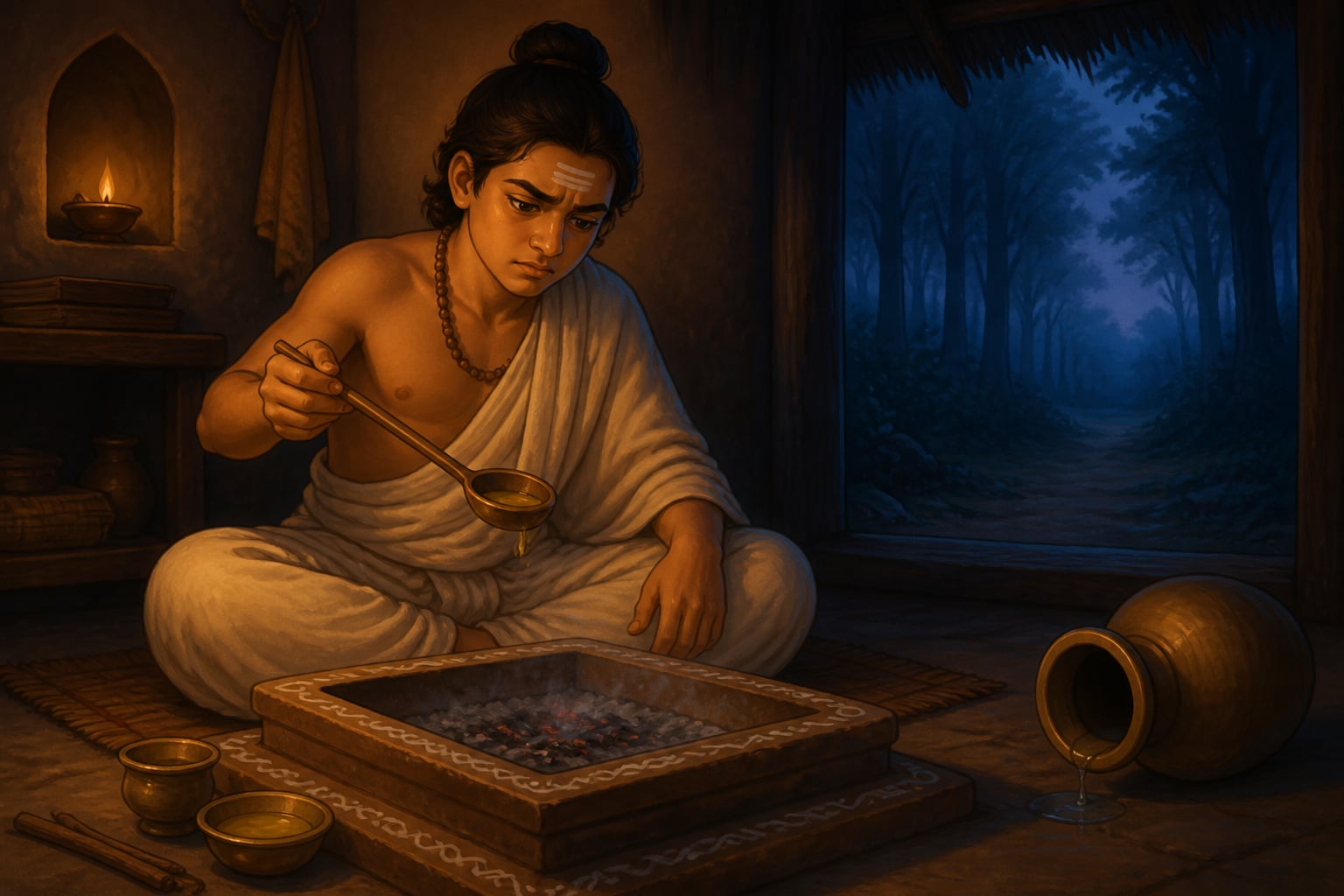
The waters had stopped flowing. Not the physical rivers, though those too seemed sluggish, but the waters within. The young Rishi had known clarity once. Mantras had flowed through him like the Saraswati in flood. Understanding had come easily. But now, for months, everything felt blocked. The same verses that once illuminated his mind now sat like stones, inert and heavy.
His guru recognized the look. "You have met Vritra," he said simply.
"Vritra? The demon Indra slays?"
"The same. But Vritra is not only out there, in the stories. Vritra lives in every mind. He is the one who dams the waters, who holds back the light. The question is not whether you will meet him, everyone does. The question is whether you understand what feeds him."
The Vritra Within
The Vedic analysis of confusion's causes remains remarkably relevant. Modern research on burnout, cognitive load, and attention fragmentation rediscovers what the Rishis mapped millennia ago. Understanding that confusion has specific, identifiable causes, not random bad luck or personal defect, transforms how we relate to our own mental struggles. The ancient diagnostic framework offers practical purchase on modern problems.
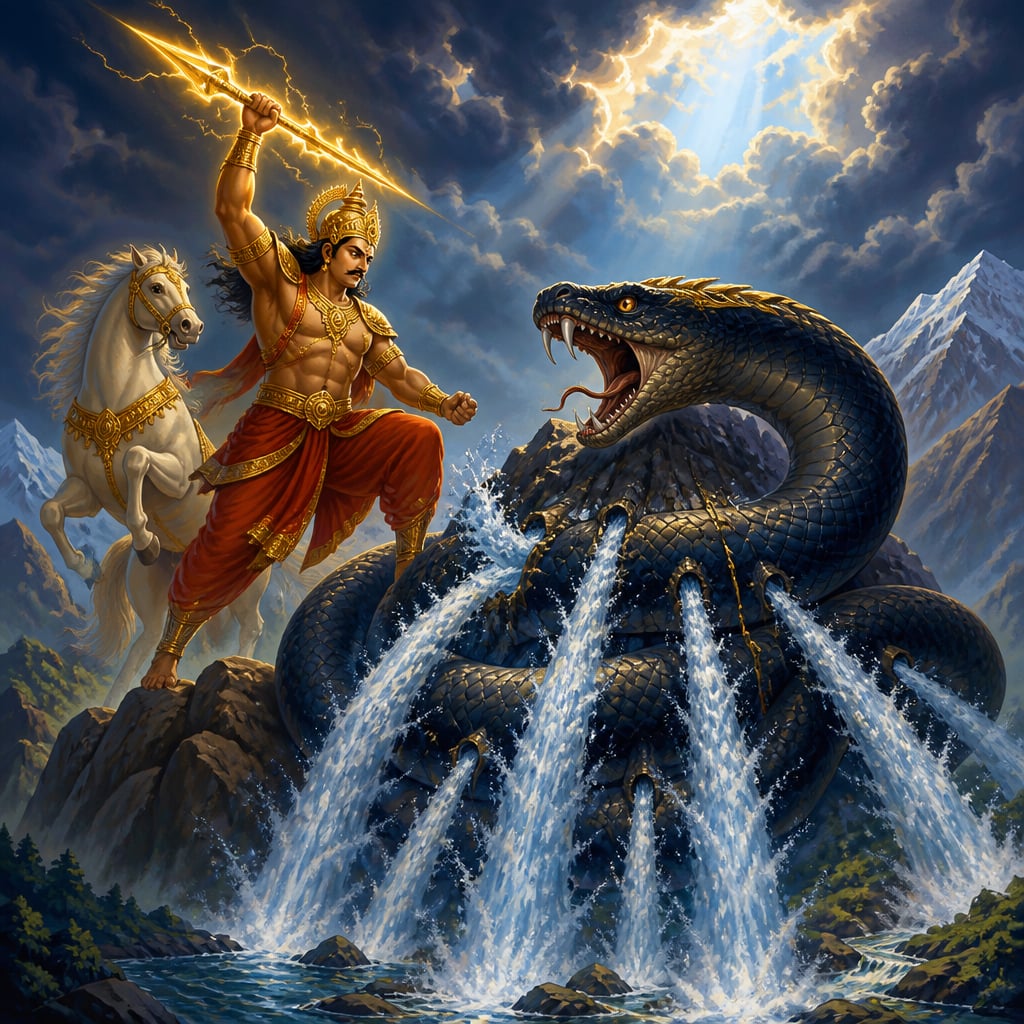
The Rig Veda's most famous battle is Indra's conquest of Vritra, the serpent-demon who coils around the cosmic waters and withholds them from the world. When Indra slays Vritra with his vajra (thunderbolt), the waters flow again, fertility returns, and the world is renewed.
But the traditional commentators saw more than cosmic drama. Sri Aurobindo, in The Secret of the Veda, interprets Vritra as the force of psychological obstruction, the constricting energy that blocks the flow of consciousness itself. The "waters" (āpaḥ) are not merely rain but the streams of awareness, vitality, and understanding that should flow freely through the mind.
As the Rig Veda declares:
"ahan vṛtram ... āpo arṇavīḥ" "I slew Vritra ... [and released] the streaming waters."
The Rishi who composed this understood: there are forces that dam our inner waters. Understanding them is the first step to releasing them.
The Five Coverings: What Blocks the Light
The Vedic tradition identified multiple sources of mental obstruction. Later systematized as the pañca-kleśa (five afflictions) in Yoga philosophy, these have roots in Rig Vedic understanding:
1. Avidyā (Ignorance), Not merely lack of information, but misperception of reality. Seeing what is temporary as permanent, what is painful as pleasurable, what is not-self as self. This is the root covering that makes all others possible.
2. Asmitā (Ego-identification), The contraction of awareness into "I am this", this body, this role, this opinion. The Rishis saw how ego-clinging creates blind spots, how defending our self-image blocks seeing clearly.
3. Rāga (Attachment), The pulling toward pleasure, which distorts perception. We see what we want to see, believe what we want to believe. Rāga creates selective blindness.
4. Dveṣa (Aversion), The pushing away from pain, equally distorting. We refuse to see unpleasant truths, avoid uncomfortable realities. Dveṣa keeps whole areas of life in darkness.
5. Abhiniveśa (Fear of dissolution), The clinging to continuity, the terror of change or death. This deepest fear contracts awareness, making us rigid and unable to see clearly.
These aren't moral failures, they're structural features of embodied consciousness. The Rishis mapped them not to blame but to understand. If you know what creates tamas, you can work with it.
How Confusion Compounds
The Rig Veda describes Vritra as āśayāna, "lying in wait." This is precise psychology. Confusion doesn't announce itself. It accumulates quietly until suddenly you realize you can't see clearly anymore.
Sayana's commentary notes that the demons of obstruction work through āvaraṇa (covering) and vikṣepa (scattering). First they veil clarity, then they fragment attention. The covered mind doesn't know it's covered. The scattered mind can't gather itself to see its own scattering.
This explains why people often don't recognize their own confusion. The very faculty that would recognize it is compromised. A person deep in tamas may feel certain they're seeing clearly, their certainty itself is a symptom of the obstruction.
The Rishis used the image of clouds covering the sun. The sun is always shining, prakāśa is the natural state of consciousness. But clouds (obscuring thoughts, emotions, conditioning) block the light. We blame the sun for not shining when we should be examining the clouds.
The Mechanism of Obstruction
Traditional sources identify specific mechanisms by which confusion arises:
Overload: Too much input overwhelms the mind's processing capacity. The Rishis lived simply not from poverty but from understanding, a cluttered environment creates a cluttered mind.
Depletion: The mind-fire (manas-agni) requires fuel. Exhaustion, inadequate rest, chronic stress, these deplete the fire that burns away confusion. Without sufficient agni, tamas accumulates like unburned residue.
Conflict: Internal contradictions drain energy. When we hold incompatible beliefs, pursue contradictory goals, or live against our own values, the mind fragments. The energy that could fuel clarity is spent in internal warfare.
Avoidance: What we refuse to face grows in power. The Rishis understood that pushed-away material doesn't disappear, it accumulates in shadow, creating zones of blindness that expand over time.
Repetition: Habitual patterns create grooves. The mind follows familiar paths even when they lead to confusion. Breaking through tamas requires disrupting these grooves.
Living This Today

Christina Maslach has studied burnout for over four decades at UC Berkeley. Her research reveals something the Rishis would recognize: burnout isn't just tiredness, it's a state of cognitive impairment where clarity becomes impossible.
Maslach identifies three dimensions of burnout: exhaustion, cynicism, and inefficacy. All three map to Vedic categories. Exhaustion depletes the mind-fire. Cynicism is a form of dveṣa, aversion that blocks seeing positive possibilities. Inefficacy reflects the scattered state (vikṣepa) where effort can't produce results.
Her research shows burnout doesn't happen suddenly. It accumulates, often unrecognized. People in early burnout may work harder, convinced they just need to push through, not recognizing that the pushing itself deepens the obstruction. This is Vritra "lying in wait."
Maslach's prescription? Not working harder, but addressing the structural conditions that create burnout, workload, control, reward, community, fairness, values. This parallels the Vedic insight: you don't fight tamas directly. You address what creates and feeds it.
Working With Your Vritra
The Rig Vedic solution to Vritra isn't to ignore him or merely endure him, it's to understand what makes him strong, then to invoke the power (Indra) that can break through.
The young Rishi whose inner waters had stopped eventually understood what had happened. Subtle exhaustion had accumulated. Conflicts he hadn't resolved drained his energy. Truths he'd avoided had grown powerful in shadow. His tamas wasn't random, it was the predictable result of conditions he'd created.
With his guru's guidance, he learned not to fight the obstruction directly, that only exhausts. Instead, he worked with its causes. He rested. He faced what he'd avoided. He simplified his life. Slowly, the inner waters began to move again.
The Rishis never promised permanent victory over Vritra. The battle recurs, sometimes the waters flow freely, sometimes they're blocked again. But each encounter with confusion, if understood, teaches. You learn what feeds your particular Vritra. You learn to recognize obstruction earlier. You learn that the waters are always there, waiting to flow when the obstruction is addressed.
This is the wisdom the Rig Veda offers: confusion has causes. It isn't random or punitive. Understand the causes, and you hold the key to clarity.
Christina Maslach's burnout research shows that cognitive impairment accumulates gradually, people often don't recognize their declining clarity until it's severe. The 'lying in wait' pattern is exactly what her research documents.
Organizations develop collective blind spots through the same mechanism. Problems lie unaddressed, creating compounding obstruction. Leaders must actively look for what's 'lying across the flow' before crisis reveals it.
Systems develop blockages at choke points, bottlenecks that restrict flow. The Vritra image applies directly: identify where flow is obstructed, and address the obstruction rather than pushing harder against it.
Cognitive therapy identifies 'cognitive distortions', systematic misperceptions that cause suffering. These map to the kleśas: catastrophizing (dveṣa), emotional reasoning (rāga), personalization (asmitā). The therapeutic approach of identifying and correcting distortions mirrors kleśa work.
Leaders who can identify which kleśa is operating in a team conflict, Is this attachment to being right? Aversion to a particular person? Ego-defense?, can address the actual cause rather than the surface issue.
Organizations have collective kleśas. Corporate avidyā might be an industry assumption everyone shares but nobody questions. Corporate rāga might be attachment to a past success that prevents adaptation.
Case studies
Christina Maslach: Mapping the Burnout Vritra
In 1981, Christina Maslach published her first research on burnout, documenting a syndrome she'd observed in healthcare and human services workers. What struck her wasn't just the exhaustion, it was the cognitive impairment. Burned-out workers showed decreased decision quality, impaired problem-solving, and persistent mental fog. Over four decades, her research revealed burnout as a progressive condition: it accumulates quietly, often unrecognized, until it becomes disabling. Critically, she found that burnout isn't about individual weakness but about systemic conditions, workload, control, reward, community, fairness, and values alignment.
Maslach documented the Vritra pattern in modern dress. Burnout 'lies in wait', it doesn't announce itself but accumulates through small daily depletions. Her finding that the cause is systemic, not individual, mirrors the Vedic insight: confusion has structural causes. The kleśas aren't personal failings but features of consciousness under certain conditions. Her six dimensions (workload, control, etc.) parallel the Vedic understanding that tamas feeds on specific inputs.
Maslach's Burnout Inventory became the standard measure worldwide. Organizations began addressing burnout through systemic changes rather than telling individuals to be more resilient. Her 2021 research showed burnout reaching epidemic levels during the pandemic, Vritra on a collective scale. Her work demonstrates that the Vedic framework isn't metaphor but accurate psychology: confusion has causes, those causes can be identified, and addressing them restores clarity.
Burnout is Vritra in modern form, a progressive obstruction that blocks the waters of consciousness. It has specific causes and accumulates quietly. The solution isn't fighting through but addressing the conditions that create it.
The WHO recognized burnout as an occupational phenomenon in 2019, affecting an estimated 67% of workers globally. Maslach's three dimensions of burnout, exhaustion, cynicism, and reduced efficacy, map directly onto the Vritra pattern of progressive obstruction. Catching burnout early requires the same skill as catching any Vritra: noticing the subtle signs before they become overwhelming.
Maslach's research shows burnout impairs cognitive function by 20-30% on standard measures, quantifying how obstruction of the 'inner waters' degrades mental clarity.
King Yayati: When Confusion Looks Like Pleasure
Yayati was a powerful king who, due to a curse, became old before his time. Given the option to exchange his old age for his sons' youth, only his youngest son Puru agreed. Restored to youth, Yayati spent decades pursuing pleasure, convinced that just a little more would bring satisfaction. Finally, after years of indulgence, he realized: 'Desire is never satisfied by enjoyment of desires. Like fire fed with ghee, it only grows more.' He returned Puru's youth and accepted his old age, having finally understood that he had been confused about the nature of happiness. His apparent clarity about what he wanted had been the deepest confusion of all.
Yayati embodies rāga (attachment) creating avidyā (ignorance). He thought he saw clearly, he wanted pleasure, and he pursued it systematically. But his clarity was illusion. The kleśa of attachment created a specific blindness: inability to see that pleasure and happiness are not the same. His confusion looked like purpose. His blindness felt like vision. This is āvaraṇa at its most subtle, a covering so complete that the covered mind doesn't know it's covered.
Yayati's eventual recognition is treated in the Mahābhārata as a teaching moment. His hard-won wisdom, that desire grows by feeding, not by satisfying, became proverbial in Indian culture. He represents the possibility of awakening even after decades of confusion. His story warns that some obstructions feel like clarity, some prisons feel like freedom. Only when he stopped pursuing did he see clearly.
The deepest confusion can feel like certainty. When we're caught in a kleśa like rāga, we often feel most certain we're seeing clearly. Yayati's awakening came not from getting what he wanted but from finally recognizing that his wanting itself was the obstruction.
Behavioral economists call it 'present bias': the tendency to overvalue immediate pleasure at the expense of long-term well-being. Yayati's story is a vivid illustration. People who recognize this pattern in their own spending, eating, or scrolling habits have taken the first step toward the awakening that took Yayati a thousand years.
Yayati exchanged his old age for his son Puru's youth and spent 1,000 years in pleasure before concluding that desires multiply with indulgence, a psychological insight modern addiction research confirms.
Reflection
- What is your personal 'Vritra' right now, the obstruction that's blocking your inner waters? Can you name it specifically rather than just feeling 'confused'?
- How might confusion sometimes feel like clarity, as it did for Yayati? Are there areas of your life where you feel certain but might actually be caught in a kleśa?
- If confusion has causes, the kleśas, the conditions that create tamas, does that mean we're responsible for our confusion? How do we balance personal responsibility with compassion for our own stuck places?