Svadharma: Work, Duty & Meaning
How the Rishis Found Identity Through Purposeful Action
Exploring svadharma, one's unique path where nature, duty, and meaning align. This is the organizing principle that transforms bahurūpa (multiple selves) from chaos into coherent purpose.
Before the sun rose over the Saraswati, the potter was already at his wheel. But he wasn't shaping clay, not yet. First, he knelt beside his workspace and spoke words that had been passed down through generations of his family.
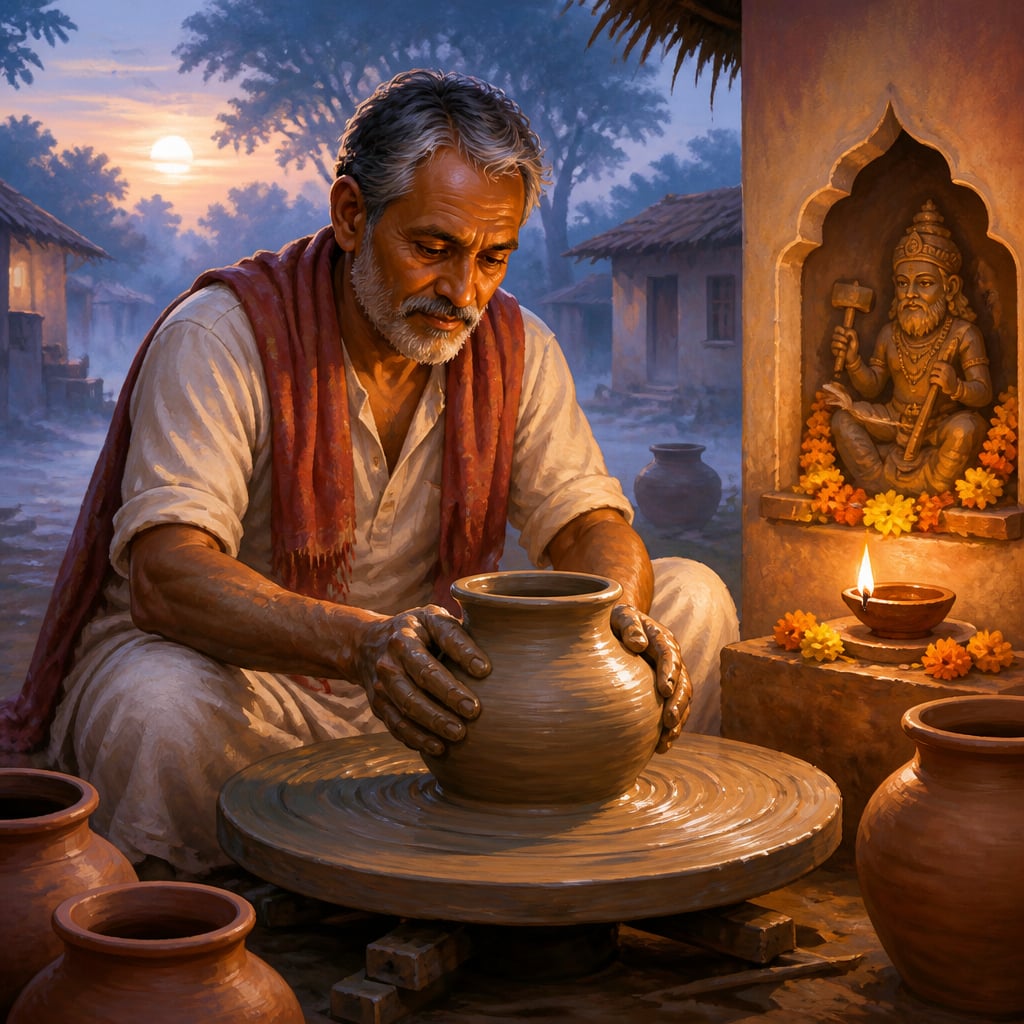
"O Vishwakarma, architect of worlds, let my hands be your hands today. Let this clay become what it is meant to become. Let my work be my offering."
Then he began. And as his hands shaped the wet earth, something remarkable happened: the boundary between the potter and the potting dissolved. He wasn't a man doing work. He was work being done through a man.
The young student watching from the doorway didn't understand. "Guru-ji, why does he pray before making pots? They're just vessels for water."
The old teacher smiled. "He isn't making pots. He is being a potter. There's a difference."
"What difference?"
"One is doing. The other is dharma." The teacher paused. "When your work and your nature align so completely that you cannot tell where 'you' end and 'work' begins, that is svadharma. And in svadharma, there is no difference between earning a living and living your truth."
The Vedic Insight: Work as Identity
In a world of endless career options and constant comparison through social media, svadharma offers grounding. It's not about finding the 'best' path but finding YOUR path. It's not about what's prestigious but what's aligned. And crucially, it's not about self-indulgence but service, true svadharma always nourishes beyond the self. The Kayaka principle further democratizes this: whatever your work, performed with devotion and integrity, can be your spiritual practice. This matters because most of us spend most of our waking hours working. If work can be worship, then most of life can be sacred practice.
The Rishis understood something that modern culture often forgets: work isn't just what you do to earn money or fill time. Work, the right work, aligned with your nature, is how your identity expresses in the world. They called this svadharma: sva (one's own) + dharma (path, duty, nature).
In the previous lessons, we explored how identity is functional (svabhāva) and multiple (bahurūpa). But these insights create a question: if we can be many things, how do we know what to be? If identity is what we do, what should we do?
Svadharma is the answer. It's the organizing principle that turns multiplicity into purpose.
The Vishwakarma Sukta of the Rig Veda celebrates the divine architect whose identity is his creative function:
"víśvakarmā vimánā ād vihāyā dhātā́ vidhātā́ paramótá sáṃdṛk" "Vishwakarma, the all-creating, all-measuring, the highest form, the supreme seeing one."
Vishwakarma doesn't have a job, he is his function. Creation is not what he does; it's who he is. This is the Vedic model for human identity: not work as burden, but work as expression of deepest self.
What the Mantras Reveal
The Rig Veda contains hymns by Rishis of every occupation, not just priests. There are warrior hymns, farmer hymns, merchant hymns. The tradition held that every aligned work could be a path to truth.
One hymn addresses this directly:
"kárman kṛṇvántó víśvam āryam" "Through karma, make the whole world noble."
The word karma here isn't metaphysical, it's simply "action, work." The hymn suggests that through right action, properly aligned, one contributes to cosmic order. Your work doesn't just serve you; it serves the ṛta, the cosmic pattern.
Sayana's commentary emphasizes that this "right action" must be svadharma-anuṣṭhānam, "performed according to one's own dharma." Not any work, but your work. Not the duty of another, but your duty.
The Bhagavad Gita (which draws on Vedic roots) makes this explicit:
"śreyān sva-dharmo viguṇaḥ para-dharmāt sv-anuṣṭhitāt" "Better is one's own dharma, though imperfectly performed, than the dharma of another well performed."
This isn't about lowering standards. It's about alignment. A fish perfectly executing a bird's dharma is still drowning in the sky.
Traditional Interpretations: The Threefold Alignment
Traditional commentators describe svadharma as the intersection of three factors:
| Factor | Sanskrit | Meaning |
|---|---|---|
| Nature | Svabhāva | What you're naturally inclined toward, your tendencies |
| Capacity | Śakti | What you're capable of, your abilities |
| Context | Deśa-kāla | What the world needs from you here and now |
Svadharma isn't just "do what you love", that ignores capacity and context. It isn't just "do what you're good at", that ignores nature. It isn't just "do what's needed", that ignores both. It's the intersection where all three align.
Sri Aurobindo interprets svadharma psychologically: it's the work through which your soul naturally expresses. When you're in svadharma, effort feels like flow. Resistance decreases. Not because the work is easy, but because it's yours.

Living This Today: Dr. V and the Mission-Identity
In 1976, Dr. Govindappa Venkataswamy, known simply as "Dr. V", retired from a government medical post at age 58. His hands were crippled by rheumatoid arthritis. By conventional logic, his working life was over.
Instead, he opened an 11-bed eye clinic in Madurai with money borrowed against his home. His svadharma, as he stated it, was stark: "Eliminate needless blindness." Not "become a successful eye surgeon" or "build a hospital" but a mission so clear it organized everything else.
Dr. V wasn't just doing eye surgery; he was the elimination of needless blindness. When asked about his work, he didn't describe procedures, he described the unnecessary suffering of the blind poor. His identity and his mission had become indistinguishable.
This clarity produced results that defied normal logic. Aravind Eye Care now performs over 500,000 surgeries per year, more than any other eye care system in the world. They charge paying patients market rates and treat the poor for free, yet remain profitable. They've trained surgeons across three continents. All from an 11-bed clinic started by a man with arthritic hands.
Dr. V's answer when asked how he accomplished this: "I just saw what needed to be done and did it." This is svadharma distilled, when your dharma is clear, the path appears.
The Kayaka Principle: Work as Worship
But what about those whose work seems mundane? What about the potter, the weaver, the farmer?

Here the 12th-century saint Basavanna offers profound insight. A minister in the court of King Bijjala, Basavanna founded the Lingayat movement and articulated the principle of Kayaka: work as worship.
"Kayakave Kailasa", "Work itself is Kailasa (heaven)."
Basavanna taught that any honest work, performed with devotion and without exploitation, was equivalent to temple worship. The weaver at his loom and the priest at the altar were equals if both performed their svadharma with dedication.
This was revolutionary. In a society that often hierarchized occupations, Basavanna insisted that the quality of consciousness in work mattered more than the type of work. A sweeper in svadharma stands higher than a priest performing another's dharma.
The Kayaka principle has three elements:
- No work is inherently degrading, only the consciousness behind it
- Work serves the community, the fruits are shared, not hoarded
- Work is offered to the divine, each action becomes an offering
When these align, work becomes worship, and identity becomes purposeful.
Finding Your Svadharma
How do you find your svadharma? The Rishis would suggest listening for three signals:
1. What absorbs you? When you lose track of time, when effort feels effortless, when you're so engaged that self-consciousness disappears, you're probably near svadharma. This isn't the same as "what's easy." Svadharma can be hard, but it's hard in a way that feels meaningful.
2. What does the world need that you can provide? Svadharma isn't solipsistic. It's your nature in relationship to the world's needs. Dr. V didn't invent his need for eye surgery, he saw a need and felt called to meet it. Your svadharma emerges in dialogue with context.
3. What would you do even without reward? Not "what would you do if money didn't exist", that's fantasy. But: what work would you find worth doing even if no one applauded, even if compensation were modest, even if it never made you famous? That's svadharma whispering.
The Rishis didn't promise that svadharma would be easy to find or constant once found. Life stages change; contexts shift; capacity develops. But they offered this assurance: when you find it, you'll know, because you'll feel like you're finally doing what you were made to do.
Your Work as Identity
The potter's prayer wasn't superstition. It was technology, a technology for aligning identity with action, for transforming work from burden into expression.
Consider: when someone asks "Who are you?" how much of your answer involves what you do? For most people, profession appears early in self-description. The Rishis would say this isn't superficial, it's accurate. You are, in part, what you do. The question is whether that doing is aligned with your nature or fighting against it.
Svadharma doesn't mean you'll never do unpleasant tasks or take work for survival. It means you'll have a north star, a sense of what your work is meant to be, that gives coherence to the necessary compromises. Even Dr. V did administrative work he didn't love. But it was in service of svadharma.
In the next lesson, we'll explore what happens when identity becomes rigid, when svadharma becomes prison, when healthy identity-through-work calcifies into ego, when ahaṃkāra transforms purpose into possession.
Mihaly Csikszentmihalyi's 'flow' research shows that optimal experience occurs when challenge matches skill in an activity of intrinsic interest. This is psychological svadharma, the zone where nature, capacity, and task align.
Jim Collins' concept of the 'Hedgehog', the intersection of passion, competence, and economic engine, mirrors the threefold alignment. Great organizations, like great individuals, find where these three meet.
In ecology, 'niche' is the role an organism plays in its ecosystem, not just what it does, but how that doing serves the whole. Svadharma is the human equivalent: your niche in the social-cosmic ecosystem.
Research on 'job crafting' (Wrzesniewski & Dutton) shows that people who infuse meaning into their work, seeing it as calling rather than just job, report higher well-being and performance. This is kāyaka psychology.
Leaders who frame work as meaningful service, not just tasks for compensation, inspire greater engagement. Kāyaka leadership transforms 'employees' into 'contributors to something larger.'
In a healthy system, each component's function serves the whole. Kāyaka teaches that conscious work naturally benefits beyond the worker, it's how individual function integrates with system health.
Case studies
Dr. V: When Mission Becomes Identity
In 1976, Dr. Govindappa Venkataswamy retired from government service at 58, his hands crippled by rheumatoid arthritis. He had performed over 100,000 surgeries but now could barely hold instruments. By all conventional measures, his working life was over. Instead, he mortgaged his home, borrowed money from family, and opened an 11-bed eye clinic in Madurai. His stated mission: 'Eliminate needless blindness.' Not 'build a successful hospital' or 'become wealthy', a mission so clear it organized every subsequent decision. He would say, 'When you give yourself completely to the work, the work takes care of itself.'
Dr. V exemplifies svadharma where identity and mission merge. He didn't 'have' a goal to eliminate blindness; he 'was' the elimination of needless blindness. This is Vishwakarma consciousness, identity as function. His physical limitations became irrelevant once svadharma was clear: he trained others to operate, built systems that scaled, created a model that others could replicate. The crippled hands that couldn't perform surgery designed the world's most productive eye care system. His svadharma found expression despite, perhaps because of, constraint.
Aravind Eye Care now performs over 500,000 surgeries annually, more than any system worldwide. They treat 60% of patients free while remaining profitable. They've trained over 300,000 eye care professionals globally. Dr. V died in 2006, but his svadharma continues: the Aravind model has been adapted for eye care in 30+ countries. His identity, 'eliminate needless blindness', outlived his body.
When svadharma is clear enough, identity and mission become one. Dr. V didn't 'do' eye care; he 'was' the elimination of blindness. This clarity created extraordinary results because there was no gap between who he was and what he did.
Mission-driven founders consistently outperform mercenary ones in building lasting organizations. When identity and purpose fuse, as they did for Dr. V, the result is a clarity that attracts talent, sustains effort through setbacks, and scales beyond individual capacity. The question 'What would I still do if no one paid me?' is a diagnostic for svadharma alignment.
Aravind performs surgeries at 1% of the cost of equivalent UK procedures while maintaining equivalent outcomes. Svadharma-driven design finds efficiency that profit-driven design misses.
Basavanna: The Minister Who Dignified Labor
In 12th-century Karnataka, Basavanna rose to become chief minister to King Bijjala, a position of immense power and prestige. Yet he was troubled by the rigid hierarchies of his society, where birth determined worth and certain occupations were considered spiritually degrading. Though he could have simply enjoyed his status, Basavanna used his position to articulate and spread a revolutionary teaching: Kāyaka, work as worship. He taught that the weaver at his loom, the cobbler at his bench, the farmer in his field performed spiritual service equal to any priest's ritual. 'Kayakave Kailasa', work itself is heaven. He founded the Anubhava Mantapa, perhaps history's first parliament of spiritual democracy, where men and women of all occupations gathered as equals.
Basavanna's svadharma was paradoxical: he used the power of high position to dismantle the hierarchy that gave him that power. His nature was reform; his capacity was political influence; his context was a society rigid with occupational hierarchy. Where these three met, he found his unique path. The Kāyaka principle extended svadharma to everyone, not just kings and priests but weavers and farmers. This was deeply Vedic: the Rig Veda hymn 'various are our thoughts, different the vocations of people' celebrated occupational diversity millennia before Basavanna.
The Lingayat movement Basavanna founded still thrives, roughly 20 million adherents in Karnataka alone. His vachanas (prose-poems) remain among the finest literature in Kannada. Most importantly, the Kāyaka principle permanently changed how work was understood in South Indian culture. Basavanna was eventually martyred for his reforms, but his svadharma, dignifying labor through devotion, continues through every craftsperson who sees their work as offering.
Svadharma sometimes means using your privilege to extend privilege to others. Basavanna's path wasn't abandoning power but using power to change power. His work became worship by making everyone's work potentially worship.
In an era of growing inequality, Basavanna's model of using institutional power to expand dignity remains urgently relevant. Leaders in tech, policy, and business who recognize that their privilege comes with responsibility to change the systems that granted it are practicing the same principle. Power used only to accumulate more power is a failure of svadharma.
Basavanna's Anubhava Mantapa (Hall of Experience) in 12th-century Kalyani was the first recorded institution where potters, cobblers, weavers, and Brahmins sat as intellectual equals to compose vachanas.
Reflection
- Map your current situation against the threefold alignment: What is your nature calling toward? What do you have capacity for? What does your context need? Where do all three overlap?
- If work can be worship (kāyaka), what would change about how you approach your daily tasks? What consciousness would you bring to your ordinary activities?
- If 'better is one's own dharma imperfectly performed than another's perfectly', how do you know when to persist in your path versus when to recognize misalignment and change course?