Bahurūpa: Multiple Selves in One Life
How the Rishis Understood Contextual Identity Without Fragmentation
Exploring the Vedic insight that being different in different contexts is not hypocrisy but the natural expression of an adaptive self. The Rishis understood that we contain multitudes, and this is a feature, not a bug.
The old Rishi sat by the Saraswati at twilight, watching the water carry the day's offerings downstream. A young student approached, hesitant.
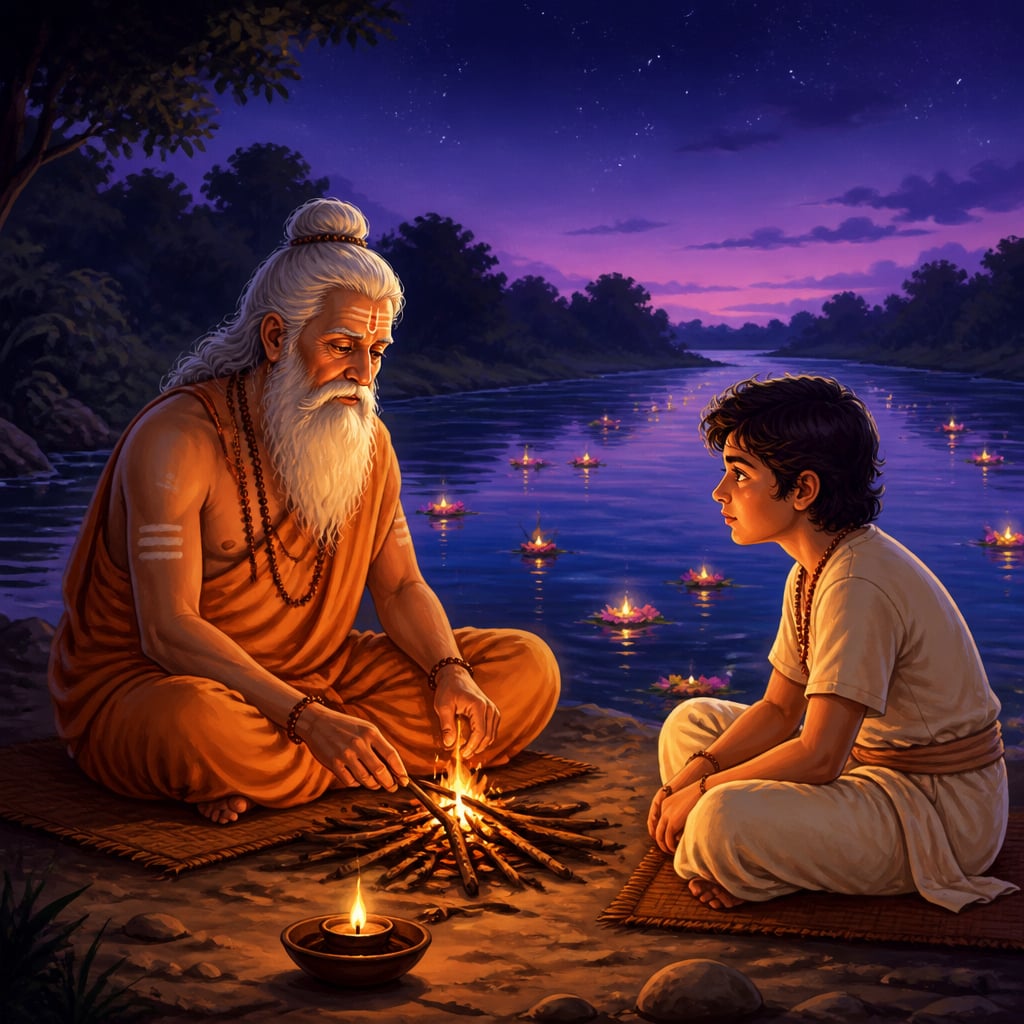
"Guru-ji, I have a question that troubles me."
"Ask."
"When I am with my parents, I am respectful, quiet, obedient. With my friends, I am loud, joking, sometimes crude. In the ashram, I am serious, focused, prayerful. Which one is the real me? Am I being false to someone?"
The old Rishi smiled, the smile of someone who has asked this question before, and lived long enough to find the answer.
"Tell me," he said, "is the fire in the hearth the same fire that burns on the altar?"
"Yes, Guru-ji. Fire is fire."
"And is the fire that lights the cremation ground the same fire that rises as the sun?"
"...Yes. All fire is Agni."
"Then why does Agni behave so differently in each place? Is Agni being false when he cooks food gently but consumes bodies completely?"
The student was silent.
"You are like Agni," the Rishi continued. "One self, many forms. Bahurūpa, the one who takes many shapes. This is not deception. This is the nature of consciousness itself."
The Vedic Understanding: One Self, Many Forms
Modern identity anxiety often comes from the pressure to be 'consistent', the same person everywhere, all the time. The Vedic bahurūpa teaching offers relief: you're supposed to be different in different contexts. The authenticity isn't in sameness but in values-coherence across difference. You can be fierce and gentle, serious and playful, devoted and questioning, as long as these forms emerge from your genuine response to context rather than manipulation or fear. This reframe turns identity complexity from a problem into a resource.
The Rishis had a term for this: bahurūpa, "having many forms." It was applied to Agni, to Indra, to Vishnu, and ultimately to the self that dwells in each person. The term wasn't a criticism but a recognition of something fundamental: consciousness adapts, expresses differently in different contexts, and this is its nature.
The āśrama system encoded this insight into the structure of life itself. The same person was expected to be a celibate student (brahmachārin), then a passionate householder (gṛhastha), then a forest-dwelling contemplative (vānaprastha), and finally a renunciate who owns nothing (sannyāsin). These weren't four different people. They were four rūpas, forms, of one life.
As a hymn to Agni declares:

"tváṃ agne bahubhír vasavyo vásur vasūnām asi" "You, O Agni, are the treasure of treasures, of many forms among the wealthy."
Agni's multiplicity was his wealth, not his weakness. The same fire that purifies also destroys, that illuminates also conceals. Context determines expression. The essence remains one.
What the Mantras Reveal
The Rig Veda repeatedly celebrates divine beings who manifest in multiple forms. Krishna's viśvarūpa in the Bhagavad Gita has Vedic roots, the cosmic vision of one being expressing as everything.
One mantra addresses this directly:
"éko devá bhúvaneṣu gūḍhó vyāpī sarvá-bhūtāntarātmā" "The one Divine is hidden in all beings, pervading all, the inner self of all."
The "one Divine" doesn't contradict being in "all beings", the multiplicity is how the unity expresses. Sri Aurobindo interprets this as the psychological truth that our one consciousness manifests through many mental, emotional, and social forms without losing its essential unity.
Sayana's commentary on Agni's epithets notes that the same fire is called purohita (priest) in ritual, atithi (guest) in the home, and dūta (messenger) between humans and gods. These aren't metaphors for different fires, they're the same fire performing different functions. "So too the ātman," Sayana adds, "takes different forms according to the field of action."
Traditional Interpretations: The Theater of Self
The Nirukta of Yaska offers an illuminating etymology: rūpa (form) comes from the root rūp, "to represent, to symbolize." A form is a representation of something deeper. When you take multiple forms in different contexts, you're not fragmenting, you're representing your essence through varied symbolic expressions.
This is why the dramatic tradition (nāṭya) was considered sacred in ancient India. The actor who plays king, then beggar, then god, then demon doesn't have multiple personality disorder, he has the skill to represent different aspects of human experience while remaining one person. Life, the Rishis suggested, is the same: we are all actors on the stage of existence, playing different roles without losing our witnessing self.
The Taittiriya Upanishad speaks of kośas, sheaths or layers of the self. The physical self (annamaya), the vital self (prāṇamaya), the mental self (manomaya), the wisdom self (vijñānamaya), and the bliss self (ānandamaya) coexist in one person. You're not fragmented into five people, you're one person expressing through five dimensions.
Living This Today

Consider Virat Kohli. On the cricket field, he's intense, aggressive, confrontational, the competitor who feeds on pressure and transforms anxiety into runs. Off the field with his wife Anushka Sharma, he's tender, devoted, publicly protective of their privacy and their daughter. In interviews about his fitness journey, he's disciplined, almost monastic. In moments captured on camera with his spiritual practices, there's a seeker, someone doing pranayama, visiting temples, speaking of being "at peace."
Is Kohli being fake when he's gentle at home after being fierce on the field? The Vedic answer is clear: no. He's being bahurūpa, one self, many forms. The fierce competitor and the gentle husband aren't contradictions but contextual expressions of the same underlying nature. What would be false is being aggressive with his daughter or tender with opponents trying to sledge him.
Modern psychology has begun to articulate this. Psychologist William James noted over a century ago that "a man has as many social selves as there are individuals who recognize him." More recent research on "self-complexity" shows that people with multiple, well-differentiated self-aspects actually have better mental health and resilience. Having many authentic selves isn't pathological, it's adaptive.
The Coherence Beneath Multiplicity
But doesn't this make the self arbitrary? If we can be anything in any context, is there any "real" self at all?
The Rishis would say: look for the coherence beneath the forms. Krishna appears as cowherd, friend, lover, king, charioteer, and teacher, but there's a consistency: he always speaks truth, always acts for the welfare of those he engages with, always maintains complete inner freedom regardless of the role. The forms vary; the values remain constant.
Your many selves aren't random. They share a moral center, a set of values, a quality of attention. When your forms contradict your values, when you're cruel to someone you should protect, or sycophantic to someone you should challenge, that's when inauthenticity enters. Not in being different, but in betraying your own center.
The witness-self we explored in Lesson 1 provides the continuity. It watches you being a professional, then a parent, then a friend, then a stranger on the street. It doesn't change. And it knows, in each moment, whether this particular expression is aligned with who you are, or a performance that betrays you.
Your Many Authentic Selves
The Rishis invite a reframe: instead of asking "Which is the real me?" ask "How does my essence express in this context?"
The student-you, the professional-you, the friend-you, the family-member-you, these aren't masks hiding your true face. They're facets of a gem, each catching light differently but all part of one stone. The gem doesn't become five stones when you rotate it.
What matters is not consistency of behavior but consistency of values. You can be quiet with elders and loud with friends and be authentic, if both expressions emerge from your genuine response to context, not from fear of judgment or desire to manipulate. The form can vary; the integrity shouldn't.
In the next lesson, we explore how svadharma, one's unique path, provides the organizing principle for all these multiple selves, turning bahurūpa from potential confusion into purposeful expression.
Research on 'self-complexity' (Patricia Linville) shows that people with multiple, well-articulated self-aspects have better emotional resilience. When one domain of life suffers, others provide buffer. Psychological health requires bahurūpa.
Leaders who can shift styles, directive when needed, collaborative when appropriate, visionary for inspiration, detail-oriented for execution, outperform those locked into one approach. This is organizational bahurūpa.
Adaptive systems require components that can play multiple roles depending on feedback. An immune cell can be helper, killer, or memory depending on signals. Rigid single-function elements make systems fragile.
Values clarification research (e.g., ACT therapy) shows that knowing your core values provides stability across changing contexts. When you're clear on what matters, different situations call forth different behaviors, but all aligned with the same values.
Jim Collins notes that visionary companies have 'core ideology' that remains constant while strategies and tactics change dramatically. This is organizational values-coherence enabling strategic bahurūpa.
Complex adaptive systems maintain identity through feedback loops that preserve core patterns while allowing surface variation. Your values function as these feedback loops for personal identity.
Case studies
Virat Kohli: The Integration of Fierce and Gentle
Virat Kohli on a cricket field is a study in controlled aggression. His celebrations are intense, his sledging legendary, his competitive fire unmistakable. In 2016, when he became captain, critics wondered if his aggression would destroy team harmony. The same year, he began a relationship with Anushka Sharma that revealed a completely different person, tender, protective, willing to publicly defend her against trolls, prioritizing family time over endorsement deals. In 2020, he took paternity leave during a crucial Australia tour, the aggressive captain choosing to be present for his daughter's birth over Test match glory. Meanwhile, his social media increasingly showed a third Kohli: the seeker who practices pranayama, visits temples quietly, and speaks of inner peace.
Kohli demonstrates bahurūpa in action. The fierce competitor and the gentle husband are not contradictions but contextual expressions of the same person. What makes this authentic rather than schizophrenic? Values coherence. The intensity he brings to cricket is the same intensity he brings to protecting his family, different forms, same underlying commitment. His competitive aggression and his spiritual seeking aren't opposed either: both reflect a person who engages fully rather than half-heartedly. The thread connecting all these 'Kohlis' is totality of engagement, complete presence in whatever context he enters.
Rather than his 'multiple selves' creating confusion, they've made Kohli more effective. His willingness to show vulnerability (taking paternity leave, public devotion) has increased his influence with younger players. His intensity on field paired with calm off it has extended his career, at 35, he's still performing at elite levels while contemporaries have retired. The bahurūpa isn't fragmenting him; it's sustaining him.
Authentic multiplicity requires values coherence, not behavioral consistency. Kohli isn't fake when he's gentle after being fierce, he's responding appropriately to context. The question isn't 'Which is the real Kohli?' but 'What values connect all these expressions?' The answer: total engagement, protective instinct, and presence.
Social media forces people to present a single, consistent personal brand, but real people contain contradictions. A software engineer who writes poetry, a CEO who practices vulnerability, a competitive athlete who teaches gentleness. Kohli's example shows that integrating apparently contradictory traits is not hypocrisy but wholeness, guided by consistent underlying values.
After becoming more publicly integrated, showing devotion alongside aggression, Kohli's on-field performance improved: his post-marriage Test average is higher than pre-marriage, contradicting predictions that 'settling down' would dull his edge.
Arjuna: From Prince to Exile to Teacher to Warrior
Arjuna's life required him to be radically different people at different times. As a young prince, he was the brilliant student, so focused that he saw only the bird's eye while others saw the tree. In exile, he became a pilgrim, traveling to sacred sites, engaging in penance, even ascending to Indra's heaven. During the incognito year, he became Brihannala, a dance and music teacher in women's quarters, his warrior identity completely concealed. Then on the battlefield of Kurukshetra, he was expected to become killer of his own teachers and kinsmen. Each transition required becoming something seemingly incompatible with what came before.
The Bhagavad Gita captures Arjuna's identity crisis: 'I see no good in killing my own kinsmen.' His multiple selves have collided, the devoted student can't kill his teachers; the warrior prince must. Krishna's teaching is essentially about bahurūpa: 'You are not the body, not the mind, not these roles. You are the witness of all of them.' The warrior-Arjuna and the teacher-Brihannala and the student-Arjuna are all expressions of one ātman. The form (fighting, dancing, learning) is contextual; the essence (dharmic alignment) is constant. Krishna doesn't ask Arjuna to suppress his grief but to transcend identification with any single role.
Arjuna fights, and fights brilliantly. The same precision that made him the best archer makes him the most effective warrior. But the Gita suggests he fights differently now: not as 'Arjuna the identity' but as a function through which dharma expresses. His many selves become integrated not by reducing to one but by being witnessed by the one who is none of them.
Identity crises often come when our multiple selves seem to demand contradictory actions. The resolution isn't choosing one self over others but finding the witness who can hold all of them. Arjuna's peace comes not from eliminating roles but from realizing he is the witness of all roles.
Major life transitions, such as becoming a parent, changing careers, moving countries, or aging, require holding multiple versions of yourself simultaneously. Arjuna's serial identity transformations model how to navigate these transitions: not by clinging to who you were but by finding the thread of dharma that runs through all your roles.
Arjuna adopted at least 5 distinct identities across the Mahabharata including prince, exile, disguised dance teacher, and charioteer, each requiring a complete shift in behavior while maintaining core character.
Reflection
- Identify two contexts where you behave very differently (e.g., work vs. home, friends vs. family). What values remain constant across both? What values seem to conflict?
- If all your different 'selves' were gathered in one room, student-you, professional-you, friend-you, family-member-you, what would they have in common? What would they argue about?
- If identity is bahurūpa, many forms of one essence, what makes you 'you' when all the forms could be different? Is there a self without any form?