Ahaṃkāra: Ego as Over-Identification
When Identity Becomes Prison: The Rishis on Ego Attachment
Exploring the shadow side of identity, when healthy self-understanding calcifies into rigid ego. The Rishis understood ahaṃkāra not as evil but as the over-identification that transforms freedom into bondage.
The king had ruled for forty years. His kingdom stretched from the mountains to the sea. When he walked through his palace, servants bowed; when he spoke in council, ministers listened; when he decided, armies moved. He was, by every measure, powerful beyond questioning.
Then the drought came. Three years without monsoon. The rivers shrank. The crops failed. The people starved.
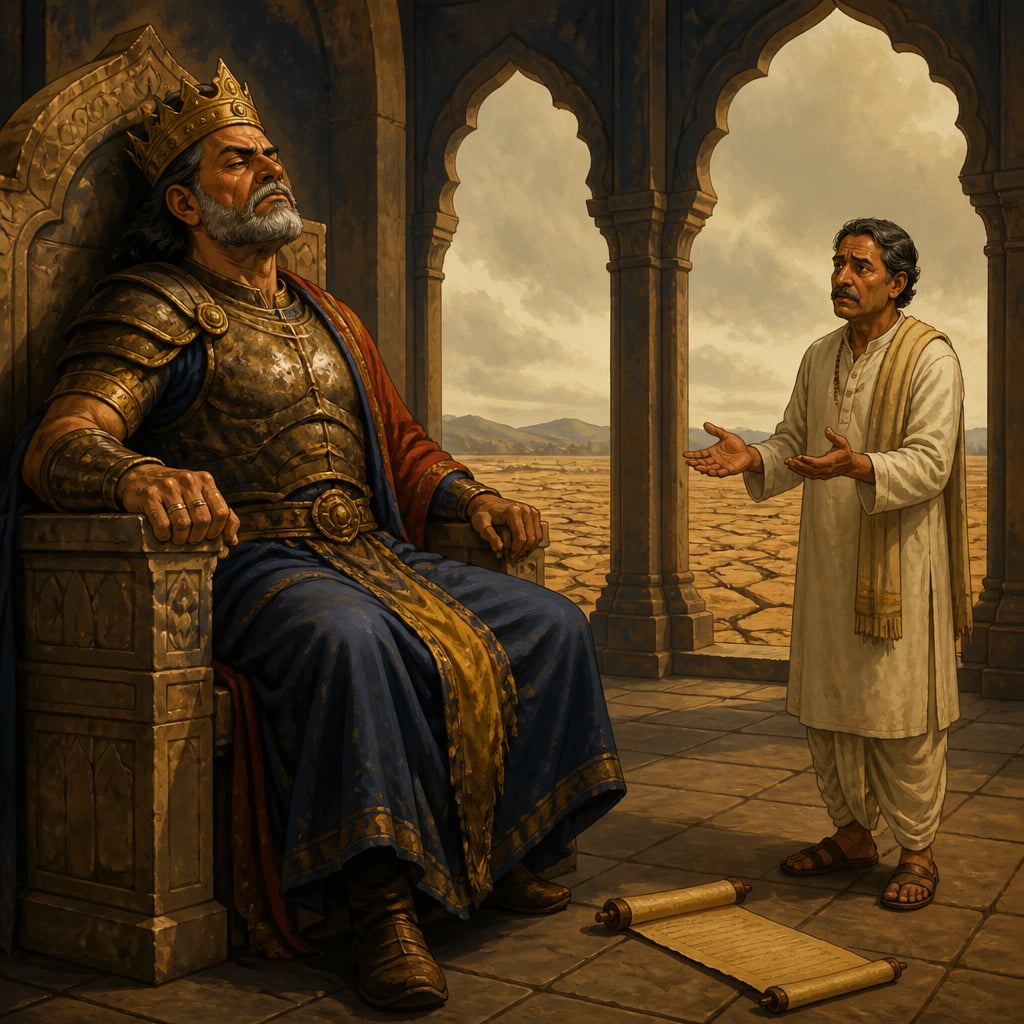
"Majesty," his chief minister said carefully, "we must ask neighboring kingdoms for grain. We must accept their help."
The king's face hardened. "Ask? Accept? I am the king who has never asked. I am the ruler who gives, not receives. I am, "
"You are a man," the minister said quietly, "whose people are dying while he protects his idea of himself."
Something cracked in the king's eyes. Not anger, something deeper. The realization, perhaps, that the crown he thought he wore had been wearing him. That the identity he thought he possessed had possessed him.
This is the teaching of ahaṃkāra: the moment identity stops serving you and you start serving it.
The Vedic Understanding: I-Making
In a culture that often celebrates 'strong ego' and 'self-belief,' understanding ahamkara offers essential balance. Confidence is valuable; inflation is dangerous. The distinction matters because inflated ego doesn't just cause individual suffering, it causes harm to others (Napoleon's soldiers, the king's subjects, the children of fused parents). Learning to observe the ego without being captured by it is both spiritual practice and practical wisdom.
The Sanskrit term ahaṃkāra is precise: aham (I) + kāra (making). It's the "I-making" function, the psychological process by which we construct and maintain a sense of self. This isn't inherently negative. Without some sense of "I," you couldn't function, couldn't distinguish yourself from environment, couldn't take purposeful action.
The problem isn't ahaṃkāra's existence but its excess, when "I-making" becomes "I-defending," when the constructed self becomes a fortress to protect rather than a vehicle to use.
The Rishis distinguished between two modes:
| Mode | Sanskrit | Description |
|---|---|---|
| Healthy | Aham-buddhi | Self-awareness that enables function without fixation |
| Pathological | Ahaṃkāra | Over-identification where ego becomes master, not servant |
In healthy identity (which we explored in previous lessons), you have roles but you're not trapped by them. In ahaṃkāra, the role has you. The king's "I am the ruler who never asks" started as functional identity, probably useful for projecting strength. But when it prevented him from saving his people, the tool had become the tyrant.
What the Mantras Reveal
The Rig Veda contains warnings about ego that echo across millennia:
"mā́ gṛdhaḥ kásyasvid dhánam" "Do not covet anyone's wealth."
Sayana's commentary extends this beyond material wealth: don't covet the dhanam (wealth) of identity either, titles, status, recognition. The grasping (gṛdha) that applies to possessions applies equally to self-image.
Another hymn speaks directly to the illusion:
"ándhō'ndháṃ práṇayati" "The blind leading the blind."
When ego leads ego, we stumble. The "blindness" isn't lack of information but lack of seeing, the ahaṃkāra creates a screen between you and reality, showing you only what confirms the identity you're defending.
The Nasadiya Sukta (RV 10.129) offers the deepest reflection:
"kó addháa véda ká ihá prá vocat" "Who really knows? Who can here proclaim it?"
Even the gods may not know the ultimate origin. This radical humility is anti-ahaṃkāra medicine: if the cosmic itself holds mystery, how can any human ego claim complete knowledge of who it is?
Traditional Interpretations: The Constructed Self
The Sāṃkhya philosophy provides the clearest analysis. According to Sāṃkhya, consciousness (puruṣa) becomes entangled with material nature (prakṛti) through ahaṃkāra, the ego that says "this experience is happening to me; this body is mine; this success is my achievement."
The entanglement happens in stages:
- First, pure awareness gets associated with a body-mind
- Then ahaṃkāra claims ownership: "This is my body, my mind, my experience"
- Then defense begins: "I must protect what is mine"
- Finally, imprisonment: the protector becomes the prison
Sri Aurobindo interprets ahaṃkāra psychologically: it's the "limitation of consciousness" that identifies the infinite Self with a finite form. Not evil, but a necessary stage that becomes obstacle when outgrown. A cocoon is essential for the caterpillar but must be shed for the butterfly.

Living This Today: When Parent Becomes Parenthood
Consider the parent whose identity becomes completely fused with their children's success.
It often begins beautifully. The child is born; love floods in; the parent feels purpose like never before. "I am a mother" or "I am a father" becomes central to self-understanding. This is healthy, parenting should be significant.
But then the fusion can deepen. The child's achievements become my achievements. The child's failures become my failures. "I am a parent" subtly shifts to "I am only a parent", other aspects of identity atrophy as the parent-identity consumes everything.
Now the child's choices become threats. When the teenager rebels, it's not normal development, it's an attack on who I am. When the young adult chooses a different path than I hoped, I experience it as my own failure. When the adult child moves away, I feel not just loss but erasure. If they don't need me, who am I?
This is ahaṃkāra at work. The parent has forgotten that parenthood is a function they perform, not an essence they are. The role became the whole identity, and when the role naturally changes (as children grow), the parent faces what feels like death.
The suffering is real. But the Rishis would say: it was preventable. Not by caring less, but by identifying more lightly. You can pour yourself completely into parenting without believing that parenting is all you are. The intensity is the same; the grip is different.

The Pattern in History: Napoleon's "Invincible" Self
Napoleon Bonaparte's career illustrates ahaṃkāra on a civilizational scale.
His early identity was functional: "I am a talented military strategist." This was accurate. His victories at Toulon, in Italy, in Egypt demonstrated genuine capability. The identity served him, it organized his actions, clarified his decisions, enabled his rise.
But success fed ahaṃkāra. "Talented strategist" became "military genius." "Genius" became "invincible." "Invincible" became "destined." Each inflation seemed confirmed by further victories. The ego grew into a structure that demanded constant feeding.
By 1812, the ahaṃkāra was in full control. Advisors warned against invading Russia. Winter, supply lines, the vastness of the territory, all argued for caution. But the ego couldn't hear. An "invincible" emperor doesn't listen to warnings. A "destined" conqueror doesn't turn back.
The result: 600,000 troops entered Russia; fewer than 100,000 returned. Napoleon's military dominance never recovered. But even in exile on Elba, the ahaṃkāra wasn't finished, he escaped, raised another army, and met final defeat at Waterloo.
The pattern is clear: ahaṃkāra doesn't process negative feedback. It's built to defend identity, not to revise it. When reality contradicts the ego-image, ahaṃkāra doesn't update, it explains away, doubles down, or collapses entirely.
The Mechanics of Ego Inflation
The Rishis would recognize the pattern:
Stage 1: Functional Identity You develop a self-image based on real capacity or role. This is necessary and healthy.
Stage 2: Success Confirmation The identity proves useful. Success follows. The ego registers: "This identity works. Protect it."
Stage 3: Inflation The identity expands beyond its original accuracy. "I'm good at this" becomes "I'm the best." "I'm a parent" becomes "I'm only valuable as a parent."
Stage 4: Rigidity The inflated identity can't tolerate challenge. Negative feedback is rejected. The ego defends rather than learns.
Stage 5: Crisis Reality eventually forces correction. The inflated identity meets something it cannot deny. Either the ego cracks (creating opportunity for growth) or it shatters (creating breakdown).
Napoleon reached Stage 5 in Russia. The parent reaches Stage 5 when the child leaves. The professional reaches Stage 5 when the career ends. The pattern is universal.
Liberation: Holding Identity Lightly
The Rishis' solution wasn't to destroy ahaṃkāra but to see through it. You don't need to stop having identities; you need to stop being possessed by them.
This is the witness-self we explored earlier. There is something in you that observes the ego, watches it construct "I am X" narratives, sees it defend and inflate and grasp. That observer is not the ego. When you can observe the ego without being captured by it, you're free.
Practically, this means:
- Notice when "I am" becomes "I must be", the shift from description to defense signals ahaṃkāra
- Welcome challenges to identity, they're opportunities to hold more lightly
- Distinguish function from essence, you perform as parent, professional, creator; you don't become these roles
- Practice "Not I, not mine", the ancient neti-neti applied to ego constructions
The king in our story faced a choice: protect the ego-identity or save the people. Ego demanded he never ask for help. Reality demanded otherwise. His liberation began when he could say: "I have been a king who doesn't ask. I can be a king who asks. The crown does not require this rigidity."
In the next lesson, we'll explore the positive alternative: psychological flexibility as health, the capacity to adapt identity to reality rather than defend it against reality.
Research on 'self-serving bias' shows that people systematically attribute success to themselves and failure to circumstances. This is ahaṃkāra's fingerprint, protecting the ego-image against disconfirming evidence.
Leaders with 'CEO disease' can't receive honest feedback, their position inflates ego, and ego rejects information that challenges it. Effective leaders build structures that bypass their own ego defenses.
In systems, feedback loops either stabilize or amplify. Ahaṃkāra creates an amplifying loop: success → ego inflation → selective perception → more apparent success → more inflation. Without dampening, the system destabilizes.
Brené Brown's research shows that vulnerability, admitting weakness, acknowledging mistakes, actually increases rather than decreases resilience and connection. The ego fears vulnerability will destroy us; the opposite is true.
Leaders who can say 'I was wrong' or 'I don't know' report higher trust from teams than those who defend an infallible image. Ego thinks admission of error destroys authority; it actually builds it.
Error-acknowledging systems (hospitals, aviation) dramatically outperform error-hiding systems. When the ego of the system prevents error admission, the same mistakes repeat. Confession is systemic learning.
Case studies
When Parent Becomes Parenthood: Identity Fusion in Family
A composite case reflecting a common pattern: A parent invests everything in their children's development. Every achievement is celebrated as shared victory; every setback is felt as personal wound. When asked about themselves, the parent's answers revolve entirely around the children. 'What are your interests?', 'Getting my kids into good schools.' 'What do you do for yourself?', 'I don't have time for that.' Over twenty years, the parent's individual identity atrophies while the parent-identity expands to fill all available space. Then the children leave for college. The parent experiences not just emptiness but identity crisis, if they're not actively parenting, who are they? Depression follows. The crisis isn't about missing the children (though that's real), it's about the constructed self having nothing left to construct around.
This is ahaṃkāra in its most sympathetic form, built through love, not ambition. The parent didn't intend to lose themselves; they intended to serve their children. But the identity fusion happened anyway. 'I am a parent' (functional, healthy) became 'I am only a parent' (fused, limiting) became 'I exist only through my children's success' (complete ahaṃkāra capture). The Rishis would recognize this: even good roles can become prisons. Abhimāna (possessive identification) with children creates suffering because children are not possessions, they're independent beings who will, healthily, differentiate.
Recovery typically requires what feels like grieving a death, the death of the parent-identity that was everything. Through therapy, support, and conscious practice, the parent slowly discovers or rediscovers other aspects of self. The ahaṃkāra structure must be released before new (or old, dormant) identities can emerge. Many parents report that the crisis, painful as it was, led to a richer sense of self, they became more than 'just' a parent by first losing that as their total identity.
Intensity of love doesn't require fusion of identity. You can pour yourself completely into parenting, or any role, without believing the role is all you are. The distinction is subtle but crucial: full engagement versus total identification.
Helicopter parenting, stage parenting, and the 'my child is my legacy' pattern are increasingly recognized by psychologists as harmful to both parent and child. When a parent's self-worth depends entirely on their child's performance, every setback becomes an identity crisis. Building a self that includes parenting but is not consumed by it protects both the parent and the child.
Research on 'empty nest syndrome' shows that parents whose identity was most fused with the parenting role experience the most severe depression when children leave, confirming the ahaṃkāra mechanism.
Napoleon: When Invincibility Becomes Blindness
Napoleon Bonaparte's career traces a textbook arc of ahaṃkāra. His early military identity was functional: 'I am skilled at strategy.' Victories at Toulon (1793), in Italy (1796-1797), and Egypt (1798-1799) confirmed and expanded this. By 1804, he crowned himself Emperor. By 1811, he controlled most of Europe. Each success inflated the identity: 'talented' became 'genius' became 'invincible' became 'destined by history.' In 1812, advisors unanimously warned against invading Russia. The territory was vast, winter brutal, supply lines vulnerable. Every rational analysis pointed to catastrophic risk. Napoleon dismissed all warnings. An invincible emperor, destined by history, doesn't turn back from challenges.
Napoleon demonstrates mada (intoxication of success) leading to complete ahaṃkāra capture. His ego-identity, 'the invincible conqueror', had been fed by years of victory until it became the master rather than servant. When reality (Russian winter, guerrilla tactics, supply collapse) contradicted the ego-image, he couldn't process it. The ego-logic was: 'I am invincible, therefore this will work.' Reality-logic was: 'This will not work, regardless of who you are.' Ahaṃkāra always chooses ego-logic until reality forces otherwise. For Napoleon, 'otherwise' meant 600,000 soldiers dead or captured in a single campaign.
The Russian disaster broke Napoleon's military dominance. He was exiled to Elba, escaped, raised another army, and was definitively defeated at Waterloo (1815). Even in final exile on St. Helena, he spent years writing memoirs that defended his decisions and maintained his greatness. The ahaṃkāra structure, even when defeated externally, continued internally, constructing narratives that protected the ego-image until death.
Ahaṃkāra doesn't process negative feedback, it's built to defend identity, not revise it. When reality contradicts ego-image, the ego doesn't update; it explains away, doubles down, or collapses. Intelligence doesn't protect against this; Napoleon was genuinely brilliant. Only viveka (discriminating awareness) that can observe the ego from outside offers protection.
Founders who identify so completely with their startup that they cannot hear feedback, CEOs who surround themselves with yes-men, and political leaders who confuse personal criticism with national insult all display Napoleon's pattern. The inability to process negative feedback is a reliable predictor of eventual catastrophic failure in any leadership role.
Napoleon won 53 of his 60 major battles, yet the 7 losses driven by ego-blindness cost him his empire, his freedom, and ultimately his life on St. Helena.
Reflection
- When was the last time you resisted admitting you were wrong? What identity was your ego protecting? What would have happened if you'd simply admitted the error?
- Which of your identities do you most fear losing? What would remain if that identity were stripped away? Can you sense the witness that would still be there?
- If the ego is constructed (ahaṃkāra = 'I-making'), who or what is doing the constructing? Can the constructed observe the constructor?