Saṅgha: Belonging Without Losing Self

How the Rishis Balanced Community and Individuality

Exploring the Vedic wisdom of maintaining authentic selfhood while participating fully in community life. The Rishis understood that true belonging enriches rather than erases individual identity.

In a village by the Yamunā, a young man named Devadatta had earned his place in the sabhā, the village council. For three seasons he had watched, listened, learned the rhythms of consensus. The elders valued harmony above all else.

Then came the matter of the merchant's tax.
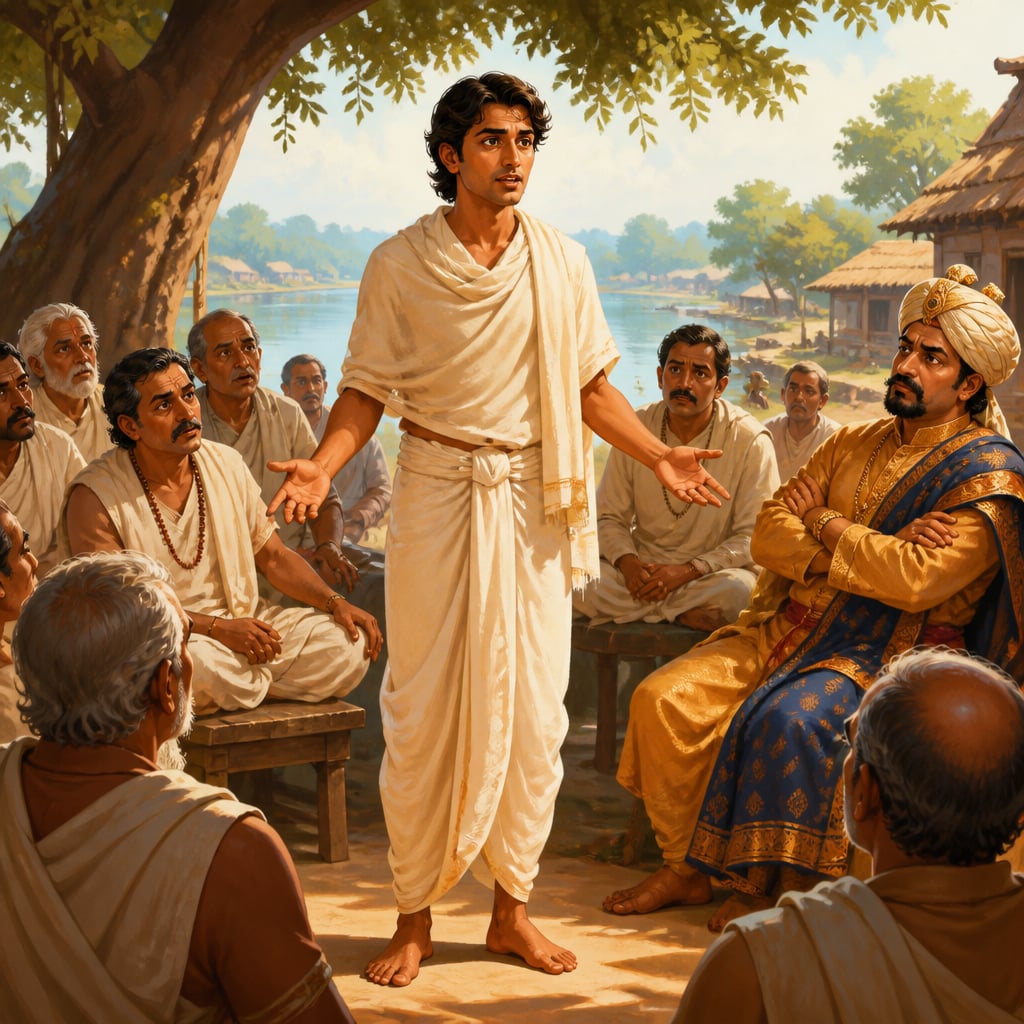
Young villager Devadatta standing in the village sabha

The wealthy grain merchant proposed a levy that would fall hardest on the poorest farmers, those who could least afford it. One by one, the council members nodded. The merchant was powerful. His goodwill kept the village prosperous. And besides, the levy was 'for the common good.'

Devadatta felt something twist inside him. He had seen his neighbor's children go hungry. He knew where this levy would truly land.

But to speak would mean standing alone. It would mean breaking the harmony he had worked so hard to become part of. The elders might never look at him the same way again.

He remembered his grandfather's words: 'A man who only echoes others has surrendered his ātman to the crowd. But a man who cannot sit with others has lost something equally precious.'

This is the central tension the Rig Vedic seers understood, the dance between saṅgha (community belonging) and svasvarūpa (one's own essential nature). They didn't see these as opposites to choose between, but as complementary forces to balance.

The Rishis lived in communities. They gathered in assemblies, shared knowledge, performed rituals together. Yet each maintained their unique perspective, their individual relationship with truth. The Rig Veda itself is not one voice but many, sometimes agreeing, sometimes questioning each other, always in dialogue.

Consider Ṛgveda 10.191: 'Saṃ gacchadhvaṃ saṃ vadadhvaṃ saṃ vo manāṃsi jānatām', 'Come together, speak together, let your minds know together.' This famous verse is often cited for unity. But notice: it calls for minds to 'know together,' not to 'think the same.' Unity of purpose, not uniformity of thought.

The Vedic assembly (sabhā) operated on a remarkable principle: dissent was sacred. The one who questioned the consensus was performing a vital function, testing the truth against different perspectives. Without the dissenter, the group would become an echo chamber, mistaking agreement for wisdom.

This is the paradox of authentic belonging: you can only truly be part of a community when you bring your whole self to it. The person who hides their real thoughts to fit in hasn't joined the community, they've abandoned themselves and offered the group a mannequin.

Devadatta, in our story, faced what every conscious person faces: the fear that speaking truth would exile him from belonging. But the deeper wisdom is this, a community that demands you erase yourself was never offering real belonging in the first place.

A small Indian classical ensemble harmonizing distinct voices

The Rishis had a term for this: svabhāva-sthiti, remaining established in one's own nature while participating in collective life. It's the bamboo that bends with wind but returns to its center. It's the musician in the ensemble who blends with others yet maintains their distinct voice.

When Devadatta finally spoke, hands trembling, voice steady, something unexpected happened. Two other council members who had been silent admitted they shared his concerns. The merchant's proposal was modified. And Devadatta discovered that his voice, far from destroying his belonging, had deepened it. The elders respected him more, not less.

The Vedic insight is psychologically profound: communities need individuals who maintain their authentic perspective. And individuals need communities that can hold difference without demanding erasure.

This is why the Rig Veda speaks of 'ṛta', cosmic order, as a harmony that includes all the diverse notes, not a monotone that silences them. True saṅgha is not a mass of identical people; it's a gathering of whole selves who choose to walk together while remaining themselves.

Case studies

The Grassroots Organizer: Building Movements Without Burning Out

In the early 2000s, a young woman joined an environmental justice movement in her industrial hometown. The community was passionate, committed, and deeply interconnected. They won real victories, blocking polluting factories, securing health resources for affected families. But she noticed something troubling. Long-time members were burning out. The movement demanded total identification: every conversation, every friendship, every choice had to serve 'the cause.' Those who set boundaries were subtly labeled as less committed. Personal struggles were minimized compared to collective struggles. She made a different choice. She maintained friendships outside the movement. She kept her spiritual practice separate from activism. She sometimes said 'no' to events, prioritizing her wellbeing. Some questioned her dedication. Yet she became one of the movement's most effective voices, precisely because she had preserved something to give. After a decade, many early members had left, exhausted and disillusioned. She remained, stable and sustainable, having understood what others missed: you cannot pour from an empty cup. Her secret was svabhāva-sthiti, remaining established in her own nature while fully participating in collective action. She belonged to the movement without being consumed by it. The boundary wasn't a wall but a membrane, allowing exchange while maintaining integrity. The irony: by not making the movement her entire identity, she could serve it more effectively and longer than those who had. Her lesson for modern collective action is profound, movements need members who bring whole selves, not burned-out husks. Sustainable belonging requires sustainable selves.

The organizer exemplified svabhava-sthiti: remaining established in one's own nature while fully participating in collective action. The Vedic principle teaches that the self must be stable before it can sustain service. Like a lamp that must be lit before it can illuminate a room, the individual must be whole before the collective benefits.

The organizer remained effective and engaged for over a decade, outlasting many original members who burned out. By preserving her individual identity while participating fully, she demonstrated sustainable activism rooted in svabhava-sthiti.

Sustainable belonging requires a sustainable self. Movements, organizations, and relationships that demand total identification eventually consume the very people they need most. The boundary between self and group is not a wall but a membrane: it allows exchange while maintaining integrity. You cannot pour from an empty cup.

Activist burnout is one of the most common reasons social movements lose momentum. When members cannot distinguish between their personal identity and the cause, every setback feels like personal destruction. Sustainable activism requires the same boundary the grassroots organizer learned: you can be fully committed without being fully consumed.

Research on activist burnout shows that 60% of social movement participants disengage within 3 years, while those maintaining independent identity sources sustain engagement 2-3x longer.

Guru Nanak (1469-1539): Walking Between Worlds

In 15th century Punjab, religious identity was sharply divided. You were Hindu or Muslim. Your community, your practices, your allegiances were determined at birth. To belong meant to conform. Nanak was born Hindu but refused this limitation. After a profound spiritual experience at age 30, he declared: 'There is no Hindu, there is no Muslim.' This wasn't a rejection of community, it was a refusal to let community boundaries define the truth. For the next twenty years, Nanak walked. He visited Mecca dressed as a pilgrim. He sat with Hindu sadhus at Varanasi. He engaged Sufi masters in dialogue. He traveled to Tibet, Sri Lanka, and Baghdad. Everywhere, he participated fully in local communities while maintaining his distinct voice. What made Nanak remarkable wasn't that he rejected belonging, he deeply belonged to multiple communities simultaneously. He wore the Hindu sacred thread AND the Muslim prayer beads. He drew from Vedic wisdom AND Islamic mysticism. He didn't average these traditions into something bland; he synthesized them into something new. When disciples gathered around him, he created a community (the Sikh sangat) built on different principles. No caste distinctions. Hindu and Muslim sat together for langar (community meal). Women participated equally. The community existed to support individual spiritual growth, not to demand conformity. Nanak embodied the Vedic principle of unity through diversity. His famous couplet captures it: 'Truth is high, but higher still is truthful living.' Belonging to truth meant he could walk freely between communities that thought themselves opposed, seeing the common thread they couldn't see. His legacy, 25 million Sikhs worldwide, proves that authentic belonging, rooted in personal truth rather than tribal conformity, can build communities that endure for centuries.

Nanak embodied the Vedic principle of unity through diversity (ekam sat vipra bahudha vadanti). His refusal to be confined by a single community's boundaries mirrors the Rig Vedic understanding that truth transcends the containers that hold it. Belonging to truth meant he could walk freely between communities that thought themselves opposed.

Nanak founded the Sikh tradition that now has 25 million followers worldwide, built on the principle that authentic belonging transcends tribal boundaries. His community, the sangat, endured because it honored individual truth within collective practice.

Authentic belonging is rooted in personal truth rather than tribal conformity. Nanak showed that honoring your own insight allows you to connect more deeply with diverse communities, not less. The one who belongs to truth can walk freely between worlds that think themselves opposed, seeing the common thread others cannot.

In an era of rigid political and cultural tribalism, where belonging to one group often requires hostility toward another, Nanak's example of authentic belonging across boundaries is especially needed. People who refuse to be reduced to a single tribal identity, who draw from multiple traditions while remaining rooted in personal truth, often become the bridges their communities desperately need.

Guru Nanak traveled over 28,000 km across South Asia, the Middle East, and Central Asia during his four Udasis (journeys), engaging with Hindu, Muslim, Buddhist, and Jain communities while founding the Sikh tradition of 25 million followers.

Reflection

More in Ātman: The Self & Identity

All lessons in Ātman: The Self & Identity · Rig Vedic Psychology course