Sama: Balance Over Perfection

The Inner Landscape Seeks Equilibrium, Not Stillness

The Vedic path does not aim for a frozen, perfect inner state. Like a river flowing between banks, the goal is dynamic balance, forces in equilibrium, not eliminated. This lesson explores why wholeness, not perfection, is the true aim of psychological health.

A frustrated young student before the morning fire

"Guru-ji, my meditation was terrible today."

The student sat by the morning fire, frustration evident in his voice. The old teacher continued to tend the flames, adding small pieces of wood, adjusting, watching.

"Tell me what happened."

"Thoughts kept coming. I tried to stop them, but they returned. Emotions arose, frustration, then anger at myself for being frustrated, then despair. I could not reach stillness. I failed."

The teacher gestured to the fire between them. "What would happen if I made this fire perfectly still? No movement, no flickering?"

"It would... go out."

"Yes. Fire lives by movement. And the river, what if it achieved perfect stillness?"

"It would become a stagnant pond."

"So why do you believe your inner fire, your inner river, should be frozen into stillness? Who taught you that life should stop moving?"

The Tyranny of Perfection

The Vedic model of balance offers liberation from the tyranny of perfectionism. You don't need to achieve a frozen, ideal state. You need to develop the capacity to return, to come back to center when displaced. This is achievable, practical, and aligned with how living systems actually work.

Somewhere along the way, spiritual seeking became confused with perfection-seeking. The goal became a still mind, a pure heart, an unwavering equanimity, a state with no disturbing thoughts, no inconvenient emotions, no messy contradictions.

But this is not what the Rig Veda teaches.

The Rishis who composed the hymns were not monks in caves. They were householders, married, with children, with cattle and crops to tend. They experienced desire and frustration, fear and anger, joy and grief. Their hymns express the full range of human emotion, not a sanitized, perfected version of life.
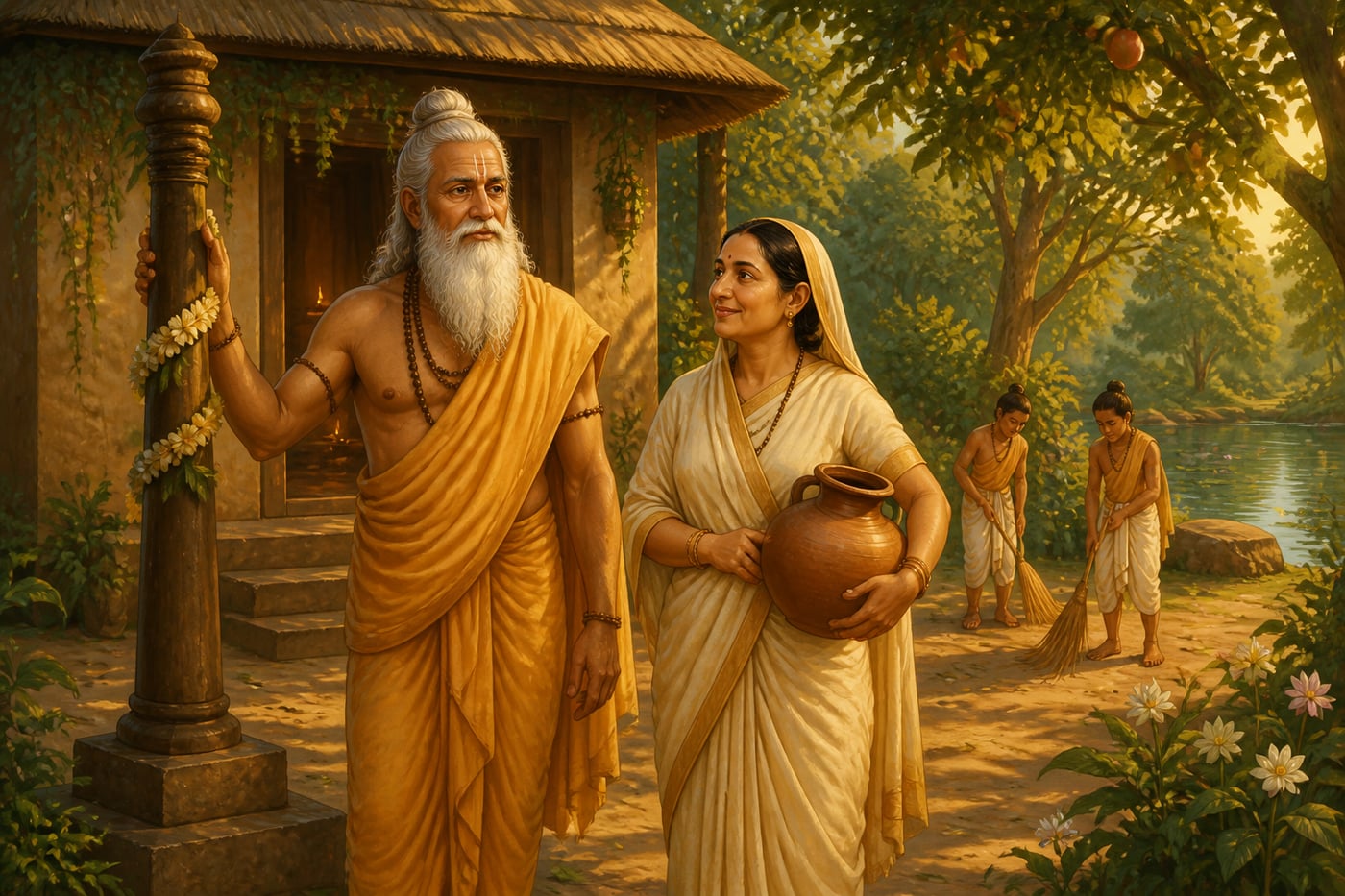
Vasishtha and Arundhati at their forest hermitage

Rishi Vasiṣṭha had a wife, Arundhatī, whose devotion became legendary. Rishi Viśvāmitra struggled with anger his entire life, his famous rivalry with Vasiṣṭha is part of the tradition. Rishi Bharadvāja worried about providing for his family. These were not perfected beings beyond emotion; they were balanced beings who could hold the full range of human experience without being destroyed by it.

Sama: The Vedic Concept of Balance

The Sanskrit term sama means evenness, balance, equilibrium. It appears throughout the Vedic literature, not as a static state but as a dynamic relationship.

"samaṃ manaḥ"

"A balanced mind"

This phrase doesn't mean a mind without movement. It means a mind in equilibrium, like a scale that can tip and return, a river that flows between its banks, a fire that burns steadily without either dying or raging out of control.

A clear river flowing steadily between two strong stone banks at midday

The opposite of sama is not emotion or movement; it is excess, going too far in any direction. Too much stimulation overwhelms; too little leads to numbness. Too much activity exhausts; too little stagnates. The Vedic path seeks the middle, not by avoiding the extremes but by moving between them and returning to center.

Krishna articulates this in the Bhagavad Gita:

"yuktāhāra-vihārasya yukta-ceṣṭasya karmasu | yukta-svapnāvabodhasya yogo bhavati duḥkha-hā"

"For one who is balanced in eating, recreation, balanced in action, balanced in sleep and waking, yoga becomes the destroyer of suffering." , Bhagavad Gita 6.17

Notice: the goal is not to stop eating, sleeping, or acting. It is to find balance, yukta, joined to the middle way.

The Nervous System's Wisdom: Polyvagal Balance

Modern neuroscience confirms what the Rishis observed. Stephen Porges' Polyvagal Theory reveals that the nervous system is not seeking stillness, it is seeking safety through flexibility.

Porges identifies three states of the autonomic nervous system:

  1. Ventral Vagal (social engagement): calm, connected, present
  2. Sympathetic (fight/flight): mobilized, activated, ready for action
  3. Dorsal Vagal (shutdown): collapsed, numb, disconnected

Psychological health is not about staying in ventral vagal permanently (impossible) or never experiencing sympathetic activation (also impossible and undesirable, you need fight/flight for genuine threats). Health is about flexibility, the ability to move between states and return to balance.

This is exactly the Vedic model: sama is not a frozen state but a dynamic equilibrium. The healthy inner landscape can be activated (sympathetic), can rest deeply (dorsal), can engage warmly (ventral), and can return to center after each movement. The problem is getting stuck, frozen in anxiety (chronic sympathetic) or frozen in collapse (chronic dorsal).

The clinical concept of the "window of tolerance" captures this: we each have a range within which we can experience activation and still function. The work is not to eliminate activation but to widen the window, to be able to hold more without losing balance.

The Danger of Perfectionism

Carol Dweck's research on mindset reveals the psychological cost of perfectionism. A "fixed mindset", believing ability is static and must be proven, leads to fragility: people avoid challenges (might fail), hide mistakes (reveals imperfection), and collapse under criticism (threatens identity).

The Vedic path offers what Dweck calls a "growth mindset": ability develops through effort, mistakes are information, challenges are opportunities. But the Vedic frame goes deeper: you are not your performance at all. You are the witness, the landscape through which performances move.

Kristin Neff's research on self-compassion reveals that treating yourself with kindness (rather than harsh self-judgment) actually produces better outcomes, more motivation, more resilience, more willingness to try again after failure. Perfectionism doesn't work even on its own terms; self-compassion does.

The Rishis who expressed frustration and longing in their hymns were not failing at spirituality, they were practicing it. The hymns to Varuna that confess wrongdoing and ask for forgiveness model a relationship to imperfection: acknowledge it, learn from it, release it. Not perfection, but return.

Psychological Flexibility: The Modern Sama

Acceptance and Commitment Therapy (ACT), developed by Steven Hayes, offers a modern framework remarkably aligned with Vedic psychology. ACT identifies psychological flexibility, not rigid control, as the key to wellbeing.

Psychological flexibility has six components:

  1. Acceptance: allowing thoughts and feelings without fighting them
  2. Defusion: seeing thoughts as thoughts, not as reality (the Vedic witness)
  3. Present moment: being here now, not lost in past/future (the Manas Sukta's teaching)
  4. Self-as-context: you are the space in which experience happens, not the content (the two birds)
  5. Values: knowing what matters to you (dharma)
  6. Committed action: moving toward values despite discomfort

Notice: the goal is not to eliminate difficult thoughts and feelings. It is to hold them flexibly while moving toward what matters. This is sama, balance that allows movement, not rigidity that prevents it.

Martin Seligman's Positive Psychology research confirms: flourishing (what he calls PERMA, Positive emotion, Engagement, Relationships, Meaning, Achievement) is not about maximizing any single element but about balance among them. Too much positive emotion without meaning becomes hedonism; too much achievement without relationship becomes isolation. Wellbeing is integrated, sama.

The River, Not the Pond

Ayurveda, the Vedic science of health, understands the body as a system of three doshas, vata (air/movement), pitta (fire/transformation), kapha (earth/stability). Health is not about eliminating any dosha but about maintaining their dynamic balance. Each person has a unique constitution; the goal is your balance, not some abstract ideal.

When vata is excessive, anxiety and scattered thinking arise. When pitta is excessive, anger and inflammation. When kapha is excessive, lethargy and stagnation. The Ayurvedic approach is not to eliminate these forces but to bring them into relationship, sama.

This applies directly to the inner landscape. You will have days of high energy and days of low. Periods of clarity and periods of confusion. Seasons of creativity and seasons of rest. The perfectionistic mind judges these fluctuations as failure; the balanced mind recognizes them as the natural rhythm of a living system.

Coming Home to Center

The student by the fire was quiet. Then: "So my meditation was not a failure?"

"Your meditation was alive. Thoughts moved, emotions moved, awareness moved. The question is not whether movement happened, it always will. The question is: did you return? When you noticed the frustration, did awareness come back to the breath? When despair arose, did some part of you witness it?"

"Yes... I suppose it did."

"Then you practiced. The practice is not achieving stillness. The practice is returning. Every return strengthens the capacity for balance. The river is not failing when it touches its banks, it is finding its way."

You are not meant to be still. You are meant to be balanced, capable of movement and return, activation and rest, engagement and withdrawal. The inner landscape is a living terrain. It breathes. It flows. It seeks equilibrium, not death.

Perfection is a frozen ideal that life cannot sustain. Balance is the living art of coming home, again and again, to center.

Stephen Porges' Polyvagal Theory shows that the nervous system has three states: social engagement (ventral vagal), fight/flight (sympathetic), and shutdown (dorsal vagal). Health is not staying in one state but having flexibility to move between states and return to balance. Dan Siegel's 'window of tolerance' measures this: how much activation can you hold before losing function?

Effective leaders have wide windows of tolerance, they can face crises without either panicking (hyperactivation) or checking out (hypoactivation). The capacity to stay regulated under pressure, or to return quickly when dysregulated, is a trainable leadership skill.

Systems seek homeostasis, dynamic balance, not rigidity. A healthy organization can handle stress (activation) and also rest (recovery). Organizations stuck in perpetual crisis mode or perpetual inertia are dysregulated systems. Balance is systemic health.

ACT (Acceptance and Commitment Therapy) identifies psychological flexibility as the key predictor of wellbeing. Its six components, acceptance, defusion, present moment, self-as-context, values, committed action, map remarkably onto Vedic psychology: allow thoughts/emotions (acceptance), see them as passing (defusion/witness), be present (manas returning), know the witness (self-as-context), understand dharma (values), act accordingly (committed action).

Carol Dweck's growth mindset research shows that flexible self-concept ('I can learn and improve') outperforms rigid self-concept ('I must prove my worth'). Kristin Neff's self-compassion research shows that self-kindness produces better outcomes than self-criticism. Both point to flexibility over rigidity.

Organizations need both stability (structure, process) and flexibility (adaptation, innovation). Too much rigidity and the system can't respond to change. Too much flexibility and the system has no coherence. The art is dynamic balance, sama at the organizational level.

Case studies

Polyvagal Theory: The Nervous System Seeks Balance, Not Stillness

In the 1990s, neuroscientist Stephen Porges proposed Polyvagal Theory, revolutionizing our understanding of the autonomic nervous system. Traditional models saw two states: fight/flight (sympathetic) and rest/digest (parasympathetic). Porges identified a third: the 'social engagement system' (ventral vagal), and showed that the parasympathetic has two branches, one for healthy rest (ventral) and one for dangerous shutdown (dorsal). The nervous system, he demonstrated, is not seeking one state but the flexibility to move between states safely.

Polyvagal Theory validates the Vedic concept of sama. The Rishis didn't teach elimination of arousal states but balance among them, the capacity to be activated (sympathetic) when appropriate, to rest deeply (dorsal appropriately engaged), and to connect socially (ventral). The 'window of tolerance' concept maps directly onto sama: how wide is the range within which you can function? The practice is widening the window, not narrowing life.

Polyvagal Theory has transformed trauma therapy, parenting approaches, and understanding of anxiety disorders. Therapists now work to expand clients' 'windows of tolerance' rather than simply reducing activation. Schools use 'regulation' techniques. The understanding that safety is felt through flexible nervous systems, not rigid control, aligns ancient and modern wisdom.

Your nervous system is not designed for permanent calm. It is designed for flexible responsiveness, activation when needed, return when safe. Health is not the absence of stress response but the capacity to move through states and return to equilibrium. This is sama embodied.

Workplace wellness programs that promise permanent stress-free states set employees up for failure. Polyvagal Theory confirms what the Rishis taught: the goal is not to eliminate activation but to recover from it efficiently. Teaching nervous system flexibility, not permanent calm, is the more honest and effective approach for high-pressure careers in tech, medicine, or finance.

Studies show that trauma survivors have narrowed windows of tolerance, they become hyperactivated or shut down more quickly. Effective therapy widens these windows, restoring the flexibility that is nervous system health (Porges, 2011; Siegel, 1999).

The Rishis as Householders: Integration, Not Renunciation

The Rishis who composed the Rig Veda were overwhelmingly householders, married, with children, with livestock and fields. Vasiṣṭha and Arundhatī were a legendary couple; their names are still invoked at Hindu weddings. Viśvāmitra had sons and struggled with rivalry. Atri's family included his wife Anasūyā and sons who also became Rishis. These were not renunciates who had transcended ordinary life but engaged participants who found wisdom within it.

This challenges the assumption that spiritual development requires withdrawal from life. The Rishis modeled integration, holding sacred vision alongside daily responsibility, balancing inner development with outer engagement. They didn't seek perfection by eliminating desire, family, or emotion. They sought sama, balance that includes the full range of human experience.

The householder Rishi became the model for Vedic society. Later traditions would emphasize renunciation (sannyāsa), but the Vedic foundation was integration. This is why Hindu tradition includes both paths, and why the householder stage (gṛhastha) is often called the most important of the four life stages (āśramas). Fullness, not escape.

You don't have to withdraw from life to develop spiritually. The Rishis found wisdom while raising families, tending cattle, and negotiating with rivals. Spiritual depth and worldly engagement are not opposites, they can be balanced. This is the Vedic path: sama in full life, not sama by avoiding life.

The modern wellness industry often implies you need a retreat, a sabbatical, or a major life change to grow spiritually. The Rishis composed humanity's most profound hymns while managing households, livestock, and community disputes. This is directly relevant to working parents, caregivers, and busy professionals who feel they cannot 'find time' for inner work.

Over 90% of the hymn composers named in the Rig Veda were householders with families, not renunciates, indicating that Vedic psychological insight arose from engaged life, not withdrawal.

Reflection

More in Antaryāmin: The Inner Landscape

All lessons in Antaryāmin: The Inner Landscape · Rig Vedic Psychology course