Bhāva: Emotions as Signals, Not Enemies

Messengers from the Depths Deserve a Hearing

The Rig Veda treats emotions not as disturbances to be suppressed nor as masters to be obeyed, but as messengers from the depths, signals carrying vital information from the hidden three-fourths of our inner landscape. This lesson explores how to listen to emotions without being controlled by them.

"Guru-ji, I am ashamed."

The young student stood before his teacher, eyes cast down. The dawn fire crackled between them.
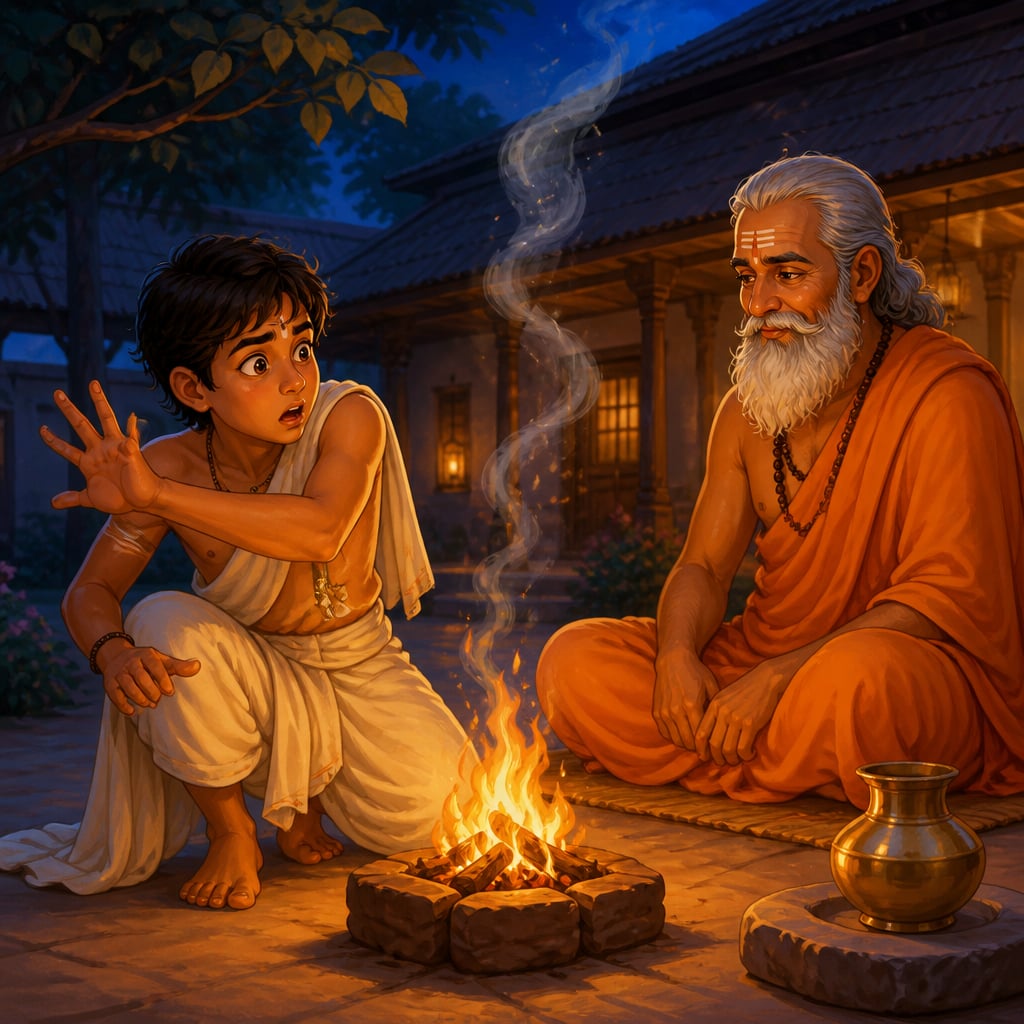
A young student lowering his eyes before his teacher beside the dawn fire

"What troubles you?"

"Tomorrow I must speak before the assembly for the first time. And I am... afraid." He said the word as if it were poison. "A Brahmin should not feel fear. I have failed before I have even begun."

The old teacher was silent for a long moment. Then he smiled.

"Tell me, when you place your hand near the fire, what happens?"

"I feel heat, Guru-ji."

"And what do you do?"

"I pull my hand back."

"Do you feel shame that your hand feels heat? Do you consider it a failure of your hand?"

The student looked confused. "No, of course not. Heat is how the body knows to protect itself."

"And fear? Is that not how your inner being knows something important is at stake? The fire sends heat; the depths send fear. Both are messengers. Why would you shame the messenger for delivering a message?"

Emotions as Messengers from the Depths

In a culture that often pathologizes emotion or swings to the other extreme of 'follow your feelings' reactivity, the Vedic middle path offers wisdom: emotions are messengers deserving a hearing, but the witness, not the emotion, makes the final choice. This integration of feeling and awareness is psychological health.

The Rig Veda does not treat emotions as problems to be eliminated. The hymns are full of emotion, grief at death, fear in battle, longing for the divine, joy at dawn, anger at enemies, love for Soma. The Rishis did not suppress these movements; they listened to them.

Remember the teaching from the first lesson: three-fourths of our inner life is hidden in the guhā, the cave of the heart. Emotions are how that hidden realm communicates with the surface. When fear arises, the depths are signaling: Pay attention. Something important is happening. When anger flares, the depths are announcing: A boundary has been crossed. When grief overwhelms, the depths are insisting: Something precious has been lost. Honor it.

To suppress an emotion is to shoot the messenger. The message doesn't disappear, it just goes underground, emerging later in distorted form.

The Heart Knows What the Mind Cannot Speak

The Rig Veda repeatedly locates emotion in the hṛdaya, the heart-space:

"hṛdā matiṃ janaye"

"From the heart, I generate understanding." , Rig Veda 1.171.2

Notice: the heart generates understanding. Emotion is not opposed to wisdom, it is a source of wisdom. The hṛdaya knows things that the manas (processing mind) cannot articulate. This is why we speak of "heartfelt" truth, why important decisions are confirmed by a sense in the chest, why something can be intellectually correct yet feel wrong.

The Rishis honored this body-based knowing. When invoking Agni, they often spoke of the fire that burns in the heart, not just the fire on the altar. This inner fire illuminates, but it also feels. Awareness and emotion were not separated.

Rasa: Emotion as Doorway

A classical dancer expressing rasa at sunset

The tradition that most fully developed this insight was the theory of rasa, aesthetic emotion as spiritual experience. The great Kashmiri philosopher Abhinavagupta (10th-11th century CE) taught that emotions in art (poetry, drama, music) could become doorways to transcendent states.

Abhinavagupta identified nine primary rasas: love (śṛṅgāra), humor (hāsya), sorrow (karuṇa), anger (raudra), courage (vīra), fear (bhayānaka), disgust (bībhatsa), wonder (adbhuta), and peace (śānta). Each was a valid pathway. The devotee who weeps in bhakti and the warrior who blazes with fury before battle, both are experiencing rasa, emotion as gateway.

This stands in sharp contrast to traditions that treat emotion as purely obstacle. For Abhinavagupta, the problem was never the emotion itself, but unprocessed, unconscious, reactive emotion. When emotion is witnessed, savored, allowed to complete its movement, it becomes rasa, aesthetic nectar, spiritual fuel. When it is suppressed or blindly acted upon, it becomes poison.

This teaching has echoes in Krishna's guidance to Arjuna in the Bhagavad Gita. When Arjuna is overwhelmed by grief and confusion before the battle, Krishna does not say "Stop feeling." He helps Arjuna understand his emotions, their source, their meaning, their proper place. The emotion is not the enemy; unconsciousness is.

The Body's Wisdom: Interoception

Listening to the body's signals from the heart-space

The Vedic insight that the heart "knows" finds modern validation in the science of interoception, the perception of internal bodily states. We now understand that emotions are not purely mental events; they are bodily events that the brain interprets.

You feel anxiety as tightness in the chest, butterflies in the stomach, quickened breath. You feel anger as heat in the face, tension in the jaw, clenched fists. These physical sensations are the emotion, not symptoms of it, but the thing itself.

This is why the Rig Veda places emotional wisdom in the hṛdaya rather than the head. The heart, the gut, the whole body participates in knowing. When we ignore bodily signals, overriding fatigue, suppressing fear, powering through distress, we cut ourselves off from vital intelligence.

Antonio Damasio's research on patients with damage to emotion-processing brain regions revealed something startling: without access to emotional signals, people make terrible decisions. They can reason logically, but they cannot feel which options matter. Emotion, it turns out, is not the enemy of reason, it is the foundation of practical wisdom.

Working With Emotions: The Vedic-Modern Synthesis

How do we work with emotions skillfully? The Vedic approach aligns remarkably with what modern emotion regulation research has discovered:

1. Recognition (Not Suppression)

The first step is to notice the emotion arising. James Gross's research at Stanford shows that suppression, trying not to feel, backfires: suppressed emotions don't disappear, they intensify and leak out in other ways. The Vedic witness (sākṣin) offers a better approach: acknowledge what is arising without either suppressing or acting out.

2. Location (Body-Based Awareness)

Where do you feel it? Fear might be a cold tightness in the chest. Anger might be heat rising in the face. By locating the emotion in the body, you shift from being in the emotion to observing it, the two-birds practice applied to feeling states.

Marsha Linehan's Dialectical Behavior Therapy (DBT), developed for people with intense emotions, includes exactly this practice: notice where in the body the emotion lives. This alone creates space.

3. Investigation (What Is the Message?)

What is this emotion trying to tell you? Fear before public speaking may signal: This matters to you. Anger at a colleague may reveal: A value has been violated. Grief may insist: Something needs to be honored before you move on. The emotion is a messenger; what is the message?

Daniel Goleman's work on emotional intelligence emphasizes this capacity, not just to feel emotions, but to understand them, to decode their meaning. Marc Brackett's RULER program teaches children this skill: Recognize, Understand, Label, Express, Regulate. The sequence matters: understanding comes before regulation.

4. Allowing (Completion, Not Catharsis)

Emotions have a natural arc, they arise, peak, and subside. When we allow this arc to complete (without suppressing or amplifying), the emotion metabolizes. This is not the same as catharsis (venting anger by punching pillows) which often intensifies the emotion. It is witnessing: feeling fully, without acting reactively, until the wave passes.

Lisa Feldman Barrett's research suggests that the emotions we experience are partly constructed by our concepts and expectations. By bringing curiosity rather than fear to emotional experience, we literally change what we feel. The Vedic witness transforms not just our relationship to emotion, but the emotion itself.

The Fear at Dawn: Completing the Teaching

The young student looked up. "So fear before my speech is... normal? Not shameful?"

"Fear before something important is intelligent. It means your body knows this matters. The question is not how to eliminate the fear, but how to let it speak its message and take your seat anyway."

"What is fear's message, Guru-ji?"

"Usually: Pay attention. Be present. This matters. Sometimes: Prepare more. Occasionally: This is genuinely dangerous, reconsider. You must learn to distinguish these. The only way to learn is to listen."

"And the shame I feel about being afraid?"

The teacher's eyes softened. "That too is a messenger. It says: You believe fear is weakness. Ask yourself, who taught you that? Is it true? Or is fear simply the depths speaking?"

Emotions are not enemies. They are the voice of the guhā, the hidden cave, speaking in the only language it knows. Learn to listen. The messenger has traveled far to reach you.

Antonio Damasio's 'somatic marker hypothesis' demonstrates that emotions are essential to rational decision-making. Patients with damage to emotion-processing brain regions can reason logically but make disastrous life decisions, they cannot 'feel' what matters. The heart's understanding is real.

Effective leaders trust their 'gut feeling' while also examining it. The felt sense that 'something is off' in a deal or a hire often proves accurate. Emotional intelligence research (Goleman, Salovey & Mayer) confirms: leaders who access emotional information outperform those who rely on analysis alone.

In complex systems, emergent patterns are often felt before they're seen. The unease that 'something isn't working' may detect system dysfunction before metrics show it. Emotional signals are data from the field, ignore them at your peril.

James Gross's emotion regulation research distinguishes between suppression (trying not to feel, which backfires) and reappraisal (changing how you see the situation). The rasa approach adds a third option: full witnessing without either suppression or reaction, allowing the emotion to complete its natural arc.

Marsha Linehan's DBT (Dialectical Behavior Therapy) teaches 'radical acceptance' of emotions, neither fighting them nor drowning in them. Leaders who can feel fear fully without being paralyzed, or feel anger fully without acting destructively, access the energy of emotion without its dangers.

In organizational change, unexpressed emotions become system dysfunctions. Teams that can surface and witness difficult emotions (fear of change, grief for what's being lost) move through transitions more effectively than teams that suppress 'negativity.'

Case studies

Damasio's Somatic Markers: When Emotion Disappears, Reason Fails

In the 1990s, neuroscientist Antonio Damasio studied patients with damage to the ventromedial prefrontal cortex, a brain region connecting emotion to decision-making. These patients could reason logically and score normally on IQ tests. Yet their lives fell apart: they made disastrous business decisions, ruined relationships, and couldn't plan effectively. One famous patient, 'Elliot,' could analyze options endlessly but couldn't decide which option to choose. Without emotional signals, all options felt equally weighted.

The Rig Veda's insistence that wisdom arises from the hṛdaya (heart), not just the head, is validated by Damasio's findings. The 'somatic marker hypothesis' proposes that emotions create bodily signals that mark options as good or bad, safe or dangerous. Without these markers, pure reason spins uselessly. The heart's knowing is not irrational, it is a different and essential form of intelligence.

Damasio's research revolutionized neuroscience and psychology, demonstrating that the Enlightenment ideal of 'pure reason' divorced from emotion is both impossible and undesirable. His books ('Descartes' Error,' 'The Feeling of What Happens') brought this insight to mainstream culture. Today, emotional intelligence is recognized as crucial to effective decision-making.

Emotions are not obstacles to wisdom, they are essential to it. The Vedic tradition's respect for heart-knowing anticipated what neuroscience would confirm: decisions that ignore emotional signals are not more rational but less intelligent. The messenger from the depths carries vital information.

The corporate push for 'data-driven decisions' often dismisses gut feelings as irrational. Yet Damasio's research shows that people who lose emotional input make worse decisions, not better ones. Leaders, investors, and parents who learn to read their emotional signals alongside analytical data consistently outperform those who rely on logic alone.

Patients with ventromedial prefrontal cortex damage showed normal IQ and reasoning but could not make effective life decisions, demonstrating that emotion is essential to practical reason (Damasio, 1994).

Abhinavagupta's Rasa Revolution: Emotion as Spiritual Path

In 10th-century Kashmir, the philosopher Abhinavagupta confronted a puzzle: why does watching tragedy bring pleasure rather than just pain? Why does art's fear feel different from life's fear? Building on Bharata's Nāṭyaśāstra (the ancient text on drama), Abhinavagupta developed a radical answer: aesthetic experience transforms raw emotion (bhāva) into rasa, a refined, savored experience that becomes a doorway to transcendent states (brahmāsvāda, 'tasting the infinite').

Abhinavagupta's insight extends the Vedic understanding that emotions are messengers, not enemies. But he went further: properly witnessed, emotion becomes not just signal but sacrament. The difference between suffering and rasa is the quality of awareness brought to feeling. Raw, unconscious emotion is karma, binding. Witnessed emotion is liberation, freeing. The same grief, depending on how it is held, either traps or transforms.

Abhinavagupta's rasa theory became the foundation of Indian aesthetics, influencing music, dance, sculpture, and poetry for a millennium. His approach, neither suppressing emotion nor drowning in it, but savoring it with witness-consciousness, offers a middle path that modern therapy is rediscovering. DBT's 'radical acceptance,' somatic therapy's emphasis on completion, and mindfulness-based approaches all echo his ancient insight.

Emotion is not the problem; unconscious reactivity is. When we bring witness-awareness to feeling, allowing it space to be fully felt without being blindly enacted, emotion transforms from obstacle to doorway. Every rasa, fully tasted, can become a path to the infinite.

The modern self-help industry often frames emotions as problems to fix: anger management, anxiety reduction, mood optimization. Abhinavagupta's rasa framework offers a radically different approach. Emotions become portals to deeper understanding when witnessed fully rather than managed away. This reframe is especially useful for creative professionals and anyone who feels too much.

Abhinavagupta's Natya Shastra commentary identified 9 primary rasas (aesthetic emotions), a classification system still used in Indian classical arts after 1,000 years.

Reflection

More in Antaryāmin: The Inner Landscape

All lessons in Antaryāmin: The Inner Landscape · Rig Vedic Psychology course