Antaryāmin: The Inner World in the Rig Veda

Discovering the Self as Landscape, Not Label

The Rig Veda presents the human psyche not as a fixed personality but as a dynamic inner terrain, a landscape where thoughts move like clouds, emotions flow like rivers, and a witnessing awareness observes it all. This foundational lesson introduces the Vedic framework for understanding the mind.

"Guru-ji, I feel like a different person at dawn than at dusk. At sunrise, I am hopeful, disciplined, full of resolve. By evening, I am irritable, scattered, doubtful. Which one is the real me?"

The old teacher smiled. He had heard this question before, from a hundred students across five decades. It was the question that opened every genuine inquiry into the self.
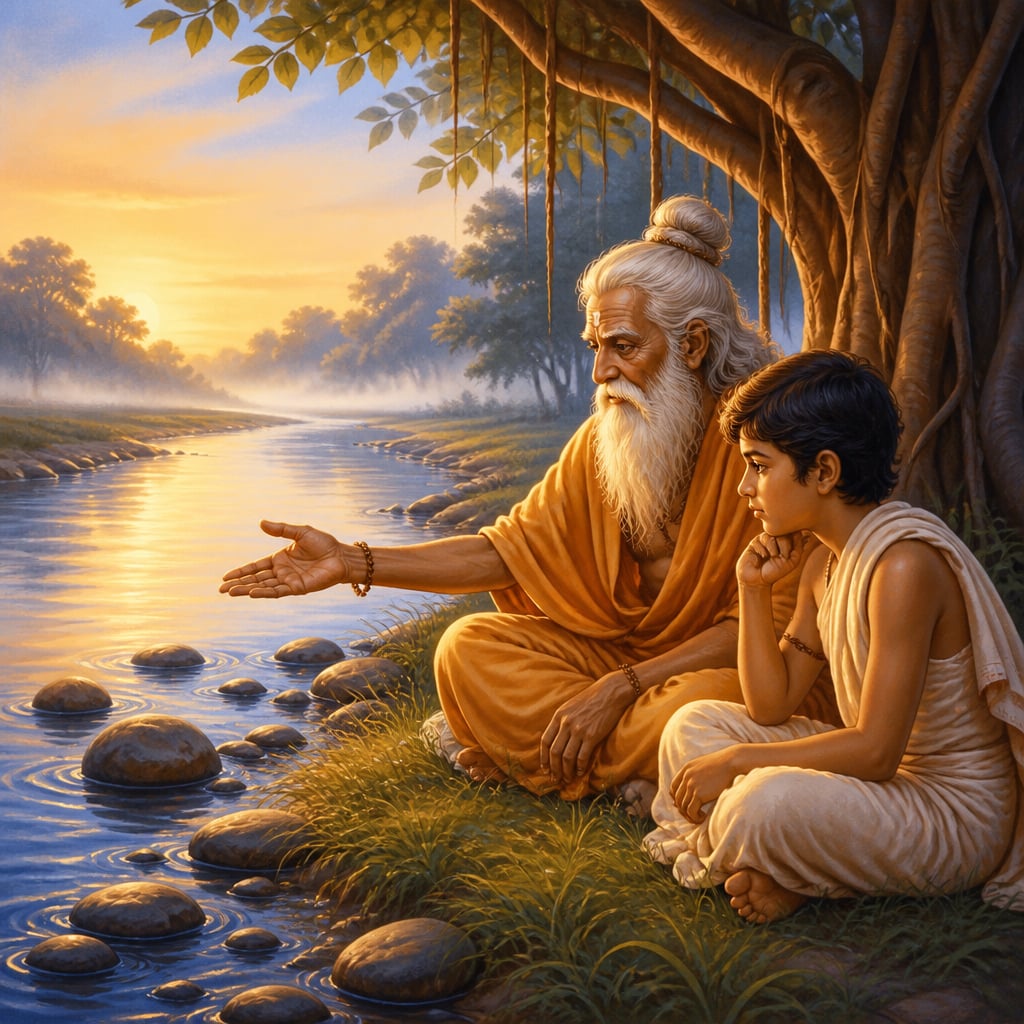
An old rishi smiling at a young student beside the Saraswati at dawn

"Tell me," he said, "when you stand by the Saraswati and watch the water flow, which part of the river is the 'real' river? The water that passed this morning? The water passing now? Or the water that will come tomorrow?"

The student frowned. "But Guru-ji, a river is not a person. I have a self."

"Do you? Or do you have a landscape, through which many selves move?"

The Vedic View of the Inner World

A word of caution as we explore this ancient wisdom: understanding the Vedic context prevents us from reading modern assumptions into these texts. The Rishis were not armchair philosophers, they were practitioners who observed their own minds with the same rigor they observed the stars. Their insights come from direct experience, which is why they can be verified through direct experience today.

The Rig Veda does not speak of personality in the way modern psychology does. There is no fixed "type", no introvert or extrovert, no Myers-Briggs category, no permanent label. Instead, the Rishis saw the human being as an antara-loka, an inner world, a terrain through which forces move.

This inner landscape has geography: the hṛdaya (heart-space) where intentions are born, the manas (processing mind) where thoughts form and dissolve, and deeper still, the ātman, the witnessing awareness that observes without being consumed.

The Rishis mapped this terrain not through abstract theory but through direct observation. They sat in meditation by riverbanks, watched their own minds as carefully as they watched the dawn, and reported what they found.

The Two Birds: Watcher and Experiencer

One of the most striking images in the Rig Veda captures this insight:

Two birds on a pippala tree

"dvā suparṇā sayujā sakhāyā samānaṃ vṛkṣaṃ pari ṣasvajāte | tayor anyaḥ pippalaṃ svādv atty anaśnann anyo abhicākaśīti ||"

"Two birds, close companions, cling to the same tree. One eats the sweet fruit; the other watches without eating." , Rig Veda 1.164.20

This is not poetry for poetry's sake. The Rishi Dīrghatamas is describing direct experience: within each person, there is an experiencer (the bird that eats) and a witness (the bird that watches). The experiencer gets caught up in pleasure and pain, success and failure, hope and despair. The witness simply observes.

Sayana's commentary identifies the eating bird with the jīva (individual soul caught in experience) and the watching bird with the paramātman (supreme self). Sri Aurobindo goes further: the watching bird represents the capacity within each human to step back from mental activity and observe it, the foundation of all psychological freedom.

What Moves Through You

If you are a landscape rather than a fixed thing, then what moves through you?

The Rig Veda answers: the Devas. But not Devas as external gods demanding worship. In the psychological reading that Aurobindo develops, the Devas are inner faculties, cosmic forces expressing through human consciousness.

Agni is not merely the fire on the altar; he is the fire of awareness, the capacity to see clearly, to illuminate what is hidden. Indra is not merely the storm god; he is the force of will that breaks through obstacles, the psychological strength to face difficulty. Soma is not merely the ritual drink; he is the flow of inspiration, the bliss that arises in meditation.

These forces move through your inner landscape like weather patterns. Some days, Agni burns bright, you see clearly, think sharply, act decisively. Other days, clouds gather; tamas (inertia) settles like fog. This is not failure of character. It is the nature of an inner terrain through which forces move.

Traditional Understanding: The Heart-Cave

The cave of the heart with a steady inner flame

The Rig Veda repeatedly locates the deepest self in the hṛdaya, not the physical heart, but the "heart-cave" (guhā), the innermost chamber of being.

"hṛdā manīṣā manasābhikliptaḥ"

"Formed by the heart's wisdom, shaped by the mind..." , Rig Veda 10.71.8

This suggests a hierarchy: the mind (manas) processes, but the heart (hṛdaya) knows. Thoughts rise and fall in the manas like waves on a lake. But beneath the waves, in the depths of the hṛdaya, there is stillness, the witness who watches the waves without drowning in them.

Sayana explains that the hṛdaya is where prajñā (wisdom) resides, not intellectual knowledge, but direct seeing. The Rishis did not speculate about the self; they observed it, the way a scientist observes phenomena.

Modern Resonance: Psychology Discovers the Landscape

When Sigmund Freud proposed that the psyche has multiple layers, id, ego, superego, he was mapping terrain the Rishis had walked millennia earlier. The Vedic view is arguably richer: where Freud saw conflict between parts, the Rishis saw forces moving through a landscape, with the possibility of a witness who could observe without being captured.

Carl Jung came closer. His concept of individuation, the integration of conscious and unconscious into a whole self, echoes the Vedic goal of recognizing both birds on the tree: the experiencer and the witness, neither denied, both acknowledged. Jung's archetypes (the Hero, the Shadow, the Self) function like the Vedic Devas, universal patterns expressing through individual psyches.

Modern mindfulness research validates the practical insight. When people learn to observe their thoughts without identifying with them, the core practice derived from Buddhist and Vedic traditions, activity in the default mode network (the brain's "self-referential" system) decreases. The witness becomes neurologically real.

Your Inner Terrain

You are not a fixed personality. You are not your mood this morning, your failure last year, or your ambition for tomorrow.

You are a landscape, vast, changing, and observed.

The question is not "Who am I?" as if there were one answer. The question is: "Who is watching?" When you notice that you are irritable, who notices? When you observe your own thoughts, what is doing the observing?

This is where the Rig Veda begins its psychology: not with labels, but with the startling recognition that you can watch yourself. Two birds on the same tree. One eats the fruit of experience. One watches.

Which bird are you paying attention to?

Cognitive Behavioral Therapy (CBT) teaches 'cognitive defusion', separating yourself from your thoughts. The Vedic two-birds image offers a more radical frame: you are not your thoughts, and there is always a part of you that can watch. This aligns with ACT (Acceptance and Commitment Therapy) research showing that psychological flexibility, the ability to observe thoughts without fusing with them, predicts mental health outcomes better than thought content.

Daniel Goleman's emotional intelligence research shows that self-awareness, the ability to recognize your emotional states while in them, is the foundation of effective leadership. The two-birds model provides the architecture: the leader who can observe their own reactions gains the pause between stimulus and response.

Just as a system analyst steps back to see patterns rather than getting lost in individual data points, the witness perspective allows you to see your own psychological patterns, recurring reactions, habitual thoughts, emotional cycles, rather than being caught in each instance.

Freud's discovery of the unconscious, that most mental life occurs outside awareness, echoes this Vedic insight. Jung went further, positing a collective unconscious with archetypal patterns. The Rig Veda's 'three-fourths hidden' anticipates both: personal depths (like Freud's unconscious) and transpersonal forces (like Jung's archetypes, which parallel the Devas).

Effective leaders understand that their visible decisions emerge from invisible assumptions, biases, and emotional patterns. The 'three-fourths hidden' principle suggests that self-knowledge requires exploring beneath surface reasons to deeper motivations.

In systems thinking, the 'iceberg model' shows that events (visible) arise from patterns, structures, and mental models (invisible). The Vedic insight applies equally to inner and outer systems: surface phenomena have deeper roots.

Case studies

The Vipassana Movement in Indian Tech: Watching the Mind to Transform It

Since the 2010s, Vipassana meditation, a practice of observing the mind without reacting, has become widespread among Indian technology leaders and entrepreneurs. Infosys co-founder N.R. Narayana Murthy has spoken about meditation's role in his life. Zerodha founders Nithin and Nikhil Kamath completed the rigorous 10-day silent Vipassana retreat. Jack Dorsey (Twitter co-founder) famously took Vipassana retreats in India. The Igatpuri Vipassana center near Mumbai has seen enrollment double since 2019.

Vipassana's core technique, observing sensations and thoughts without reacting, directly cultivates the 'witness bird' of RV 1.164.20. Practitioners learn to watch their inner landscape rather than being swept away by it. The practice doesn't suppress experience (the eating bird continues to eat); it strengthens the capacity to observe (the watching bird). This is the Vedic two-birds teaching made practical.

Practitioners report increased equanimity under business pressure, better decision-making through reduced reactivity, and improved focus. Zerodha became India's largest stock broker by valuation. The founders credit their meditation practice with enabling them to stay calm during market volatility and make decisions from clarity rather than fear.

The Vedic insight that you can observe your own mind is not abstract philosophy, it's a trainable skill with measurable benefits. When tech leaders sit in silence for 10 days watching their thoughts arise and pass, they are practicing what the Rishis discovered millennia ago: the watching bird can be strengthened, and its strength transforms everything.

Mindfulness apps like Headspace and Calm now have over 100 million downloads, yet most users quit within two weeks. The Vipassana model shows that depth of practice, not convenience, builds the witness capacity. For anyone feeling overwhelmed by their own reactivity at work or home, the path is the same: sit, observe, and strengthen the watcher.

Vipassana centers in India reported a 60% increase in enrollment between 2015-2023, with tech professionals being the fastest-growing demographic.

Ramana Maharshi's 'Who Am I?', The Vedic Inquiry Made Direct

In 1896, a 16-year-old boy named Venkataraman sat alone in his uncle's house in Madurai and asked himself a simple question: 'Who am I?' He noticed that thoughts come and go, emotions rise and fall, but there is something that watches it all. Rather than answer the question intellectually, he turned attention back on itself, looking for the looker. This direct inquiry led to a profound shift. He left home, traveled to Tiruvannamalai, and became Ramana Maharshi, one of the most influential sages of the 20th century.

Ramana's method, 'Self-inquiry' (ātma-vicāra), is a direct application of the two-birds teaching. Instead of analyzing the content of thoughts (what the eating bird experiences), he turned attention to the witness itself (who is watching?). He taught that if you trace any thought or feeling back to its source, you find the 'I' that is aware. This 'I' is the watching bird, and discovering its nature is liberation.

Ramana's teaching spread worldwide through books like 'Who Am I?' and 'Talks with Sri Ramana Maharshi.' Carl Jung called him one of the most significant figures of our time. His Ashram in Tiruvannamalai continues to draw seekers from across the world. The practice of Self-inquiry has influenced modern teachers from Nisargadatta Maharaj to Eckhart Tolle.

The Vedic insight of the two birds, experiencer and witness, is not meant to be merely understood but investigated. Ramana showed that asking 'Who am I?' and turning attention back on itself is a direct path to experiencing the witness. The teaching from RV 1.164.20 can be practiced in any moment, by anyone, right now.

Self-inquiry has re-emerged in therapy through approaches like Internal Family Systems and Acceptance and Commitment Therapy, where clients learn to observe their inner parts rather than be ruled by them. Ramana's method requires no app, no subscription, and no therapist. The question 'Who am I?' remains the most direct tool anyone can use when caught in anxiety spirals or identity confusion.

Sri Ramana Ashram in Tiruvannamalai receives over 2 million visitors annually, making self-inquiry one of the most practiced meditation methods in India today.

Reflection

More in Antaryāmin: The Inner Landscape

All lessons in Antaryāmin: The Inner Landscape · Rig Vedic Psychology course