Dvandva: Inner Conflict as Natural

The Clash of Inner Forces Is Not Failure, It Is Fuel

The Rig Veda does not shy from inner conflict, it reveals it as the creative tension that drives growth. This lesson explores how opposing forces within (desire vs duty, passion vs restraint, ambition vs contentment) are not problems to be solved but polarities to be held.

The two great Rishis faced each other across the ritual fire.

Viśvāmitra, the former king who had become a sage through sheer will, his eyes still burning with the intensity of a warrior. Vasiṣṭha, the priest born into wisdom, calm as the Saraswati in the dry season, his authority rooted in lineage and surrender.

They had clashed for years, generations, perhaps. Viśvāmitra had once tried to steal Vasiṣṭha's miraculous cow, Nandinī, and been humiliated. He had sworn to match Vasiṣṭha's spiritual power through tapas alone, through the fire of his own effort. And now they stood here, both Rishis, both honored, both essential to the tradition.

"We are enemies," Viśvāmitra said. It was not a question.
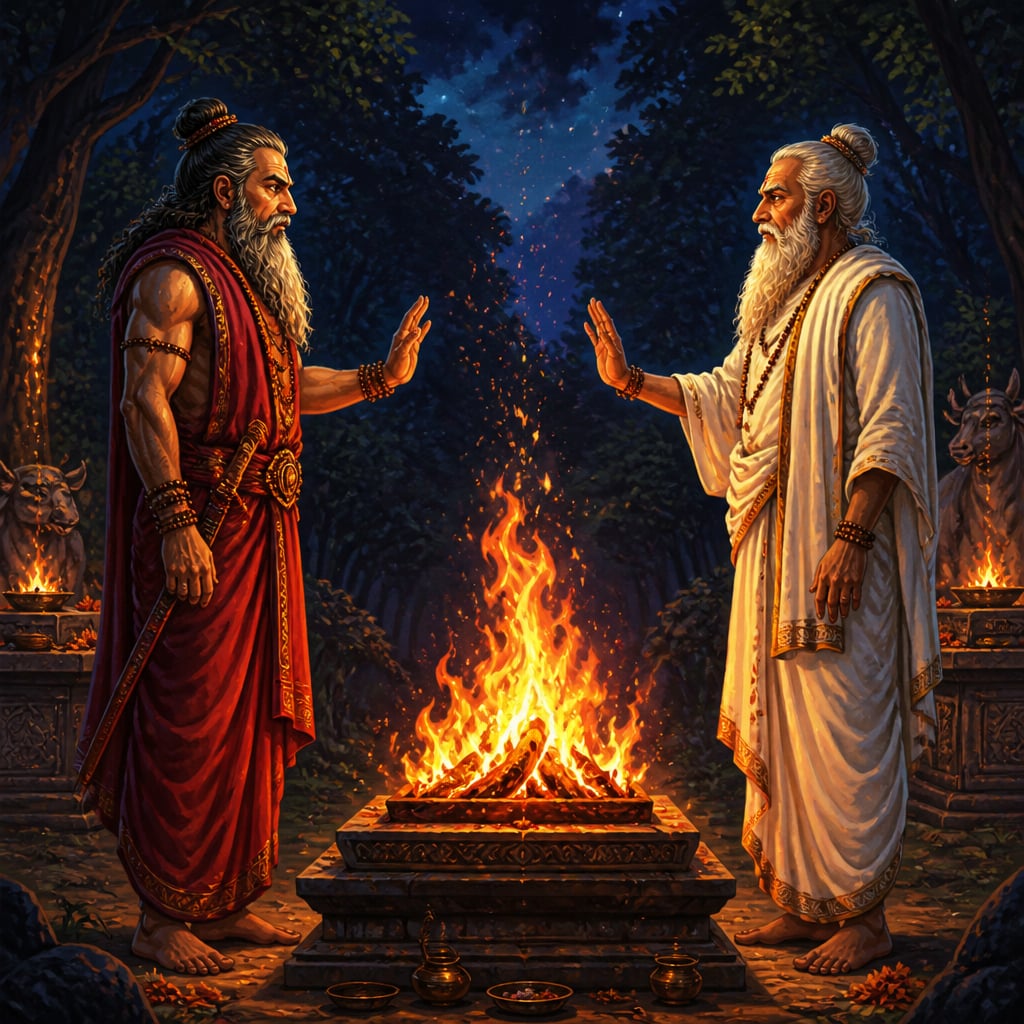
Vishvamitra and Vasishtha facing each other across a ritual fire

"We are rivals," Vasiṣṭha replied. "Not the same thing. An enemy you wish to destroy. A rival sharpens you. Without your hunger, I would have grown soft. Without your challenge, my knowledge would have become complacent."

"And without your lineage, I would have had nothing to surpass."

For a moment, the fire between them seemed to burn brighter. The conflict that had driven them both, the tension between will and surrender, effort and grace, the self-made and the given, was the very fuel of their transformation.

The Rig Veda's Embrace of Conflict

In a culture that often pathologizes inner conflict, medicalizing ambivalence, seeking to 'resolve' all tensions, the Vedic model offers liberation. Your inner conflicts are not symptoms of failure. They are the structure of a living psyche, the fuel of growth, the raw material of development.

The Rig Veda is not a text of serene harmony. It is full of conflict, between gods and demons, light and darkness, order and chaos. The great battle between Indra and Vritra, the god of expansion and the serpent of constriction, is retold again and again. The Devas and Asuras are locked in eternal struggle.

But here is the crucial insight: the tradition does not resolve this conflict by eliminating one side. The Asuras are not destroyed permanently, they return, cycle after cycle. Vritra is slain, but new obstacles arise. The conflict is not aberration; it is the structure of reality itself.

This is dvandva, the pairs of opposites, the fundamental polarities that constitute existence: light/dark, hot/cold, pleasure/pain, desire/aversion. The Vedic understanding is that these pairs are not meant to collapse into one; they are meant to be held in creative tension.

The inner landscape is no different. Within you, multiple forces contend: the part that wants safety and the part that craves adventure; the part that desires connection and the part that needs solitude; the part committed to duty and the part aching for freedom. This is not pathology. This is the nature of a living psyche.

The Shadow: What We Reject Returns

A figure and its extended shadow showing rejected features

Carl Jung, who studied Indian thought deeply, developed the concept of the Shadow, the rejected, disowned parts of the self that are pushed into the unconscious. The Shadow contains what we cannot accept about ourselves: our aggression when we want to be peaceful, our selfishness when we want to be generous, our fear when we want to be brave.

But here is Jung's insight: what we reject does not disappear, it gains power in the darkness. The suppressed rage erupts as sudden fury. The denied need controls us from beneath. The rejected desire shapes our life precisely because we refuse to acknowledge it.

The Vedic model anticipated this. The Asuras are not external enemies, they are the forces we have not integrated. Vritra, the serpent who holds back the waters, is the constriction within, the frozen places where energy cannot flow. Indra must battle Vritra not to destroy him permanently (impossible) but to release the waters, to restore flow.

Integration, not elimination. The Shadow is not an enemy to be killed but a part to be met.

Dialectical Movement: Conflict as Growth Engine

The philosopher Hegel articulated a pattern the Rishis knew intuitively: thesis–antithesis–synthesis. A position (thesis) generates its opposite (antithesis); their clash produces a higher integration (synthesis), which becomes a new thesis, generating new conflict, driving endless development.

This is the structure of growth. You hold a belief; life challenges it; the conflict forces you to a more nuanced understanding. You commit to a path; obstacles arise; the struggle develops capacities you wouldn't have developed on an easy road.

Viśvāmitra's rivalry with Vasiṣṭha follows exactly this pattern. The warrior-king (thesis) meets the Brahmin priest (antithesis); their conflict drives Viśvāmitra to develop a third way, the sage who achieves through will what others receive through birth. Neither pure warrior nor pure priest, a synthesis that created new possibilities for the tradition.

Without conflict, there is no movement. Without antithesis, thesis becomes stagnant dogma.

Parts in Dialogue: The IFS Model

Modern psychotherapy has developed remarkably Vedic-aligned models of inner conflict. Richard Schwartz's Internal Family Systems (IFS) proposes that the psyche contains multiple parts, subpersonalities with different needs, fears, and strategies.

Some parts are protectors: they manage, control, criticize, or distract to keep us safe. Other parts carry exiled pain: rejected emotions, wounded aspects, vulnerable places we've hidden. And there is the Self, the witnessing awareness (the Vedic sākṣin) that can hold all parts with compassion.

In IFS, psychological health is not about silencing parts or resolving conflict permanently. It is about the Self leading, the witness engaging with parts, understanding their concerns, helping them work together. Parts don't disappear; they transform through relationship.

This maps directly onto the Vedic model: the Devas (inner faculties) need not destroy the Asuras (shadow forces) but integrate them under the leadership of the witnessing awareness. Conflict becomes dialogue; war becomes council.

Ambivalence as Information: Motivational Interviewing

William Miller and Stephen Rollnick developed Motivational Interviewing for working with people who are ambivalent about change, part of them wants to change, part resists. Their crucial insight: ambivalence is not resistance to be overcome but information to be explored.

When you feel torn, wanting both to stay and to go, to indulge and to restrain, to speak and to keep silent, this is not weakness. It is the psyche holding multiple valid concerns. The part that resists change often carries important information: fear of the unknown, attachment to what has worked, wisdom about costs.

Trying to bulldoze ambivalence doesn't work, the suppressed side returns with force. Working with both sides, understanding what each needs, allows genuine integration. The conflict, fully held, resolves into movement, not by eliminating one side but by honoring both.

Vivekananda's Inner Battle: Doubt and Faith

Young Narendranath questioning Ramakrishna at Dakshineswar

Narendranath Datta, who would become Swami Vivekananda, embodied this principle. Born in 1863 in Calcutta, he was a fierce intellect trained in Western philosophy and logic. When he first met Sri Ramakrishna, he challenged the mystic: "Sir, have you seen God?"

What followed was years of inner conflict. Naren's rational mind demanded proof; his heart was drawn to devotion. He oscillated between atheistic doubt and spiritual longing. He tested Ramakrishna's teachings against his education, against his logic, against everything he knew.

Ramakrishna did not try to eliminate Naren's doubt. He engaged with it, welcomed it, used it. "You are a nāstika (skeptic)," he said, "and yet you will be my greatest teacher."

The conflict between reason and faith was not resolved by abandoning either. Vivekananda synthesized them: Vedanta as rational philosophy, spirituality as scientific experiment, faith grounded in direct experience. His doubt was not his weakness, it was the antithesis that drove him to a synthesis his teacher alone could not have reached.

Holding the Tension

You carry conflicts within you. Part of you wants certainty; part craves mystery. Part demands productivity; part needs rest. Part is drawn to relationship; part protects solitude. Part wants to succeed in the world; part questions whether the world's success is worth wanting.

These conflicts are not problems to be solved. They are polarities to be held.

The question is not "How do I eliminate one side?" The question is "Can the witness hold both?" Can you feel the pull toward adventure and the pull toward safety, without being torn apart? Can you acknowledge ambition and contentment, desire and discipline, letting neither dominate?

This is the work of integration. Not synthesis that dissolves tension, Viśvāmitra and Vasiṣṭha remained different, but holding that enables both poles to contribute. The inner landscape is richer for its conflicts. The Devas need the Asuras. Indra needs Vritra. You need your Shadow.

The clash of inner forces is not failure. It is fuel.

Carl Jung's concept of the Shadow describes the rejected parts of the self, what we've pushed into the unconscious because it doesn't fit our self-image. Jung's insight: the Shadow doesn't disappear; it influences us from below. Integration requires making the Shadow conscious, meeting it, understanding it, incorporating it rather than projecting it onto others.

Leaders who haven't integrated their shadows project them: the leader who suppresses his own ambition sees threatening ambition everywhere; the leader who denies vulnerability attracts crises that force it. Shadow work is leadership development.

Organizations also have shadows, the spoken values versus the operating values, what's officially encouraged versus what's actually rewarded. System dysfunction often lives in these shadows. Bringing them to light enables genuine change.

Hegel's dialectic, thesis generates antithesis; their conflict produces synthesis, describes psychological development. You hold a belief (thesis); experience challenges it (antithesis); the conflict forces a more nuanced understanding (synthesis). Without the challenge, there's no growth.

Effective leadership often requires holding competing goods: short-term and long-term, individual and collective, efficiency and resilience. The leader who can hold these tensions without collapsing into either pole enables creative solutions that honor both.

In organizations, productive tension between departments (sales vs operations, innovation vs compliance) can drive better outcomes than forced harmony. The key is managing the conflict so it's generative rather than destructive, sharpening, not destroying.

Case studies

Hegel's Dialectic: Conflict as the Engine of History

German philosopher Georg Wilhelm Friedrich Hegel (1770-1831) observed a pattern in the development of ideas and societies: every position (thesis) generates its negation (antithesis); the conflict between them produces a higher synthesis, which becomes a new thesis, generating new conflict, driving endless development. This dialectical pattern appears in the evolution of political systems, scientific theories, artistic movements, and individual consciousness.

The Vedic narrative of Devas and Asuras follows this dialectical structure. Each victory is temporary; the opposition returns; the cosmos evolves through their ongoing interaction. The Viśvāmitra-Vasiṣṭha conflict similarly produced synthesis: the tradition came to honor both paths, the self-made and the inherited, effort and grace. Neither was eliminated; both were integrated.

Hegel's dialectic influenced Marx (who applied it to economic systems), existentialists (who applied it to consciousness), and countless therapies that work with polarities. The insight that conflict is productive, not merely destructive, offers a framework for engaging inner and outer tensions without premature resolution.

Trying to eliminate conflict, whether inner or outer, is trying to stop history. Growth requires opposition. The antithesis that challenges your thesis is not your enemy; it is the condition of your development. Learn to engage conflict dialectically: what synthesis is trying to emerge?

Political polarization, social media echo chambers, and cancel culture all share a common pattern: the attempt to eliminate opposing views rather than hold creative tension with them. Hegel's insight, rooted in the same principle the Vedic tradition recognized, suggests that the healthiest individuals and societies are those that can hold contradictions productively rather than resolve them prematurely.

Studies in creativity research show that divergent thinking (generating contradictory ideas) precedes convergent thinking (synthesis). Teams that skip conflict produce less innovative solutions than teams that engage productive disagreement.

Swami Vivekananda: Doubt and Faith in Creative Tension

Narendranath Datta (1863-1902) was a young man of fierce intellect, trained in Western logic and philosophy at Scottish Church College in Calcutta. When he met Sri Ramakrishna, he came not as a devotee but as a skeptic, challenging, questioning, testing every claim. 'Sir, have you seen God?' was his first question. For years, he oscillated between rational doubt and spiritual longing, unable to accept what he couldn't verify, unable to abandon what he couldn't disprove.

Vivekananda's inner conflict was the thesis (rational doubt) meeting antithesis (direct spiritual experience). Ramakrishna did not ask him to suppress his doubt, he engaged with it, respected it, used it as fuel. The synthesis that emerged was Vivekananda's unique contribution: Vedanta as rational spirituality, faith grounded in experience, philosophy that could withstand scientific scrutiny. Neither blind faith nor cold skepticism, a third way born from their conflict.

Vivekananda became one of the most influential Hindu teachers in history, representing Hinduism at the 1893 Parliament of Religions in Chicago and founding the Ramakrishna Mission. His approach, integrating Eastern spirituality with Western rationality, shaped modern Hinduism and influenced figures from Nikola Tesla to Aldous Huxley. His doubt was not his weakness; it was his gift.

Inner conflict between doubt and faith, between reason and experience, is not a problem to solve but a tension to hold. Vivekananda did not resolve his conflict by abandoning doubt, he transformed it into rigorous inquiry. The clash between his thesis (skepticism) and Ramakrishna's antithesis (devotion) produced a synthesis that neither could have reached alone.

Many people today experience a painful split between their rational worldview and their spiritual intuitions. They feel drawn to meditation or prayer but embarrassed by it intellectually. Vivekananda's example shows that this tension is not a defect but a creative force. Holding both the questioning mind and the experiencing heart produces a more robust and authentic spiritual life.

Vivekananda delivered over 300 lectures across the US and Europe between 1893-1896, translating Vedantic concepts into modern psychological language that reached millions.

Reflection

More in Antaryāmin: The Inner Landscape

All lessons in Antaryāmin: The Inner Landscape · Rig Vedic Psychology course