Viniyoga: Reading Symbolically, Living Practically

The Integration of Wisdom and Action

Understanding symbols is not enough, wisdom must be lived. This final lesson of the chapter synthesizes everything: how to read symbolically, think multi-dimensionally, and translate understanding into practical action. The Rishis didn't create an armchair philosophy; they built temples, structured rituals, and organized society around symbolic principles made concrete.

The architect stood at the construction site, blueprints unrolled before him. It was 1000 CE, and he was building a temple in Thanjavur. Every measurement he made carried meaning beyond measurement.
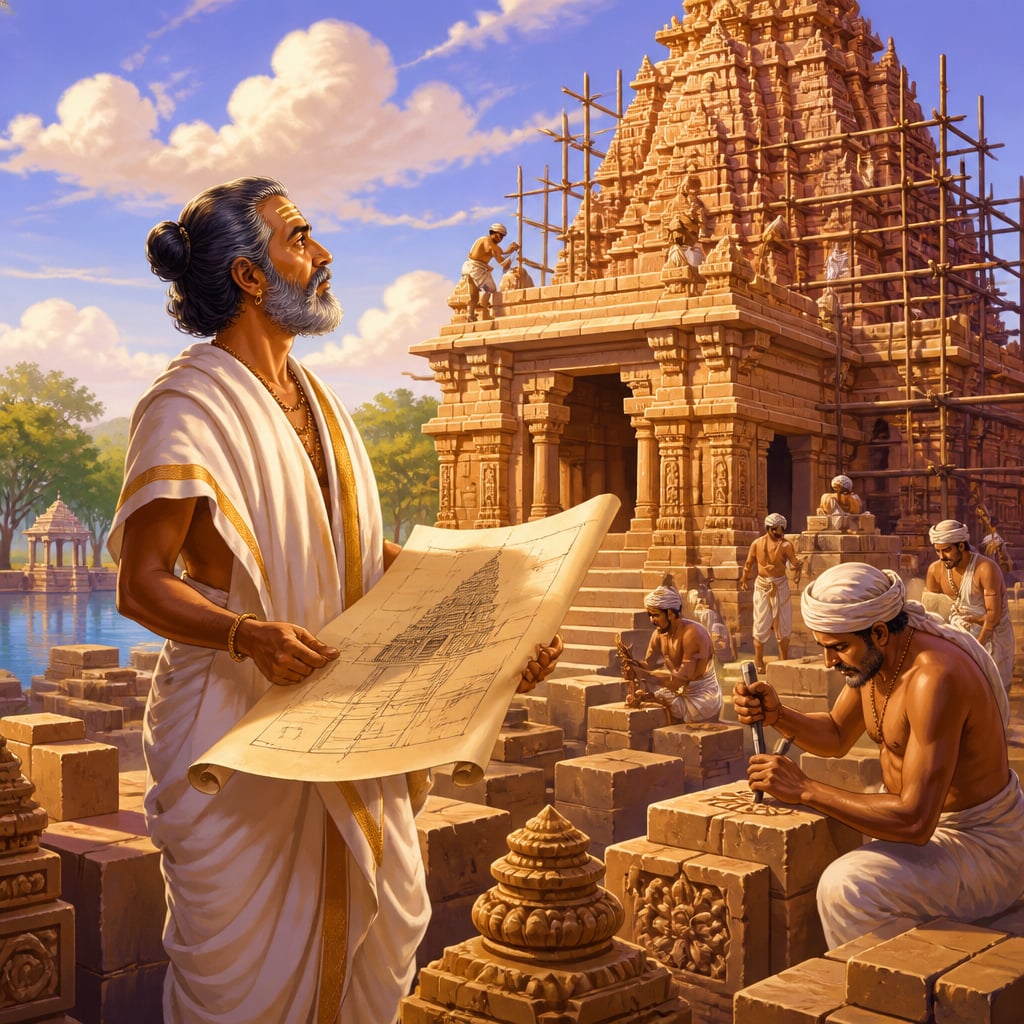
A temple architect studying blueprints at Thanjavur

The garbhagriha, the innermost sanctuary, was precisely positioned. Not arbitrary. It represented the heart, the center of consciousness. The walls would rise in specific proportions, not for aesthetic whim but because the proportions modeled cosmic ratios. The tower would reach upward like aspiration itself, its geometric patterns encoding the journey from multiplicity to unity.

When pilgrims would enter, centuries hence, they wouldn't consciously decode these symbols. But they would feel something, the space would work on them. The architecture was practical (it stood, it sheltered, it directed movement) and symbolic (it taught, it transformed, it pointed beyond itself) simultaneously.

This is the Vedic integration: symbols not as ornament but as structure, meaning not as decoration but as foundation.

The Problem of the Split

Modern life tends to separate symbol from practice. We have "work" (practical, measurable, serious) and "meaning" (personal, optional, soft). Business speaks in metrics; spirituality speaks in metaphor. The two rarely meet.

This split would have been incomprehensible to the Rishis. For them, every practical act carried symbolic dimension, and every symbol demanded practical expression. The fire ritual wasn't "practically" about cooking meat while "symbolically" about transformation. It was both simultaneously, the cooking was the transformation made concrete; the transformation was the cooking made conscious.

The previous lessons explored how this worked conceptually:

Now: How do we integrate this into living?

The Vedic Model: Ritual as Integration

A Vedic priest pouring an oblation while a young student observes

The Vedic ritual (yajna) is the prototype of symbolic-practical integration. Consider what happens:

Practical level: Fuel is gathered. Fire is kindled. Offerings (ghee, grain) are placed in the flames. Mantras are chanted. The fire consumes the offerings.

Symbolic level: The fuel represents the accumulated material of life. Fire represents transformative will. The offering represents what we give up to receive something higher. The rising smoke represents aspiration ascending. The mantras invoke cosmic principles into the act.

Psychological level: The practitioner experiences transformation, not just witnesses it but participates. The external act restructures internal reality.

These three levels operate simultaneously. The ritual is not "really" psychological with physical trappings, or "really" physical with symbolic overlay. It is multi-level by design. Reducing to any single level destroys it.

This is the key: integration doesn't mean choosing between levels. It means operating on all levels at once.

What the Mantras Reveal About Integration

The Rig Veda's instructions for ritual consistently emphasize multi-level operation:

ritam ca satyam cabhiddhat tapaso 'dhyajayata

"From heated consciousness (tapas) were born Rta (cosmic order) and Satya (truth)."

Notice: Rta and Satya emerge from tapas, concentrated effort, heat, practice. The cosmic principles don't descend from abstract heaven; they're generated through disciplined action. Theory and practice, symbol and substance, are born together.

The Gayatri Mantra (RV 3.62.10) models this integration:

tat savitur varenyam bhargo devasya dhimahi dhiyo yo nah pracodayat

"We meditate upon the excellent radiance of the divine Impeller; may He inspire our thoughts."

This is simultaneously:

The practitioner doesn't choose which level to engage. All three activate together. The practical discipline of daily recitation creates conditions for psychological transformation, which connects individual consciousness to cosmic pattern.

Traditional Wisdom: Viniyoga

The tradition developed a formal concept for this integration: viniyoga, the application or appropriate use of something.

Before chanting a mantra, practitioners traditionally state its viniyoga:

This practice ensures that the mantra is not abstracted from context. It reminds: this sound has a source (Rishi), a reference (devata), a form (chandas), and a function (viniyoga). To chant without awareness of these is to operate at only one level, missing the integration.

Sayana's commentaries consistently show how the same verse operates at adhibhautika (physical), adhidaivika (cosmic), and adhyatmika (psychological) levels. He doesn't argue which interpretation is "correct", all are correct because the verse was designed to work multiply.

Living This Today: Symbolic Rituals in Modern Organizations

The integration of symbol and practice isn't ancient artifact, it's ongoing wherever organizations build culture.

Consider how modern companies create and maintain culture:

Amazon's "Empty Chair": At meetings, an empty chair represents the customer. Practically, it's furniture. Symbolically, it embodies the customer-centric value. Psychologically, it keeps the customer present in decision-making. Employees don't consciously think "symbolic" when they see it, but the symbol works on them. Decisions shift because the chair is there.

Basecamp's "Heartbeats": The company's regular all-hands meetings are called "Heartbeats." The name isn't accidental, it encodes the idea of regular rhythm, life-sustaining pulse, organizational health. The meeting is practical (information sharing, coordination) and symbolic (affirming connection, sustaining culture) simultaneously.

Retrospectives and Rituals: Agile teams conduct "retrospectives" after each sprint, reviewing what worked, what didn't. The format is ritualized: specific questions, regular timing, structured participation. Practically, it's process improvement. Symbolically, it enacts the value of continuous learning. Psychologically, it creates safety for honest feedback.

All-Hands Gatherings: Whether "town halls" or "all-hands," regular gatherings of entire organizations serve practical purposes (announcements, alignment) but carry symbolic weight far beyond content. They enact "we are one company"; they make visible what's usually abstract; they create shared experience.

The companies that build strong cultures understand intuitively what the Rishis knew explicitly: symbols must be practiced, and practices must carry symbol. The empty chair, the heartbeat meeting, the retrospective ritual, these work because they integrate multiple levels.

Temple Architecture: Symbol Made Stone

Indian temple architecture represents perhaps the most sophisticated integration of symbolic and practical thinking ever achieved.

Consider a Hindu temple:

Practical level: It's a building. It shelters. It directs movement. It survives monsoons and centuries. The engineering must work.

Symbolic level: The entire structure models the cosmos and the body:

A pilgrim walking down the temple's central aisle toward the garbhagriha

Psychological level: The pilgrim's movement through the temple enacts the journey inward. You enter from the outer world, pass through increasingly sacred spaces, and arrive at the innermost sanctuary, facing the deity, facing your own deepest nature. The architecture doesn't just represent the journey; it creates conditions for it.

The architects (sthapatis) worked with precise texts (Vastu Shastras, Silpa Shastras) encoding these principles. Measurements weren't arbitrary, they related the temple to cosmic proportions, to the human body, to geometric patterns that recur at every scale.

A pilgrim entering the temple doesn't need to know any of this consciously. The architecture works on them. The space teaches without words. This is symbol made stone, integration so complete that the practical and symbolic become indistinguishable.

The integration of symbol and practice is perhaps the Vedic tradition's most practical gift. In a world that separates meaning from action, understanding how to reunite them offers both personal and organizational power. The temple, the ritual, the integrated life, these aren't ancient artifacts but living possibilities.

Behavioral psychology confirms that action shapes belief as much as belief shapes action. Rituals work because doing changes being. The 'act as if' principle, behave as though you are what you want to become, is tapas generating satya.

Organizational culture is created through rituals, not mission statements. Amazon's 'working backward' from press release, Google's 20% time, Bridgewater's radical transparency meetings, these practices create the values they embody.

Systems change through intervention points that combine symbolic and practical dimensions. A new policy (practical) with a new narrative (symbolic) and new habits (behavioral) creates more change than any single level alone.

Environmental psychology shows that spaces shape behavior. Hospital design affects healing; classroom layout affects learning; office architecture affects collaboration. The space teaches without words, exactly as temples do.

Office design is organizational philosophy made visible. Open floor plans embody (or impose) collaboration values. Private offices embody individual focus values. The architecture isn't neutral, it's symbolic-practical integration.

Systems have architecture, the structure that shapes how components interact. Organizational charts, process flows, communication channels, these are practical-symbolic architectures that embody values and shape behavior.

Your Path Forward: Living the Integration

How do you bring this integration into your own life?

First, recognize existing integrations. Your life already contains symbolic-practical fusions, birthday celebrations, graduation ceremonies, family meals, workplace rituals. These aren't empty formalities; they're how meaning is made concrete. Notice them. Honor them. Perhaps strengthen them.

Second, add symbolic dimension to practical acts. The transition from office to home can be just walking. Or it can be conscious threshold-crossing, a shift from work-self to home-self. The morning coffee can be just caffeine. Or it can be a dawn-ritual, a marking of new beginning. The symbol doesn't require elaborate ceremony, just awareness of multiple levels.

Third, add practical expression to symbolic understanding. If you value creativity (symbolic), what practice embodies it? If you seek inner peace (symbolic), what daily discipline creates conditions for it? Understanding that doesn't become practice remains mere entertainment.

Fourth, design integrative rituals. Whether for yourself, your family, or your organization, consider what values matter, and what practices could embody them. The ritual should work at multiple levels: practically (it accomplishes something), symbolically (it encodes meaning), psychologically (it transforms participants).

The Rishis didn't theorize about symbols; they built temples, structured days, organized society around principles made concrete. Their philosophy was lived or it wasn't philosophy.

The final lesson of this chapter explores the relevance of all this to your life in 2026 and beyond. But the foundation is here: symbol without practice is abstraction; practice without symbol is mechanism. Integration is the Vedic way.

Case studies

Rituals in Modern Startups: Symbol Made Culture

The most effective modern organizations don't just state values, they ritualize them: **Amazon's Empty Chair**: In meetings, an empty chair represents the customer. Practically: it's a chair. Symbolically: it embodies customer-centricity. Psychologically: decisions shift because the customer is 'present.' The ritual is so simple it seems trivial, until you notice how it works on decision-making. **Basecamp's Heartbeats**: All-hands meetings called 'Heartbeats', the name itself embedding the value of regular rhythm and organizational vitality. The meeting handles practical business, but the naming transforms routine into ritual. **Retrospectives as Ritual**: Agile teams conduct retrospectives, structured reviews of what worked and what didn't. The format is ritualized: specific questions, regular timing, facilitated participation. Practically, it's process improvement. Symbolically, it enacts continuous learning. Psychologically, it creates safety for honest feedback. **All-Hands and Town Halls**: Regular gatherings of entire organizations serve practical purposes (information sharing) but carry symbolic weight far beyond content. They enact 'we are one company,' make visible what's usually abstract, create shared experience that email cannot. **Zappos's Culture Book**: Each year, Zappos publishes a book of unedited employee reflections on company culture. Practically: it's documentation. Symbolically: it embodies the value of authentic voice. The ritual of creating the book is as important as the book itself.

These modern rituals embody the Vedic principle of viniyoga, the specific application that integrates multiple levels. The empty chair is like a deity in the garbhagriha, a focal point that transforms the space around it. Its presence restructures the meeting's energy, orienting decisions toward the customer even without conscious thought. The 'Heartbeat' naming recalls mantra, the word that does work. By calling meetings 'heartbeats,' Basecamp invokes vitality, regularity, and life-sustenance. The name teaches. The retrospective parallels the yajna's structure: preparation (sprint), action (work), offering (honest feedback), integration (improvements). The ritual form carries the transformation. The Rishis would recognize these instantly: symbols made practice, meaning made concrete, culture built through ritual. The vocabulary is different; the structure is the same.

Companies that integrate symbolic and practical dimensions build stronger cultures than those that rely on mission statements alone. Amazon's customer obsession is famous precisely because it's ritualized, not just stated. Zappos became known for culture by creating rituals that embody culture, not just policies that describe it. The pattern is consistent: stated values without ritual expression remain abstract. Ritualized values become lived reality.

Culture is built through practice, not proclamation. The most effective organizations understand what the Rishis knew: symbols must be enacted to become real. An empty chair can do more cultural work than a wall of mission statements.

The most effective remote-work companies, from GitLab to Basecamp, have discovered that culture requires ritual even more in distributed settings. Virtual stand-ups, shared async ceremonies, and deliberate onboarding rituals replace the hallway interactions that once built culture organically.

Research by MIT's Culture 500 project found that companies with strong symbolic rituals (regular ceremonies, consistent practices, meaningful traditions) significantly outperform those with stated-but-not-enacted values on employee engagement and retention metrics.

Temple Architecture: Cosmos Made Stone

The Hindu temple represents perhaps history's most sophisticated integration of symbolic and practical architecture. **The Structure**: A traditional temple comprises: - *Garbhagriha*: The womb-chamber, dark and intimate, housing the main deity - *Antarala*: The vestibule, transition space approaching the sanctum - *Mandapa*: The hall where community gathers, often columned and decorated - *Shikhara/Vimana*: The tower rising above the garbhagriha, aspiration made visible - *Prakara*: The boundary wall defining sacred from profane space - *Gopuram*: The elaborate gateway, the transition from outside to inside **The Symbolism**: The temple models both cosmos and body: - The garbhagriha is the heart, the innermost self - The shikhara is the crown, consciousness rising - The proportions encode cosmic ratios, measurements relate heaven to earth - The circumambulation path (pradakshina) models the sun's journey - The progressive darkness from gopuram to garbhagriha models the journey inward **The Practice**: Pilgrims don't need to know any of this consciously. They enter through the gopuram, pass through the mandapa, approach the garbhagriha, receive darshan. The architecture guides their movement; the movement enacts the journey. The building teaches without words.

Temple architecture is the Vedic understanding of symbol made permanent in stone. The temple is simultaneously: - **Practical**: A building that shelters worship, survives weather, directs movement, serves community - **Symbolic**: A model of cosmos and body, encoding in proportion and placement the principles that govern reality - **Transformative**: A space that works on the pilgrim, guiding their journey from outer to inner, from multiplicity to unity The sthapatis (architects) worked from detailed texts, Vastu Shastras, Silpa Shastras, that encoded these principles. But the texts themselves are practical applications of Vedic cosmology. The temple is yajna frozen in stone, the same multi-level operation made permanent. The Brihadisvara Temple at Thanjavur, built in 1010 CE, demonstrates this integration at massive scale: engineering that still amazes (how was the 80-ton capstone raised?), symbolism that still teaches, and space that still transforms pilgrims 1,000 years later.

Indian temple architecture influenced religious architecture across Asia, Angkor Wat, Borobudur, and countless other structures adapted the principles. The reason is not aesthetic fashion but functional effectiveness: temples built this way work. They create the experiences they're designed to create. Modern architects studying temple design find integrated thinking that contemporary architecture often lacks. The temple wasn't designed by specialist consultants in separate streams; it emerged from unified understanding of how space, symbol, and psychology interact.

The temple demonstrates that the highest architecture integrates practical function with symbolic meaning and transformative effect. Buildings can be more than shelter, they can teach, transform, and transmit. The Rishis' understanding of viniyoga achieved permanent form in stone.

Architects designing modern temples, museums, and public spaces are rediscovering that buildings can do more than house activities. Spaces that guide movement, shift awareness, and create emotional progression, from Apple Stores to the Akshardham complex, draw on the same principles that shaped ancient temple architecture.

The Brihadeshvara Temple at Thanjavur uses a vimana (tower) that rises 66 meters, with the entire structure aligned to cardinal directions within 1 degree of accuracy. Angkor Wat in Cambodia, built in the 12th century CE, covers 162.6 hectares and encodes astronomical alignments based on Indian temple-building principles transmitted via Southeast Asian trade routes.

Reflection

More in Vāc: Symbols, Language & Meaning

All lessons in Vāc: Symbols, Language & Meaning · Rig Vedic Philosophy course