Anrta: When Words Create Confusion

The Shadow Side of Sacred Speech

The same Vac that illuminates can also obscure. The Rishis understood that language has a shadow side, when words substitute for understanding, when definitions create illusions of knowledge, when debates about terminology miss the reality they claim to describe. This lesson explores how speech fails, and why that failure matters.

Two scholars sat facing each other in the assembly hall. The debate had lasted three days. Both were learned; both could cite the shastras fluently; both had devoted their lives to study. Yet somehow, they were further from agreement now than when they began.

"You deny the Atman!" one charged.

"I deny nothing real," the other replied. "I deny only your word for what cannot be worded."

The audience shifted restlessly. Were these men arguing about reality, or merely about language? And if merely about language, why did it matter so much?

A young student in the back row wondered: Can words meant to reveal truth actually hide it?
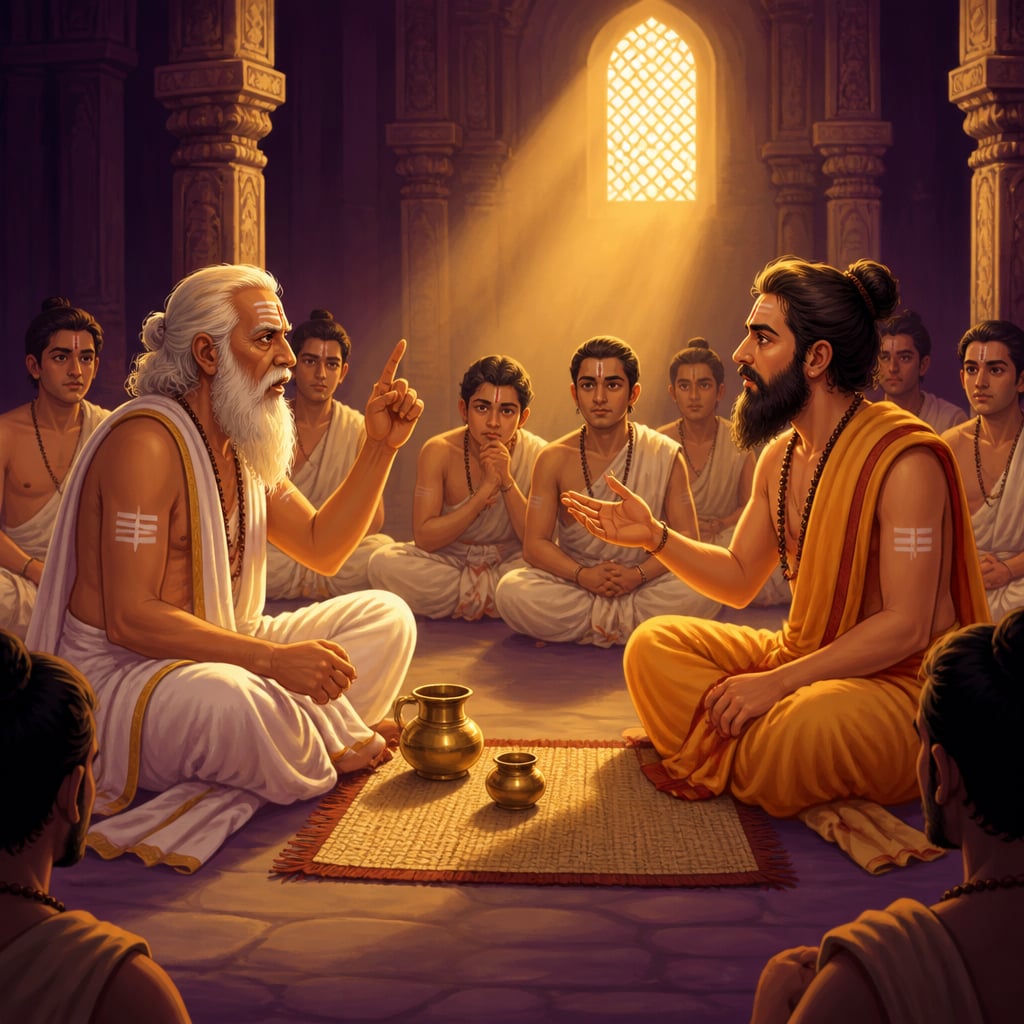
Two scholars debating in an ancient Vedic assembly hall

When Vac Turns Against Itself

The previous lessons celebrated Vac, sacred speech as creative power, the careful symbols that carry meaning literal words cannot. But the Rishis were too honest to pretend this was the whole story.

The Rig Veda itself warns:

uta tvah pashyan na dadarsha vacam, uta tvah shrnvan na shrnoty enam

"Some, though seeing, do not see speech; some, though hearing, do not hear it."

This isn't about deafness or blindness. It's about the paradox that language, the very tool meant to communicate truth, can become an obstacle to it. How does this happen?

Three ways, primarily: when words substitute for understanding, when translations betray meaning, and when categories create confusion.

The Illusion of Understanding

Consider the word "consciousness." You've heard it many times. If asked, you could probably define it: "awareness," "the state of being awake," "subjective experience." But have you thereby understood consciousness? Or have you merely replaced one word with others?

The Rishis recognized this trap. In the Kena Upanishad, a teaching built on Vedic foundations, the sage warns:

yasyamatam tasya matam, matam yasya na veda sah

"To whom it is unknown, to him it is known; to whom it is known, he does not know."

This sounds like a riddle, but it points to something real: the person who thinks they've understood Brahman through definition has mistaken the word for the reality. The one who recognizes that words cannot capture it, who holds the "not-knowing", is closer to truth.

The problem isn't that words are useless. The problem is that words can create the illusion of understanding. You learn a term, memorize a definition, pass an examination, and believe you know something. But the word was always pointing beyond itself. If you stop at the word, you've missed the pointing.

When Translation Betrays: The Colonial Distortion of 'Dharma'

A Victorian colonial translator struggling over a single Sanskrit word at Oxford

No example better illustrates how words can create confusion than what happened when European scholars translated Sanskrit into English.

Consider "Dharma." The colonial translators needed an English equivalent. They chose "religion." This single translation created a century of misunderstanding that persists today.

Dharma means, approximately: cosmic order, natural law, righteous conduct, duty according to one's nature and station, the sustaining principle of reality. It is not belief-based but action-based. It is not about faith in a deity but alignment with reality's structure.

"Religion," by contrast, carries the weight of Christianity's history: belief, creed, church, salvation through faith, the division of sacred and secular. None of this applies to Dharma. A rock has dharma (its nature is to be solid). A river has dharma (to flow). Neither has "religion."

Yet once the translation was made, it stuck. Generations of English-educated Indians learned to think of their tradition as a "religion" like Christianity, and therefore to compare it using Christian categories. The British colonial administration classified India's diverse practices as "Hinduism" (a religion) with "believers" (who could be converted) and "scriptures" (to be compared with the Bible).

None of this mapping fits. But the words created a frame, and the frame created confusion that persists today when Indians defend "Hinduism" as if it were a religion requiring belief, rather than a civilizational matrix of Dharmic practices requiring alignment.

When Categories Confuse: Varna and Jati

A second catastrophic confusion arose from conflating two distinct Sanskrit concepts: varna and jati.

Varna, in the Rig Veda, refers to four fundamental types of human capacity and function: the intellectual/spiritual (Brahmana), the protective/governing (Kshatriya), the productive/commercial (Vaishya), and the serving/supporting (Shudra). These are described as emerging from different aspects of the cosmic Purusha, head, arms, thighs, feet, suggesting functional interdependence, not hierarchical superiority.

Jati, by contrast, refers to birth-group, community, clan, the thousands of endogamous groups that developed in Indian society over time, based on occupation, region, and custom.

The colonial census-makers, needing administrative categories, translated both as "caste", a Portuguese term meaning "breed" or "lineage." Suddenly, a functional model of complementary capacities (varna) and a complex social reality of communities (jati) were collapsed into a single rigid hierarchy.

The consequences echo today. Debates about "caste" conflate issues that should be distinguished: questions about social stratification (real), about birth-based discrimination (real and wrong), about whether the original Vedic model intended such discrimination (a separate scholarly question). Because the words were conflated, the debates are confused, people argue about "caste" without distinguishing whether they mean varna-as-concept, jati-as-community, or colonial-classification-as-administration.

Living This Today: When Definitions Become Battlegrounds

Scroll through any social media platform and you'll find debates that are, at root, about words. What counts as "violence"? What does "racism" really mean? Who gets to define "woman" or "justice" or "freedom"?

These debates generate enormous heat but little light. Why? Because the participants are arguing about definitions while believing they're arguing about reality.

The pattern is predictable: Party A uses a term in their sense. Party B objects based on their sense. Neither acknowledges that they're using the same sounds for different concepts. The debate continues indefinitely because it's not really about facts but about which meaning gets to wear the prestigious word.

The Rishis would recognize this instantly. It's what happens when speech turns against itself, when Vac, instead of pointing toward truth, becomes a battlefield for controlling labels.

This doesn't mean definitions don't matter. They matter enormously, which is why the Rishis developed Nirukta (etymology) and took such care with terminology. But they also understood that definitions are pointers, not destinations. Fighting over definitions while ignoring the reality being pointed to is like arguing over the shape of a finger while ignoring where it points.

Traditional Insight: The Danger of Knowledge-Pride

Sayana and later commentators recognized this danger as shabda-jala, the "net of words." The scholarly mind, trained in precise terminology, can become trapped in definitions, substituting verbal mastery for realized understanding.

Understanding how language can confuse is essential to using language wisely. The Vedic tradition developed sophisticated tools for linguistic precision (Nirukta, Vyakarana) precisely because they recognized the dangers of imprecise speech. We inherit both their insights and the confusions created by centuries of careless translation.

The Isha Upanishad, building on Vedic insight, warns:

andham tamah pravishanti ye 'vidyam upasate tato bhuya iva te tamo ya u vidyayam ratah

"Into blinding darkness enter those who worship ignorance; into greater darkness, as it were, those who delight in knowledge."

This is not anti-intellectualism. It's a warning that knowledge which hasn't become wisdom is more dangerous than simple ignorance. The ignorant person knows they don't know. The one who has mastered words may believe they know, and be further from truth because they're no longer seeking.

Therapy often involves recognizing how our self-descriptions become self-limiting. 'I'm anxious' can become an identity rather than a description of passing states. The label creates the trap. CBT techniques help clients distinguish themselves from their verbal self-characterizations.

Organizational change often fails because leaders confuse announcing new values with embodying them. 'We value innovation' becomes a slogan that substitutes for actual innovative practice. The word becomes a shield against the reality it supposedly names.

Systems thinker Donella Meadows warned about 'linguistic traps', terms that frame problems in ways that preclude solutions. 'Economic growth' as inherently good frames any alternative as 'decline.' The words shape what we can even consider.

Cross-cultural psychology recognizes that concepts like 'self,' 'happiness,' and 'mental health' carry different meanings in different cultural frameworks. Western therapeutic models applied without cultural translation can misunderstand and mistreat.

Global organizations struggle when corporate values translated between languages lose or change meaning. 'Accountability' in American English versus Japanese versus Hindi corporate contexts means subtly different things, sometimes disastrously different.

Interdisciplinary work often fails when the same words carry different meanings in different fields. 'Theory' in physics versus social science, 'model' in economics versus ecology, the surface similarity hides conceptual mismatch.

Your Path Forward

How do you work with language without being trapped by it?

First, notice when you're debating words versus reality. Ask: "Are we disagreeing about facts, or about what to call something?" Often, clarifying this dissolves the debate.

Second, hold definitions lightly. A definition is a tool, not a truth. When the Rishis defined terms, they offered multiple interpretations, acknowledged limitations, invited further inquiry. Certainty about definitions often signals distance from reality.

Third, watch for the illusion of understanding. When you learn a new term, especially for something subtle (consciousness, self, truth), pause. Have you understood the thing, or merely learned a label?

The next lesson explores what lies beyond words: the role of silence and what cannot be said. But first, we had to see how words fail, because only then does silence become meaningful.

Case studies

The Definition Wars: When Social Media Debates Words Instead of Reality

Consider any contentious social media debate: Is criticism of a policy 'violence'? Can members of a majority group experience 'discrimination'? What counts as 'racism', individual prejudice or systemic patterns? Is certain speech 'harmful'? These debates generate enormous engagement, millions of posts, heated arguments, broken relationships, but rarely resolve anything. Why? Because the participants are fighting over which definition gets to wear a prestigious or stigmatized word, while believing they're arguing about facts. Party A uses 'violence' to mean physical harm; Party B expands it to include emotional/psychological/systemic harm. Each accuses the other of being wrong, but they're using different dictionaries. The pattern repeats: capture a morally charged word ('violence,' 'racism,' 'justice,' 'freedom'), redefine it to support your position, then accuse opponents of denying the obvious because they're using the old definition.

The Rishis would recognize this as shabda-jala, the net of words, taken to a civilizational scale. The debates are not about reality but about language. The participants mistake verbal territory for actual territory. RV 10.114.8 reminds us: 'The wise speak of the One Truth in many ways.' This isn't relativism, it's recognition that different words can point to the same reality, and that fighting over words while ignoring shared referents is a waste of the precious human capacity for speech. The Vedic solution isn't to declare one definition correct. It's to ask: What reality are we trying to point to? Can we agree on the phenomenon even if we use different labels? The word-fight dissolves when people distinguish the label from the labeled.

Social media platforms have become engines of verbal conflict precisely because their architecture rewards engagement over resolution. Definition-debates are infinitely engaging (because definitionally unresolvable) while genuine inquiry is quick and quiet. Those who recognize the pattern can opt out, distinguishing 'we disagree about facts' from 'we're using words differently.' This often dissolves conflicts that seemed intractable.

When you find yourself in a debate that generates heat without light, ask: Are we arguing about reality or about words? The ability to distinguish these is a form of viveka (discernment) that the Rishis would recognize as essential to wisdom.

Online discourse frequently stalls because participants are debating definitions rather than realities. Recognizing when a disagreement is about words versus about facts is a critical skill for navigating social media, workplace conflicts, and political conversations without generating pointless friction.

A 2023 MIT study found that morally charged words generate 20% more engagement than neutral descriptions of identical content. The reward structure of social media literally incentivizes definition-battles over genuine inquiry.

The Great Mistranslations: 'Dharma' as 'Religion' and Varna/Jati as 'Caste'

In the 18th and 19th centuries, European scholars faced the challenge of translating Sanskrit concepts into English. Two translations proved particularly consequential: **Dharma → Religion**: William Jones and other Orientalists translated 'Dharma' as 'religion,' mapping Hindu traditions onto the Christian concept of faith-based belief. Suddenly, practices that had been about alignment with cosmic order became about 'religious belief.' A civilization organized around doing (dharmic action) was reframed as one organized around believing (religious faith). **Varna + Jati → Caste**: The Portuguese word 'casta' (breed) was applied to both the Vedic model of functional types (varna) and the sociological reality of birth-communities (jati). A conceptual framework (varna) and a social reality (jati) were collapsed into one rigid hierarchy (caste). These weren't malicious mistranslations, the scholars did their best with unfamiliar concepts. But the consequences were enormous.

These mistranslations exemplify what RV 10.71.4 warns about: 'Some, though seeing, do not see speech.' The colonial scholars saw Sanskrit words but did not see what they pointed to, because their conceptual categories couldn't accommodate the reality. 'Religion' implies the category structures of Christianity: belief/unbelief, orthodox/heretic, convert/unconverted, sacred/secular. None of these apply to Dharma, which is about alignment with cosmic order whether one 'believes' in it or not. Similarly, 'caste' implies the rigid birth-hierarchy the British wanted to administer. But varna was originally about function (what you do), while jati was about community (who you're born among). Collapsing them erased the distinction between concept and sociology, making it impossible to have clear conversations about either.

These translations shaped policy, education, and self-understanding for generations: - Indians learned to defend 'Hinduism' as a religion, accepting the frame - Caste became an administrative category the British could manipulate - Contemporary debates about caste conflate varna, jati, and colonial classification, ensuring confusion - The secular/religious divide (alien to Dharmic thought) became a framework for Indian politics Recovering from these mistranslations requires not just better definitions but recognition that the English words may be obstacles to understanding.

Translation is never neutral. When concepts cross between different civilizational frameworks, the receiving language's categories reshape what's received. Being aware of this, asking 'what does the original actually mean?', is essential for anyone engaging with cross-cultural knowledge.

Mistranslation of cultural concepts continues to shape global politics. Terms like 'jihad,' 'karma,' and 'yoga' carry radically different meanings in their source traditions versus Western popular usage. Awareness of translation distortion is essential for anyone engaging seriously with cross-cultural knowledge.

The word 'caste' derives from the Portuguese 'casta,' first applied to Indian society in the 16th century. The 1901 Census of India under Herbert Risley classified the entire population into rigid caste categories, codifying over 2,000 jati groups into a fixed hierarchy. The word 'dharma' appears over 60 times in the Rig Veda alone, carrying meanings ranging from cosmic law to ritual duty to moral order.

Reflection

More in Vāc: Symbols, Language & Meaning

All lessons in Vāc: Symbols, Language & Meaning · Rig Vedic Philosophy course